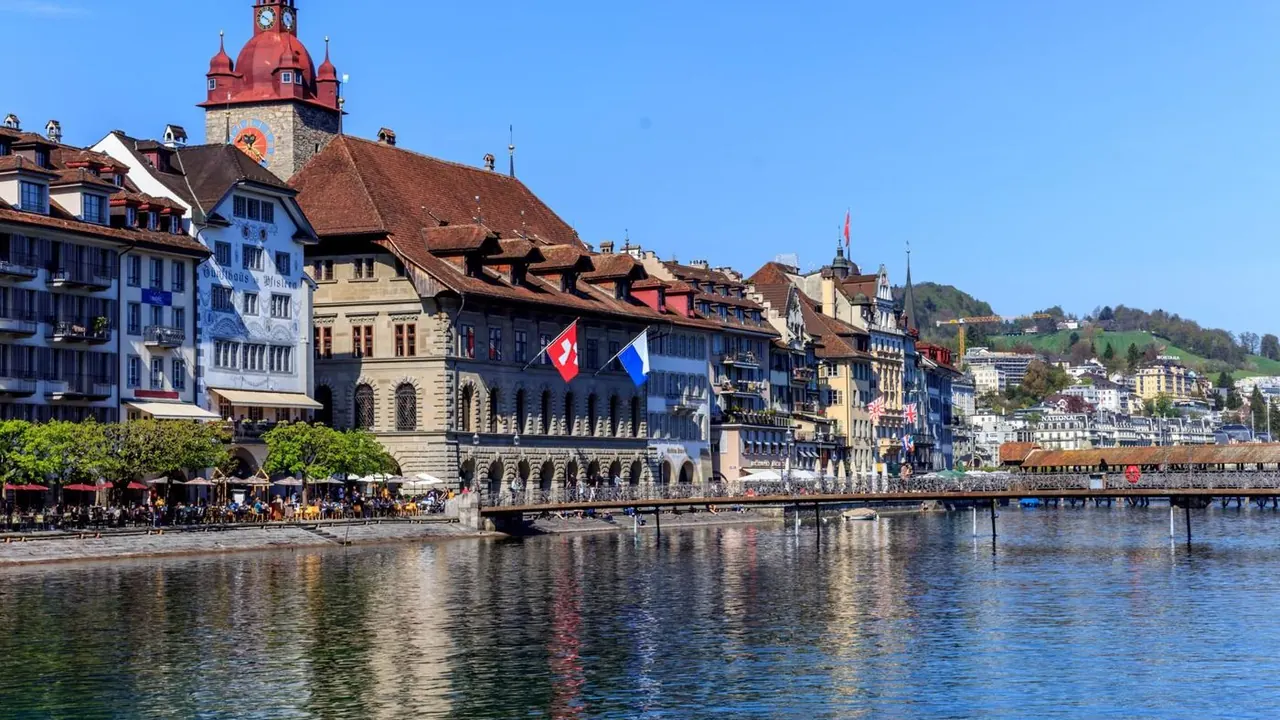
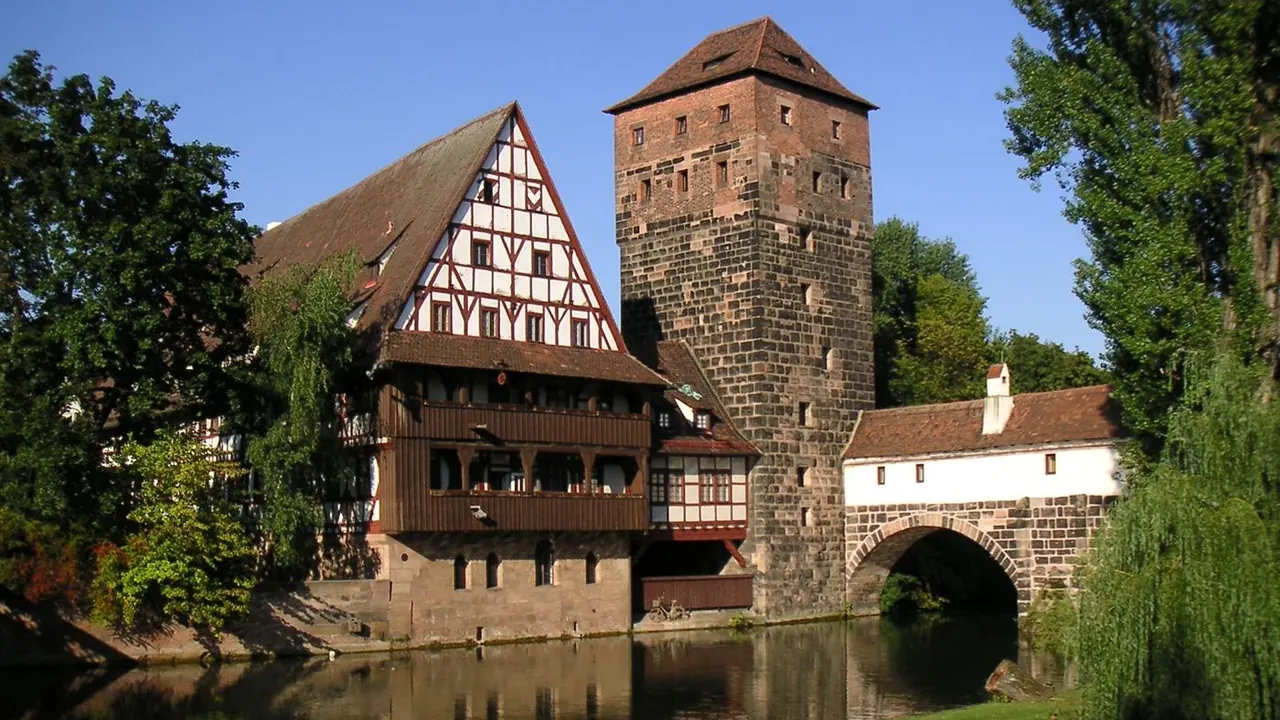
Photos: Lucerne by ILOVESwitzerland, Pexels License; Nuremberg by Horst Gutmann, CC BY 2.0, cropped.
Lucerne or Nuremberg?
Our verdict in twelve categories, each scored against the same fixed benchmark cities, and the climate month by month, so you can choose for your trip.
Choose Lucerne for
- nature and the outdoors
- beaches
- live music and the arts
Lucerne suits travellers who want mountains within reach of their hotel. Pilatus, Rigi and the Stanserhorn rise straight from the lake, paddle steamers and cogwheel railways leave from beside the station, and the Lucerne Festival brings world-class orchestras to the lakefront in late summer. It is a scenic, quiet and very expensive trip, best for people who will spend their days on the water and the slopes, not in restaurants or bars.
Choose Nuremberg for
- prices
- food and drink
- nightlife
Nuremberg is the better choice for history, beer and a sensible budget. The walled old town, the Kaiserburg and the Germanisches Nationalmuseum sit alongside the sobering Rally Grounds and Courtroom 600, and Franconian taverns pour local lagers with grilled bratwurst. Bamberg, Regensburg and Würzburg are easy train rides away, and it costs far less than Lucerne.
Scoreboard
Twelve categories on one fixed scale from 0 to 100. The shaded stretch is the gap between the two.
Your match
Pick a travel style or drag the sliders, and both match scores follow your weighting.
Too close to call, level with your weighting
Wins on nature and the outdoors and beaches with your weighting.
Wins on prices and food and drink with your weighting.
What matters to you?
Category by category
What the scores mean for a trip.
Beaches & swimming
Neither city is for a beach vacation, but in Lucerne a swim is right on the doorstep. The Lido, the old wooden lake baths and the lawns at Ufschötti are close to the centre, and the clean lake is backed by mountains. Expect grass and jetties rather than sand.
Nuremberg has no open water in the city, only outdoor pools. The nearest real swimming is in the Franconian Lake District, an hour south, where the Brombachsee has small sandy strips. That makes a swim a half-day outing, not something you fit in between sights.
Food & drink
Nuremberg gives you more to eat and drink. Its finger-sized bratwurst, Sunday Schäufele and Lebkuchen are a real regional cuisine, and Franconia's small breweries fill the beer gardens along the Pegnitz with lagers you won't find elsewhere.
Lucerne's cooking is good but narrow: Chügelipastete, fondue, rösti and lake perch in Old Town guild houses. Many tables near the Chapel Bridge cater to tour groups. The riverside terraces are more for coffee or a glass of Swiss white than for a meal you will remember.
Culture & sights
Nuremberg has more depth. Inside the medieval walls are the Kaiserburg, the Gothic churches of St Sebaldus and St Lorenz and Dürer's house, and the Germanisches Nationalmuseum can fill a whole day. The Rally Grounds and Courtroom 600 add a twentieth-century history that few cities can match.
Lucerne is more compact. The Chapel Bridge, the Musegg towers, the Lion Monument and the Picassos and Klees of the Rosengart Collection are memorable, but you can see them all in a day or two.
Nightlife
Neither city is a place for serious clubbing, but a night out goes on longer and offers more choice in Nuremberg. In Lucerne an evening usually means a drink or two after dinner, in an Old Town wine bar or on a terrace by the Reuss. A handful of cocktail bars and a small club scene near the station only really come alive at weekends, and most visitors are back at their hotel early.
Nuremberg's evenings start in the old town taverns over local beer, and on warm nights they move outdoors as students gather on the squares and along the Pegnitz. The more interesting places are in the old working-class quarter just west of the walls, a cluster of small bars and alternative venues. Students coming in from Erlangen make weekends noticeably livelier than anything Lucerne offers on an ordinary Saturday.
Nature & outdoors
This is where Lucerne pulls far ahead. Pilatus, Rigi, the Stanserhorn and the glacier on Titlis are all within a short trip, and you can combine steamer, rack railway and a ridge walk in one day. Winter adds skiing and sledging. The catch is low cloud, which can hide everything for days.
Nuremberg's countryside is gentler. You can walk and cycle in the Reichswald pine forest at the city's edge, and the limestone valleys and climbing crags of Franconian Switzerland are an hour away. It is good walking country, but it has no mountains.
Day trips
Both cities make excellent bases, but for different kinds of outing. From Lucerne, Bern, Basel and Zurich are each under an hour by train, and the lake is a day out in itself. Boats sail to Weggis and Brunnen and on to the Rütli meadow, where the William Tell story is set.
Nuremberg offers a chain of historic towns instead. You can reach smoked-beer Bamberg, Danube-side Regensburg and baroque Würzburg in about an hour, the walled Romantic Road towns of Rothenburg and Dinkelsbühl are a little further, and Munich is an easy run by fast train.
Good for families
With children in Lucerne, the day out is mostly the trip itself: paddle steamers, cogwheel trains up Pilatus and Rigi and the summer toboggan run, plus a full day at the Swiss Museum of Transport. All of that needs clear skies and costs add up quickly, and with no zoo or aquarium a wet week can leave you short of ideas.
Nuremberg copes better with bad weather. The Toy Museum and the railway museum, with its full-size locomotives, both keep children busy indoors, and the zoo in the wooded old quarries has a dolphin and manatee house. There is also a large play park in Zirndorf. The steep cobbled climb to the castle is the one hard part.
Getting around
Both centres are easy on foot, but Lucerne is simpler for excursions. The station, the steamer piers and the Old Town are all on one stretch of lakefront, and boats, trains, cogwheel railways and cable cars share one ticket system. A mountain day starts a few steps from the platform.
Nuremberg's walled centre is about 1.5km across and easy to walk, apart from the climb to the castle. To reach the zoo, the Rally Grounds or Fürth you need the U-Bahn and trams, which are efficient but mean more changes than in Lucerne.
Shopping & style
Lucerne sells Swiss watches, and Nuremberg sells gingerbread and handmade crafts. In Lucerne the big watch and jewellery houses on Schwanenplatz and the lakefront set the tone, with army knives, chocolate and cuckoo clocks beside them. You will find few fashion labels or design shops beyond that.
In Nuremberg the better buys are Lebkuchen in decorated tins, wooden toys, tin figures and the work of the Handwerkerhof's courtyard workshops. Königstraße has ordinary chains and department stores. In Advent the Christkindlesmarkt on the Hauptmarkt adds ornaments and plum-figure dolls.
Affordability
In Lucerne the costs come from every part of the trip. Central hotels are dear, especially in summer and during the music festival. Simple meals are pricey too, and the cable cars and mountain railways, which are the reason to come, add most to the bill. A Swiss travel pass covers the lake boats and some excursions, but it only takes the edge off.
In Nuremberg the costs are mostly in one place: hotel rooms during the big trade fairs, the toy fair among them, and the Advent market season. If you book outside those weeks, an ordinary stay is fairly priced and the sights are modest to enter.
Live music & performing arts
For classical music, Lucerne is the stronger choice. The Lucerne Festival brings leading orchestras to Jean Nouvel's lakefront hall, which is known for its acoustics, and the hall keeps a programme all year. Outside the festival weeks, though, there is little live music most nights.
Nuremberg offers a broader but more regional mix. The Staatstheater in its Art Nouveau opera house has opera and ballet, there are free folk concerts at the Bardentreffen, and a big rock festival is held by the Zeppelinfeld.
Wellness & relaxation
For rest, Lucerne offers lakeside calm and Nuremberg offers the German sauna. Lucerne has no bathing tradition of its own, so you unwind on slow steamer afternoons, on the promenades in the quiet evenings and at the old wooden lake baths in summer. For a proper soak with a mountain view, head to Mario Botta's mineral bath high on the Rigi, about an hour away.
Nuremberg's spa culture is the more serious one. A large thermal spa with sauna gardens is a short U-Bahn ride away in Fürth, and Bad Windsheim's saline pools, where you can float, are an hour west. Expect the saunas to be nude and mixed.
When should you go?
Pick your month. The climate figures are measured averages, not a forecast.
Lucerne in July
Nuremberg in July
Daytime high, °C
Rainfall in the month, mm
Where the figures come from
Lucerne has no rain gauge within 25 km of the centre, so its rainfall comes from a gridded climate dataset read at the city rather than from a gauge further away.
Lucerne's sunshine is measured 42 km from the centre, at Zurich Town / Ville..
Temperature and rainfall are climate normals, averaged over the years shown. Lucerne: 2005-2025 (sunshine 1991-2020, rainfall 1991-2020) normals, Emmen (4.2 km from centre). Nuremberg: 1991-2020 normals, Nuernberg (5.5 km from centre).
The two cities share almost the same temperatures. Both are cold in winter, with daytime highs near 4°C from December to February, and both warm up through May to a peak in July and August of about 24°C in Lucerne and 24°C in Nuremberg. The big difference is rain. Lucerne's summer is wet, with around 124mm a month from May to July, while Nuremberg's wettest month is July with 77mm. Nuremberg also gets slightly more sunshine from spring to early autumn.
For Lucerne, July and August are the months for swimming in the lake. June to September suits mountain walks, and September is drier and still mild. Nuremberg is good for walking the old town from May to September, and April is already fairly sunny and dry there. In both cities, November to February is short, grey and cold, better for museums than for long days outdoors.
Which traveller are you?
On an outdoors trip, Lucerne is the obvious pick. You can take a cogwheel railway up Pilatus, walk the Rigi ridge or see the glacier on Titlis, all by boat and train. Nuremberg's forests and Franconian Switzerland are pleasant, but they have no mountains.
For a trip on a tight budget, Nuremberg wins easily. Tavern meals are filling, local beer and transport are cheap, and many sights cost little. Lucerne's hotels, meals and mountain railways make a cheap stay impossible, however carefully you plan.
On a food and nightlife trip, choose Nuremberg. Beechwood-grilled bratwurst, Schäufele, smoky Kellerbier and the small bars of Gostenhof make better evenings than Lucerne's narrow menus and lakefront, which is mostly empty by midnight outside Fasnacht.
Before you go
| Measure | Lucerne | Nuremberg |
|---|---|---|
| Official language | French, German, Italian, Romansh | German |
| Currency | Swiss Franc (CHF) | Euro (EUR) |
| Sockets | CJ230 V, 50 Hz | CF230 V, 50 Hz |
| Driving side | Right | Right |
| Time zone | UTC+1, UTC+2 in summer | UTC+1, UTC+2 in summer |
| Emergency number | 112 | 112 |
| Elevation | 436 m | 209 m |
| Main airport | Zürich Airport (ZRH)49 km from centre226 non-stop destinations | Nuremberg Airport (NUE)5 km from centre56 non-stop destinations |
| Public holidays this year | 12 days | 12 days |
By the numbers
| Measure | Lucerne | Nuremberg |
|---|---|---|
| City population | 86,234 | 531,159 |
| People per km² | 2,963 | 2,848 |
| Museums within 10 km | 14 | 50 |
| UNESCO World Heritage sites within 50 km | 1 | 1 |
Where else could you go?
Every comparison below shares a destination with this one, so you can follow Lucerne or Nuremberg somewhere new.