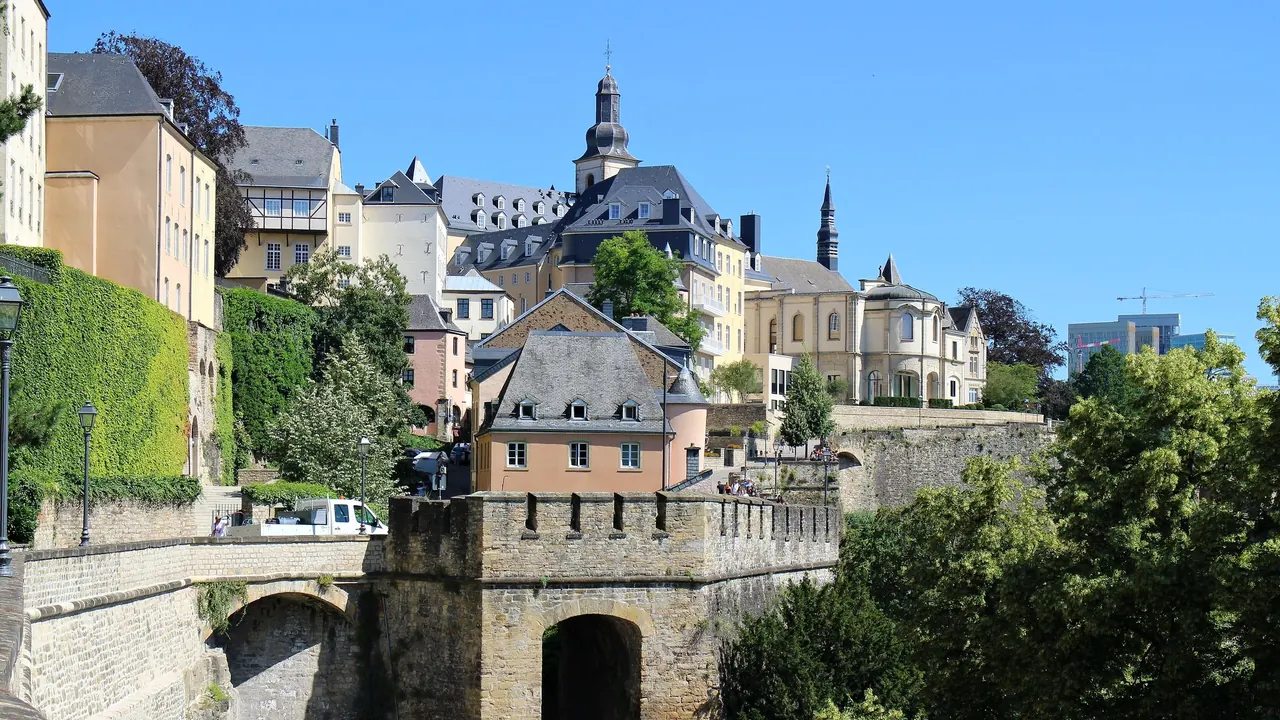
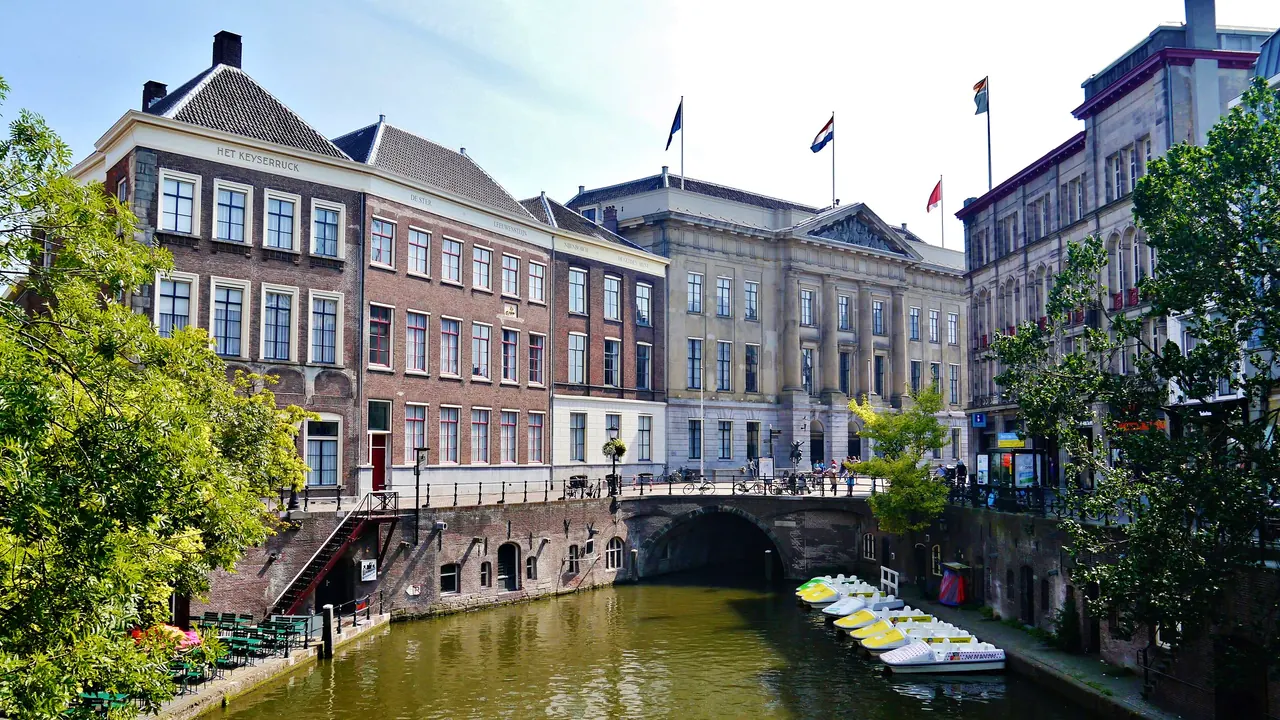
Photos: Luxembourg by Suicasmo, CC BY-SA 4.0, cropped; Utrecht by Zairon, CC BY-SA 4.0, cropped.
Luxembourg or Utrecht?
Our verdict in twelve categories, each scored against the same fixed benchmark cities, and the climate month by month, so you can choose for your trip.
Choose Luxembourg for
- nature and the outdoors
- wellness
- food and drink
Luxembourg suits a calm, well-fed trip where the setting matters most: a fortress city on a rock above wooded gorges, with Moselle Riesling and crémant at the table and serious French-led cooking. It also suits walkers, since the Müllerthal and the Ardennes are close, and anyone who wants a spa day at Mondorf. It is at its best in summer, when it is the sunnier of the two, and in autumn, when the forests turn and the grapes come in. It works best for travellers who don't mind high costs and quiet evenings.
Choose Utrecht for
- prices
- families
- shopping
Utrecht is the better base for seeing more and spending a little less. It sits at the hub of the Dutch rail network, with Amsterdam, Rotterdam and Delft close enough for an easy day out. Its student population keeps the canal-side bars full on weeknights, and its small streets are lined with independent shops. Families will find more for children here, from the Railway Museum to Miffy's own museum.
Scoreboard
Twelve categories on one fixed scale from 0 to 100. The shaded stretch is the gap between the two.
Your match
Pick a travel style or drag the sliders, and both match scores follow your weighting.
Wins on nature and the outdoors and wellness with your weighting.
Wins on prices and families with your weighting.
What matters to you?
Category by category
What the scores mean for a trip.
Beaches & swimming
Neither city is a place for a beach trip, and for both, swimming is a hot-day outing. What differs is where you go to swim. Luxembourg has inland water only: the wooded reservoir shores of the Upper Sûre, about an hour north, and the old gravel pits at Remerschen in the Moselle valley. Utrecht has lakes on its edge, such as the Maarsseveense Plassen, and the North Sea is about an hour or more away by train for a cool day on real sand.
Food & drink
Luxembourg eats better. French cooking leads at the top end, and for a small city it has an unusual number of fine-dining tables. The Moselle vineyards supply crisp Riesling, Pinot Gris and crémant by the glass, and hearty local dishes like smoked pork collar with broad beans add some character of its own.
Utrecht is about casual meals rather than a cuisine. The real pleasure is eating on terraces at the water's edge on the Oudegracht wharves. Student demand keeps lunch cafés and Indonesian and Surinamese kitchens busy, and the Vredenburg market sells herring and cheese. Few people plan a trip around Utrecht's food, while Luxembourg's wine alone is worth planning around.
Culture & sights
Both have two days' worth of sights, but of very different kinds. Luxembourg's main sight is its landscape: the fortress remains wrapped around a sandstone plateau, the Bock casemates tunnelled into the rock, and the view down from the Corniche to the Grund. MUDAM on Kirchberg adds contemporary art.
Utrecht is a medieval Dutch city at street level. You can climb the free-standing Dom Tower, stroll the two-level Oudegracht wharves, and follow a thread of modern design from the De Stijl collections to the Rietveld Schröder House.
Nightlife
Utrecht is livelier after dark because students fill the bars around the Neude, the Janskerkhof and the canal edge on weeknights as well as weekends. Most evenings are spent in brown cafés and on terraces rather than in clubs, and Amsterdam is a short train ride away for a bigger night out.
Luxembourg's going-out runs on its international office crowd. It is busiest on Thursdays and Fridays, mostly in the former brewery of the Rives de Clausen and the Grund's riverside pubs, and it thins out at weekends when many residents leave the city.
Nature & outdoors
Luxembourg has the more varied countryside, starting inside the city with the deep wooded Pétrusse and Alzette valleys. The Müllerthal's sandstone gorges and rock passages make a superb day of walking, and the Ardennes add steep hills and river loops further north.
Utrecht's countryside is flat and best seen by bike. Routes run along the Vecht past country estates and windmills, and the Utrechtse Heuvelrug has heath and low wooded ridges. It suits easy cycling and sailing on the Loosdrecht lakes, but serious walkers will find more in Luxembourg.
Day trips
Both make excellent bases, but Utrecht has the edge because it sits at the hub of the Dutch rail network. Amsterdam is under half an hour away, Rotterdam and The Hague are well under an hour, and Delft, Leiden, Haarlem and Gouda are all simple trips. You can see much of the country without changing hotels.
Luxembourg's strength is its borders. Roman Trier and Gothic Metz are each under an hour away, in Germany and France. Free trains within Luxembourg reach the castle at Vianden, Clervaux and the Moselle wine villages.
Good for families
Utrecht has more to offer children. The Railway Museum, in an old station, is one of the country's best museums for children, toddlers have the Miffy museum, and Dutch culture takes children everywhere as a matter of course. The only real hazard is the constant stream of bikes.
Luxembourg is calm and safe, and the casemate tunnels and ramparts feel like an adventure. Beyond that there is mainly the small Parc Merveilleux at Bettembourg, so it suits two or three days rather than a school-vacation week.
Getting around
Both are easy, but in different ways. In Luxembourg, trams, buses and trains are free across the whole country. The city is built on several levels, and public lifts and a funicular carry you between the plateau and the river quarters. Utrecht is flat, so you can walk from the station to the Dom and most museums, and a rental bike covers the rest the way locals travel.
Shopping & style
Utrecht is the more rewarding place to browse. Independent fashion, design, book and homeware shops fill the Oudegracht wharves, the Twijnstraat and the lanes around them, and the Vredenburg general market, the flower market and the textile market add character.
Luxembourg's Grand-Rue is about luxury and premium brands for a wealthy local clientele, with little independent design. The best things to take home are porcelain, made in the city for centuries, and bottles of Moselle crémant.
Affordability
Neither is cheap, but Luxembourg is the dearer of the two by some way. Its hotels are priced for business travellers and EU institutions, and eating out costs more than in most of Western Europe. Free public transport, free museums and lunch menus help, and many visitors save by sleeping in Trier or Metz.
In Utrecht, the main expense is a bed in the small historic centre. Day-to-day costs are lower, as student cafés and snack bars keep lunch cheap and you can walk or cycle almost everywhere.
Live music & performing arts
Utrecht has a slight edge, mainly because of its calendar. The Festival Oude Muziek is one of Europe's leading early-music festivals, and TivoliVredenburg's stacked halls can run classical, pop and jazz on the same evening. Most of its theatre, though, is in Dutch.
Luxembourg is stronger on classical music and stage work in languages visitors can follow. The Philharmonie on Kirchberg is a fine concert hall, and the Grand Théâtre hosts visiting opera and dance, which Utrecht, with no opera house, cannot match.
Wellness & relaxation
Luxembourg is the better choice for slowing down, mainly because of Mondorf-les-Bains, half an hour away. Its warm mineral spring has fed a thermal spa in a landscaped park since the nineteenth century, making an easy restorative day.
Utrecht's version is the Dutch sauna complex in the green belt around the city, usually a bus ride or a drive away, and there are few hotel spas in the centre. Its calm comes instead from quiet evenings on the canal wharves and the cloister garden of the Pandhof beside the Dom.
When should you go?
Pick your month. The climate figures are measured averages, not a forecast.
Luxembourg in July
Utrecht in July
Daytime high, °C
Rainfall in the month, mm
Temperature and rainfall are climate normals, averaged over the years shown. Luxembourg: 1991-2020 normals, Luxembourg / Luxembourg (6.3 km from centre). Utrecht: 1991-2020 normals, De Bilt (4.3 km from centre).
Both cities share a mild, damp climate, so the best months are much the same: May to September for walking and sitting outside, with no real heat to avoid. Luxembourg's summer is a touch warmer, reaching 24°C in July and August, and much sunnier, which makes it the better choice for high summer outdoors. Its winters are colder, though, with January highs of around 4°C and the wettest month in December.
Utrecht's winters are slightly milder, but its rain peaks in summer and autumn, at around 85mm in July. Neither city is a beach destination. Utrecht's nearest sea, the North Sea, peaks at 19°C in August, which is bracing rather than warm. For autumn, Luxembourg has the edge, with turning forests and the grape harvest in a drier October than Utrecht's.
Which traveller are you?
On a family trip with children, Utrecht is the stronger choice. The national Railway Museum and the Miffy museum are made for young visitors, Kasteel de Haar is close, and zoos and theme parks are a short train ride away. Luxembourg has no zoo, aquarium or theme park.
For an outdoors trip, choose Luxembourg. Wooded gorges cut through the city itself, the mossy rock passages and beech forest of the Müllerthal are half an hour away, and the Ardennes offer steep hills. Utrecht's flat polders suit gentle cycling rather than walking.
On a tight budget, Utrecht is easier on the wallet, though neither city is cheap. Student cafés and simple pubs keep everyday meals affordable, and the walkable centre means almost no transport costs. In Luxembourg, hotels are priced for business travellers and eating out is dear.
Before you go
| Measure | Luxembourg | Utrecht |
|---|---|---|
| Official language | French, German, Luxembourgish | Dutch |
| Currency | Euro (EUR) | Euro (EUR) |
| Sockets | CF230 V, 50 Hz | CF230 V, 50 Hz |
| Driving side | Right | Right |
| Time zone | UTC+1, UTC+2 in summer | UTC+1, UTC+2 in summer |
| Emergency number | 112 | 112 |
| Elevation | 300 m | 5 m |
| Main airport | Luxembourg-Findel International Airport (LUX)6 km from centre115 non-stop destinations | Amsterdam Airport Schiphol (AMS)34 km from centre287 non-stop destinations |
| Public holidays this year | 12 days | 11 days |
By the numbers
| Measure | Luxembourg | Utrecht |
|---|---|---|
| City population | 137,678 | 359,370 |
| People per km² | 2,663 | 3,619 |
| Museums within 10 km | 19 | 28 |
| UNESCO World Heritage sites within 50 km | 4 | 5 |
| Swim season, months above 21 °C | - | None |
Where else could you go?
Every comparison below shares a destination with this one, so you can follow Luxembourg or Utrecht somewhere new.
- Amsterdamvs Utrecht
- Haarlemvs Utrecht
- Rotterdamvs Utrecht
- The Haguevs Utrecht
- Antwerpvs Utrecht
- Maastrichtvs Luxembourg