Malaysia
Kota Kinabalu
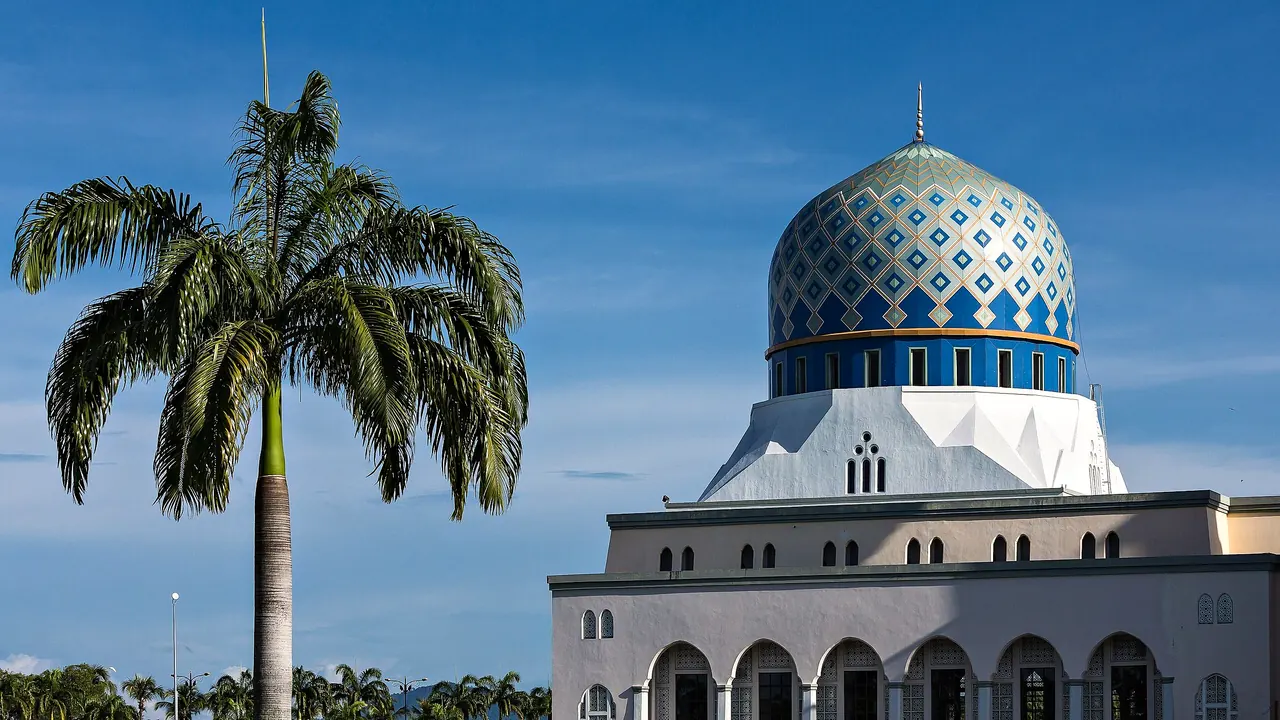
The patterned blue dome of the City Mosque
- Nature & outdoors87
- Affordable cities77
- Beaches72
Photo: CEphoto, Uwe Aranas, CC BY-SA 3.0, cropped
Match
47
Every category weighted equally
- Beach & sun54
- Culture & arts39
- Food & nightlife42
- Family trip54
- Outdoors55
- Relax & unwind52
- Shopping & style42
- On a budget50
Kota Kinabalu in twelve categories
Our verdict on each, scored 0 to 100 against the same fixed benchmark cities, so a score means the same thing on every page.
Beaches & swimming. Scores 72 out of 100.
Food & drink. Scores 62 out of 100.
Culture & sights. Scores 26 out of 100.
Nightlife. Scores 33 out of 100.
Nature & outdoors. Scores 87 out of 100.
Day trips. Scores 32 out of 100.
Good for families. Scores 55 out of 100.
Getting around. Scores 35 out of 100.
Shopping & style. Scores 33 out of 100.
Affordability. Scores 77 out of 100.
Live music & performing arts. Scores 12 out of 100.
Wellness & relaxation. Scores 40 out of 100.
Kota Kinabalu category by category
Beaches & swimming
72The best swimming is offshore. The five islands of Tunku Abdul Rahman Park, among them Manukan, Sapi and Mamutik, lie fifteen to twenty minutes by speedboat from the jetty. They have short white-sand beaches, coral close to shore and water around 29°C all year. They are easy to reach and lovely early in the day. By late morning they fill with day-trippers, and the beaches are small.
On the mainland, Tanjung Aru is the city's beach. People go for long sunset walks and food stalls rather than for clean, clear water. The beachfront resorts at Tanjung Aru and Dalit Bay, about an hour north, give a quieter stay with the sea as the focus. Choppy water and the odd jellyfish are more likely in the northeast monsoon months.
Food & drink
62This is a seafood town. In the big open-air restaurants you choose your fish, prawns, lobster and crab from live tanks, then pick how they are cooked. On the waterfront, the night market grills squid and stingray over charcoal. The Chinese-Sabahan kopitiams give the city its own dishes: sang nyuk mee (pork noodles), Tuaran mee and ngiu chap beef noodle soup. Kadazan cooking adds hinava, a raw fish salad cured with lime, and bambangan, a wild mango pickle.
The Sunday market on Gaya Street and the central markets sell tropical fruit and Sabah tea. Eating is cheap and casual, and the best of it is at plastic tables. Fine dining and international range are thin outside the big hotels.
Culture & sights
26Very little of the old town survived the bombing of 1945, so the centre is mostly postwar concrete. The main sight is the Sabah Museum, with its displays on Borneo's peoples, a heritage village of traditional longhouses and an ethnobotanic garden. The floating City Mosque on its lagoon and the gold-domed State Mosque are both worth a stop. The Atkinson Clock Tower, from 1905, is one of the few colonial survivors. Half a day covers the lot. Borneo's indigenous cultures are more vivid in the villages and cultural centres outside town than in the city itself.
Nightlife
33Most evenings mean a long seafood dinner, then a drink on the waterfront, where a row of bars and pubs looks out over the sunset and the islands. A handful of live-band bars and small clubs keep going later at weekends, and local crowds dominate. Alcohol is easy to find in this mainly Chinese and Kadazan city, but the scene is small. Most visitors are up early for boats and mountain trips, and that sets the tone.
Nature & outdoors
87The big draw is Mount Kinabalu, about two hours' drive inland. At 4,095m it is the highest peak in Borneo and in Malaysia, and its national park is one of the richest botanical sites on earth, with orchids, pitcher plants and cloud forest changing with every few hundred metres of height. Climbers do it in two days, staying overnight at a mountain hut and setting out before dawn for the granite summit. The park's lower trails and the cool highland farms of Kundasang suit those who would rather walk than climb.
Closer to town, the marine park islands have snorkelling, diving and sea kayaking. The Crocker Range rises behind the city, and there is whitewater rafting on the Kiulu and Padas rivers. On the Klias and Weston wetlands, dusk river cruises spot proboscis monkeys and fireflies. Orangutans need a longer trip east.
Day trips
32Most excursions from the city are into landscape rather than to other places, and the list of towns and heritage stops is short. The best is the Sunday tamu at Kota Belud, about an hour and a half north. It is a big rural market where Bajau and Dusun villagers trade livestock, produce and crafts.
The old colonial railway, built in the 1890s and the only line on Borneo, still runs south from Tanjung Aru through rice fields and stilt villages to Papar and Beaufort. It is a slow ride through small-town Sabah. On the road to the mountain, Kundasang has a memorial garden for the wartime death marches. Nearer town, recreated tribal villages show longhouse life, rice-wine making and blowpipe skills, though in a staged way.
Good for families
55Families mostly treat the city as a base for gentle outings. Short boat rides take them to island beaches with shallow, warm water and fish to snorkel over. Lok Kawi Wildlife Park, south of the city, has orangutans, pygmy elephants and a petting area. The cultural villages, with dancing and blowpipe demonstrations, tend to hold children's attention. The large beach resorts have pools and kids' clubs, and many families never leave them.
Malaysians are warm towards children and the city is relaxed. On the other hand, there are few attractions made for children, the heat is constant, and pavements and road crossings are poor. The mountain trips involve long drives on winding roads.
Getting around
35The downtown strip along the waterfront is compact enough to walk, with its markets, the jetty and Gaya Street all close together. Beyond it, the city spreads along busy roads and pavements give out. There is no rail transit, and the local minibuses run informal routes that visitors find hard to use. In practice, people use ride-hailing apps and taxis, which are cheap. Boats to the islands leave from the jetty in the centre. Mount Kinabalu and the rivers mean a tour, a hired driver or a rented car.
Shopping & style
33The interesting shopping is local. On Sundays, Gaya Street becomes a long street market of orchids, rattan baskets, batik and local snacks. The handicraft market by the waterfront sells shell work, cultured pearls and woven goods from across Sabah and the southern Philippines. Sabah tea, wild honey and Borneo beadwork make good small gifts. The city also has large modern malls with the usual international chains. There is no designer or boutique scene to speak of.
Affordability
77Day to day, the city is cheap. Noodle breakfasts in the kopitiams, market seafood, ride-hailing across town and comfortable mid-range hotels all cost little by international standards. The costs pile up in the experiences people come for. The big beachfront resorts charge resort rates, and climbing Mount Kinabalu means paying for permits, compulsory guides and the mountain hut. Diving, rafting and river tours add more. Island hopping is good value, but count on park and jetty fees as well as the boat.
Live music & performing arts
12There is little formal performance to attend. The traditional dances of the Kadazan-Dusun, Murut and Bajau, including the sumazau and the bamboo-pole dance, are usually seen as staged shows in the cultural villages and at hotel dinners. The Kaamatan harvest festival is the exception. Its main celebration, at the Kadazandusun cultural hall in Penampang on the city's edge, brings gong ensembles, bamboo bands and dancing in full traditional dress, and it is the best chance to see this music performed by and for local people. At other times, live music means cover bands in waterfront bars.
Wellness & relaxation
40Wellness here mostly means a resort stay. The large beachfront hotels at Tanjung Aru and Dalit Bay have full spas and slow days by the pool, and the city's foot reflexology and massage parlours are plentiful and cheap. Poring Hot Springs, on the far side of Mount Kinabalu, has open-air sulphur tubs among the trees, a welcome soak after the climb but a long drive from town. The pace of the city is unhurried. Still, there is no bathing tradition to build a trip around.
When should you go?
Pick a month to see what it is like. The climate figures are measured averages, not a forecast.
Kota Kinabalu in July
Daytime high, °C
Rainfall in the month, mm
The whole year
Shaded against this city’s own year: the deepest cell is its best month for that figure and the palest its weakest.
Temperature and rainfall are climate normals, averaged over the years shown. Kota Kinabalu: 1991-2020 (sunshine 1981-2010) normals, Kota Kinabalu (5.3 km from centre).
Before you go
| Measure | Kota Kinabalu |
|---|---|
| Official language | Malay |
| Currency | Malaysian Ringgit (MYR) |
| Sockets | G240 V, 50 Hz |
| Driving side | Left |
| Time zone | UTC+8 |
| Emergency number | 999 |
| Elevation | 5 m |
| Main airport | Kota Kinabalu International Airport (BKI)5 km from centre37 non-stop destinations |
By the numbers
| Measure | Kota Kinabalu |
|---|---|
| City population | 452,058 |
| People per km² | 1,284 |
| Museums within 10 km | 3 |
| UNESCO World Heritage sites within 50 km | 0 |
| Swim season, months above 21 °C | 12 months |
Compare Kota Kinabalu with
Every comparison with a written verdict behind it.