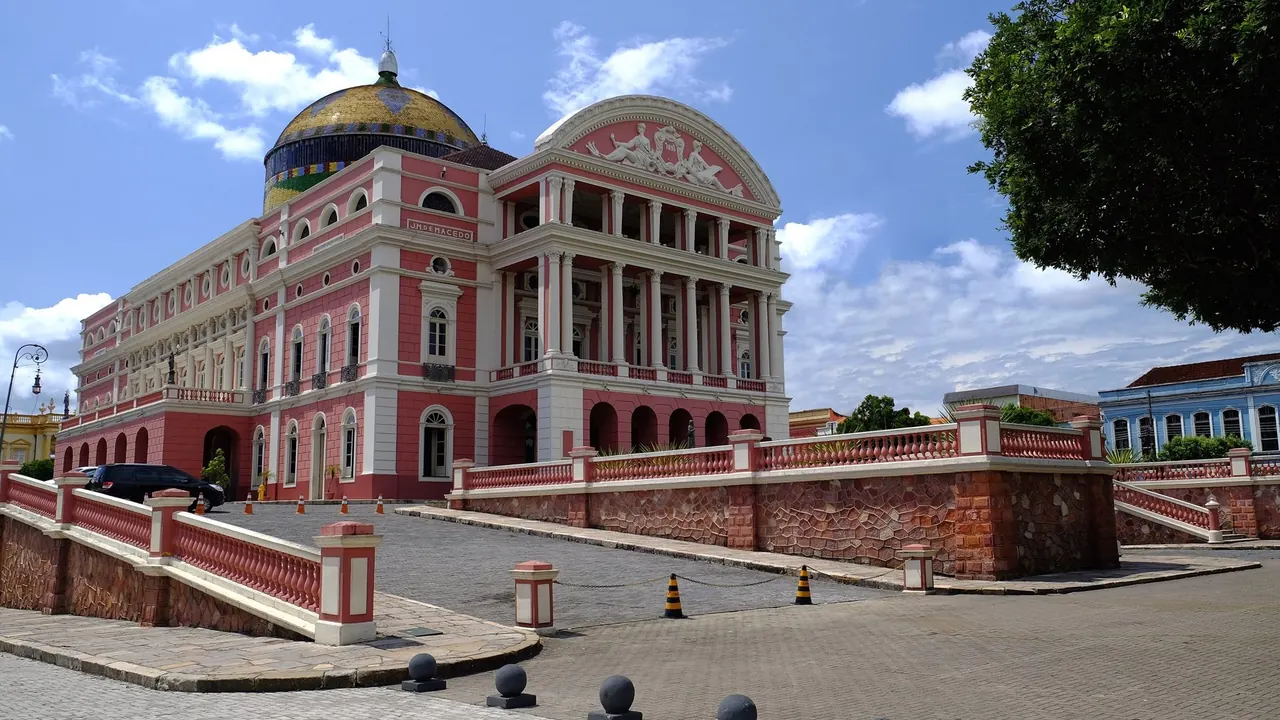
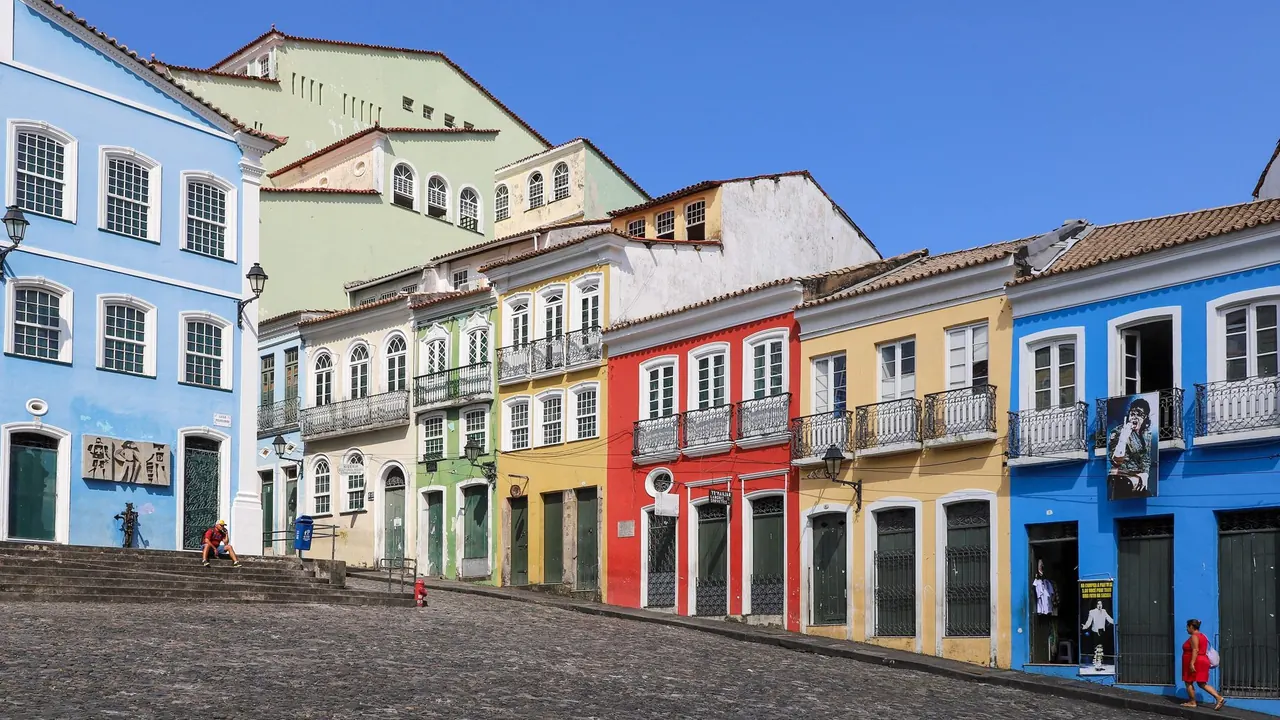
Photos: Manaus by Jardelsliumba, CC BY-SA 4.0, cropped; Salvador by Paul R. Burley, CC BY-SA 4.0, cropped.
Manaus or Salvador?
Our verdict in twelve categories, each scored against the same fixed benchmark cities, and the climate month by month, so you can choose for your trip.
Choose Manaus for
- nature and the outdoors
Manaus makes sense when the Amazon itself is the reason for the trip: river dolphins, flooded forest, the Meeting of the Waters and a few nights at a jungle lodge. The city is a base rather than a destination. Its rubber-boom opera house is worth an evening, but this is a trip for travellers willing to give up beaches, nightlife and easy sightseeing for wildlife and days on the river.
Choose Salvador for
- beaches
- day trips
- culture and sights
For almost everything else, Salvador is the stronger choice. It has a warm Atlantic and calm bay coves, the baroque churches of the Pelourinho, a cuisine with deep West African roots and drum-driven nights in Rio Vermelho. It suits travellers who want a city break and a beach trip in one, with colonial towns such as Cachoeira close enough for a day out.
Scoreboard
Twelve categories on one fixed scale from 0 to 100. The shaded stretch is the gap between the two.
Your match
Pick a travel style or drag the sliders, and both match scores follow your weighting.
Wins on nature and the outdoors with your weighting.
Wins on beaches and day trips with your weighting.
What matters to you?
Category by category
What the scores mean for a trip.
Beaches & swimming
Salvador is a real beach city and Manaus is not. In Manaus you swim in the dark water of the Rio Negro, at Ponta Negra or on the sandbanks around Tupé that appear only when the river is low, and the water is not always clean.
Salvador has the sea on two sides. Sheltered bay coves such as Porto da Barra are good for easy swimming, and the Atlantic shore grows cleaner and wilder towards Stella Maris and Flamengo. The reef pools at Praia do Forte add a full beach day an hour to the north.
Food & drink
Each city cooks food found nowhere else in Brazil, but from very different sources. Manaus cooks from the river and the forest: tambaqui ribs, pirarucu, tacacá with jambu leaves that make the lips tingle, and fruits such as cupuaçu and camu-camu at the Adolpho Lisboa market.
Salvador's Bahian cooking, built on dendê oil, coconut milk and West African tradition, gives you more variety over a week of meals. Acarajé is sold by baianas on the squares, and you can share a clay pot of moqueca at a beach shack. Neither city has much fine dining or international food.
Culture & sights
Salvador has far more to see. The Pelourinho is a whole UNESCO-listed colonial quarter of baroque churches, with the gilded São Francisco as its highlight. Beyond it are the Mercado Modelo, the Bonfim church on its hill and an Afro-Brazilian heritage that runs through the whole city.
Manaus has one great set piece, the Teatro Amazonas, with a cluster of rubber-boom buildings and small museums around it. It fills a day or two between river trips, while Salvador's old town alone takes several days.
Nightlife
In both cities a night out means plastic tables on the pavement and cold beer, but Salvador has more going on and more of it in one place. Rio Vermelho stays busy well past midnight, Barra draws a younger crowd by the beach and the Pelourinho squares fill on Tuesday and weekend nights. Carnival is among the largest street parties anywhere.
Manaus is quieter and more spread out, with the Ponta Negra waterfront, bars in Adrianópolis and Vieiralves, and dance halls playing forró and boi-bumbá. Most visitors are about to head into the jungle or have just come back, so nights end early.
Nature & outdoors
This is where Manaus stands apart. It is the gateway to the Amazon, with the Meeting of the Waters, pink river dolphins, flooded forest in the high-water months and the maze of the Anavilhanas islands upstream. A few nights at a lodge turn it into serious wildlife watching.
Salvador's nature is gentler and coastal: sailing on the Bay of All Saints, the dunes and dark lagoon of Abaeté, surfing to the north and humpback whales offshore from about July to October. For wilder country you have to go to the Chapada Diamantina, which takes several days.
Day trips
Salvador has the better choice of days out. The baroque river town of Cachoeira is about two hours inland in the Recôncavo, Praia do Forte lies to the north and ferries cross to Itaparica and the islands of the bay.
From Manaus there are almost no towns to visit within easy reach. Apart from the waterfalls and caves around Presidente Figueiredo, time away from the city is best spent on the river.
Good for families
Neither is an easy place for a family, though Salvador is the simpler of the two. The calm, shallow water at Porto da Barra suits young swimmers, the turtle centre at Praia do Forte and the bay islands work well for older children, and a beach hotel makes a practical base.
Manaus has animals children love, from river dolphins to the otters and manatees at the Bosque da Ciência. But the constant humidity, the mosquitoes and the long days on boats make it better suited to older children than to toddlers.
Getting around
Manaus is a sprawl with only a scrap of walkable centre, while Salvador packs its old town onto two levels you can explore on foot. In Manaus the walking stops after a few blocks around the Teatro Amazonas and the market, and the heat, broken pavements and traffic make even those blocks hard work. With no metro or tram, Ponta Negra and the restaurant districts are a taxi ride away, and the river means an organised boat or a ferry from the port.
In Salvador the Pelourinho is steep and cobbled but compact. The Lacerda Elevator and a funicular take you down to the port, and Barra is an easy walk along the seafront. The two metro lines are mostly useful for the airport and the bus station, and you only need a car for the coast to the north.
Shopping & style
In both cities crafts are the reason to shop rather than fashion, and in both the national brands are found in air-conditioned malls. Manaus has the more unusual pieces: indigenous basketry, seed jewellery, feather work and Amazon oils, plus the electronics shops of its free-trade zone.
Salvador has a little more to browse, centred on the Mercado Modelo and the Pelourinho: carved wood, lacework, berimbaus, drums and Bonfim ribbons. The São Joaquim market is better for wandering than for buying.
Affordability
Day-to-day costs are low in both cities, with cheap street food and cheap taxis. The difference is what you come for. In Manaus the biggest costs are the river excursions and jungle lodges, which cost far more than staying in town.
In Salvador the main pleasures, the beaches and churches, cost little or nothing, and simple guesthouses in Barra and the Pelourinho keep the budget down. Carnival week is the one time it gets expensive.
Live music & performing arts
The two cities offer very different kinds of performance. Manaus has the formal stage. The Teatro Amazonas puts on its philharmonic, ballet and an annual opera festival, and an evening inside that rubber-boom hall is a highlight. Boi-bumbá drumming fills the dance halls.
Salvador has more live performance through the week, almost all of it rhythm and dance. Bloco drum groups hold open rehearsals of samba-reggae in the Pelourinho and Liberdade, the Balé Folclórico da Bahia performs most evenings and capoeira breaks out in the squares. Opera is rare there, though, so Manaus is the better stop for the classical stage.
Wellness & relaxation
Neither city has a spa or bathing tradition, so how restful the trip is depends on where you stay. Salvador's unhurried pace helps: long lunches, a quiet guesthouse in Santo Antônio or a resort spa on the coast north of the city.
Manaus is hot, noisy and congested, and you only find calm by leaving it for a lodge on the river, with hammocks and the sounds of the forest.
When should you go?
Pick your month. The climate figures are measured averages, not a forecast.
Manaus in July
Salvador in July
Daytime high, °C
Rainfall in the month, mm
Temperature and rainfall are climate normals, averaged over the years shown. Manaus: 1991-2020 normals, Manaus (1.7 km from centre). Salvador: 1991-2020 normals, Salvador (4.5 km from centre).
Manaus is hot in every month, and afternoons reach 35°C in September, so walking the streets is tiring at any time of year. Heavy rain falls from about November to May, with more than 300mm a month at its peak. It eases from June to October, which are also the sunniest months. The river keeps its own calendar. High water from about May to July floods the forest for boat trips, and as the river drops from September the sandbanks appear.
Salvador is milder and more even through the year, and the sea stays near 28°C for much of it, warm enough to swim in any month. Its wet season falls at a different time from Manaus, peaking in April and May at close to 290mm. December and January are the driest and sunniest months and the best for the beach. From September to February the weather suits both walking around the city and beach days. Midyear is a little cooler but much wetter.
Which traveller are you?
On a beach and sun trip, Salvador is the clear choice. The Atlantic stays warm all year, Porto da Barra has calm swimming in the city and Praia do Forte is an hour north. Manaus has only river beaches, which come and go with the water level.
For an outdoors trip, Manaus is the place. Boats reach pink dolphins, giant water lilies and the islands of the Anavilhanas, and a stay at a lodge brings real wildlife watching. Salvador's outdoors is coastal: sailing on the bay, surfing and whales in season.
On a culture and arts trip, Salvador gives you far more for your days: the Pelourinho's baroque churches, the Afro-Brazilian Museum, open drum rehearsals and folk dance. Manaus has the Teatro Amazonas and its opera festival, which make a fine evening, but two days covers its sights.
Before you go
| Measure | Manaus | Salvador |
|---|---|---|
| Official language | Portuguese | Portuguese |
| Currency | Brazilian Real (BRL) | Brazilian Real (BRL) |
| Sockets | CN60 Hz | CN60 Hz |
| Driving side | Right | Right |
| Time zone | UTC-4 | UTC-3 |
| Emergency number | Police 190, ambulance 192, fire 193 | Police 190, ambulance 192, fire 193 |
| Elevation | 92 m | 8 m |
| Main airport | Eduardo Gomes International Airport (MAO)9 km from centre21 non-stop destinations | Deputado Luiz Eduardo Magalhães International Airport (SSA)20 km from centre31 non-stop destinations |
| Public holidays this year | 14 days | 14 days |
By the numbers
| Measure | Manaus | Salvador |
|---|---|---|
| City population | 2,303,732 | 2,417,678 |
| People per km² | 202 | 3,489 |
| Museums within 10 km | 13 | 49 |
| UNESCO World Heritage sites within 50 km | 1 | 1 |
| Swim season, months above 21 °C | - | 12 months |
Where else could you go?
Every comparison below shares a destination with this one, so you can follow Manaus or Salvador somewhere new.