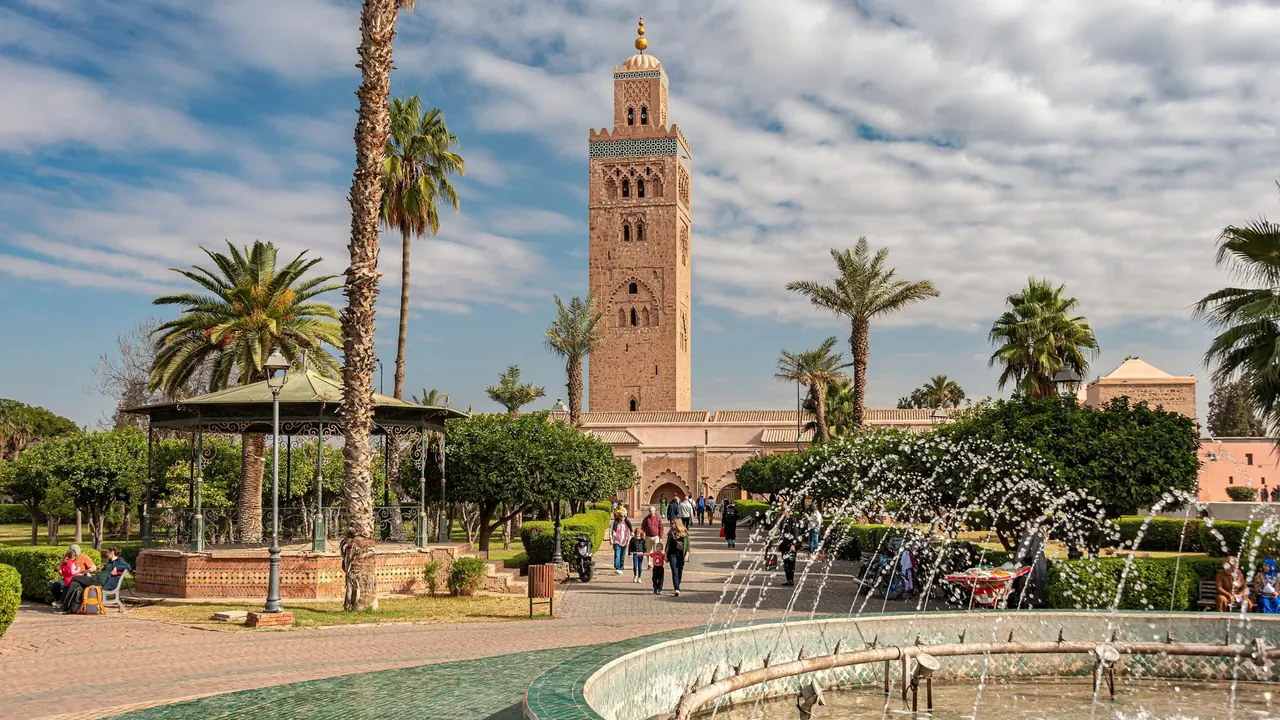
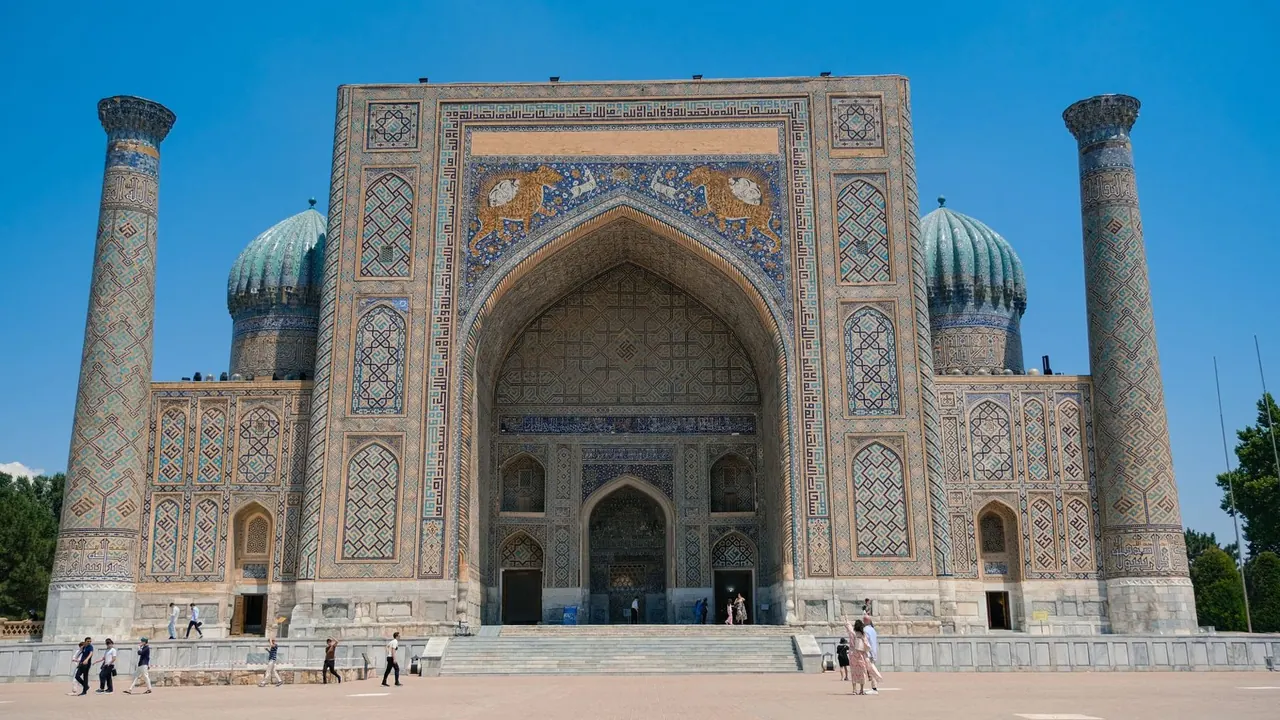
Photos: Marrakech by Jorge Franganillo, CC BY 2.0, cropped; Samarkand by Yaşar Başkurt, Pexels License.
Marrakech or Samarkand?
Our verdict in twelve categories, each scored against the same fixed benchmark cities, and the climate month by month, so you can choose for your trip.
Choose Marrakech for
- wellness
- nature and the outdoors
- shopping
Marrakech suits travellers who want a city that works on all the senses and then lets them retreat. Days go on bargaining in the souks for carpets and lanterns, afternoons in a hammam or a riad courtyard, and the High Atlas is close enough for a village walk or a night in the Agafay desert. It is also the livelier of the two after dark, so pick it if shopping, spa time and mountain scenery all belong in the trip.
Choose Samarkand for
- day trips
- getting around
- culture and sights
Anyone drawn above all to architecture should look to Samarkand. The Registan, Shah-i-Zinda and Gur-e-Amir form a run of Timurid monuments finer even than Marrakech's medina, the main sights sit along one walkable street, and the fast train puts Bukhara within easy reach for a second great old town. It is quieter, a little cheaper and has almost no nightlife or bathing culture, so it rewards a focused trip built around history and tilework.
Scoreboard
Twelve categories on one fixed scale from 0 to 100. The shaded stretch is the gap between the two.
Your match
Pick a travel style or drag the sliders, and both match scores follow your weighting.
Wins on wellness and nature and the outdoors with your weighting.
Wins on day trips and getting around with your weighting.
What matters to you?
Category by category
What the scores mean for a trip.
Beaches & swimming
In neither city will you swim anywhere but a pool, and in summer it is worth booking a hotel or riad with one in both. The difference is that Marrakech at least has somewhere to escape to: the Atlantic at Essaouira, a long drive away with cool water and strong wind, or the Lalla Takerkoust reservoir in the foothills for a lakeside afternoon. Samarkand is in a doubly landlocked country, so there is no sea within reach at all, only the shallow Zarafshan river that locals use.
Food & drink
Marrakech has the more rewarding food. Tagines, pastilla, harira and the slow-cooked tanjia make a deeper range of dishes, and the grill stalls of Jemaa el-Fna at dusk turn dinner into an event. Gueliz and Hivernage add some international choice once the riad menus start to repeat.
Samarkand's cooking is narrower and plainer, built on plov at lunchtime, glazed Samarkand non, shashlik and somsa, and Siab Bazaar is the place to see it all. Beyond Uzbek and Russian dishes the options run out quickly, though a tasting at the city's nineteenth-century winery is an interesting extra that Marrakech has nothing to match.
Culture & sights
Samarkand has the greater monuments. The Registan's three tiled madrasas, the avenue of mausoleums climbing the hill at Shah-i-Zinda and Timur's gilded tomb at Gur-e-Amir are architecture few cities can equal, and Ulugh Beg's observatory and the Afrasiyab murals add depth.
Marrakech's strength is the medina as a whole, a medieval maze that is still lived in, with the Koutoubia above it. The Ben Youssef Madrasa, the Bahia Palace and the Saadian Tombs are inside the walls and the Jardin Majorelle is outside them. Its sights are smaller and part of daily street life, while Samarkand's stand on their own between Soviet-era avenues.
Nightlife
Neither is a party city, but Marrakech at least offers a night out. Jemaa el-Fna keeps the medina lively after dark, and Hivernage and Gueliz have lounge bars, hotel bars and a few large clubs with DJs that stay open late. Samarkand empties well before midnight: the evening is dinner in a hall where wedding parties dance to live bands, then a walk past the floodlit Registan, with only a handful of hotel bars for a drink.
Nature & outdoors
Marrakech has the far grander setting. The snow-capped High Atlas is visible from the city. Within about an hour and a half are the Ourika valley's waterfalls, the Berber villages around Imlil and the two-day climb of Toubkal, and there is winter skiing at Oukaimeden. Closer in, the Agafay desert has balloon flights and camel rides.
Samarkand's countryside is gentler: juniper woods, walnut groves and village trails in the Aman-Kutan valley and the hills above Urgut, with the Nuratau range for treks between homestays. It is good walking country in spring, but the high mountains lie across the border in Tajikistan.
Day trips
Samarkand is much the better base for day trips. The high-speed train reaches Bukhara in about an hour and a half, close enough for a full day in another great old town, and Shakhrisabz, Timur's birthplace, is a manageable drive over a mountain pass. The Sunday bazaar at Urgut and the paper-makers of Konigil fill shorter days.
From Marrakech, the outings worth taking go into the mountains and the desert rather than to other towns. Essaouira is two and a half hours or more each way and better with a night there, Ait Benhaddou needs an overnight stay, and closer in there are only village souks such as Asni and the Almohad mosque at Tinmel.
Good for families
Neither city is easy with young children, and both work best for older ones in spring or autumn. The problems differ, though. In Marrakech it is the medina itself: crowded lanes shared with motorbikes, persistent sellers and snake charmers some children find unsettling, softened by riad plunge pools, resort gardens and a water park. Samarkand is calmer, with wide pedestrian streets and simple rides in its parks, but its sights are mausoleums and madrasas that hold little for children, and the distances feel long in the heat.
Getting around
Samarkand is the simpler city to get around. Its main monuments line up along one pedestrian street from the Registan to Shah-i-Zinda, and app taxis at fixed fares cover the observatory, Afrasiyab and the station.
Marrakech takes more patience. The medina is walkable but a maze of unnamed alleys shared with motorbikes and carts, petit taxis often need the fare agreed first, and the buses are hard for newcomers to use. A trip into the mountains or the desert means hiring a driver or joining a tour.
Shopping & style
Marrakech is worth the trip for its shopping alone. The souks north of Jemaa el-Fna run lane by lane through leather, metalwork, carpets, lanterns and babouches. The design boutiques of Gueliz and the Sidi Ghanem showrooms are a calmer alternative to long bargaining over tea.
Samarkand's shopping is smaller and centred on crafts: suzani embroidery, ikat silk and ceramics sold from old madrasa cells, hand-knotted carpets, and mulberry-bark paper from Konigil. Some pieces are distinctive, but quality is uneven and there is far less to browse.
Affordability
Both are inexpensive places to travel, and Samarkand is the easier of the two on a tight budget. Plov, bazaar food and monument entry cost little, family-run guesthouses are good value, and app taxis come at fixed fares.
Marrakech is cheap at street level, with Jemaa el-Fna stalls, petit taxis and simple medina riads. But first prices in the souks are set high for visitors, and the city's large luxury tier of palace hotels and boutique riads makes it easy to spend much more.
Live music & performing arts
Neither city has an opera, orchestra or theatre season worth planning around, so the difference is in where performance happens. In Marrakech it is spontaneous and nightly: gnawa musicians, drummers and storytellers gathering crowds on Jemaa el-Fna, a tradition UNESCO lists as intangible heritage. Samarkand's is staged for visitors, with folk costume shows and a sound-and-light show at the Registan, and its highlight, the Sharq Taronalari festival, is held only in some years.
Wellness & relaxation
Marrakech is one of the great bathing cities. Every quarter has a neighbourhood hammam with black soap and kessa scrubs, spa hammams add argan oil massage and rhassoul wraps, and a riad courtyard with a fountain and orange trees is a retreat in itself.
Samarkand has one old domed bathhouse near Bibi-Khanym and a few hotel spas. Rest here comes from slowing down instead, over long afternoons on a topchan in the shade and in the quiet courtyards of the old quarter once the tour groups have gone.
When should you go?
Pick your month. The climate figures are measured averages, not a forecast.
Marrakech in July
Samarkand in July
Daytime high, °C
Rainfall in the month, mm
Temperature and rainfall are climate normals, averaged over the years shown. Marrakech: 1991-2020 normals, Marrakech (5.1 km from centre). Samarkand: 1991-2020 normals, Samarkand (10 km from centre).
Marrakech is the milder of the two in winter. Daytime highs are around 19°C in January and most days are sunny, so the city works for sightseeing from October right through to May. Spring is the best time, before the dry heat of July and August reaches 38°C and makes the medina hard going after mid-morning. Rain is light all year and almost absent in summer.
Samarkand swings much further. Winter is cold, with January highs near 7°C and short grey days. March and April are the wettest months, and May is the tail end of that wet season: warm and long on sunshine, but still with 41mm of showers. Late September and October are the reliably dry window, with warm days and clear skies. Summer is hot here too, though a few degrees less fierce than in Marrakech.
Which traveller are you?
On a relaxing and wellness trip, Marrakech is the clear choice if you plan the days around retreating: a morning in the souks, an afternoon in a spa hammam, the evening on a riad roof terrace. Samarkand is calm, but offers little bathing to build a trip on.
For an outdoors trip, Marrakech gives far more to do. You could spend two days walking between Berber villages or climbing North Africa's highest peak, then camp a night in the stony desert. Samarkand suits gentle spring walks and village homestays, not real mountain days.
On a culture and arts trip, Samarkand rewards the traveller who wants to linger, coming back to the same tiled façades in different light and spending whole mornings on one building. The trade-off is quiet evenings and a narrow menu, while Marrakech packs its smaller sights into market life.
Before you go
| Measure | Marrakech | Samarkand |
|---|---|---|
| Official language | Arabic, Standard Moroccan Tamazight | Uzbek |
| Currency | Moroccan Dirham (MAD) | Uzbekistan Sum (UZS) |
| Sockets | CE50 Hz | CFI220 V, 50 Hz |
| Driving side | Right | Right |
| Time zone | UTC+1 | UTC+5 |
| Emergency number | Police 19/112, ambulance 15, fire 15 | 112 |
| Elevation | 465 m | 702 m |
| Main airport | Marrakesh Menara Airport (RAK)6 km from centre113 non-stop destinations | Samarkand International Airport (SKD)5 km from centre29 non-stop destinations |
| Public holidays this year | 11 days | - |
By the numbers
| Measure | Marrakech | Samarkand |
|---|---|---|
| City population | 1,002,697 | 546,303 |
| People per km² | 4,360 | 5,058 |
| Museums within 10 km | 14 | 11 |
| UNESCO World Heritage sites within 50 km | 1 | 1 |
Where else could you go?
Every comparison below shares a destination with this one, so you can follow Marrakech or Samarkand somewhere new.