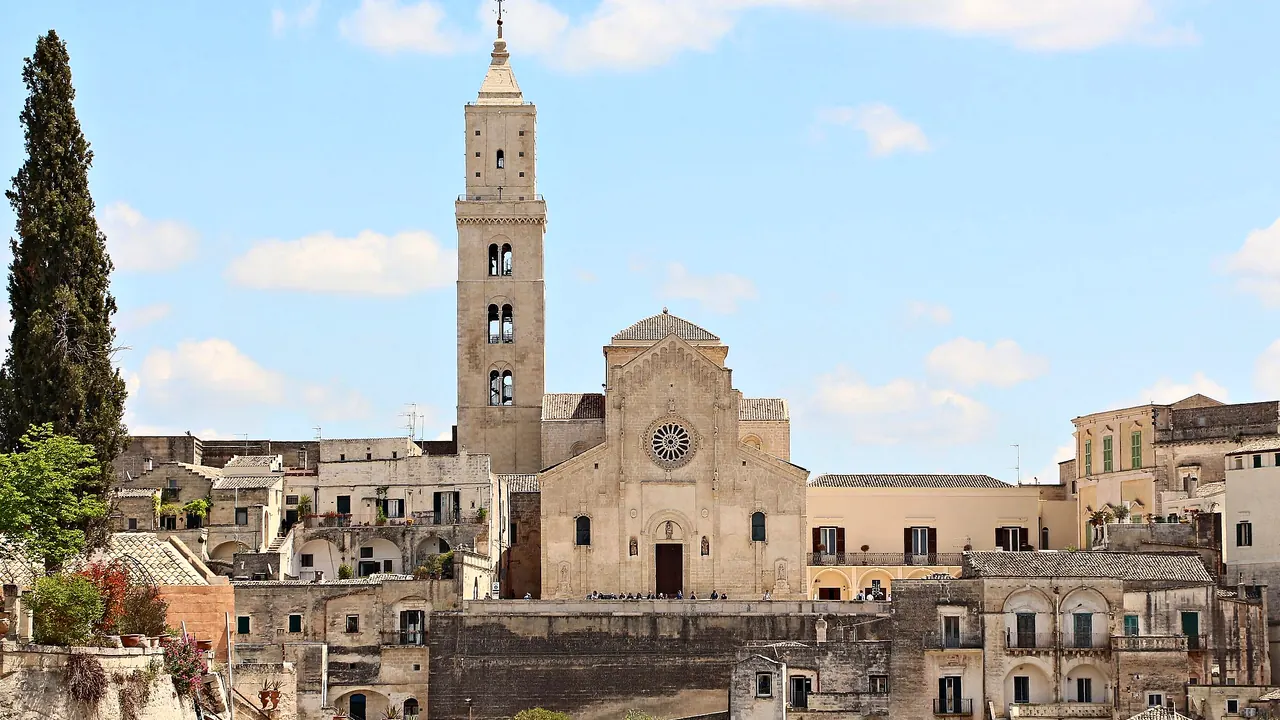
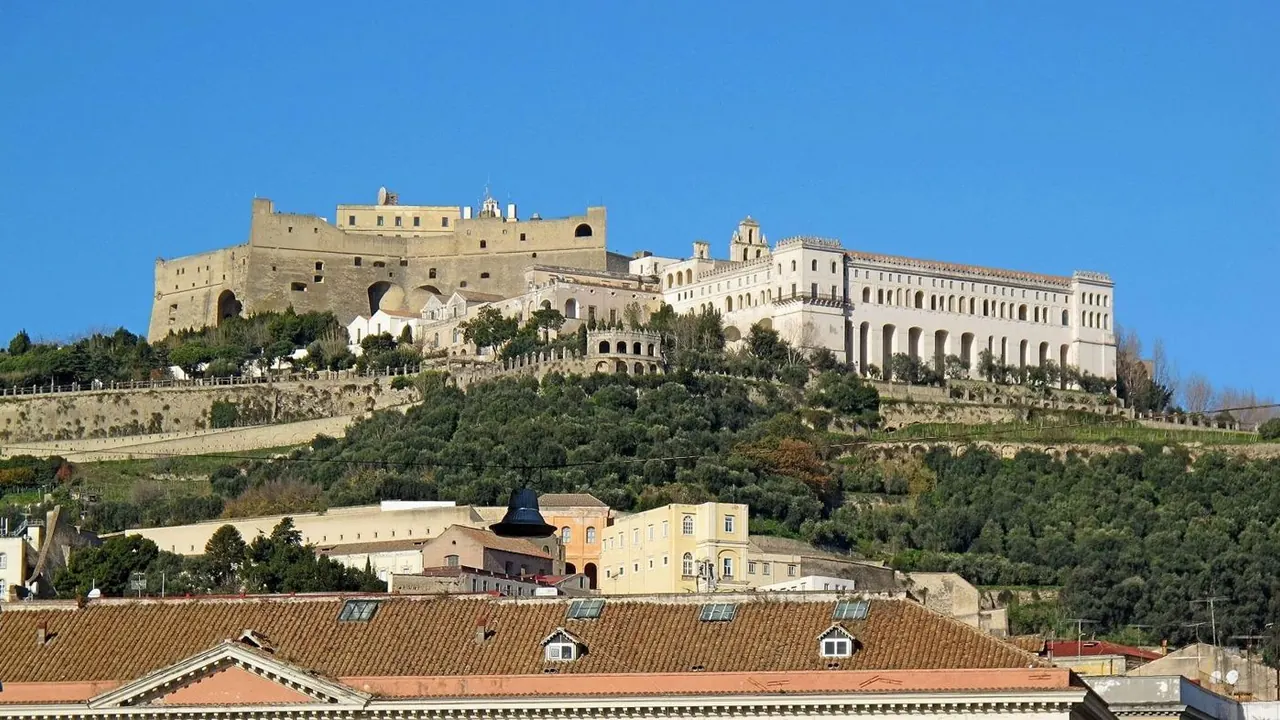
Photos: Matera by Bernard Gagnon, CC BY 4.0, cropped; Naples by pietro scerrato, CC BY 3.0, cropped.
Matera or Naples?
Our verdict in twelve categories, each scored against the same fixed benchmark cities, and the climate month by month, so you can choose for your trip.
Choose Matera for
Matera does not lead in any category we score.
Choose Matera for a slow, short stay built around one extraordinary sight: the cave districts of the Sassi climbing the side of the Gravina gorge, best seen at dusk or from the far rim of the Murgia. It suits couples and walkers who want quiet evenings over a glass of wine rather than a night out. It also works for drivers who want a base for the trulli and white towns of Puglia.
Choose Naples for
- live music and the arts
- nightlife
- shopping
Naples wins on almost everything else, and by a wide margin in several places. The food is a reason to travel in itself, the historic centre and the Archaeological Museum could fill a week, and the San Carlo opera house gives the evenings real weight. Pompeii, Herculaneum, Capri and the Amalfi Coast are all within reach without a car. You need some patience with noise, traffic and crowds, and the city repays it generously.
Scoreboard
Twelve categories on one fixed scale from 0 to 100. The shaded stretch is the gap between the two.
Your match
Pick a travel style or drag the sliders, and both match scores follow your weighting.
Has no clear advantage with the weighting you have chosen.
Wins on live music and the arts and nightlife with your weighting.
What matters to you?
Category by category
What the scores mean for a trip.
Beaches & swimming
Neither is a beach city, but Naples makes the sea easier to reach. From Matera the nearest shore is a drive of about 45 minutes to the long sandy Ionian beaches at Metaponto and Policoro. The water there is shallow and calm and good for children, but without a car it is hard to get to.
Naples has swimming off the rocks below the Lungomare and at small lidos in Posillipo, though the water near the port is not always clean. Its real advantage is the ferries and hydrofoils to the clear, rocky coves of Procida, Ischia and Capri, which make a day by the sea simple without driving.
Food & drink
Matera serves the plain peasant cooking of Basilicata: the horn-shaped pane di Matera, crapiata soup, hand-made cavatelli and crackling fried peperoni cruschi. It is honest and good, but there is little beyond it and no street food or markets to explore.
Naples has far more to eat and much more conviction about it. Pizza was born here, and you also get fried pizza, cones of fried seafood, babà, and coffee drunk standing at the bar. The Pignasecca and Porta Nolana markets show off the mozzarella, fish and San Marzano tomatoes. Both cities pour Aglianico, and neither offers much international food.
Culture & sights
Matera has one remarkable set of sights in a small space: the cave dwellings of Sasso Caveoso and Sasso Barisano, rock churches such as Santa Maria de Idris with their faded frescoes, and the Romanesque cathedral on the Civita. Nowhere else looks like it, and two or three days do it justice.
Naples works on a much larger scale. There is the Greek street grid of Spaccanapoli, a church in almost every block, the Pompeii frescoes and mosaics in the Archaeological Museum, the Veiled Christ and the Capodimonte gallery. Both cities have a world underground, but Matera's walk-through cistern is a single visit, while Naples has whole networks of tunnels and catacombs.
Nightlife
Evenings in Matera are a passeggiata along Via del Corso, a long dinner and a drink on a terrace above the lit Sassi. Outside summer the town is quiet soon after.
Naples actually goes out. Students fill Piazza Bellini beside the old Greek walls, and a smarter crowd spills out of the small bars of Chiaia well past midnight. Like Matera, it has few clubs of note, but its nights are loud and sociable, with people gathering in the street.
Nature & outdoors
Matera's best landscape is right on its doorstep. A path drops from Sasso Caveoso into the Gravina gorge and climbs to Murgia Timone, past abandoned rock churches and Neolithic village sites, and kestrels nest in the cliffs. The sandstone peaks of the Lucanian Dolomites are further out, by car.
Naples has the more dramatic scenery. You can climb to the crater rim of Vesuvius, walk the oak-filled crater of Astroni in the Phlegraean Fields, and snorkel or kayak at the Gaiola underwater park. Within a long day you can hike the Path of the Gods above the Amalfi Coast or climb Monte Solaro on Capri.
Day trips
From Matera there are good outings on both sides of the regional border: Altamura and Gravina close by, then the trulli of Alberobello, the white towns of the Valle d'Itria, Castel del Monte and the ghost town of Craco. Almost every one of them needs a car.
Naples has the stronger list and needs less planning. Pompeii and Herculaneum are a train ride away, boats run to Capri, Ischia and Procida, and Caserta's palace, the Amalfi Coast and the temples of Paestum are all within reach. Most of this works on public transport.
Good for families
Both cities are warm towards children but hard work with them, and Naples is a little easier. In Matera the Sassi are a maze of steep stone steps where a pushchair is useless, and there is little shade in summer. Older children enjoy the caves and the cistern, but nothing in the town is made for them.
Naples has scooters in the lanes and broken pavements, but it also has a zoo, the Edenlandia amusement park, a science museum, funiculars and ferry rides. Many families stay in Sorrento or on an island and come into the city for the day.
Getting around
Inside both cities you mostly walk. Matera's flat upper town leads to the Sassi by steep stairways, and cars cannot enter most of the old districts. The trouble starts when you want to go further: the town is off the national rail network, the narrow-gauge line to Bari is slow, and in practice a hire car is needed.
Naples has the opposite problem. Getting around is noisy and unreliable, but there is a real network: Metro Line 1 with its art-filled stations, four funiculars up to Vomero and Posillipo, and the crowded Circumvesuviana to Pompeii and Sorrento. You never need a car, and driving in the city is best avoided.
Shopping & style
Shopping in Matera is a short list of souvenirs: painted cuccù whistles, little tufa carvings of the town, and dried peppers and Aglianico to take home.
Naples has much more character for shoppers. Chiaia's tailoring workshops make handmade suits, shirts and silk ties, and Via Toledo and the iron-and-glass Galleria Umberto I cover the high street. The nativity workshops of San Gregorio Armeno and the coral and cameos from Torre del Greco make memorable things to bring home.
Affordability
Both are cheaper to eat in than northern Italy, but money goes a little further in Naples. Pizza, street food and coffee at the bar cost little, the metro and funiculars are cheap, and modest B&Bs sit right in the historic centre. Costs climb only when you head for the islands or the Amalfi Coast, or pay entry to the big archaeological sites.
In Matera, what you spend depends mostly on where you sleep. The cave hotels in the Sassi charge for the experience, while guesthouses in the newer town are much cheaper and only a short walk away. Walking the Sassi and the Murgia costs nothing.
Live music & performing arts
Matera has little regular performance: concerts at the conservatory, a summer jazz festival with some events staged against the Sassi, and the Festa della Bruna, when the papier-mâché float is torn apart.
Naples has the Teatro di San Carlo, the oldest opera house in Europe still in use, with a full season of opera, ballet and concerts in its red-and-gold auditorium. Add chamber music in the churches, the San Pietro a Majella conservatory and Neapolitan song sung table to table in the trattorias, and an evening of music is easy to find.
Wellness & relaxation
Matera has no bathing tradition. Its spas are in hotels, some with candlelit pools cut into the rock, and its real calm comes from quiet mornings in the Sassi and slow evenings over the gorge.
Naples itself is too loud to relax in, but the volcanic ground around it has real thermal water. The springs at Agnano have been used since Roman times, and Ischia, about an hour away by hydrofoil, is a true spa island with terraced thermal parks above the sea. Many visitors who come mainly to unwind stay on Ischia and visit the city for the day.
When should you go?
Pick your month. The climate figures are measured averages, not a forecast.
Matera in July
Naples in July
Daytime high, °C
Rainfall in the month, mm
Where the figures come from
Matera has no rain gauge within 25 km of the centre, so its rainfall comes from a gridded climate dataset read at the city rather than from a gauge further away.
Naples's sunshine is measured 28 km from the centre, at Grazzanise.
Temperature and rainfall are climate normals, averaged over the years shown. Matera: 2005-2025, 10 years observed (rainfall 1991-2020) normals, Matera / Martella (4.8 km from centre). Naples: 2005-2020 (sunshine 1991-2020, rainfall 1971-2000) normals, Napoli / Capodichino (4.6 km from centre).
Matera stands on an inland plateau, so its summers are hotter and its winters cooler than on the bay. July reaches 32°C, too hot for climbing the Sassi stairways in the middle of the day, and January highs are only around 10°C. Its best months for walking are May, then September into October, before the rain builds through November. For a swim you drive to the Ionian coast, which is warm enough from June to September, with the sea near 26°C in August.
Naples is milder in winter but much wetter, with rain peaking at 163mm in November, so late autumn and winter are its weakest months for sightseeing. May, June and September are the sweet spot: warm enough to swim from June, and less tiring than high summer. July brings around 324 hours of sunshine and the same warm sea as Matera's coast, but the lanes of the centre are hot work then.
Which traveller are you?
For a food and nightlife trip, Naples is the clear choice. You can eat pizza where it was invented, graze on fried street food and sfogliatelle, then join the crowds on the steps of Piazza Bellini until late. Matera goes quiet soon after dinner.
On a culture and arts trip, Naples has far more to offer: the Archaeological Museum, the Veiled Christ, Capodimonte, Pompeii by train and opera at the San Carlo. Matera's Sassi and frescoed rock churches are unforgettable, but you can see them in a couple of days.
For a short city break, Matera fits two or three days well. The Sassi, the rock churches, the Palombaro Lungo cistern and the walk across the gorge to the Murgia are all close together, and the quiet evenings above the lit caves need no planning.
Before you go
| Measure | Matera | Naples |
|---|---|---|
| Official language | Italian | Italian |
| Currency | Euro (EUR) | Euro (EUR) |
| Sockets | CFL230 V, 50 Hz | CFL230 V, 50 Hz |
| Driving side | Right | Right |
| Time zone | UTC+1, UTC+2 in summer | UTC+1, UTC+2 in summer |
| Emergency number | 112 | 112 |
| Elevation | 401 m | 17 m |
| Main airport | Bari Karol Wojtyła International Airport (BRI)54 km from centre104 non-stop destinations | Naples International Airport (NAP)7 km from centre131 non-stop destinations |
| Public holidays this year | 13 days | 13 days |
By the numbers
| Measure | Matera | Naples |
|---|---|---|
| City population | 59,685 | 913,462 |
| People per km² | 152 | 7,676 |
| Museums within 10 km | 8 | 65 |
| UNESCO World Heritage sites within 50 km | 1 | 5 |
| Swim season, months above 21 °C | 5 months | 5 months |
Where else could you go?
Every comparison below shares a destination with this one, so you can follow Matera or Naples somewhere new.