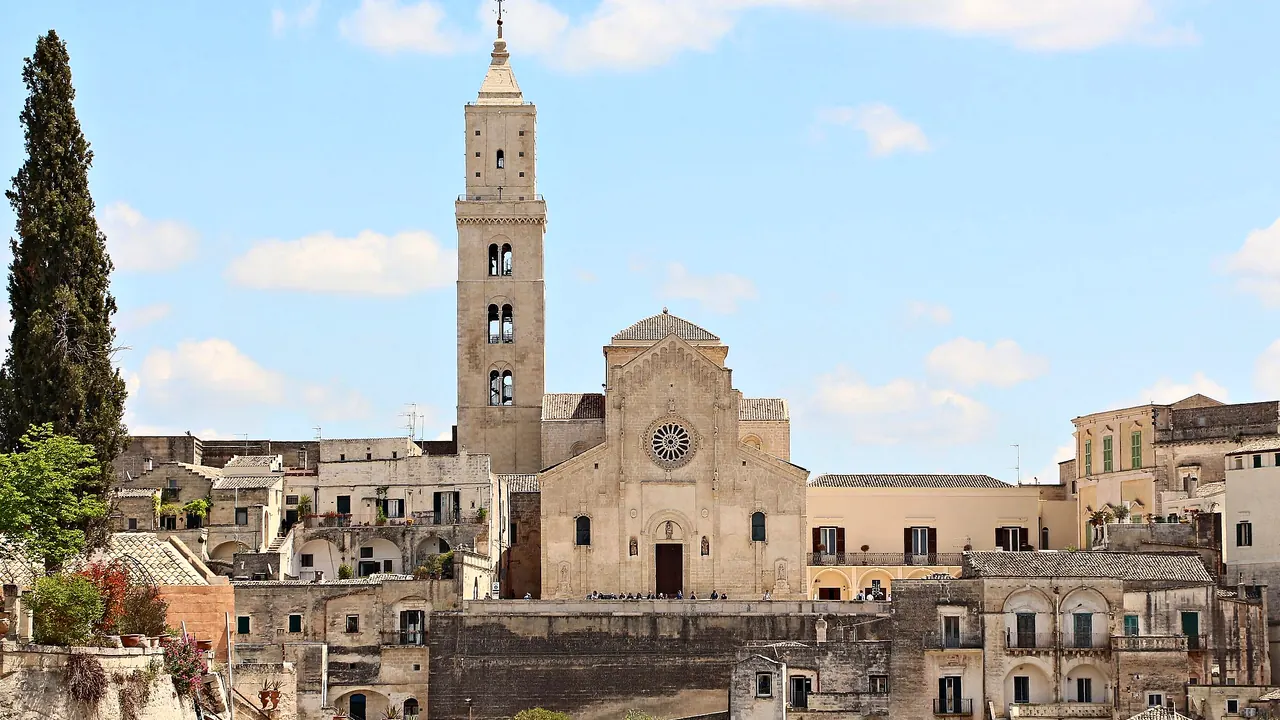
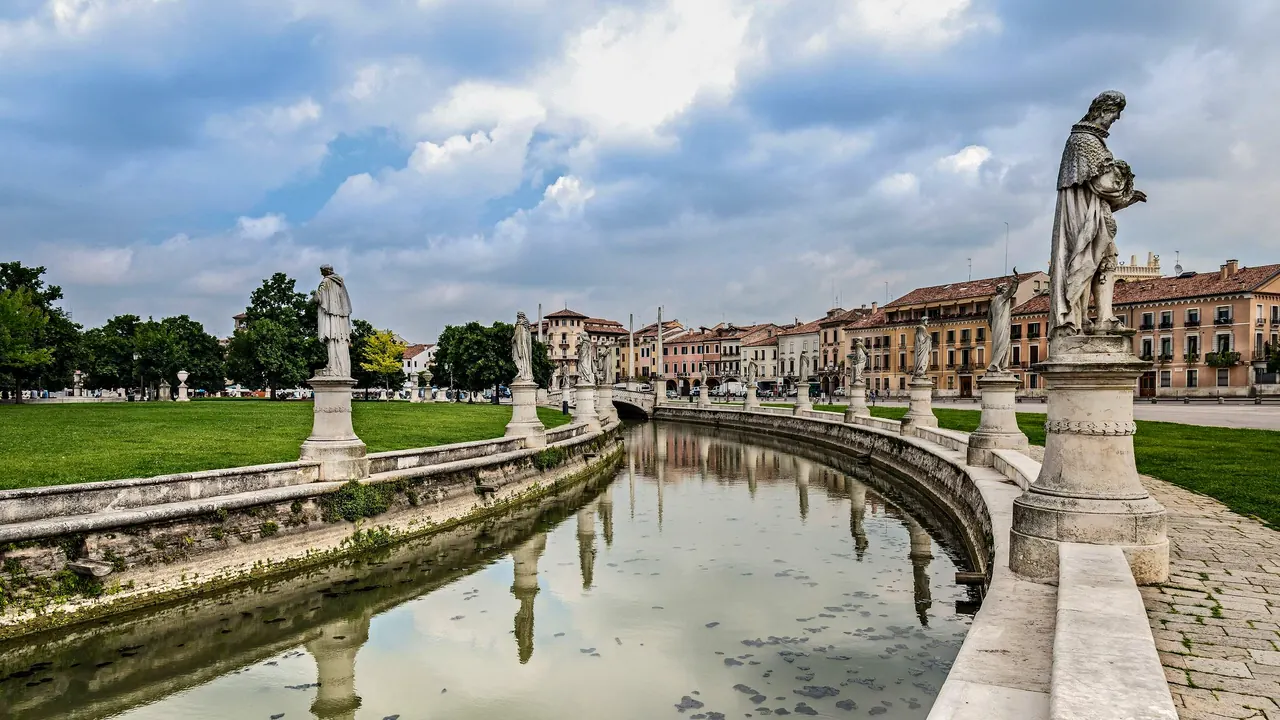
Photos: Matera by Bernard Gagnon, CC BY 4.0, cropped; Padua by Didier Descouens, CC BY-SA 4.0, cropped.
Matera or Padua?
Our verdict in twelve categories, each scored against the same fixed benchmark cities, and the climate month by month, so you can choose for your trip.
Choose Matera for
- beaches
- nature and the outdoors
- prices
Matera suits travellers who want one extraordinary place and are happy to slow down in it. The Sassi, the cave churches and the gorge below them make a townscape found nowhere else in Italy, and the stony Murgia across the ravine is a walk from your door. It works best for couples and walkers with a hire car, on a stay of a few days built around dusk views, long dinners and drives into Puglia and the Lucanian peaks.
Choose Padua for
- wellness
- getting around
- nightlife
Padua is the better pick for a trip with more moving parts. Its station puts Venice, Vicenza, Verona and Bologna within easy reach without a car, the old centre is flat and simple to manage with children, and the evenings have more life, with spritz in the market squares and a student crowd. Add Giotto's frescoes, the thermal pools of Abano a short ride away and markets that feed you well, and it rewards a longer, more varied stay.
Scoreboard
Twelve categories on one fixed scale from 0 to 100. The shaded stretch is the gap between the two.
Your match
Pick a travel style or drag the sliders, and both match scores follow your weighting.
Wins on beaches and nature and the outdoors with your weighting.
Wins on wellness and getting around with your weighting.
What matters to you?
Category by category
What the scores mean for a trip.
Beaches & swimming
Neither is a beach town, but Matera has the better sea within reach. The Ionian shore around Metaponto and Policoro is about 45 minutes away by car, with wide sandy beaches backed by pine woods and calm, shallow water.
Padua's nearest sand, at Sottomarina or the Venice Lido, takes about an hour and is easier to reach without a car, by train and boat. What you find there is long flat stretches of umbrellas and bathing establishments rather than scenery.
Food & drink
Padua eats and drinks better. Its twin markets in Piazza delle Erbe and Piazza della Frutta, the delicatessens beneath the Palazzo della Ragione, Venetian dishes such as bigoli with duck sauce and the early evening spritz in the squares make food part of the day's rhythm, with Caffè Pedrocchi as a grand set piece.
Matera's cooking is honest Lucanian peasant food: the horn-shaped durum bread, crapiata, cavatelli, crisp fried peperoni cruschi and Aglianico to drink. It is satisfying, often served in cave rooms, but the range barely goes beyond the regional table and there is no market life to speak of.
Culture & sights
These two are close in depth but very different in kind. Matera's draw is the place itself: the cave districts of Sasso Caveoso and Sasso Barisano, rock churches with faded Byzantine frescoes and furnished cave houses, best taken in by wandering, especially at dusk.
Padua's strength is great art and learning in a compact centre. Giotto's Scrovegni Chapel, which needs a timed booking, leads a UNESCO-listed group of fresco cycles, joined by Donatello's work at the Basilica of Saint Anthony, the anatomical theatre at Palazzo Bo and the oldest university botanical garden still on its original site.
Nightlife
Padua has more going on after dark. The aperitivo crowds around Piazza delle Erbe and Piazza dei Signori stay out late on warm nights, and in term time the university fills wine bars and small pubs in the old ghetto, though clubs are few and the city goes quiet during the student breaks.
Matera's evenings come down to the passeggiata, a long dinner and a glass on a terrace above the lit Sassi, with a few cave bars open late in summer. It is lovely for couples but offers nothing like a night out.
Nature & outdoors
Matera puts wild country right on the doorstep. A path drops from Sasso Caveoso into the Gravina gorge and climbs to Murgia Timone, among thyme, caves, Neolithic sites and kestrel cliffs, and the Lucanian Dolomites and the Pollino forests are within a drive.
Padua sits on a flat plain, so its outdoors starts further out. The volcanic Euganean Hills, about 15km away, offer vineyard trails and road cycling, the Brenta towpaths make easy bike rides, and real mountain walking on Monte Grappa or the Asiago plateau means a drive of about an hour and a half.
Day trips
Both make good bases, but Padua is outstanding. Venice is under half an hour by train, Vicenza a quarter of an hour, and Verona, Treviso, Bologna and Ferrara all fit easily into a day, with the Brenta villas and the walled towns of Este, Monselice and Montagnana closer still.
Matera's list is strong too, reaching across the border to Altamura, the trulli of Alberobello, the white towns of the Valle d'Itria and Castel del Monte, plus Craco and the peak villages of Castelmezzano and Pietrapertosa. Almost all of them need a car, which is where Padua pulls ahead.
Good for families
Padua is the easier city with children. Its centre is flat, safe and largely pedestrianised, Prato della Valle gives them space to run, and Gardaland and the shores of Lake Garda are about an hour and a quarter away.
Matera can thrill older children with its caves, the walk-through cistern and the scramble into the gorge, but the Sassi are steep stone steps where a pushchair is useless, and summer afternoons are hot with little shade. A short stay and a baby carrier are the realistic approach.
Getting around
Padua is far simpler to move around. Its arcaded centre is flat, a tram runs from the station to Prato della Valle, bikes are normal, and fast trains in every direction let you skip the car entirely.
Matera is walkable too, but the stairways down into the Sassi tire the legs, and leaving town is the hard part. The city is off the national rail network, the narrow-gauge line to Bari is slow and buses are sparse, so a hire car is close to essential.
Shopping & style
Padua offers more, though neither is a shopping destination. Its arcades hold Italian fashion and shoe shops, independent boutiques and university bookshops, and a large antiques market fills Prato della Valle one Sunday a month.
Matera's shopping is mostly souvenirs from Sassi workshops: the cockerel-shaped cuccù whistle, tufa carvings and papier-mâché. Beyond that, the best things to take home are dried peppers, local pasta and Aglianico.
Affordability
Costs are much alike, but where the savings lie differs. In Matera, simple trattorias in the upper town are cheap, while the cave hotels of the Sassi are the expensive part, so staying in the newer town a short walk away keeps a trip affordable.
Padua's value lies in using it as a base: its hotels are reasonably priced for a region that includes Venice, and the walkable centre and short train rides keep transport cheap. Rooms there get dearer during the big trade fairs and graduation season.
Live music & performing arts
Padua has a real year-round programme, modest as it is: theatre and some opera at the Teatro Verdi, a chamber orchestra playing in the Sala dei Giganti and the Basilica, and student music venues. The Fenice in Venice and the Arena in Verona are also within easy reach.
Matera's performance life rests on conservatory concerts, a summer jazz festival and the Festa della Bruna, when the procession ends with a papier-mâché float being torn apart. Outside those dates there is little to see on stage.
Wellness & relaxation
Padua has one of Europe's great spa districts on its doorstep. At Abano Terme and Montegrotto Terme, about 12km away, hot mineral water feeds indoor and outdoor pools and mud has been used for treatments since Roman times, and many spa hotels take day visitors.
Matera has no bathing tradition, only hotel spas, some with candlelit pools cut into the rock. Its calm comes instead from quiet early mornings in the Sassi and evenings watching the light fade over the gorge.
When should you go?
Pick your month. The climate figures are measured averages, not a forecast.
Matera in July
Padua in July
Daytime high, °C
Rainfall in the month, mm
Where the figures come from
Matera has no rain gauge within 25 km of the centre, so its rainfall comes from a gridded climate dataset read at the city rather than from a gauge further away.
Padua's temperatures are measured 35 km from the centre, at Treviso / Istrana.
Padua has no rain gauge within 25 km of the centre, so its rainfall comes from a gridded climate dataset read at the city rather than from a gauge further away.
Padua's sunshine is measured 36 km from the centre, at Treviso / S. Angelo.
Temperature and rainfall are climate normals, averaged over the years shown. Matera: 2005-2025, 10 years observed (rainfall 1991-2020) normals, Matera / Martella (4.8 km from centre). Padua: 1991-2020 normals, Treviso / Istrana (35.4 km from centre).
Both cities have hot summers, but they differ in how the rest of the year behaves. Matera is at its best for walking in May, September and October, when the days are warm and the Murgia is pleasant underfoot. July and August are hot, around 32°C, on a bare plateau with little shade, so sightseeing shifts to early morning and evening. Its rain falls mostly in autumn and winter, peaking in November, while early summer stays fairly dry. The Ionian coast is warm enough for swimming from June into September, reaching about 26°C in August.
Padua starts its winter colder and its spring earlier, with mild, sunny days by April and May, though those months also bring some of its heaviest rain. Summer is humid rather than dry, with the sunniest weather in July and the Adriatic warm for swimming from late June to early September. Rain is spread through the year, peaking at 97mm in November, and winter brings fog over the plain, so late spring and early autumn are the gentlest months for city walking.
Which traveller are you?
On a relaxing and wellness trip, Padua is the clear choice. The thermal district of Abano and Montegrotto lies a short ride away, with hot mineral pools and mud treatments, while Matera offers only hotel spas, however atmospheric their rock-cut pools.
For a food and nightlife trip, Padua again comes out ahead. Morning markets under the Palazzo della Ragione, Venetian cooking and the evening spritz crowds in the squares beat Matera's regional trattorias and quiet terraces, where the night ends soon after dinner.
On an outdoors trip, Matera has the edge. The Gravina gorge drops straight from the Sassi to trails across the Murgia past abandoned rock churches, and the Lucanian Dolomites and Pollino are within a drive, whereas Padua's walking starts in the hills and pre-Alps beyond the plain.
Before you go
| Measure | Matera | Padua |
|---|---|---|
| Official language | Italian | Italian |
| Currency | Euro (EUR) | Euro (EUR) |
| Sockets | CFL230 V, 50 Hz | CFL230 V, 50 Hz |
| Driving side | Right | Right |
| Time zone | UTC+1, UTC+2 in summer | UTC+1, UTC+2 in summer |
| Emergency number | 112 | 112 |
| Elevation | 401 m | 12 m |
| Main airport | Bari Karol Wojtyła International Airport (BRI)54 km from centre104 non-stop destinations | Venice Marco Polo Airport (VCE)39 km from centre103 non-stop destinations |
| Public holidays this year | 13 days | 13 days |
By the numbers
| Measure | Matera | Padua |
|---|---|---|
| City population | 59,685 | 206,496 |
| People per km² | 152 | 2,220 |
| Museums within 10 km | 8 | 29 |
| UNESCO World Heritage sites within 50 km | 1 | 5 |
| Swim season, months above 21 °C | 5 months | 4 months |
Where else could you go?
Every comparison below shares a destination with this one, so you can follow Matera or Padua somewhere new.