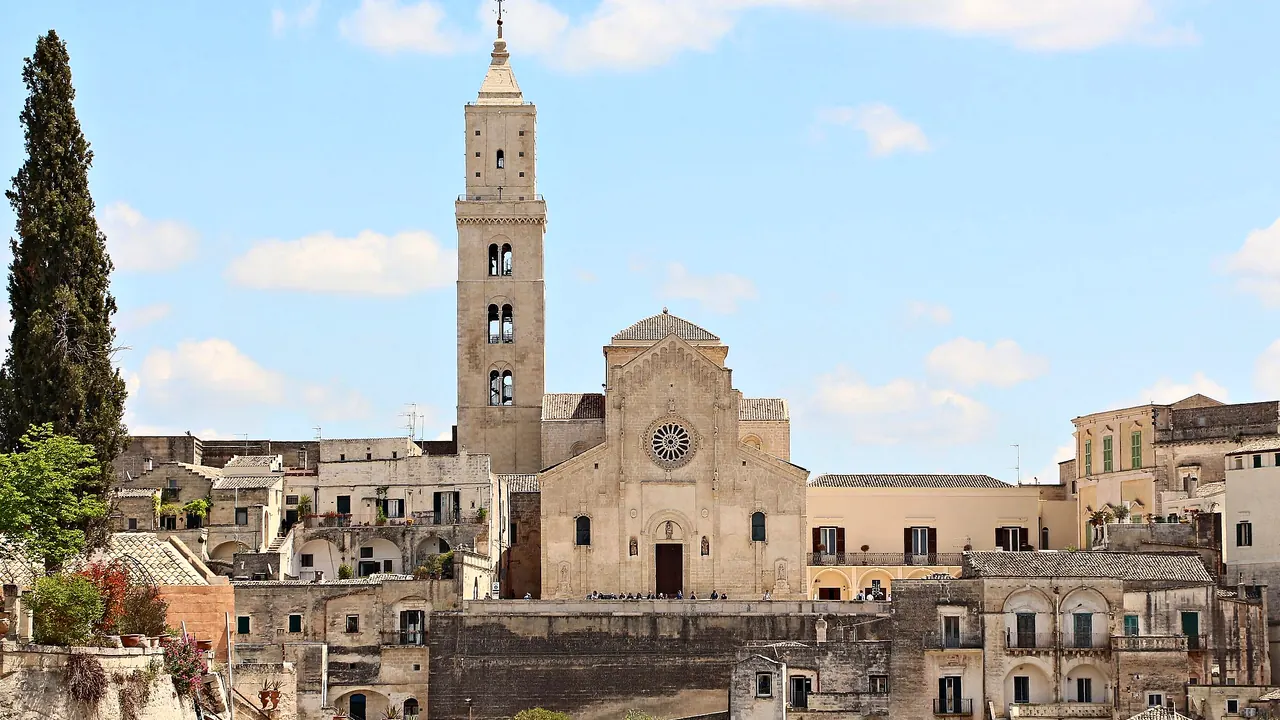
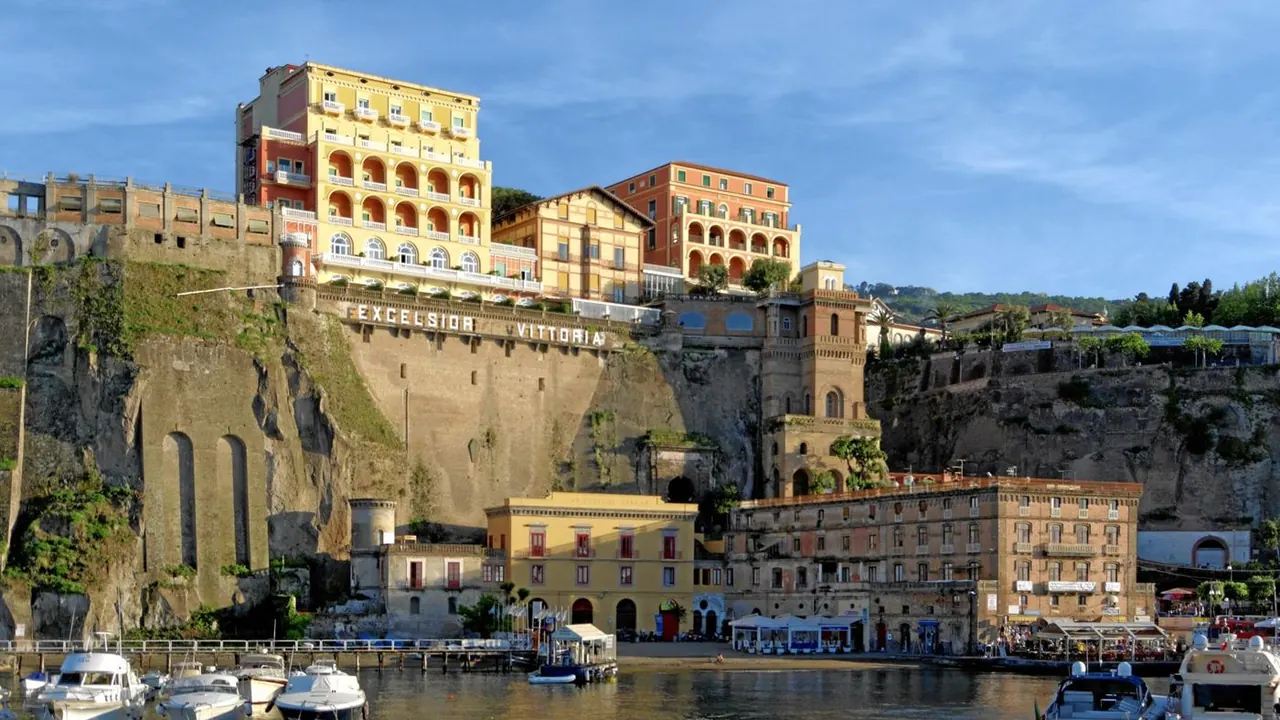
Photos: Matera by Bernard Gagnon, CC BY 4.0, cropped; Sorrento by Berthold Werner, CC BY-SA 3.0, cropped.
Matera or Sorrento?
Our verdict in twelve categories, each scored against the same fixed benchmark cities, and the climate month by month, so you can choose for your trip.
Choose Matera for
- culture and sights
- prices
Matera is for travellers who want one extraordinary place rather than a long list of excursions. The cave districts of the Sassi, the frescoed rock churches and the walk across the gorge to the Murgia make a trip you will not repeat anywhere else. It costs less to eat and sleep, it is very quiet after dinner, and it works best for a couple with a hire car who also want to see the trulli and white towns of Puglia.
Choose Sorrento for
- beaches
- nature and the outdoors
- day trips
Pick Sorrento if you want the sea at the door and the Bay of Naples as your playground. Pompeii, Capri, the Amalfi Coast and Vesuvius are all a train or ferry ride away, the walking on the peninsula is superb, and a swim off the piers fits easily into most days. You will pay more, and you will spend more of your time out of town than in it.
Scoreboard
Twelve categories on one fixed scale from 0 to 100. The shaded stretch is the gap between the two.
Your match
Pick a travel style or drag the sliders, and both match scores follow your weighting.
Wins on culture and sights and prices with your weighting.
Wins on beaches and nature and the outdoors with your weighting.
What matters to you?
Category by category
What the scores mean for a trip.
Beaches & swimming
Matera has no sea of its own. Its beaches are the long, sandy, pine-backed stretches around Metaponto and Policoro, about 45 minutes away by car. The water there is shallow and calm, but without a car most visitors never get there.
Sorrento puts swimming at the foot of the town, though not on sand. You climb down ladders from wooden piers at Marina Piccola and Marina Grande into clear, deep water, or lie on the rocks at the Bagni della Regina Giovanna. Pebble coves on Capri and the Amalfi side are a boat ride away. Expect paid lidos and crowding in high summer.
Food & drink
Matera's table is inland and frugal. It is built around its horn-shaped durum-wheat bread, pulse soups such as crapiata, hand-made cavatelli, lamb and crackling dried peppers, with Aglianico to drink. It is honest cooking, but there is little beyond it, and the best meals are in the upper town rather than in the cave restaurants.
Sorrento has more range, and the sea on the plate. You can eat fish all'acqua pazza at Marina Grande, gnocchi baked with fior di latte, and Naples-style pizza, with lemons running through the desserts. The hill villages of the peninsula add serious fine dining, which Matera cannot match, provided you steer clear of the tourist menus around Piazza Tasso.
Culture & sights
Matera wins easily. The cave districts of Sasso Caveoso and Sasso Barisano, inhabited since prehistoric times, are a sight in their own right. Add rock churches with Byzantine frescoes, the walk-through cistern of the Palombaro Lungo under the main piazza, Carlo Levi's panorama in Palazzo Lanfranchi, and sculpture in carved rooms at MUSMA.
Sorrento's old town is pleasant rather than remarkable. Its highlights are the Roman street grid, the cloister of San Francesco, the Museo Correale and the ruined mill in the Vallone dei Mulini. They fill a gentle day, and the town's great cultural pull is the ancient sites further round the bay.
Nightlife
Neither town is for a big night out, and both evenings follow the same pattern: a passeggiata, dinner and a drink on a terrace. Matera's version ends with wine in a cave bar above the lit Sassi, with no clubs at all.
Sorrento offers a bit more choice. It has pubs, piano bars playing Neapolitan song, and a club or two in summer. For anything livelier you would need to stay overnight in Naples or on Capri, because the last trains and ferries leave early.
Nature & outdoors
Matera's outdoors starts at the edge of town. A path drops into the Gravina gorge and climbs to the Murgia plateau, past abandoned rock churches and Neolithic sites, with kestrels on the cliffs. The Lucanian Dolomites and the Pollino forests are further out, by car.
Sorrento has the more varied landscape, with both mountain and sea. There are the lemon-terraced ridge, the trail to Punta Campanella facing Capri, the protected bay of Ieranto, the Path of the Gods and the crater rim of Vesuvius. You can also take to the water by kayak or small boat, which Matera's dry upland cannot offer.
Day trips
Both make excellent bases, but Sorrento's outings are more famous and easier to reach. Pompeii and Herculaneum are a short train ride away, Capri a quick ferry, and boats run to Positano and Amalfi in summer, with Naples and its archaeological museum within the hour.
Matera's range is wide too. It takes in Altamura and Gravina, the trulli of Alberobello, Ostuni and the Valle d'Itria, Castel del Monte, ghostly Craco and the temple at Metaponto. Almost every one of them depends on having a car.
Good for families
Sorrento is the easier choice with children. The flat, largely pedestrian centre works with a pushchair, and boat trips and the train to Pompeii keep them busy. The catch is that swimming means deep water off piers and rocks, so families with small children often pick a hotel with a pool.
Matera's Sassi are all steep stone steps, so you need a baby carrier rather than a pushchair, and summer afternoons are hot with little shade. Older children love the caves and the cistern, and with a car you can reach the shallow, sandy Ionian beaches, which suit toddlers better than anything in Sorrento.
Getting around
Matera depends on a car in a way Sorrento does not. In the town itself you walk everywhere. The upper town is flat, and steep stairways lead down into the Sassi, which most traffic cannot enter. Beyond the town it is harder. Matera is off the national rail network, the narrow-gauge line to Bari is slow and buses are few, so the beaches, the parks and most outings need a hire car.
In Sorrento a car is more trouble than it is worth, with narrow roads, little parking and restricted zones. The centre is flat and easy on foot, and a lift runs down to the marinas. In summer the Circumvesuviana, the coast buses and the ferries are crowded and sometimes late, but between them they reach almost everywhere you want to go.
Shopping & style
Neither is a shopping destination, but Sorrento has the more distinctive crafts. Workshops there make intarsia boxes and trays, cut leather sandals to measure, and sell linen, coral and cameos alongside endless limoncello, and Capri and Naples are close for fashion.
Matera's souvenirs are smaller and quirkier: the painted cuccù whistle, little tufa models of the Sassi and papier-mâché. Beyond those, the best things to take home are dried peppers, local pasta and a bottle of Aglianico.
Affordability
Matera is the cheaper stay. Meals in the upper town cost noticeably less than in the big cities, guesthouses in the newer town are a short walk from the Sassi, and the gorge walks are free. Only the cave hotels are expensive.
Sorrento sits on one of Italy's most expensive coasts, and in summer sea-view rooms, lido sunbeds and boat trips quickly mount up. Cheap trains and buses help, and so do spring and late autumn, when hotel rates fall.
Live music & performing arts
Both are thin on live performance, and what differs is the kind. Matera's big moment is the Festa della Bruna, with its procession and the tearing apart of the float, plus a summer jazz festival and conservatory concerts against the Sassi. Sorrento offers nightly Neapolitan song and tarantella shows for visitors and chamber music in the cloister of San Francesco, and it has the Teatro di San Carlo in Naples within an hour.
Wellness & relaxation
Sorrento is the better choice for unwinding. Cliff-top hotels have spas and pools over the bay, the old villa gardens set a slow pace, and Ischia's thermal gardens fed by hot springs are a ferry ride away for a day of bathing.
Matera has no spring water of its own. Its draw is cave spas with pools cut into the rock, and the stillness of the Sassi early in the morning and at dusk.
When should you go?
Pick your month. The climate figures are measured averages, not a forecast.
Matera in July
Sorrento in July
Daytime high, °C
Rainfall in the month, mm
Where the figures come from
Matera has no rain gauge within 25 km of the centre, so its rainfall comes from a gridded climate dataset read at the city rather than from a gauge further away.
Sorrento has no rain gauge within 25 km of the centre, so its rainfall comes from a gridded climate dataset read at the city rather than from a gauge further away.
Sorrento's sunshine is measured 54 km from the centre, at Grazzanise.
Temperature and rainfall are climate normals, averaged over the years shown. Matera: 2005-2025, 10 years observed (rainfall 1991-2020) normals, Matera / Martella (4.8 km from centre). Sorrento: 2005-2025 (sunshine 1991-2020, rainfall 1991-2020) normals, Capri (17 km from centre).
Matera has the hotter summers and the harsher extremes. July reaches about 32°C on the bare limestone plateau, which makes the stone stairways of the Sassi hard going in the afternoon, and winters are cool. May, June, September and early October suit walking best. The rain builds through autumn to about 89mm in November. For a beach day on the Ionian coast, June to September is the window, with the sea at about 26°C in August.
Sorrento is milder in winter and a little less fierce in summer, with highs around 30°C, and July and August are long, dry and very sunny. It is much wetter from October to January, though, and November brings about 151mm of rain. From June to early October the sea is warm enough to swim, which makes late spring and September the sweet spot for combining swimming with hiking and sightseeing.
Which traveller are you?
On a culture and arts trip, choose Matera, where the town is the sight. Stay near the Sassi, walk them at dawn and dusk, and visit a cave house furnished as families lived in it until the 1950s. From Sorrento, culture means taking a train out most days.
On a trip on a tight budget, Matera goes further, because the main thing to see is the town, and you see it on foot. Come in spring or autumn, skip the hire car and stay several days. In Sorrento the best of the trip lies across the water, and every ferry adds to the cost.
For a beach and sun trip, choose Sorrento. From Matera, the sandy Ionian shore is a drive away and makes a day out. Sorrento has the sea right below town, with swimming from the piers and boats to the coves of Capri all summer.
Before you go
| Measure | Matera | Sorrento |
|---|---|---|
| Official language | Italian | Italian |
| Currency | Euro (EUR) | Euro (EUR) |
| Sockets | CFL230 V, 50 Hz | CFL230 V, 50 Hz |
| Driving side | Right | Right |
| Time zone | UTC+1, UTC+2 in summer | UTC+1, UTC+2 in summer |
| Emergency number | 112 | 112 |
| Elevation | 401 m | 50 m |
| Main airport | Bari Karol Wojtyła International Airport (BRI)54 km from centre104 non-stop destinations | Naples International Airport (NAP)30 km from centre131 non-stop destinations |
| Public holidays this year | 13 days | 13 days |
By the numbers
| Measure | Matera | Sorrento |
|---|---|---|
| City population | 59,685 | 15,407 |
| People per km² | 152 | 1,541 |
| Museums within 10 km | 8 | 6 |
| UNESCO World Heritage sites within 50 km | 1 | 5 |
| Swim season, months above 21 °C | 5 months | 5 months |
Where else could you go?
Every comparison below shares a destination with this one, so you can follow Matera or Sorrento somewhere new.