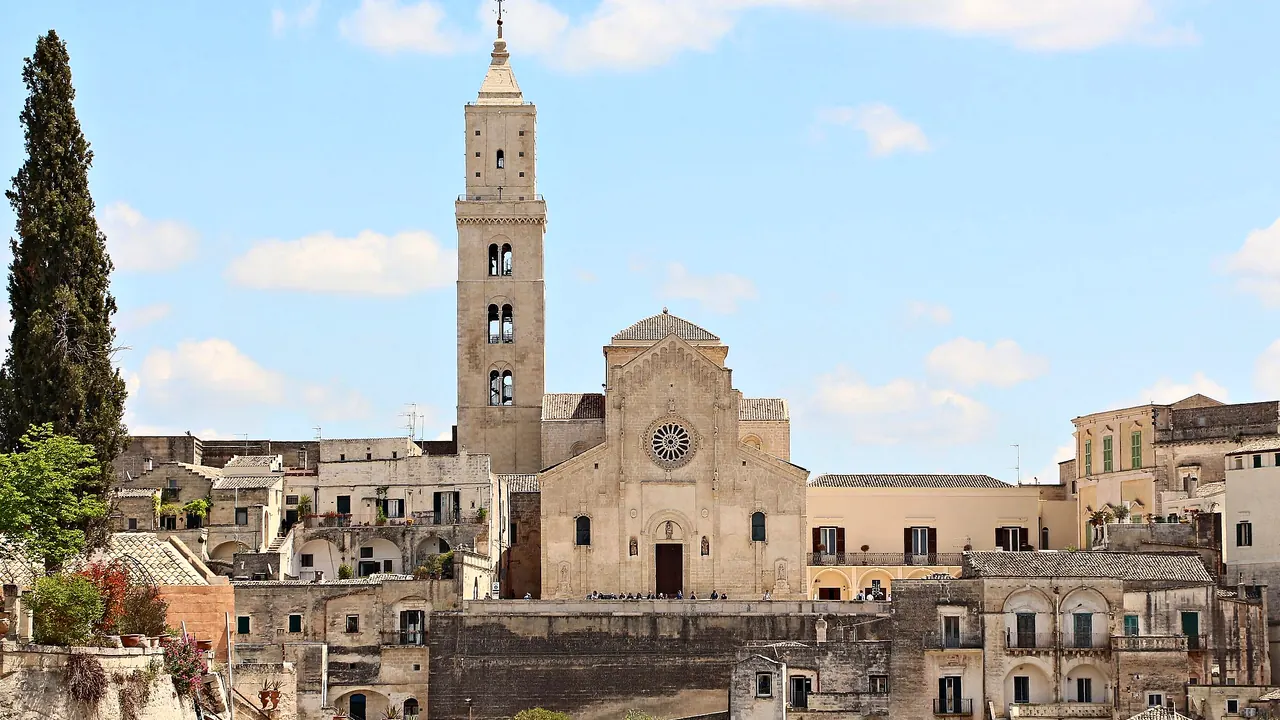
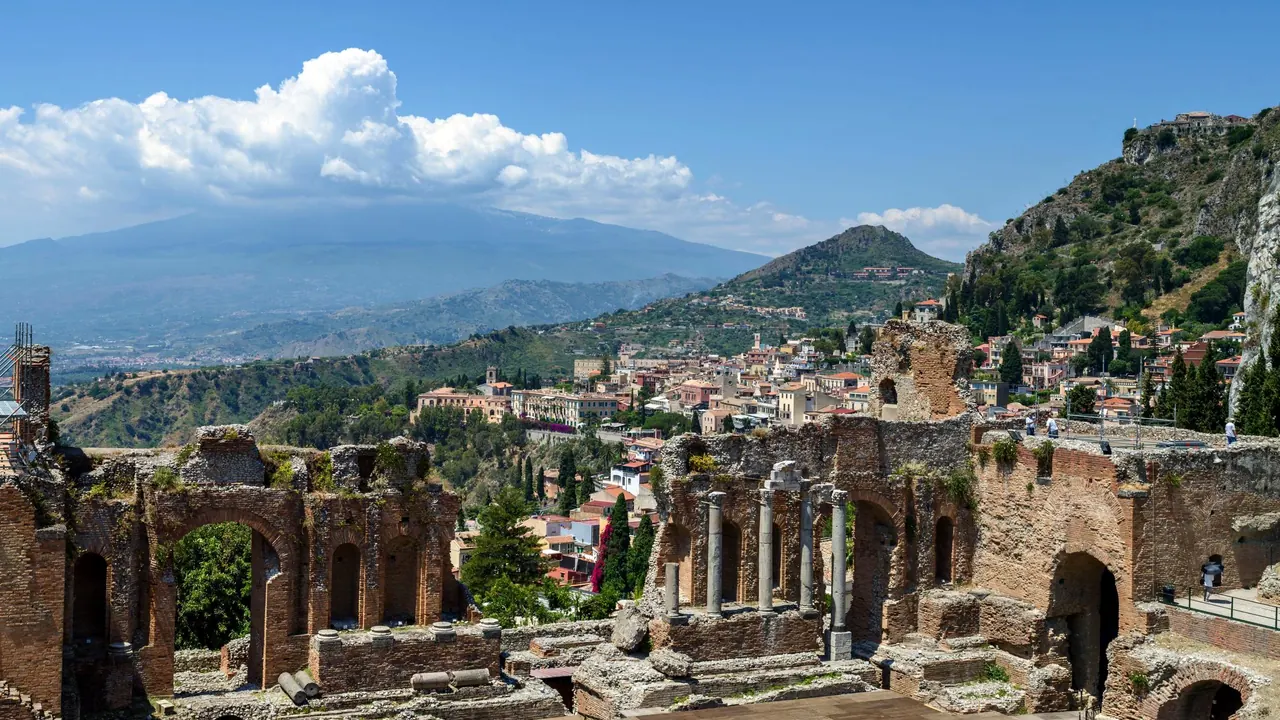
Photos: Matera by Bernard Gagnon, CC BY 4.0, cropped; Taormina by Reinhard Bruckner, Pexels License.
Matera or Taormina?
Our verdict in twelve categories, each scored against the same fixed benchmark cities, and the climate month by month, so you can choose for your trip.
Choose Matera for
- culture and sights
- prices
Matera suits travellers who come to look and to walk. The Sassi, with their cave houses, frescoed rock churches and the gorge of the Murgia opposite, are unlike anything else in Italy, and the town costs noticeably less than the resort towns of the south. It works best as a slower, sight-led trip with a hire car, accepting quiet evenings and a drive to the sea.
Choose Taormina for
- beaches
- nature and the outdoors
- shopping
For a vacation built around the sea and big scenery, Taormina is the better fit. Clear coves sit below the town, Etna is close enough for hiking, and summer concerts fill the Greek theatre, so long warm days are easy to fill. The coastal railway also lets you manage without a car. The trade-off is cost, and a crowded Corso in August.
Scoreboard
Twelve categories on one fixed scale from 0 to 100. The shaded stretch is the gap between the two.
Your match
Pick a travel style or drag the sliders, and both match scores follow your weighting.
Wins on culture and sights and prices with your weighting.
Wins on beaches and nature and the outdoors with your weighting.
What matters to you?
Category by category
What the scores mean for a trip.
Beaches & swimming
Matera has no beach of its own. The Ionian sands at Metaponto and Policoro are wide, pine-backed and shallow, gentler than anything near Taormina, but you need a car and a drive of about three quarters of an hour to get there. Swimming becomes a day out rather than part of the routine.
Taormina has the sea at its feet. A cable car or a steep path takes you down to the clear, rocky water at Mazzarò and Isola Bella, which is good for snorkelling, although the pebble strips are narrow and fill up in high summer. Giardini Naxos and Letojanni have longer stretches a short bus ride away.
Food & drink
Matera cooks like the inland farming town it is, with dishes built on grain, pulses and meat rather than seafood. You get the horn-shaped durum loaf, crapiata, hand-made cavatelli, roast lamb and peperoni cruschi fried until they crackle, with Aglianico del Vulture to drink. The cooking is often better in the upper town around Via Ridola than in the cave restaurants, and with little beyond regional food and no street food or markets, a long stay can start to feel repetitive.
Taormina's Sicilian table has more range. It runs from swordfish, raw red prawns and pasta alla Norma to cannoli from the pastry shops and almond granita with brioche at breakfast, and Etna's Nerello Mascalese reds and Carricante whites are on most lists. The catch is the tourist menus along the Corso, so the better everyday meals are in the side streets and down in Giardini Naxos.
Culture & sights
Matera has far more to see. The Sassi are a whole landscape of cave houses and carved churches, lived in since prehistory, with Byzantine frescoes at Santa Maria de Idris and Santa Lucia alle Malve. In the upper town you can add the walk-through Palombaro Lungo cistern, the Museo Ridola and MUSMA's sculpture in rock rooms. It easily fills two or three days.
Taormina's culture is one superb monument and a handsome street. The Greek theatre, with Etna framed by the stage, is a great sight, and the Duomo and Palazzo Corvaja on the Corso are fine. Still, a day of slow walking covers it, and there is no major museum.
Nightlife
Neither town is for clubbing. Matera's evening is a passeggiata on Via del Corso and a glass of wine in a cave bar above the lit Sassi. Outside summer it is over soon after dinner, and only a small student crowd keeps anything going.
Taormina offers a little more. There is aperitivo in Piazza IX Aprile, piano bars with terraces over the sea, and in summer a few lounge bars and beach clubs near Mazzarò and Giardini Naxos that stay open late, though the crowd is mostly couples.
Nature & outdoors
Matera's outdoors starts at the edge of town. A path drops from Sasso Caveoso into the Gravina gorge and climbs to Murgia Timone, past abandoned rock churches and Neolithic village sites, with kestrels on the cliffs. The Lucanian Dolomites and the Pollino forests are longer drives.
Taormina has the bigger draws. Etna is within an hour, with walks over lava flows and the Silvestri craters, guided trips towards the summit and skiing in winter. The basalt Alcantara gorges, the paths up to Castelmola and the marine reserve at Isola Bella add hiking, kayaking and diving.
Day trips
Both make excellent bases, but the outings are different. From Matera, a car opens up two regions: Altamura and Gravina close by, and the trulli of Alberobello, the white towns of the Valle d'Itria and Castel del Monte within about an hour, plus Basilicata's ghost town of Craco and the peak villages of Castelmezzano and Pietrapertosa.
Taormina's trips lead to Sicily's great baroque and Greek cities: Catania, Syracuse with Ortigia, and Noto with an early start. Several of them can be done by train or coach, which Matera's outings rarely allow.
Good for families
Matera's Sassi are a maze of steep stone stairways where a pushchair is useless, and there is little shade in summer. Older children enjoy the caves and the cistern, but the sandy Ionian beaches, which are ideal for toddlers, need a car.
Taormina copes better, though it was not built for small children either. The cable car, granita, snorkelling at Isola Bella and Etna's craters keep school-age children busy, and families with little ones can stay in Giardini Naxos for flatter streets and sandier beaches.
Getting around
Both centres are explored on foot, and both mean steep stairs. The real difference comes when you leave town. Matera is off the national rail network, the narrow-gauge line to Bari is slow and buses are few, so a hire car is close to essential.
Taormina's station by the sea puts Catania and its airport, Messina and Syracuse within reach by train or coach. A cable car links the town with the beach, and local buses run to Castelmola and Giardini Naxos. Only Etna and the inland villages really need a car or a tour.
Shopping & style
Matera is not a town to shop in. What there is lies scattered among the craft workshops of the Sassi, small handmade souvenirs such as the painted terracotta cuccù whistle, and the purchase most worth the suitcase space is something from the regional larder, a bottle of Aglianico rather than another trinket.
Taormina gives a shopper more to do, and all of it on one street. A slow walk along Corso Umberto takes you past jewellers, coral and cameo dealers and shelves of Sicilian majolica, so browsing simply becomes part of the evening stroll. The stock leans towards visitors, though, and anyone after fashion or department stores has to go to Catania.
Affordability
Matera is much easier on the wallet. Trattorias and guesthouses in the upper town cost well below the big Italian cities, and only the cave hotels in the Sassi carry a premium. Walking the Sassi and the Murgia costs nothing.
Taormina is the priciest place to stay in eastern Sicily. Grand hotels set the tone and the main street charges resort prices. Buses and granita stay cheap, and sleeping in Giardini Naxos or Letojanni brings the bill down.
Live music & performing arts
Matera's calendar is thin: conservatory concerts, a summer jazz festival with some events set against the Sassi, and the Festa della Bruna, when a papier-mâché float is paraded and then torn apart.
In summer Taormina has the more memorable stage. Concerts, opera, ballet and international acts play in the Greek theatre with Etna behind, alongside the long-running film festival. Out of season both towns are quiet, and Taormina's serious opera is in Catania.
Wellness & relaxation
Matera's most unusual way to unwind is underground, in hotel spas set in candlelit cave rooms with pools cut into the rock. Beyond those, the restful part is the town itself: quiet Sassi mornings before the groups arrive, best enjoyed from autumn to spring.
Taormina has more choice, with spas in the large hotels, pools on terraces above the sea and treatments using volcanic mud, citrus and almond. The shady Villa Comunale gardens add to the calm. Time it for May, June or late September, because in August the cruise and day-trip crowds fill the Corso.
When should you go?
Pick your month. The climate figures are measured averages, not a forecast.
Matera in July
Taormina in July
Daytime high, °C
Rainfall in the month, mm
Where the figures come from
Matera has no rain gauge within 25 km of the centre, so its rainfall comes from a gridded climate dataset read at the city rather than from a gauge further away.
Taormina's temperatures are measured 45 km from the centre, at Messina.
Taormina has no rain gauge within 25 km of the centre, so its rainfall comes from a gridded climate dataset read at the city rather than from a gauge further away.
Temperature and rainfall are climate normals, averaged over the years shown. Matera: 2005-2025, 10 years observed (rainfall 1991-2020) normals, Matera / Martella (4.8 km from centre). Taormina: 1991-2020 normals, Messina (45.1 km from centre).
Matera stands on an inland plateau, so its winters are properly cold, with daytime highs around 10°C in January. July and August reach the low thirties on bare stone with little shade, which makes walking the Sassi hard work at midday. The best months for walking are May, early June, September and October, although autumn turns wet, building to about 89mm in November. The Ionian coast within reach is warm enough to swim from June to September.
Taormina is milder all year, around 15°C even in midwinter, so it is the gentler of the two for a winter visit, though October to January is its rainy season. Summers are very dry and sunny, with more than 330 hours of sun in July, and the sea stays swimmable from June to October, peaking at 26°C in August. Late May, June and September give you beach weather without the worst of the heat.
Which traveller are you?
On a beach and sun trip, Taormina is the clear pick. A cable car drops to snorkelling water at Isola Bella and Mazzarò, and sandier beaches are a short bus ride away. From Matera, the Ionian sands are a drive of about three quarters of an hour each way.
For a culture and arts trip, Matera gives you more to see. The Sassi, the frescoed rock churches, the Palombaro Lungo cistern and Carlo Levi's panorama at Palazzo Lanfranchi fill several days. Taormina's sights are mostly its Greek theatre and one short medieval street.
On a tight budget, Matera makes the money go further. Trattorias and guesthouses in the upper town cost far less than anything in Taormina, where the Corso charges resort prices and saving money usually means sleeping down in Giardini Naxos.
Before you go
| Measure | Matera | Taormina |
|---|---|---|
| Official language | Italian | Italian |
| Currency | Euro (EUR) | Euro (EUR) |
| Sockets | CFL230 V, 50 Hz | CFL230 V, 50 Hz |
| Driving side | Right | Right |
| Time zone | UTC+1, UTC+2 in summer | UTC+1, UTC+2 in summer |
| Emergency number | 112 | 112 |
| Elevation | 401 m | 204 m |
| Main airport | Bari Karol Wojtyła International Airport (BRI)54 km from centre104 non-stop destinations | Catania-Fontanarossa Airport (CTA)47 km from centre96 non-stop destinations |
| Public holidays this year | 13 days | 13 days |
By the numbers
| Measure | Matera | Taormina |
|---|---|---|
| City population | 59,685 | 10,471 |
| People per km² | 152 | 799 |
| Museums within 10 km | 8 | 5 |
| UNESCO World Heritage sites within 50 km | 1 | 2 |
| Swim season, months above 21 °C | 5 months | 5 months |
Where else could you go?
Every comparison below shares a destination with this one, so you can follow Matera or Taormina somewhere new.
- Cataniavs Taormina
- Barivs Matera
- Syracuse, Sicilyvs Taormina
- Leccevs Matera
- Salernovs Matera
- Amalfivs Matera