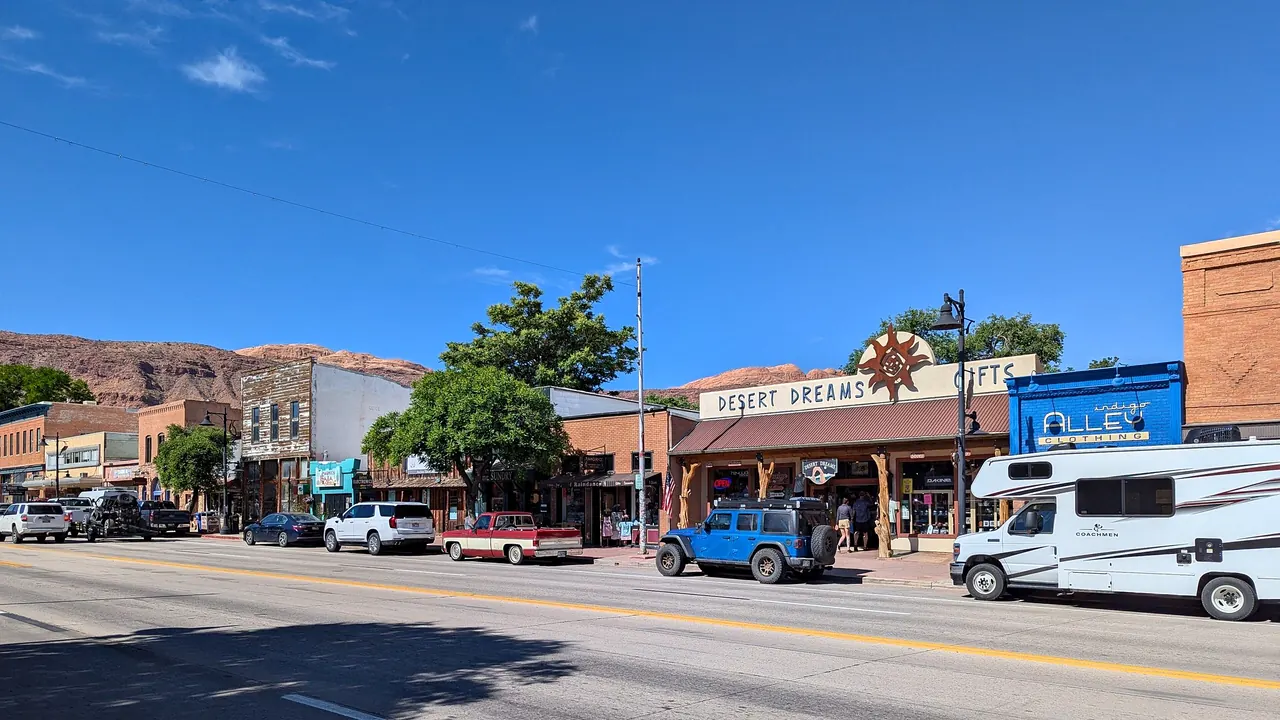
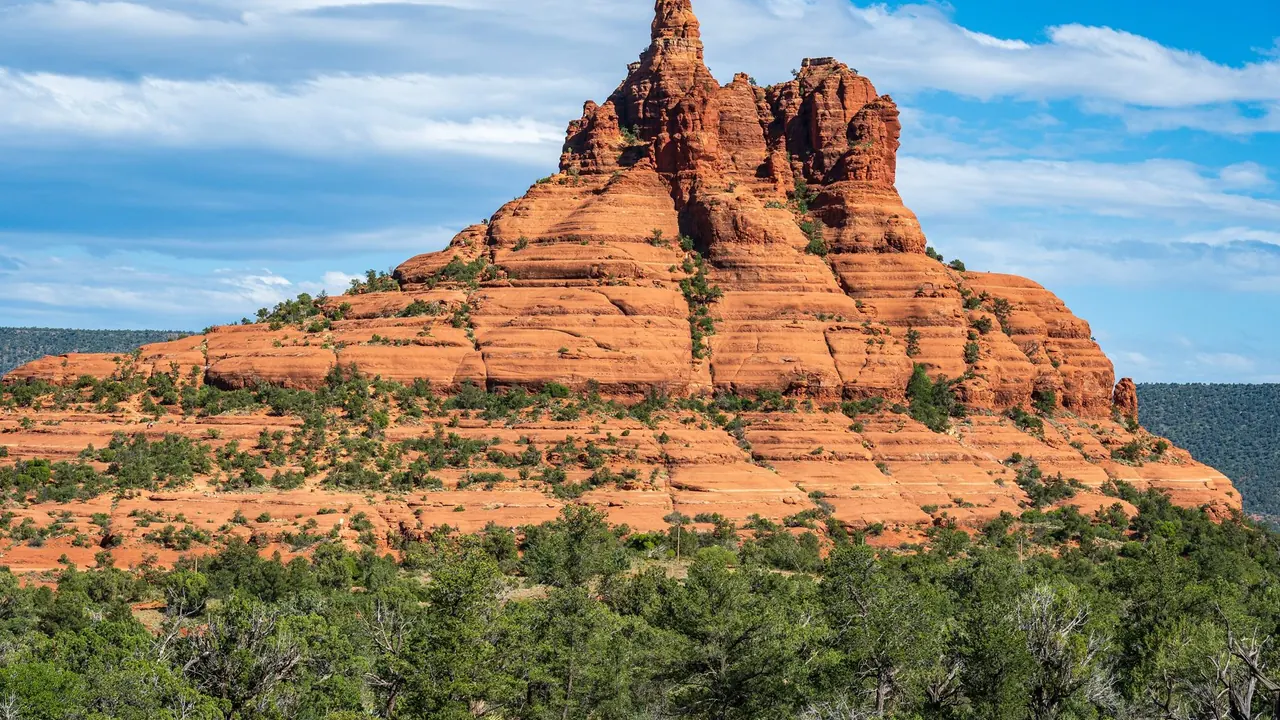
Photos: Moab by G. Edward Johnson, CC BY 4.0, cropped; Sedona by dconvertini, CC BY-SA 2.0, cropped.
Moab or Sedona?
Our verdict in twelve categories, each scored against the same fixed benchmark cities, and the climate month by month, so you can choose for your trip.
Choose Moab for
- prices
- families
- nightlife
Moab is the better pick if you plan your days around trails, rivers and bikes. Arches is on the edge of town and Canyonlands is under an hour away. The Colorado runs past for rafting, and the Slickrock and Whole Enchilada rides draw mountain bikers from all over the world. Beds are cheaper here too, with campgrounds and free dispersed camping close by. In return, the town is plain and evenings are short.
Choose Sedona for
- wellness
- day trips
- shopping
Sedona suits travellers who want red rock scenery with more comfort and variety around it. Its resort spas, yoga studios and sunrise walks to the vortexes make it a place to slow down. The galleries at Tlaquepaque and the Verde Valley outings to Jerome, Montezuma Castle and the wine towns give you plenty to do off the trail. You pay for this: rooms and meals cost noticeably more.
Scoreboard
Twelve categories on one fixed scale from 0 to 100. The shaded stretch is the gap between the two.
Your match
Pick a travel style or drag the sliders, and both match scores follow your weighting.
Wins on prices and families with your weighting.
Wins on wellness and day trips with your weighting.
What matters to you?
Category by category
What the scores mean for a trip.
Beaches & swimming
Neither town has a beach, but Sedona offers better swimming. At Slide Rock you can ride a sandstone chute into cold pools, and Grasshopper Point and Red Rock Crossing have deeper holes below the cliffs.
Moab has Mill Creek's shallow pools, Ken's Lake and sandbars on a fast, silty Colorado that calls for care. For most visitors, cooling off in Moab means the motel pool.
Food & drink
Sedona eats better. It has terraces facing the red rocks, Southwestern menus, plenty of vegetarian and health-focused cooking, and Verde Valley tasting rooms just down the road. The choice still runs out after a handful of good kitchens.
In Moab, food is mainly refuelling: burgers, tacos, pizza and brewery meals on Main Street, served in big portions to people in dusty boots. Utah's alcohol rules also make a glass of wine with dinner a more formal affair than across the border in Arizona.
Culture & sights
Sedona has a little more to see. The Chapel of the Holy Cross, built into a butte in 1956, is worth seeing for the building as well as the view. The town also has a heritage museum, many Western and Native American galleries, and the Sinagua cliff dwellings at Palatki and Honanki a short drive out.
Moab's sights are mostly outside town. Ancestral Puebloan and Fremont petroglyphs line Potash Road and Kane Creek, and dinosaur trackways lie nearby. In town, the small Museum of Moab and a few uranium-boom buildings fill a morning at most.
Nightlife
Both towns go quiet early, and in both the best thing to do after dark is look at the stars. The difference is in the crowd. Moab's brewpubs fill with mountain bikers and rafters trading stories, and on busy weekends one or two stay loud late. Sedona's wine bars and resort lounges in Uptown suit a calm drink after dinner.
Nature & outdoors
Both towns sit among some of the finest red rock country in the American Southwest. Moab gives you more scale and more ways to enjoy it. Arches and the Island in the Sky district of Canyonlands are both close, and you can raft the Colorado, canyoneer, climb, or ride the Whole Enchilada down from the snowy La Sal Mountains.
Sedona's landscape is closer at hand. Trails to Cathedral Rock, Bell Rock and Devil's Bridge start almost in town, the West Fork walk climbs into shady pine forest, and the South Rim of the Grand Canyon is about two hours away.
Day trips
Sedona is much better for day trips. Jerome, the old copper town on its mountainside, is about forty minutes away. Montezuma Castle and Tuzigoot are within half an hour, the Verde Canyon Railroad runs through a roadless canyon, and Flagstaff, Walnut Canyon and the wine towns of the Verde Valley are all within easy reach.
From Moab, most outings are more landscape. The towns nearby are small, Bluff is about two hours south, and the Puebloan sites at Edge of the Cedars and Hovenweep take a full, long day.
Good for families
For families the two are close, and both work best with active, school-age children. Moab has dinosaur tracks, a dinosaur trail park, Junior Ranger programmes and gentle raft floats on the Colorado. Sedona's best family day is Slide Rock, and jeep tours there go down well with most ages.
Sedona's hotels are aimed more at couples and spa guests, so families often add it to a Grand Canyon trip rather than staying long. In both places, summer heat, unfenced drops and long drives make toddlers hard work.
Getting around
Sedona is a little easier without a car. Uptown is walkable, and a shuttle serves some of the busiest trailheads. The town is spread along two highways meeting at the Y, though, and weekend traffic and full trailhead car parks are part of the experience.
Moab's Main Street is easy on foot, and a paved path lets you cycle to the Arches entrance. Beyond that you need a car, and dirt roads into the backcountry often need a high-clearance one.
Shopping & style
Sedona is better for shopping, especially for art. Tlaquepaque's courtyards hold galleries and craft studios, the main road has Native American jewellery, pottery and rugs, and the crystal and metaphysical shops are a Sedona speciality.
Moab's shops are practical: well-stocked bike and climbing stores, rock shops full of geodes and fossils, and a few galleries with Navajo weavings. Neither town has fashion shopping.
Affordability
Neither town is cheap, but Moab is the easier one to keep cheap. Public campgrounds and free dispersed camping lie around the parks, one park pass covers a week, most hikes cost nothing, and winter rooms cost much less.
Sedona is mostly resorts and boutique lodges with high prices, and jeep tours, balloon flights and spa treatments add to the bill. Many visitors keep costs down by staying in Cottonwood or Flagstaff instead.
Live music & performing arts
Both towns have only a few occasions a year rather than a regular season. Moab's highlight is the Moab Music Festival at the end of summer, when some chamber concerts are held in canyon grottoes you reach by boat. Sedona spreads things out more, with the Sedona International Film Festival in late winter, some local theatre and Native American flute players at the resorts.
Wellness & relaxation
This is where the two differ most. Sedona is a well-known retreat town, with destination spas facing the canyons, yoga, meditation and breathwork, and early walks to the vortexes that many visitors come for.
Moab is built for exertion, not rest. A few massage studios look after sore legs, and the calm comes from desert evenings and dark skies. Visitors who want real rest there tend to book a ranch or a cabin in the La Sals.
When should you go?
Pick your month. The climate figures are measured averages, not a forecast.
Moab in July
Sedona in July
Daytime high, °C
Rainfall in the month, mm
Where the figures come from
Moab's temperatures are measured 27 km from the centre, at Moab / Crescent Junction.
Moab's station stands 162 m above the city centre, so the centre is likely a little warmer than the figures say.
Moab has no rain gauge within 25 km of the centre, so its rainfall comes from a gridded climate dataset read at the city rather than from a gauge further away.
Sedona's station stands 153 m above the city centre, so the centre is likely a little warmer than the figures say.
Sedona has no rain gauge within 25 km of the centre, so its rainfall comes from a gridded climate dataset read at the city rather than from a gauge further away.
Temperature and rainfall are climate normals, averaged over the years shown. Moab: 2006-2020 (rainfall 1991-2020) normals, Moab / Crescent Junction (27 km from centre). Sedona: 2009-2025 (rainfall 1991-2020) normals, Sedona / West Sedona (1.3 km from centre).
Both towns are at their best in spring and autumn, roughly April to May and late September to October. Moab has the harsher seasons. Winter highs barely clear freezing, at about 2°C in January, and summer reaches 35°C, which pushes hiking into the early morning. It is dry all year, with no month much over 25mm of rain, so the weather rarely gets in the way of plans.
Sedona has much gentler winters, around 12°C in January, so it makes a far better winter destination for walking. It is also the wetter of the two: winter brings steady rain, and July and August bring summer storms, with August the wettest month at 56mm. Summer heat is about the same in both places. The creek pools and river sandbars are only worth a swim from June to August.
Which traveller are you?
On an outdoors trip, the two are evenly matched, so choose by how you like to spend the day. Moab suits travellers who want long, demanding days on water and wheels and don't mind the driving. Sedona suits walkers who prefer shorter outings and gentler winters.
For a relaxing and wellness trip, Moab is the wrong place: everything there revolves around hard exercise, and rest is limited to quiet evenings. Sedona is built for slowing down. Treatments, classes and unhurried mornings among the red rocks are the reason for the visit there, not something added on.
On a trip on a tight budget, Moab is easier to manage if you arrive with a car and camping gear, cook some of your own meals and hike without a guide. In Sedona, the resort-town costs are hard to avoid, so allow for one paid splurge and plan the rest around free trails.
Before you go
| Measure | Moab | Sedona |
|---|---|---|
| Currency | US Dollar (USD) | US Dollar (USD) |
| Sockets | AB120 V, 60 Hz | AB120 V, 60 Hz |
| Driving side | Right | Right |
| Time zone | UTC-7, UTC-6 in summer | UTC-7 |
| Emergency number | 911 | 911 |
| Elevation | 1,227 m | 1,319 m |
| Main airport | Canyonlands Regional Airport (CNY)27 km from centre2 non-stop destinations | Phoenix Sky Harbor International Airport (PHX)160 km from centre149 non-stop destinations |
| Public holidays this year | 12 days | 12 days |
By the numbers
| Measure | Moab | Sedona |
|---|---|---|
| City population | 5,366 | 9,684 |
| People per km² | 501 | 195 |
| Museums within 10 km | 1 | 0 |
| UNESCO World Heritage sites within 50 km | 0 | 0 |
Where else could you go?
Every comparison below shares a destination with this one, so you can follow Moab or Sedona somewhere new.