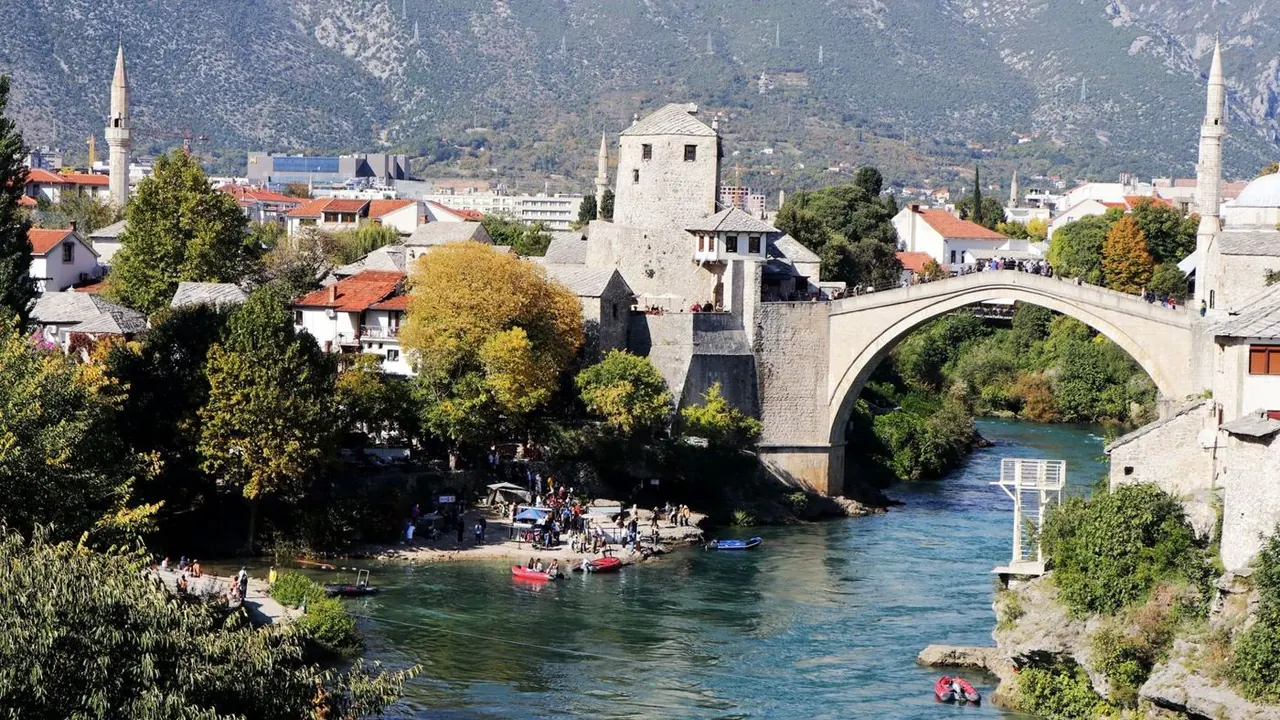
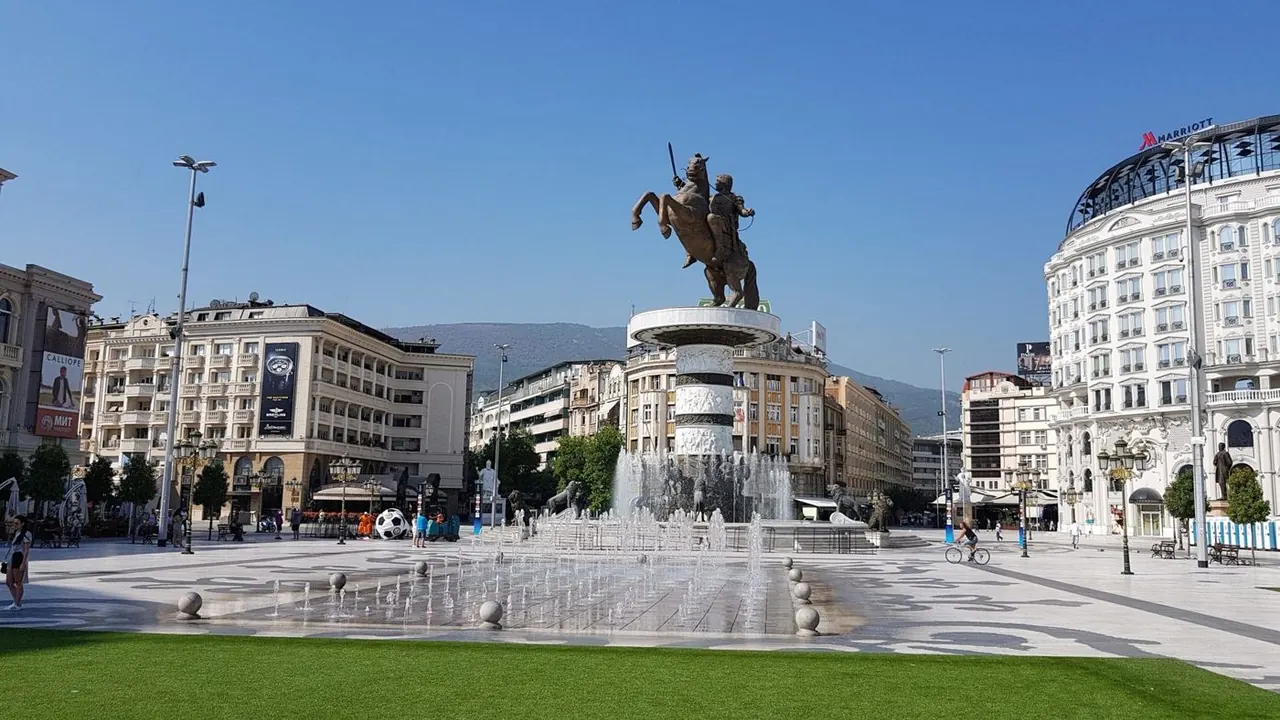
Photos: Mostar by Alan Wang, Pexels License; Skopje by George M. Groutas, CC BY 2.0, cropped.
Mostar or Skopje?
Our verdict in twelve categories, each scored against the same fixed benchmark cities, and the climate month by month, so you can choose for your trip.
Choose Mostar for
- beaches
- day trips
Mostar suits a traveller who wants one striking set piece and a landscape to go with it: the rebuilt Old Bridge, the Ottoman lanes around it, and green water close by, from the Neretva to the pool under the Kravica falls and the Adriatic at Neum a drive away. It is a short, compact stay, best paired with Blagaj, Počitelj and a car to roam the Herzegovina valleys.
Choose Skopje for
- live music and the arts
- nightlife
- food and drink
Skopje is the better pick for anyone who wants a city to live in for a few days rather than just look at. Its evenings are livelier, its taverns in Debar Maalo serve a wider spread of food with live starogradska music, and opera, a philharmonic and an autumn jazz festival give it a cultural calendar Mostar does not have. Mount Vodno and Matka Canyon put serious walking within half an hour.
Scoreboard
Twelve categories on one fixed scale from 0 to 100. The shaded stretch is the gap between the two.
Your match
Pick a travel style or drag the sliders, and both match scores follow your weighting.
Wins on beaches and day trips with your weighting.
Wins on live music and the arts and nightlife with your weighting.
What matters to you?
Category by category
What the scores mean for a trip.
Beaches & swimming
Neither city is a beach destination, but Mostar gets you to water far more easily. The cold Neretva is good for a quick dip from the rocks below the old town, Kravica's falls are about 40km away, and Neum's short stretch of Adriatic coast is a reasonable day out by car.
Skopje has nothing like that. In summer you swim in hotel or public pools, Matka's reservoir is used for kayaking rather than swimming, and Lake Ohrid is so far away that it needs a few nights of its own.
Food & drink
Mostar cooks Bosnian food with an Ottoman accent, and the menu is fairly short. Expect ćevapi in soft somun with raw onion, pies rolled from thin pastry, stuffed peppers and slow-cooked stews. The terraces by the bridge are selling the view more than the cooking, so the better meals are a few streets back. Herzegovina's Žilavka and Blatina are worth ordering, and Bosnian coffee from a copper džezva is a small ritual of its own.
Skopje gives you more to eat and more places to eat it. The day starts at burek bakeries with drinking yoghurt and moves on to Old Bazaar grill houses serving kebapi and pastrmajlija. In the evening the taverns bring out tavče gravče baked in clay, with sheep's cheese and ajvar, and Vranec and Temjanika fill the wine lists. Neither city goes far beyond its own kitchen, but Skopje's runs to more meals before it starts repeating itself.
Culture & sights
The two are broadly level, though they reward different kinds of visit. Mostar is one great image: the high Ottoman arch of Stari Most, rebuilt stone by stone after it was destroyed in the war, with divers leaping from its crown and a small, coherent quarter of bazaar, mosque and old merchant houses around it. The scarred façades along the former front line add a harder layer, and it all fits into a short stay.
Skopje has more to see but holds together less well. On one bank are the Old Bazaar, one of the largest Ottoman quarters left in the Balkans, the Kale Fortress and the carved walnut iconostasis of the Holy Saviour. On the other are the bronze statues and replica façades that went up under the government's monument programme. The museums tied to the 1963 earthquake are reason enough to give the city an extra day.
Nightlife
Skopje is the livelier of the two after dark. On weekends the café-bars around Debar Maalo fill up as coffee gives way to rakija and cocktails, and in summer the courtyards in the Old Bazaar and riverside terraces stay busy past midnight, with some open-air parties near the city park.
Mostar goes quiet once the coach groups leave. An evening there usually means a long dinner with a view of the lit bridge and perhaps a cocktail bar, and only on summer weekends do a few student clubs stay open late.
Nature & outdoors
Skopje has the edge mainly because its mountains are so close. You can walk or take the cable car up Mount Vodno from the suburbs, Matka Canyon's limestone walls, cave and cliff monasteries are half an hour away, and the Šar mountains and Mavrovo add high ridges, beech forest and winter skiing.
Mostar's surroundings are wilder but harder to get into. The bare karst of Velež and Prenj, rafting in the Neretva canyons, the Buna spring at Blagaj and the birdlife of Hutovo Blato are all superb, but most of it takes a car and some effort. Both valleys are too hot for summer walking.
Day trips
The range of day trips is similar, but the places differ. From Mostar they are small and close: the dervish tekke at Blagaj, the walled village of Počitelj, the stećci tombstones at Stolac, and the bridges of Jablanica and Konjic up the Neretva, with Sarajevo a long day by train through the gorge.
Skopje's trips cover more ground and more history: Roman mosaics at Stobi, wineries in Tikveš, the crater town of Kratovo, and Tetovo's painted mosque, plus Prizren and Pristina across the Kosovo border. Buses reach more of Skopje's destinations, while Mostar's mostly need a car or a tour.
Good for families
Neither city does much for children, and both welcome them warmly in restaurants. Mostar's best family outings are physical: watching the bridge divers, climbing the minaret and swimming at Kravica, but the steep, polished cobbles make pushchairs hard work.
Skopje's pavements are flatter, and families stroll the river and City Park in the evenings. A small zoo, a funfair, the Vodno cable car and a boat on Matka fill a couple of days, and busy roads are the main drawback.
Getting around
Both are walking cities with weak public transport, so the difference lies in the ground and in what happens once you leave the centre. Mostar's old town is a short but slippery walk on worn cobbles. Skopje's sights are spread along a flat riverside, and plentiful cheap taxis make Vodno and Matka easy to reach without a car. From Mostar, Blagaj and Kravica realistically mean a hire car or a tour.
Shopping & style
Skopje offers the more rewarding browse. Its Old Bazaar workshops make silver filigree as well as copperware, and next door Bit Pazar is a working market of spices, cheese and peppers, with Ohrid pearls and Macedonian wine to take home.
Mostar's shopping is one street, the Kujundžiluk, where a few coppersmiths still hammer coffee sets by hand among stalls full of imported souvenirs. Neither city has much in the way of fashion or design.
Affordability
Both are among the cheapest places to travel in Europe, so the difference is where you pay extra. In Mostar it is rooms in the old town and terraces facing the bridge in midsummer, and prices fall a few streets away. Skopje stays cheap even in its central hotels in summer, and inexpensive taxis keep the cost of getting around low too.
Live music & performing arts
Here Skopje is clearly the better choice. As a national capital it has opera, ballet, a philharmonic and a national theatre with regular seasons. The Skopje Jazz Festival has been held every autumn since the early 1980s, and on any night the taverns of Debar Maalo have live starogradska and folk music.
Mostar has a national theatre and a youth theatre, both playing mostly in local languages, plus some open-air concerts in summer. For most of the year, live music there means a band in a café bar.
Wellness & relaxation
Neither city has a bathing culture. Their Ottoman hammams are now monuments or galleries rather than working baths. Skopje has one real option, though: the old thermal sanatorium at Katlanovska Banja, about half an hour away, with mineral pools that are more old-fashioned than polished. In Mostar the restful part of a stay is unstructured: early mornings by the bridge before the crowds arrive and long coffees with the sound of the river.
When should you go?
Pick your month. The climate figures are measured averages, not a forecast.
Mostar in July
Skopje in July
Daytime high, °C
Rainfall in the month, mm
Where the figures come from
Skopje has no rain gauge within 25 km of the centre, so its rainfall comes from a gridded climate dataset read at the city rather than from a gauge further away.
Skopje's sunshine is measured 68 km from the centre, at Stip.
Temperature and rainfall are climate normals, averaged over the years shown. Mostar: 1991-2020 normals, Mostar (0.9 km from centre). Skopje: 1991-2020 (sunshine 1961-1990) normals, Skopje-Petrovec (18.3 km from centre).
Both cities sit in hot inland valleys, and both reach about 33°C in July and August, too hot for long afternoons on the streets but right for a swim at Kravica if you are based in Mostar. Late spring and early autumn are the best time for walking in either place. The big difference is rain. Mostar is dry and very sunny in summer, but from September the wet season sets in and builds to nearly 200mm a month in November and December. Skopje stays fairly dry all year.
Winter favours neither city. Mostar is milder, around 9°C in January, but grey and very wet. Skopje is drier but colder, with January highs near 5°C and less sunshine. So in autumn and winter Skopje is the more dependable choice for a city stay, while from May to August Mostar's sunnier days and nearby water give it the edge.
Which traveller are you?
For a beach and sun trip, Mostar is the clear choice. You can swim in the pool under the Kravica waterfalls or drive a little over an hour to the Adriatic at Neum, while Skopje's nearest proper swimming is three hours away at Lake Ohrid.
On a food and nightlife trip, Skopje gives you more. You have long tavern tables and live music in Debar Maalo, grill houses in the Old Bazaar, Tikveš wines, and café-bars full on weekend nights. Mostar's evenings tend to end on a terrace facing the bridge.
For a culture and arts trip, Skopje goes further. Alongside the Old Bazaar and its caravanserais there are seasons of opera, ballet and the Philharmonic, plus a well-known autumn jazz festival. Mostar's bridge and Ottoman houses are memorable but can be seen in a day or two.
Before you go
| Measure | Mostar | Skopje |
|---|---|---|
| Official language | Croatian, Serbian, Bosnian | Albanian, Macedonian |
| Currency | Convertible Mark (BAM) | Denar (MKD) |
| Sockets | CF230 V, 50 Hz | CF230 V, 50 Hz |
| Driving side | Right | Right |
| Time zone | UTC+1, UTC+2 in summer | UTC+1, UTC+2 in summer |
| Emergency number | 112 | 112 |
| Elevation | 60 m | 251 m |
| Main airport | Sarajevo International Airport (SJJ)68 km from centre38 non-stop destinations | Skopje International Airport (SKP)16 km from centre52 non-stop destinations |
| Public holidays this year | 8 days | 12 days |
By the numbers
| Measure | Mostar | Skopje |
|---|---|---|
| City population | 105,448 | 422,540 |
| People per km² | 90 | 739 |
| Museums within 10 km | 3 | 17 |
| UNESCO World Heritage sites within 50 km | 1 | 0 |
Where else could you go?
Every comparison below shares a destination with this one, so you can follow Mostar or Skopje somewhere new.