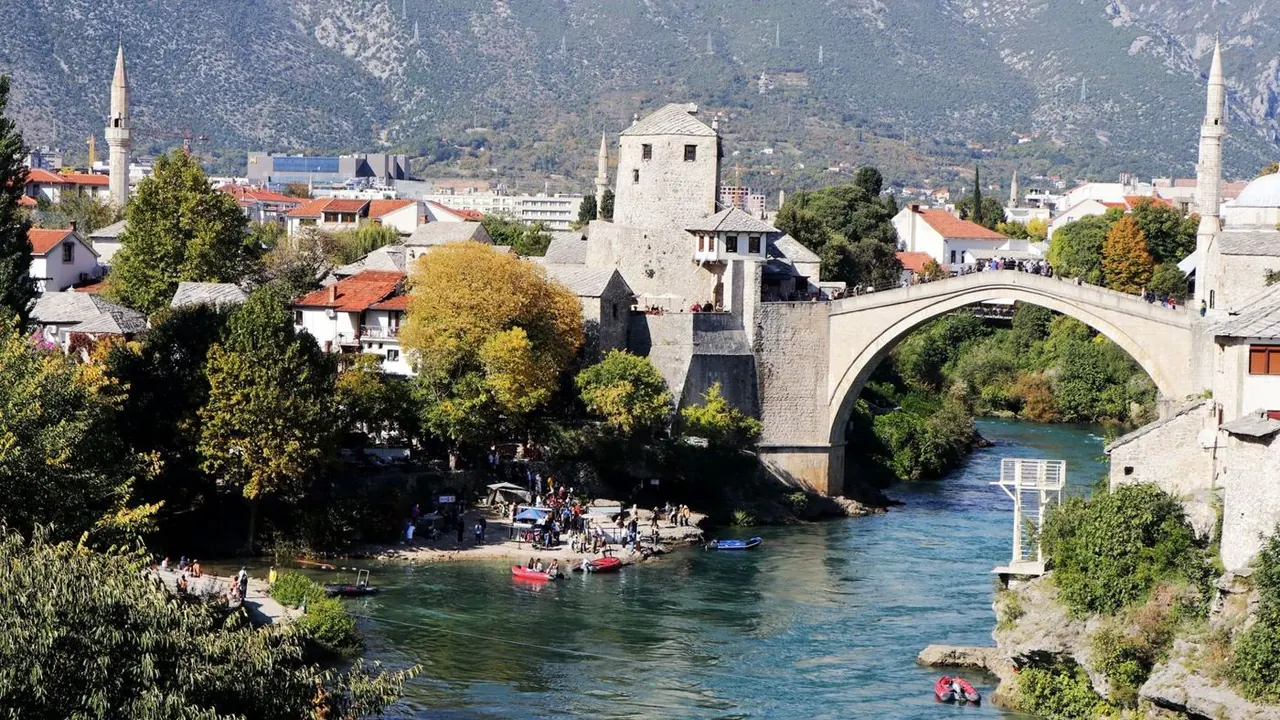
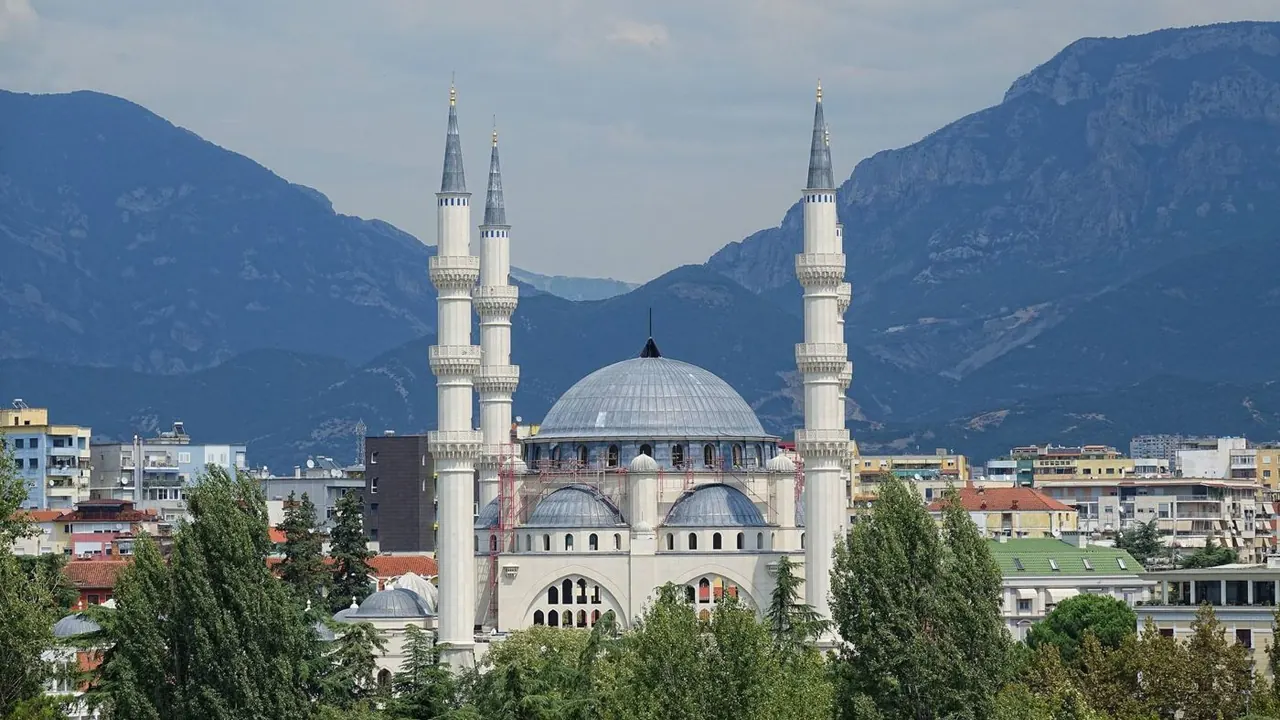
Photos: Mostar by Alan Wang, Pexels License; Tirana by Bjørn Christian Tørrissen, CC BY-SA 4.0, cropped.
Mostar or Tirana?
Our verdict in twelve categories, each scored against the same fixed benchmark cities, and the climate month by month, so you can choose for your trip.
Choose Mostar for
- culture and sights
- nature and the outdoors
- prices
For a traveller who wants one remarkable place seen properly, Mostar is the one to pick. The Ottoman bridge over the green Neretva, the bazaar lane, the carpeted old houses and the war-marked streets beyond it sit close together, with Blagaj, Počitelj and Kravica in the Herzegovina countryside around. It is a quiet, slow stop, best for a couple of days of sightseeing and walks rather than evenings out, and it fits well into a longer route through the Balkans.
Choose Tirana for
- nightlife
- beaches
- food and drink
Tirana is the better choice if you want more life after dark and more variety at the table. Blloku's bars stay full late into the night, the farm restaurants on the hills around the city are a highlight of eating there, and Durrës puts a sandy beach within reach. Kruja and Berat supply the older heritage the capital itself lacks, so it works as a base for exploring rather than a single sight to admire.
Scoreboard
Twelve categories on one fixed scale from 0 to 100. The shaded stretch is the gap between the two.
Your match
Pick a travel style or drag the sliders, and both match scores follow your weighting.
Wins on culture and sights and nature and the outdoors with your weighting.
Wins on nightlife and beaches with your weighting.
What matters to you?
Category by category
What the scores mean for a trip.
Beaches & swimming
Neither city is a beach destination, but Tirana gets you to the sea more easily. Durrës is under an hour away, with a long stretch of sand and warm, shallow water that suits children, although it is crowded on summer weekends and not always clear near the port.
Mostar's swimming is fresh water: a cold dip in the Neretva or the pool beneath the Kravica waterfalls. The Adriatic at Neum is more than an hour's drive, so the sea is a day trip, not part of the routine.
Food & drink
Tirana offers more to eat. Albanian farm cooking such as tavë kosi and fërgesë, morning byrek from the bakeries, and the farm restaurants in the hills around the city make meals a real part of a visit, and Blloku and the Pazari i Ri streets give plenty of choice.
Mostar's cooking is narrower but satisfying: ćevapi in somun bread, burek and slow-cooked stews. Its strengths are the local Žilavka and Blatina wines and the ritual of Bosnian coffee. Skip the riverside terraces by the bridge and eat a few lanes back.
Culture & sights
Mostar has the stronger sights, and they are older. The sixteenth-century bridge, rebuilt after 1993 and still used by divers, sits inside a UNESCO old town with a bazaar street, a mosque minaret you can climb and carpeted Ottoman houses.
Tirana's story is mostly the twentieth century. Bunk'Art and the House of Leaves are gripping visits into the communist past, and the Et'hem Bey Mosque and the History Museum frame Skanderbeg Square, but the historic fabric is thin. Both cities take a day or two to see.
Nightlife
This is where the two differ most. Tirana has a real scene in Blloku, where the former leadership quarter is now packed with cocktail bars and terrace lounges, with a young local crowd that dresses up and stays out late, and larger clubs near the Grand Park lake.
Mostar's evenings are dinner and a drink in sight of the floodlit bridge, with a few bars and student clubs busier at summer weekends. It is pleasant, but there is little to go out for.
Nature & outdoors
Both are good for the outdoors, but in different ways. Mostar sits in a hot, bare karst basin under the wild Prenj and Velež ranges, with rafting in the Neretva canyons, the Buna spring at Blagaj and the Hutovo Blato wetland for birdwatching.
Tirana's countryside is greener and easier to reach. A cable car lifts you from the edge of the city into the beech and pine forest of Mount Dajti, and the turquoise Bovilla reservoir is within an hour. Spring and autumn suit walking in both.
Day trips
There is plenty to see beyond both cities, but the trips are of a different kind. From Tirana you visit proper historic towns: Skanderbeg's castle at Kruja, Roman Durrës, and Berat with its white Ottoman houses, along with Shkodra and Apollonia, about two hours away.
Mostar's trips are smaller and close together: the dervish tekke at Blagaj, the walled hillside village of Počitelj, Stolac's medieval tombstones, and the bridges and bunker at Jablanica and Konjic. Sarajevo, reached by a scenic train through the gorge, makes the one big outing. In both places a car or a tour makes things easier.
Good for families
Neither city is built around children, but Tirana makes things a little easier. The Grand Park with its playgrounds, the Dajti cable car, the open space of Skanderbeg Square and a sandy beach within an hour give more to fill the days.
Mostar has a couple of memorable afternoons, watching the bridge divers and swimming at Kravica. Its steep, slippery stone lanes are hard work with a pushchair, though Tirana's traffic and broken pavements are tiring too. Both are warm towards children at the table.
Getting around
Tirana is the easier city to get around. Its flat centre puts the square, Blloku, the Pyramid and the market within a short walk, with pedestrianised streets around the square, and cheap taxis cover Bunk'Art and the cable car. Wide roads and pushy drivers call for care when crossing.
Mostar's sights fit into one short riverside stroll, but on cobbles polished smooth, so good shoes matter. Away from the centre the buses are of little use to visitors, so Blagaj or Kravica means a taxi, car or tour.
Shopping & style
Both are equally modest for shopping, and what they offer is different. Mostar has a single crafts street, the Kujundžiluk, where a few coppersmiths still hammer coffee sets among stalls of imported souvenirs.
Tirana's best stop is the food market at Pazari i Ri, with cheese, honey, olives and raki to take home. Its fashion shopping is limited to chain stores in the malls and boutiques in Blloku.
Affordability
Both are among the cheapest trips in Europe, and the difference is in what pushes the bill up. In Mostar it is rooms in the old town and terraces with a view of the bridge in midsummer. In Tirana it is the smarter restaurants and cocktail bars of Blloku, while transport and museum entry cost very little.
Live music & performing arts
Tirana gives a visitor more to see on stage. The National Theatre of Opera and Ballet on Skanderbeg Square has opera, ballet and concerts through the season, there are a few jazz bars, and you may be lucky enough to hear Albanian iso-polyphonic singing at a festival.
Mostar's theatres perform mostly in local languages, so apart from summer open-air concerts there is little for visitors beyond the occasional café band.
Wellness & relaxation
Neither city has a working bathing tradition, and Mostar offers the least for a restful stay. It has no bath you can use and only a few hotels offer treatments, so rest there is something you arrange yourself: a slow coffee in the shade, an early walk by the Neretva before the valley heats up, or a lazy afternoon at the pool beneath Kravica.
Tirana gives you a little more. Llixha, about an hour away, has hot sulphur springs for a plain, traditional soak, and the Dajti cable car takes you up into cool forest above the city. Back in town, terrace coffee and the evening xhiro make for an easy daily pace.
When should you go?
Pick your month. The climate figures are measured averages, not a forecast.
Mostar in July
Tirana in July
Daytime high, °C
Rainfall in the month, mm
Temperature and rainfall are climate normals, averaged over the years shown. Mostar: 1991-2020 normals, Mostar (0.9 km from centre). Tirana: 1961-1990 normals, Tirana (3 km from centre).
Mostar is at its best in May and June, when the days are warm and sunny and the rain eases off, which suits both the old town and the hills. July and August are the driest months but very hot in the enclosed valley, often 33°C, so walking at midday is hard. September is still warm and sunny, but the autumn rain arrives with it, about 143mm, and from then until December the city is wet. November and December are the wettest and coldest months of all.
Tirana's good season lasts longer. Late spring and early summer suit it just as well, and its September is much drier, about 78mm, with plenty of sunshine that carries into October, so walking and day trips work well into the autumn. Its summer is a little less extreme and its winters are milder, though still rainy. For swimming, the Adriatic at Durrës is warm enough from June to September and reaches about 25°C in August.
Which traveller are you?
On a food and nightlife trip, Tirana is the clear choice. Its menu is broader, from tavë kosi to farm meals on the hills, and Blloku's terraces and clubs keep going after midnight, while Mostar's old town goes quiet once the day visitors leave.
For a culture and arts trip built around historic sights, Mostar gives more. Stari Most, the Kujundžiluk, the Ottoman houses and the old front line make a richer set than Tirana's communist-era bunkers, though Tirana has the better opera and ballet stage.
On a beach and sun trip, Tirana is the more practical base. Durrës has a long sandy beach and warm, shallow sea under an hour away. From Mostar the coast at Neum is a longer drive, so swimming means the Kravica falls.
Before you go
| Measure | Mostar | Tirana |
|---|---|---|
| Official language | Croatian, Serbian, Bosnian | Albanian |
| Currency | Convertible Mark (BAM) | Lek (ALL) |
| Sockets | CF230 V, 50 Hz | CF220 V, 50 Hz |
| Driving side | Right | Right |
| Time zone | UTC+1, UTC+2 in summer | UTC+1, UTC+2 in summer |
| Emergency number | 112 | 112 |
| Elevation | 60 m | 110 m |
| Main airport | Sarajevo International Airport (SJJ)68 km from centre38 non-stop destinations | Tirana International Airport Mother Teresa (TIA)13 km from centre121 non-stop destinations |
| Public holidays this year | 8 days | 14 days |
By the numbers
| Measure | Mostar | Tirana |
|---|---|---|
| City population | 105,448 | 389,323 |
| People per km² | 90 | 9,314 |
| Museums within 10 km | 3 | 11 |
| UNESCO World Heritage sites within 50 km | 1 | 0 |
| Swim season, months above 21 °C | - | 5 months |
Where else could you go?
Every comparison below shares a destination with this one, so you can follow Mostar or Tirana somewhere new.