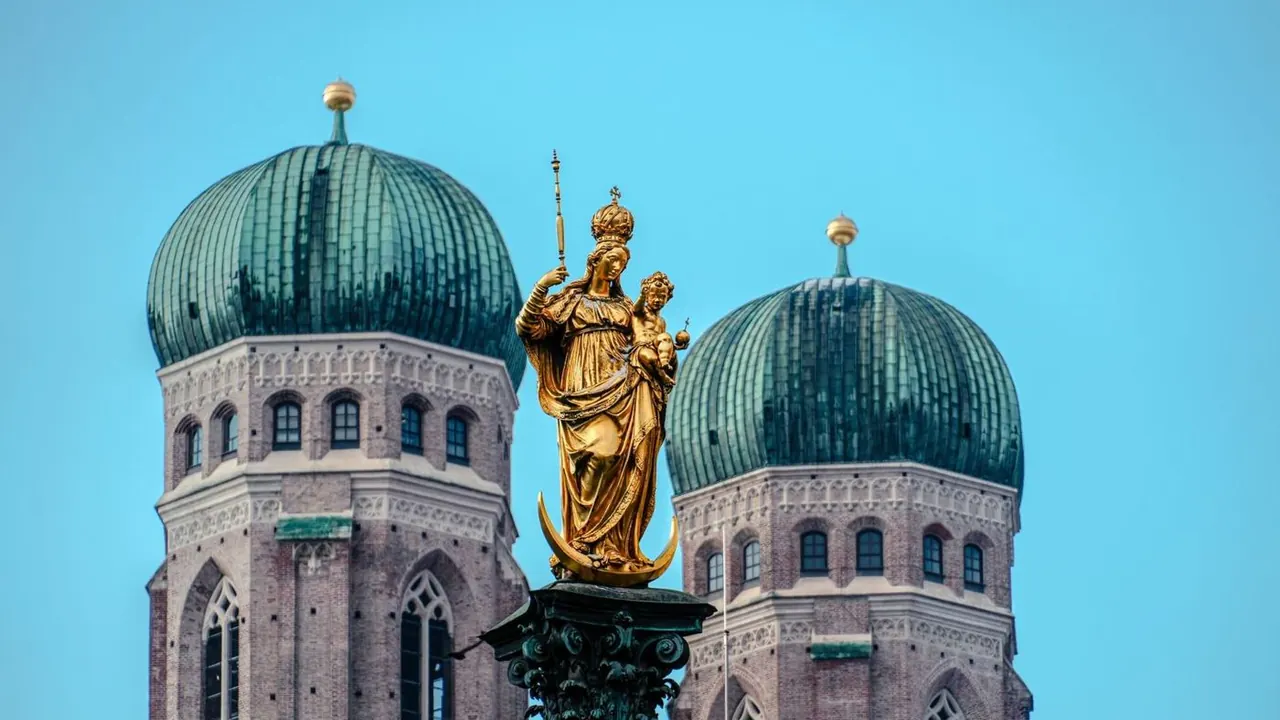
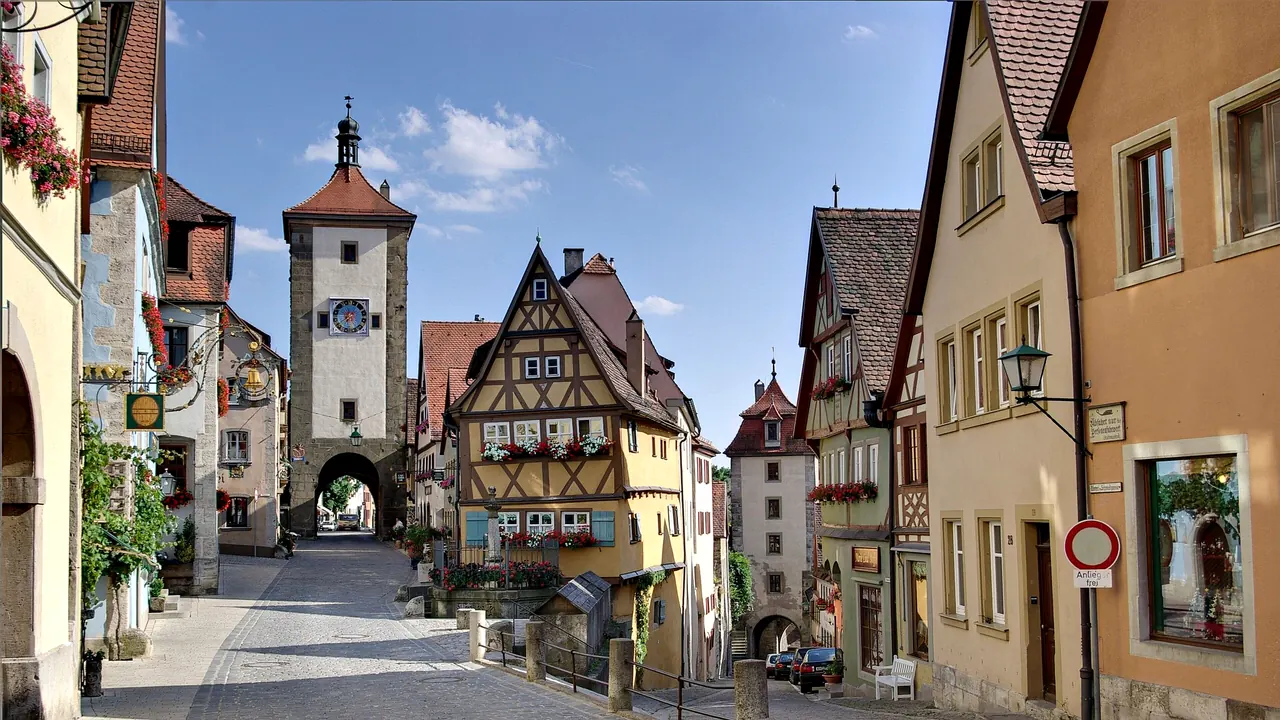
Photos: Munich by 0xd1ma, Pexels License; Rothenburg ob der Tauber by Berthold Werner, Public domain.
Munich or Rothenburg ob der Tauber?
Our verdict in twelve categories, each scored against the same fixed benchmark cities, and the climate month by month, so you can choose for your trip.
Choose Munich for
- live music and the arts
- nightlife
- nature and the outdoors
Munich suits travellers who want a full city with as much to do at night as by day. It has opera and orchestras of world standing, the Pinakotheks and the Residenz, beer gardens and a proper bar scene, and the Alps and lakes within easy reach by train. It is also the easier choice with children or without a car, because one transport network reaches almost everything, including most day trips.
Choose Rothenburg ob der Tauber for
- prices
Rothenburg is for someone who wants to wander a single intact medieval town, ideally for a night or two as one stop on a Romantic Road drive. The walls, the gate towers and Riemenschneider's altar are the whole point, and the evenings are quiet by nature. It also costs somewhat less than Munich, especially if you sleep outside the walls.
Scoreboard
Twelve categories on one fixed scale from 0 to 100. The shaded stretch is the gap between the two.
Your match
Pick a travel style or drag the sliders, and both match scores follow your weighting.
Wins on live music and the arts and nightlife with your weighting.
Wins on prices with your weighting.
What matters to you?
Category by category
What the scores mean for a trip.
Beaches & swimming
Neither city has a coast, but Munich at least makes a good summer swimming day. Locals sunbathe on the gravel banks of the Isar at the Flaucher, and the clear, fresh alpine water of the Starnberger See and the Ammersee is under an hour away by S-Bahn. In Rothenburg, swimming means the town's outdoor pool or a drive of about an hour to artificial lakes such as the Altmühlsee.
Food & drink
Munich eats far better. Besides the beer halls and the beer gardens, where by custom you can bring your own picnic, it has the Viktualienmarkt, a serious coffee-and-cake habit, starred restaurants and good Italian, Turkish and Balkan cooking.
Rothenburg's food is Franconian and the choice is narrow: Schäufele, bratwurst and Silvaner in the squat Bocksbeutel bottle, plus the sugary Schneeball pastry. Many places around the Marktplatz cook for coach parties. The better meals are in family-run guesthouses and wine taverns away from the square.
Culture & sights
Munich has far more to see, and it can fill several days. There are the old masters of the Alte Pinakothek and the rest of the Kunstareal, the Residenz and Nymphenburg, and the huge Deutsches Museum. Its old town is handsome, though much of it was rebuilt after the war.
In Rothenburg the town itself is the sight: a walled medieval whole seen from the wall walk, the Plönlein and the Rathaus tower. Its treasures are few but fine, above all Riemenschneider's Holy Blood Altar and the Medieval Crime Museum, and a day covers them well.
Nightlife
Munich offers a real night out. It runs from beer halls to the cocktail and gay bars of the Glockenbachviertel and a few techno clubs that stay open until morning at weekends, though many neighbourhoods are quiet on weeknights. In late September the Oktoberfest takes over the city for just over two weeks.
Rothenburg has almost no nightlife. Once the day visitors leave, evenings mean wine taverns, inn dining rooms and the night watchman's walking tour, and the lanes are silent by eleven.
Nature & outdoors
Munich has the Alps on its doorstep. Within about an hour or two you can be hiking or skiing around Garmisch and the Zugspitze, or cycling and sailing in the Five Lakes region. In town there is the English Garden, with surfers on the Eisbach, and cycle paths that follow the Isar south.
Rothenburg's countryside is gentle and small in scale. Paths drop from the walls into the Tauber valley, past mills and orchards, and the Tauber valley cycle path runs downstream through vineyards. There are no mountains or large lakes nearby.
Day trips
Both towns make good bases for day trips, but Munich reaches further and is easier to travel from. Augsburg, Nuremberg, Regensburg, Salzburg and Innsbruck are all within reach by train, and so are Neuschwanstein and Herrenchiemsee.
Rothenburg has the Romantic Road on its doorstep. Dinkelsbühl, Nördlingen inside its meteorite crater and Würzburg's Residenz are all within about an hour, but the train journeys are awkward, so you will want a car.
Good for families
Munich is much easier with children over several days. It has the Hellabrunn zoo along the Isar, the hands-on sections of the Deutsches Museum, the transport museum, beer gardens with playgrounds, and lake beaches in summer.
Children love Rothenburg's ramparts and the night watchman with his lantern, and older ones are gripped by the Medieval Crime Museum. Beyond that there is little made for them, and the cobbles are hard work with a pushchair.
Getting around
Both centres are easy on foot, but Munich also has an integrated U-Bahn, S-Bahn and tram network that reaches the museums, the lakes and the airport. Most day trips also run on regional trains, so you need no car at all.
You can cross Rothenburg's walled town in fifteen minutes, though the cobbles and the steep climb back from the valley take some effort. Beyond the walls, travel is harder: the branch line needs a change at Steinach and buses are sparse, so a car is the practical choice.
Shopping & style
Munich has proper shopping. There are the luxury houses on Maximilianstrasse, department stores along Kaufingerstrasse, the long-established Dallmayr delicatessen, Tracht tailors and independent boutiques in Glockenbach and Schwabing.
Rothenburg sells mainly Christmas, all year round: glass baubles, nutcrackers and Erzgebirge carvings, alongside teddy bears and cuckoo clocks. Its Christmas market on the Marktplatz is one of Germany's most atmospheric, but there is almost no fashion or everyday shopping.
Affordability
Rothenburg is the cheaper stay, and in both places the room is most of the bill. Munich has no truly cheap season: hotels are dear all year and very dear while the Oktoberfest or a big trade fair is on, so your dates matter as much as your choice of hotel. Restaurants charge what you would pay in any Western European capital, but beer-hall cooking is fair value, the English Garden and the lakes cost nothing, and several museums charge only a token fee on Sundays.
Rothenburg's premium is narrower, though it never goes away. The old guesthouses inside the walls and the tables around the Marktplatz always cost more than in an ordinary Franconian town, and most of all in December and on summer weekends. A midweek stay away from those peaks is cheaper, but the real saving comes from sleeping outside the gates or in a nearby village and walking in.
Live music & performing arts
This is the widest gap between the two. Munich is one of Europe's great music cities. The Bavarian State Opera plays in the National Theatre, three orchestras of real standing perform in halls such as the Herkulessaal, the Cuvilliés Theatre stages chamber opera and the Gärtnerplatztheater puts on operetta.
In Rothenburg, performance means history. Each year the Meistertrunk festival play is staged in costume, and there is summer open-air theatre and organ and choral music in St Jakob's. On most evenings there is no show to go to.
Wellness & relaxation
Munich has a bathing culture of its own. There is the Art Nouveau Müller'sches Volksbad with its Roman-style steam bath, there are textile-free public saunas with infusion rituals, and one of Europe's largest thermal bath complexes is at Erding, about forty minutes away.
Rothenburg's calm comes from its emptied lanes early in the morning and after the coach groups leave. For thermal bathing you need to drive about an hour to Bad Windsheim or Bad Mergentheim.
When should you go?
Pick your month. The climate figures are measured averages, not a forecast.
Munich in July
Rothenburg ob der Tauber in July
Daytime high, °C
Rainfall in the month, mm
Where the figures come from
Rothenburg ob der Tauber's sunshine is measured 27 km from the centre, at Feuchtwangen-heilbronn.
Temperature and rainfall are climate normals, averaged over the years shown. Munich: 1991-2020 normals, München (1.9 km from centre). Rothenburg ob der Tauber: 1991-2020 normals, Rothenburg ob der Tauber (0.9 km from centre).
The two share almost the same temperatures through the year. Summer highs reach about 25°C in July and August, winters are cold, and both are at their most comfortable for walking in May, June and September. Where they differ is rain. In Munich summer is the wettest season, with well over 100mm a month from May to August. Rothenburg stays fairly even all year at around 60mm, so its summer sightseeing is less often interrupted.
For swimming, Munich's lakes are worth it only from June to August. Rothenburg is at its best from late spring to early autumn, and September is a good month with highs near 20°C. In winter, Rothenburg is the gloomier of the two, with only about 41 hours of sunshine in December. Munich gets noticeably more sun in that month, though both are grey and cold.
Which traveller are you?
For a food and nightlife trip, Munich is the clear pick. Its beer halls and chestnut-shaded beer gardens, the Viktualienmarkt and its starred restaurants offer far more range, and Glockenbach's cocktail and gay bars carry on after Rothenburg's lanes have gone silent.
On an outdoors trip, Munich wins easily. Trains reach the Wetterstein, Tegernsee and the Five Lakes for alpine hiking, skiing, sailing and cycling. Rothenburg offers gentle walks in the Tauber valley and a well-known family cycle path, but there are no mountains anywhere near it.
On a trip with a tight budget, Rothenburg is easier on the wallet. Beer and wine in its inns are fairly priced, the sights charge modest fees, and sleeping in a nearby village saves more. In Munich, hotel rooms stay expensive all year.
Before you go
| Measure | Munich | Rothenburg ob der Tauber |
|---|---|---|
| Official language | German | German |
| Currency | Euro (EUR) | Euro (EUR) |
| Sockets | CF230 V, 50 Hz | CF230 V, 50 Hz |
| Driving side | Right | Right |
| Time zone | UTC+1, UTC+2 in summer | UTC+1, UTC+2 in summer |
| Emergency number | 112 | 112 |
| Elevation | 519 m | 430 m |
| Main airport | Munich Airport (MUC)29 km from centre211 non-stop destinations | Nuremberg Airport (NUE)66 km from centre56 non-stop destinations |
| Public holidays this year | 12 days | 12 days |
By the numbers
| Measure | Munich | Rothenburg ob der Tauber |
|---|---|---|
| City population | 1,505,036 | 11,331 |
| People per km² | 4,844 | 272 |
| Museums within 10 km | 75 | 6 |
| UNESCO World Heritage sites within 50 km | 1 | 2 |
Where else could you go?
Every comparison below shares a destination with this one, so you can follow Munich or Rothenburg ob der Tauber somewhere new.
- Nurembergvs Rothenburg ob der Tauber
- Bambergvs Rothenburg ob der Tauber
- Innsbruckvs Munich
- Stuttgartvs Rothenburg ob der Tauber
- Heidelbergvs Rothenburg ob der Tauber
- Salzburgvs Munich