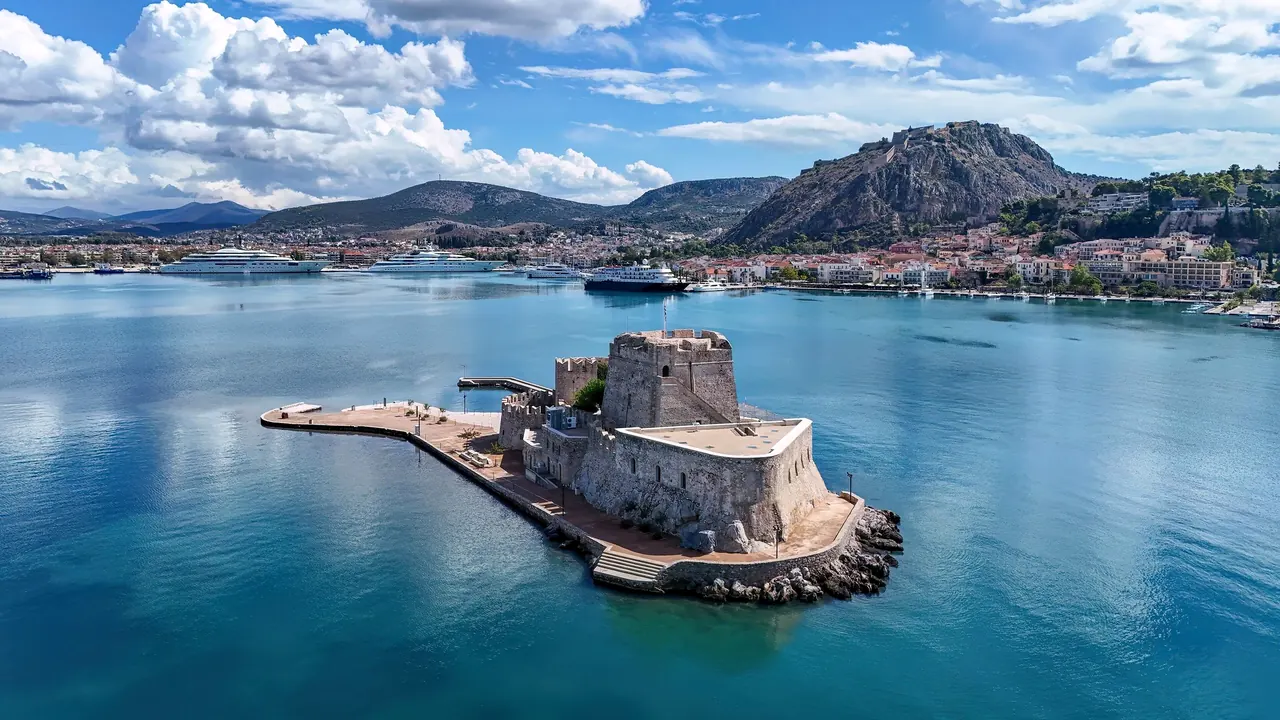
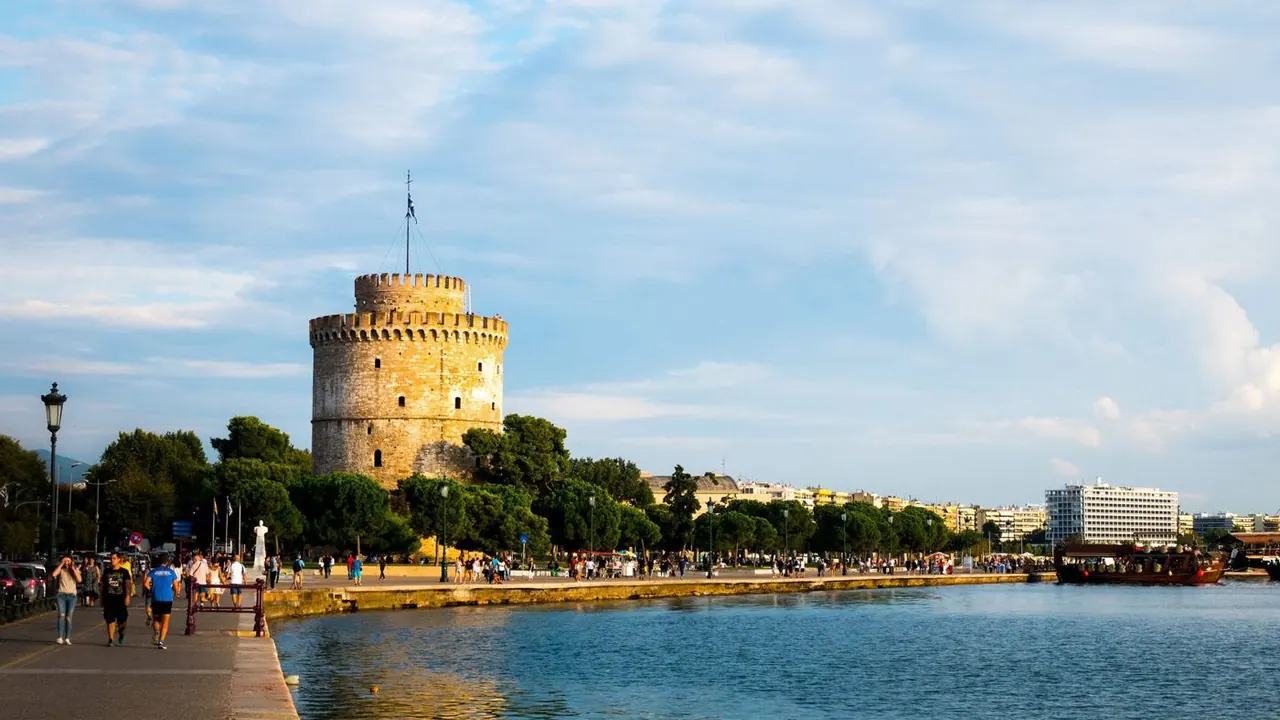
Photos: Nafplio by Giles Laurent, CC BY-SA 4.0, cropped; Thessaloniki by Destinygreece, CC BY-SA 4.0, cropped.
Nafplio or Thessaloniki?
Our verdict in twelve categories, each scored against the same fixed benchmark cities, and the climate month by month, so you can choose for your trip.
Choose Nafplio for
- day trips
- beaches
- wellness
Nafplio suits travellers who want a small, beautiful base and a slow rhythm. Its intact old town sits under the Palamidi fortress, you can swim within walking distance, and Mycenae, Tiryns and Epidaurus are close enough to fit into a morning. Pick it for ancient sites by day, a swim in the afternoon and a quiet glass of wine by the harbour in the evening, and accept that the food is simple and the nights end early.
Choose Thessaloniki for
- nightlife
- food and drink
- shopping
Thessaloniki is the better choice for anyone who wants a real city. It has the best eating in Greece, late nights every day of the week, Byzantine churches and serious museums, and it costs less than Nafplio. The trade-off is a modern centre with little old-town charm and no swimming of note in the city itself, since the good beaches are an hour away in Halkidiki.
Scoreboard
Twelve categories on one fixed scale from 0 to 100. The shaded stretch is the gap between the two.
Your match
Pick a travel style or drag the sliders, and both match scores follow your weighting.
Wins on day trips and beaches with your weighting.
Wins on nightlife and food and drink with your weighting.
What matters to you?
Category by category
What the scores mean for a trip.
Beaches & swimming
In Nafplio, swimming is part of the day. Arvanitia's pebbles below Palamidi are a short walk from the old town, the sandy, pine-backed bay at Karathona is 3km away and Tolo has a longer, busier strip. The beaches are small and crowded on summer weekends, but they are close at hand.
Thessaloniki's waterfront is for strolling, not bathing, and the suburban beaches are ordinary. Its strength is Halkidiki, whose coves are better than anything near Nafplio. Kassandra is an hour's drive away, though, so a swim there becomes a day out rather than an afternoon habit.
Food & drink
Thessaloniki is the much stronger place to eat. Ottoman, Sephardic and Anatolian refugee cooking all shape its food, from meze at the ouzeri to morning bougatsa and the working Kapani and Modiano markets. That range is something Nafplio can't offer.
Nafplio eats well but simply: grilled octopus, slow-cooked lamb and Nemea red at harbourside tables. The better meals are out in Tolo or the villages of the Argolid plain. The main squares lean towards tourist menus, and there is little beyond Greek taverna food.
Culture & sights
Thessaloniki has the weightier heritage. It has a run of UNESCO-listed Byzantine churches from the Rotunda to Agios Dimitrios, Roman remains around the Arch of Galerius, and two serious museums for Macedonian gold and Byzantine art. The catch is that these stand as islands in a city mostly rebuilt after the fire of 1917.
Nafplio is the reverse: there is less to see, but its old town of Venetian, Ottoman and neoclassical houses is intact, with Palamidi above and the Bourtzi in the harbour. Two or three days cover it. Thessaloniki rewards a longer stay.
Nightlife
The two are far apart after dark. In Thessaloniki, students and late Greek hours keep Ladadika's bars, the louder streets around Valaoritou and the outdoor tables of the Bit Bazaar busy until well past three. In summer there are open-air clubs on the edge of town, and weeknights are busy too.
Nafplio means dinner and then a drink by the harbour or off Syntagma Square. It is lively on summer weekends when visitors come down from Athens, quiet on winter weeknights, and has no clubs.
Nature & outdoors
Thessaloniki has the bigger landscapes within reach. Mount Olympus and the Enipeas gorge are about an hour and a half away, Halkidiki's coast is good for sailing, and Kaimaktsalan and Seli have skiing in winter. The Seich Sou pine forest rises right behind Ano Poli.
Nafplio's outdoors are smaller in scale but start at the edge of town. There is the path around Akronafplia, the coastal trail to Karathona, limestone for climbers and kayaking off Tolo. Arcadia's fir-covered Mainalo range is the bigger outing.
Day trips
Nafplio has the richer doorstep. Tiryns is ten minutes away, Mycenae under half an hour and Epidaurus about forty minutes, so three of Greece's great ancient sites fit into easy mornings. Corinth, Nemea, Mystras and the islands of Hydra and Spetses fill longer days.
Thessaloniki's day trips are strong too, centred on ancient Macedonia: the royal tombs at Vergina, Pella and Dion, plus Edessa's waterfalls and boat trips along the Mount Athos coast. These places are further apart, so more of each day goes on the road. A car helps from either city.
Good for families
Neither city is built around children, and both work for families happy with ice creams and evening walks. They differ in kind. Nafplio offers a largely traffic-free old town, calm, shallow water at Karathona and Tolo and the boat out to the Bourtzi. Thessaloniki has the Noesis science centre, a small zoo and seafront playgrounds, but also heavy traffic, cluttered pavements and beaches well out of town.
Getting around
Thessaloniki is easier to get around without a car. The sights lie in a flat strip along the waterfront, a metro line runs under the centre, buses fill the gaps, and taxis are cheap for the steep climb to Ano Poli.
Nafplio's old town is small and flat enough to cross on foot in minutes. Beyond it, buses are sparse, so seeing Mycenae, Epidaurus or the beaches comfortably means hiring a car and hunting for parking in summer.
Shopping & style
Thessaloniki gives a shopper far more to work with. In Nafplio, a browse through Staikopoulou and the lanes around Syntagma Square turns up mostly souvenirs, sandals and beachwear, with a few jewellers, ceramics shops and galleries in between. Komboloi worry beads, Argolid honey and olive oil and a bottle of Nemea red are the local buys, and an hour or two covers it all.
Thessaloniki has a real high street along Tsimiski, with Greek and international chains and shoe shops, malls on the edge of town and antique stalls at the Bit Bazaar. The best things to take home are edible: spices, cheeses, loukoumi and tsipouro from the Kapani and Modiano markets. Even so, this is a morning's shopping rather than a reason to come, with no luxury district or craft tradition to plan a trip around.
Affordability
Thessaloniki is the cheaper stay. It is priced for students and locals, so meze, bougatsa and nights out cost little, and hotels are sensibly priced except during big events and the autumn trade fair.
Nafplio is fair value for a Greek town that visitors know well, with reasonable tavernas and modest site fees. Its restored old-town guesthouses cater to weekend visitors from Athens, though, and cost more on Friday and Saturday nights and in high summer. Coming midweek or staying in Tolo narrows the gap.
Live music & performing arts
Thessaloniki has performances all year. The State Orchestra plays at the waterfront Concert Hall, the National Theatre of Northern Greece runs seasons that are mostly in Greek, and late-night rebetiko at the tavernas is where most visitors will find the best music.
Nafplio's offer is narrower, but its highlight is extraordinary: ancient drama in the theatre of Epidaurus on summer evenings, plus concerts at Palaia Epidavros and a classical festival in town. Outside summer there is very little.
Wellness & relaxation
Both are restful places rather than spa destinations, and neither has a working bathing culture in town. The calm takes different forms. In Nafplio it means a small town's long lunches and the walk round the headland, with thermal water at Loutraki an hour away. In Thessaloniki it means long iced coffees on the seafront, with simple spring baths at Lagadas half an hour out.
When should you go?
Pick your month. The climate figures are measured averages, not a forecast.
Nafplio in July
Thessaloniki in July
Daytime high, °C
Rainfall in the month, mm
Where the figures come from
Nafplio's temperatures are measured 89 km from the centre, at Kalamata Airport.
Nafplio has no rain gauge within 25 km of the centre, so its rainfall comes from a gridded climate dataset read at the city rather than from a gauge further away.
Temperature and rainfall are climate normals, averaged over the years shown. Nafplio: 1991-2020 normals, Kalamata Airport (88.8 km from centre). Thessaloniki: 1991-2020 normals, Thessaloniki Airport (14 km from centre).
The two share the same summer. July and August reach 32°C in both, which is too hot for exposed ancient sites or long city walks at midday. Nafplio has the easier swimming season: the gulf below the old town is warm from June to September, peaking at about 26°C, and the summer is almost rainless and very sunny. Its rain falls in winter, with November and December the wettest months at about 95mm, but the days stay mild at around 15°C, so a winter walk round the town is still pleasant.
Thessaloniki's winter is colder, about 10°C by day in January, and less sunny. Its rain is spread thinly across the year instead of coming in one wet season. The sea off the city warms as much as Nafplio's, but you would swim in it in Halkidiki rather than in town. For sightseeing, the best months in Thessaloniki are May, late September and early October. Nafplio stays comfortable for walking from March to May and again through October into November.
Which traveller are you?
For a beach and sun trip, Nafplio is the clear choice. You can swim at Arvanitia before lunch and be on the sand at Karathona or Tolo within minutes. From Thessaloniki, good swimming means an hour's drive to Halkidiki.
On a food and nightlife trip, Thessaloniki wins easily. It has meze and tsipouro in Ladadika, bougatsa for breakfast and bars that stay full past three on weeknights as well as weekends. Nafplio's quiet harbourside wine bars can't compete.
On a tight budget, Thessaloniki makes your money go further. Prices are set for students and locals, meals are generous and the metro and buses cover the centre. Nafplio's guesthouses cost more at weekends, and its sights really need a hire car.
Before you go
| Measure | Nafplio | Thessaloniki |
|---|---|---|
| Official language | Greek | Greek |
| Currency | Euro (EUR) | Euro (EUR) |
| Sockets | CF230 V, 50 Hz | CF230 V, 50 Hz |
| Driving side | Right | Right |
| Time zone | UTC+2, UTC+3 in summer | UTC+2, UTC+3 in summer |
| Emergency number | 112 | 112 |
| Elevation | 6 m | 6 m |
| Main airport | Athens Eleftherios Venizelos International Airport (ATH)109 km from centre173 non-stop destinations | Thessaloniki Macedonia International Airport (SKG)14 km from centre90 non-stop destinations |
| Public holidays this year | 15 days | 15 days |
By the numbers
| Measure | Nafplio | Thessaloniki |
|---|---|---|
| City population | 14,532 | 309,617 |
| People per km² | 433 | 16,042 |
| Museums within 10 km | 5 | 32 |
| UNESCO World Heritage sites within 50 km | 2 | 1 |
| Swim season, months above 21 °C | 5 months | 5 months |
Where else could you go?
Every comparison below shares a destination with this one, so you can follow Nafplio or Thessaloniki somewhere new.
- Athensvs Nafplio
- Ohridvs Thessaloniki
- Skopjevs Thessaloniki
- Plovdivvs Thessaloniki
- Sofiavs Thessaloniki
- Tiranavs Thessaloniki