New Zealand
Rotorua
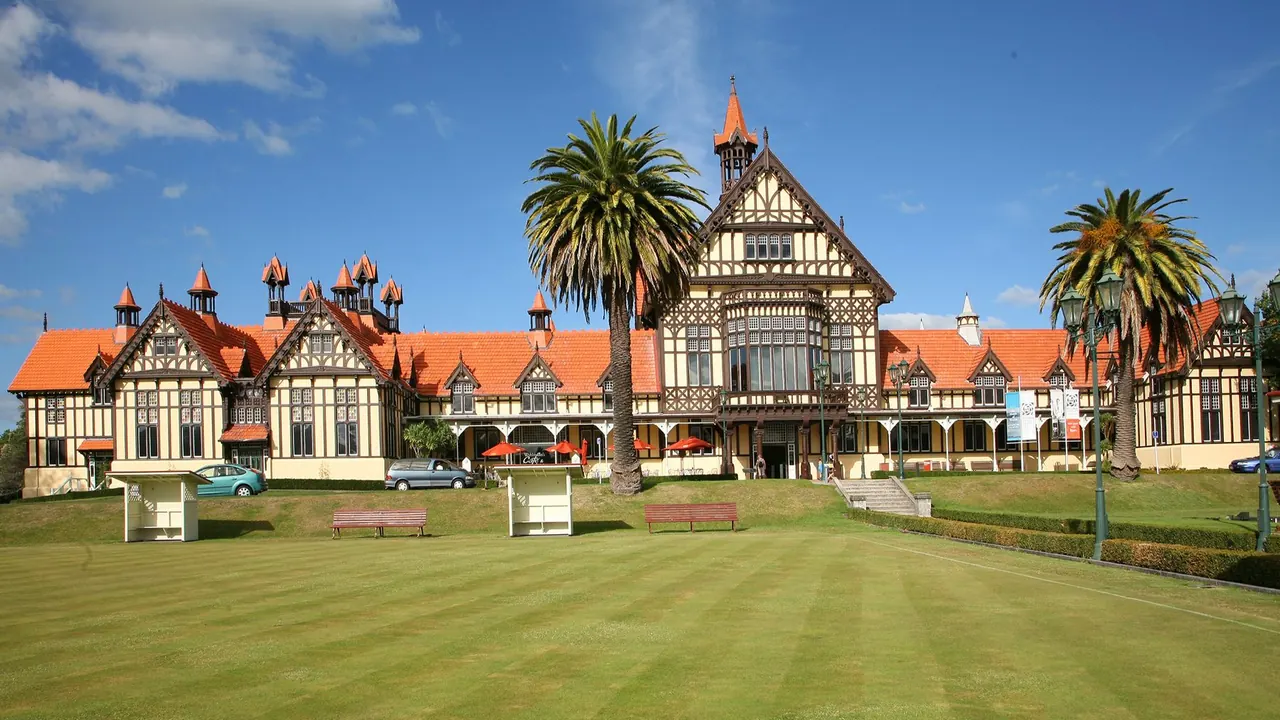
The old Bath House in the Government Gardens
- Nature & outdoors86
- Wellness & relaxation86
- Families68
Photo: W. Bulach, CC BY-SA 4.0, cropped
Match
43
Every category weighted equally
- Beach & sun46
- Culture & arts38
- Food & nightlife33
- Family trip48
- Outdoors52
- Relax & unwind51
- Shopping & style37
- On a budget43
Rotorua in twelve categories
Our verdict on each, scored 0 to 100 against the same fixed benchmark cities, so a score means the same thing on every page.
Beaches & swimming. Scores 33 out of 100.
Food & drink. Scores 33 out of 100.
Culture & sights. Scores 38 out of 100.
Nightlife. Scores 14 out of 100.
Nature & outdoors. Scores 86 out of 100.
Day trips. Scores 45 out of 100.
Good for families. Scores 68 out of 100.
Getting around. Scores 30 out of 100.
Shopping & style. Scores 22 out of 100.
Affordability. Scores 36 out of 100.
Live music & performing arts. Scores 30 out of 100.
Wellness & relaxation. Scores 86 out of 100.
Rotorua category by category
Beaches & swimming
33Rotorua is an inland lake town, so swimming here usually means fresh water. Lake Rotorua itself is shallow and better for looking at than swimming in, but the smaller lakes nearby, Tarawera, Okareka and Rotoiti among them, have sandy or pebbly shores, clear water and summer swimming around 20°C. Warm streams and lakeside hot springs add an unusual twist.
For a real sea beach, the long white surf beach at Mount Maunganui is about an hour's drive towards the Bay of Plenty, and it makes a good summer day out. Beach life is not what a stay here is built around, and from autumn to spring the lakes are too cool for most people.
Food & drink
33Eating out is relaxed and practical rather than a reason to come. Most restaurants and bars sit around the covered dining street at the lake end of Tutanekai Street, with pub food, steaks, Asian cooking and a few more ambitious kitchens using local lamb, venison and seafood. The one dish that belongs to this place is hangi, food slow-cooked in an earth oven or, here, over geothermal steam, usually eaten as part of an evening Māori cultural experience. Good coffee is easy to find, as everywhere in New Zealand, but range and late dining are limited.
Culture & sights
38Rotorua is the heartland of the Te Arawa people, and Māori culture is what gives the town its depth. Whakarewarewa is a living village where families still cook in steam vents and bathe in the hot pools, and the national Māori arts and crafts institute next door trains carvers and weavers in the open. At Ohinemutu on the lakefront, the carved meeting house and the half-timbered St Faith's Church, with its window of a Māori Christ seeming to walk on the lake, sit among steaming ground.
The Government Gardens frame the mock-Tudor Bath House, the town's best-known building, and the Buried Village of Te Wairoa recalls the Tarawera eruption of 1886. Beyond these, the sights are few and quickly covered.
Nightlife
14Evenings are quiet. A few pubs and bars around the lake end of the centre stay busy over dinner and on weekends, but there is no club scene and most of the town is asleep well before midnight. Visitors here tend to spend the evening at a hāngī and cultural performance or soaking in a hot pool rather than going out.
Nature & outdoors
86This is one of the most active geothermal landscapes on earth, and it starts in town: steam drifts from parks and drains, and mud pools bubble in Kuirau Park. Short drives lead to Wai-O-Tapu's coloured terraces and Champagne Pool, the Waimangu valley formed by the 1886 eruption, and the Pohutu geyser at Te Puia. Mount Tarawera, split open by that eruption, can be climbed or flown over.
The Whakarewarewa Forest of tall Californian redwoods on the town's edge has walking trails and some of the best mountain biking in the southern hemisphere. A ring of volcanic lakes offers kayaking, trout fishing and lakeside walks, and the Tongariro volcanoes are within a long day's reach.
Day trips
45The most famous outing is the Hobbiton film set near Matamata, about an hour away through green dairy country. Taupo, on the shore of New Zealand's largest lake, is about an hour south, and the port city of Tauranga with the beach suburb of Mount Maunganui is about an hour north. Hamilton's themed gardens and the Waitomo glowworm caves sit near the two-hour limit. It is a useful list for a few days, but there are no historic towns or wine regions of real depth within easy reach, and most excursions from here head into landscape rather than other places.
Good for families
68Rotorua works well with children, mostly because the landscape does the entertaining. Geysers erupting, mud pools plopping and steam rising from the parks hold the attention of most ages, and Kuirau Park in town is free to wander. Around this there are plenty of smaller attractions: the gondola and luge tracks on Mount Ngongotaha, a nature park where kiwi and trout can be seen up close, farm shows with sheep shearing and dog trials, a suspended walkway through the redwoods that is lit at night, and adventure parks with zorbing and swings. None of these is a big theme park, and a couple of days covers the best of them.
The town is small, safe and informal, and motels with kitchenettes and their own hot pools suit families on the move. The catches are practical: attractions are spread out and need a car, the sulphur smell puts some children off, and the boiling ground is fenced but real, so small children need holding on paths.
Getting around
30The centre is a small, flat grid between the lakefront and the Government Gardens, easy to walk, and Whakarewarewa and the forest are a short ride or a long walk away. Beyond that, a car is close to essential. The main geothermal valleys lie 20km to 30km south, the lakes are spread around the district, and local buses are infrequent and aimed at residents. Visitors without a car rely on tours and shuttles. Roads are quiet and parking is easy, so driving is the simple choice.
Shopping & style
22Shopping is modest. The worthwhile buys are Māori crafts: carved wood, woven flax, bone and pounamu greenstone pendants, best bought where the makers work at Whakarewarewa or from galleries that can say who carved a piece. Tutanekai Street and Fenton Street have outdoor gear, merino and souvenir shops, and a weekly night market brings food and craft stalls, but there is no fashion, design or department-store shopping to speak of.
Affordability
36Rotorua is one of the more reasonable places to stay in New Zealand, with long strips of motels, many with their own hot pools, at gentler rates than the big cities or alpine resorts. The day-to-day costs are less forgiving: eating out is priced at New Zealand levels, a hire car is almost a necessity, and the main attractions, from the geothermal parks to the luge and the evening cultural experiences, each charge a substantial entry fee. Free thermal parks, walks and forest trails help balance a budget.
Live music & performing arts
30The performance a visitor comes for is kapa haka: Māori song, poi dance and haka, staged most evenings at the cultural villages and marae around town, usually with a welcome ceremony and a hāngī meal. Done well, it is moving and rooted in the community that performs it. Beyond that, the town has a modest civic performing arts centre with touring shows and local productions, and occasional live bands in pubs, but no regular classical, theatre or jazz life.
Wellness & relaxation
86Rotorua grew up as a spa town in the late nineteenth century, when visitors came to take the waters for their health, and bathing is still the heart of a stay. On the lakefront, mineral pools of different temperatures look out over the water, and private pools can be booked by the hour. At Hell's Gate you can lie in warm geothermal mud, and many motels pipe hot water into their own small pools. Out of town, wild hot streams and lakeside springs reached by boat or forest track offer free and simple soaks.
The pace is unhurried and evenings are early. The faint smell of sulphur that hangs over the town is part of the deal.
When should you go?
Pick a month to see what it is like. The climate figures are measured averages, not a forecast.
Rotorua in July
Daytime high, °C
Rainfall in the month, mm
The whole year
Shaded against this city’s own year: the deepest cell is its best month for that figure and the palest its weakest.
Where the figures come from
Rotorua has no weather station within reach, so its figures come from a gridded climate model rather than a measured record, and read a broad area rather than the city itself.
Temperature and rainfall are climate normals, averaged over the years shown. Rotorua: 2001-2020 normals, NASA POWER reanalysis grid, no weather station within 90 km.
Before you go
| Measure | Rotorua |
|---|---|
| Official language | English, New Zealand Sign Language, Māori |
| Currency | New Zealand Dollar (NZD) |
| Sockets | I230 V, 50 Hz |
| Driving side | Left |
| Time zone | UTC+12, UTC+13 in summer |
| Emergency number | 111 |
| Elevation | 280 m |
| Main airport | Rotorua Regional Airport (ROT)7 km from centre3 non-stop destinations |
| Public holidays this year | 12 days |
By the numbers
| Measure | Rotorua |
|---|---|
| City population | 58,500 |
| People per km² | 22 |
| Museums within 10 km | 1 |
| UNESCO World Heritage sites within 50 km | 0 |
| Swim season, months above 21 °C | None |
Compare Rotorua with
Every comparison with a written verdict behind it.