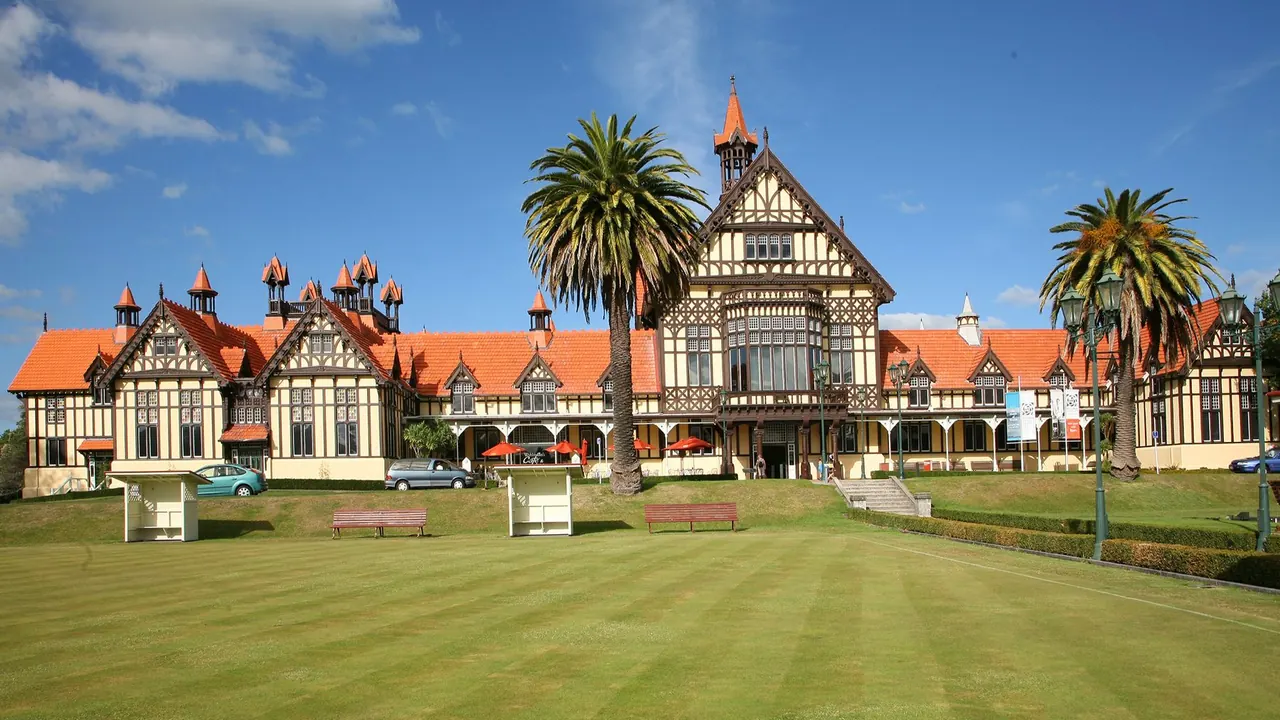
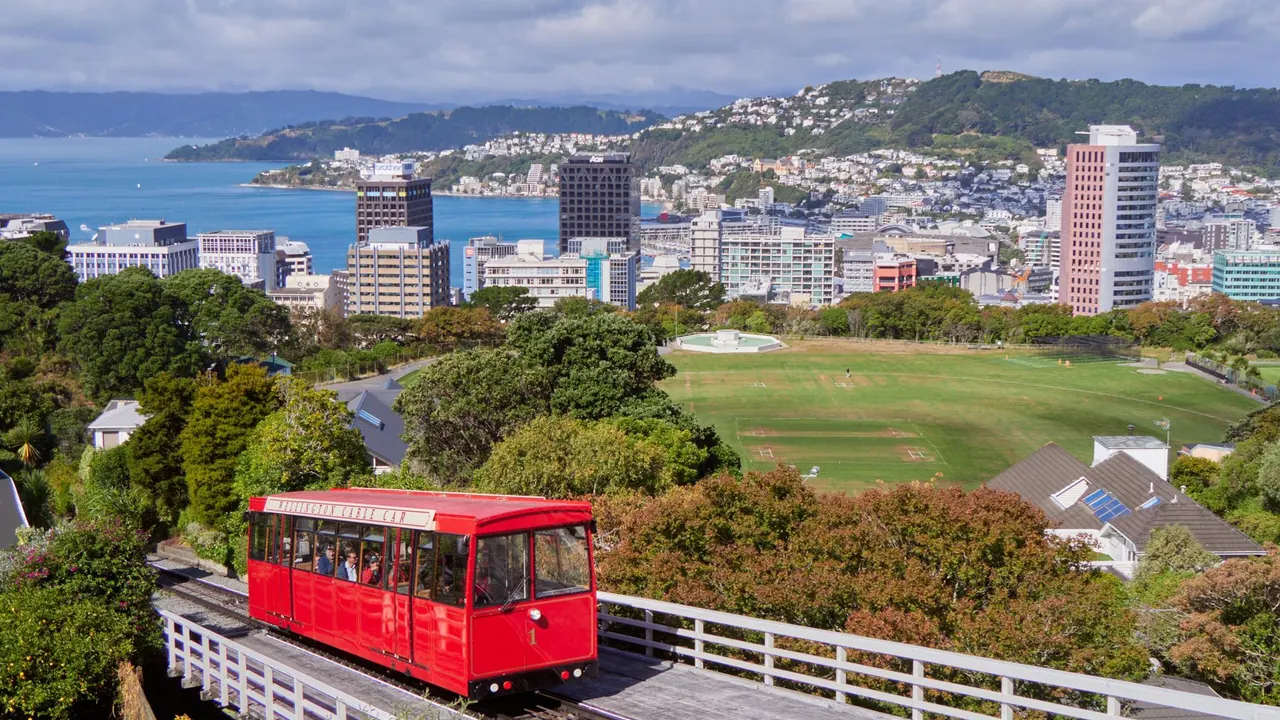
Photos: Rotorua by W. Bulach, CC BY-SA 4.0, cropped; Wellington by lumoplank, CC0.
Rotorua or Wellington?
Our verdict in twelve categories, each scored against the same fixed benchmark cities, and the climate month by month, so you can choose for your trip.
Choose Rotorua for
- wellness
- nature and the outdoors
- families
Rotorua suits travellers who want the land itself to be the main event: geysers, boiling mud, redwood trails and a ring of volcanic lakes, with a long soak in mineral water at the end of the day. Its Māori culture is lived in rather than displayed, at Whakarewarewa and around Ohinemutu, and the steaming ground keeps children busy too. Bring a car and expect early, quiet evenings.
Choose Wellington for
- getting around
- nightlife
- food and drink
Wellington is the better pick for a proper city trip with wild coast and bush close by. The centre is easy to cover on foot. Cafés, craft-beer taprooms and the bars around Cuba Street give the evenings some life, while Te Papa, the national orchestra and the ballet add an arts side that Rotorua cannot match. The trade-off is the wind, and nowhere to bathe in hot water.
Scoreboard
Twelve categories on one fixed scale from 0 to 100. The shaded stretch is the gap between the two.
Your match
Pick a travel style or drag the sliders, and both match scores follow your weighting.
Wins on wellness and nature and the outdoors with your weighting.
Wins on getting around and nightlife with your weighting.
What matters to you?
Category by category
What the scores mean for a trip.
Beaches & swimming
Neither city is a beach destination, but each offers a different kind of swim. Rotorua's swimming is in fresh water, in clear lakes such as Tarawera and Okareka that warm to around 20°C in summer, with the white surf beach at Mount Maunganui about an hour's drive away.
Wellington has sand you can walk to, at Oriental Bay in the city or in the sheltered coves around Miramar. The Cook Strait water is colder, though, and the wind is often fierce, so most visitors walk on the beaches rather than swim from them.
Food & drink
Wellington is the better place to eat. Its café culture takes coffee very seriously, small breweries fill Te Aro, and Cook Strait seafood and Martinborough pinot noir give menus a local flavour, from casual food on Cuba Street to smarter tables on the waterfront.
Rotorua eats simply, mostly along the covered dining strip on Tutanekai Street, and late dining is limited. Its one distinctive meal is hāngī cooked over geothermal steam. It is usually eaten as part of a cultural evening, not ordered in a restaurant.
Culture & sights
Wellington has the wider range of sights. Te Papa alone fills a day with Māori and Pacific collections and the national story, and Parliament's Beehive, wooden Old St Paul's and the vast timber Government Buildings are all a short walk from it.
Rotorua has fewer sights, and they are quickly covered, but they go deeper in one direction. At Whakarewarewa families still cook in the steam vents, carvers train in the open, and the meeting house at Ohinemutu stands among steaming ground. The difference is seeing Māori culture in a national museum against seeing it in the community that lives it.
Nightlife
Wellington is the only one of the two with a real night out. Courtenay Place has late bars and a few clubs, and Cuba Street's lanes hold cocktail rooms and taprooms, all close enough to move between on foot, though midweek is quiet.
Rotorua has a few pubs at the lake end of town and no clubs. Its evenings go on a kapa haka show and a hot pool, and the town is mostly asleep before midnight.
Nature & outdoors
Both have fine country close by, but Rotorua's is unique. Mud pools bubble in a town park, and short drives lead to the coloured terraces of Wai-O-Tapu, the Waimangu valley formed by the 1886 eruption and the Pohutu geyser. The Whakarewarewa redwood forest is among the best mountain-biking areas in the southern hemisphere.
Wellington's outdoors is coastal and wilder: native birds at Zealandia, fur seals at Red Rocks and the Makara Peak bike trails. It is excellent for a capital city, but the wind means planning every outing around the forecast.
Day trips
The day trips are about equal in number but different in kind. From Rotorua they head into landscape and film locations: the Hobbiton set near Matamata, Lake Taupo, the beach at Mount Maunganui, and the Waitomo glowworm caves at the edge of a day's range.
Wellington's one strong outing is the Wairarapa, over the Remutaka hills, with Martinborough's vineyards to tour by bicycle and the old colonial main streets of Greytown. It is the only real wine-and-small-towns day on offer from either city.
Good for families
Rotorua has the slight edge with children because the ground itself puts on a show. Geysers and mud pools are backed up by the gondola and luge on Mount Ngongotaha, kiwi spotting and farm shows, though you will need a car, and small children have to be held near the boiling pools.
Wellington's family days centre on Te Papa's hands-on galleries and earthquake house, then the cable car to the Space Place observatory and the zoo. It is easier to manage without a car, but the steep streets make pushchairs hard work.
Getting around
Getting around is much easier in Wellington. The flat strip from the railway station to Courtenay Place takes under half an hour to walk, and the cable car, suburban trains and the Days Bay ferry cover most of the rest without a car.
In Rotorua only the small central grid is walkable. The geothermal valleys lie 20km to 30km south and the local buses serve residents, so visitors either hire a car or join tours. The roads are quiet, so driving is straightforward.
Shopping & style
Rotorua's shopping is narrow, and Māori craft is the main reason to go looking. Carved wood, woven flax, bone and pounamu pendants are best bought at Whakarewarewa, where carvers and weavers work in the open and you can buy straight from the person who made the piece. Beyond that, Tutanekai Street has outdoor gear and merino, and a weekly night market adds craft stalls.
Wellington has far more to browse. Lambton Quay has chain stores and New Zealand fashion labels, and the lanes off Cuba Street have vintage clothing, record shops, second-hand books and small design stores, enough for an unhurried afternoon.
Affordability
Both are pricey by any standard outside New Zealand, but the costs fall in different places. Rotorua's motels, many with their own hot pools, are cheaper than city hotels, but the hire car and the separate entry fees at each geothermal park and evening show add up quickly.
In Wellington the room is the expensive part. Once you have one, Te Papa, the Botanic Garden and the town belt walks are free, and the walkable centre means you need no car.
Live music & performing arts
Wellington is home to the country's national companies. The New Zealand Symphony Orchestra plays at the Michael Fowler Centre and the Royal New Zealand Ballet at the St James Theatre, small theatres stage fringe work, and the bands and jazz around Cuba Street fill other nights.
Rotorua's one real draw is kapa haka, the song, poi and haka performed most evenings at the cultural villages and marae. It is moving, and it is the one performance Wellington cannot offer in the same setting, but there is little else on stage.
Wellness & relaxation
This is where the two cities differ most. Rotorua grew up as a spa town and bathing is still the point of a stay, from the lakefront mineral pools and private pools you can book by the hour to the geothermal mud at Hell's Gate and free hot streams reached by boat or forest track.
Wellington has no bathing tradition. Relaxing there means a day spa, the heated harbourside pool at Oriental Bay or a quiet hour in the Botanic Garden. For anyone who wants hot pools, this alone settles the choice in Rotorua's favour.
When should you go?
Pick your month. The climate figures are measured averages, not a forecast.
Rotorua in July
Wellington in July
Daytime high, °C
Rainfall in the month, mm
Where the figures come from
Rotorua has no weather station within reach, so its figures come from a gridded climate model rather than a measured record, and read a broad area rather than the city itself.
Wellington's sunshine is measured 47 km from the centre, at Paraparaumu Aerodrome.
Temperature and rainfall are climate normals, averaged over the years shown. Rotorua: 2001-2020 normals, NASA POWER reanalysis grid, no weather station within 90 km. Wellington: 1961-1990 (sunshine 1991-2020) normals, Wellington Aerodrome Aws (5.3 km from centre).
The two climates are close, but Rotorua's summers run slightly warmer. From December to March, Rotorua's days reach about 23°C and the nearby lakes are warm enough for a swim. On the Bay of Plenty coast an hour away the sea reaches about 21°C. Wellington's summer highs sit around 21°C, and the Cook Strait water rarely gets above 17°C, so a swim there is a brisk one. January and February are also Wellington's sunniest and driest months, the best time for its coast and hill walks.
Neither city gets too hot for walking at any point in the year. Winter is the weak season in both. From May to August days fall to the low teens, and June and July bring the most rain, around 113mm a month in each. Rotorua's hot pools make its cold months far more pleasant, and some people come in winter just for the bathing. Wellington's grey, windy winter is better spent indoors, at Te Papa or the theatre.
Which traveller are you?
On a relaxing and wellness trip, Rotorua wins clearly. It is a spa town by origin, with mineral pools on the lakefront, mud baths at Hell's Gate and free hot streams in the bush. Wellington's idea of unwinding is a harbour walk and a coffee.
For a food and nightlife trip, choose Wellington. Its café and craft-beer culture, the eating streets of Cuba Street and Courtenay Place, and bars you can walk between leave Rotorua behind. Rotorua's evenings mostly end after a hāngī meal.
For a short city break, Wellington makes far more sense. The flat centre, Te Papa, the cable car and the waterfront are all within walking distance, with no car needed. Rotorua spreads its best sights across 30km of countryside, so a brief stay goes on driving between them.
Before you go
| Measure | Rotorua | Wellington |
|---|---|---|
| Official language | English, New Zealand Sign Language, Māori | English, New Zealand Sign Language, Māori |
| Currency | New Zealand Dollar (NZD) | New Zealand Dollar (NZD) |
| Sockets | I230 V, 50 Hz | I230 V, 50 Hz |
| Driving side | Left | Left |
| Time zone | UTC+12, UTC+13 in summer | UTC+12, UTC+13 in summer |
| Emergency number | 111 | 111 |
| Elevation | 280 m | 0 m |
| Main airport | Rotorua Regional Airport (ROT)7 km from centre3 non-stop destinations | Wellington International Airport (WLG)5 km from centre20 non-stop destinations |
| Public holidays this year | 12 days | 12 days |
By the numbers
| Measure | Rotorua | Wellington |
|---|---|---|
| City population | 58,500 | 216,200 |
| People per km² | 22 | 487 |
| Museums within 10 km | 1 | 12 |
| UNESCO World Heritage sites within 50 km | 0 | 0 |
| Swim season, months above 21 °C | None | None |
Where else could you go?
Every comparison below shares a destination with this one, so you can follow Rotorua or Wellington somewhere new.