New Zealand
Wellington
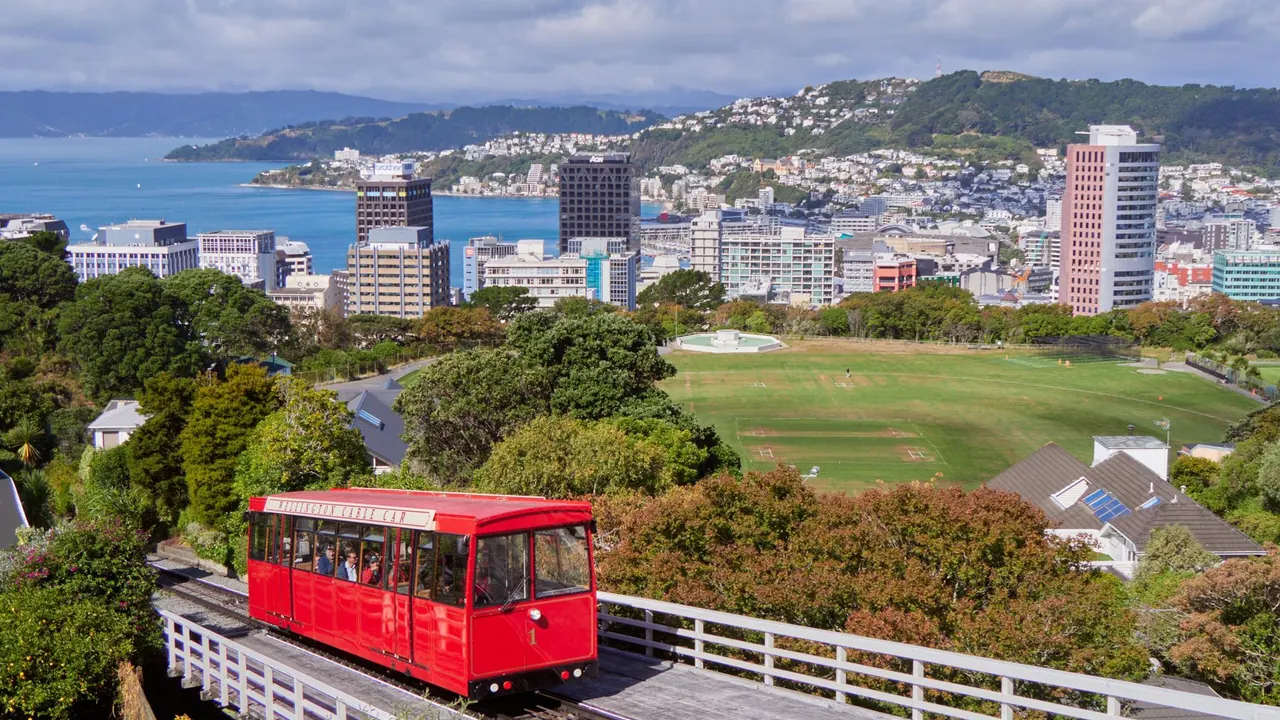
The red cable car above Wellington
- Nature & outdoors78
- Getting around68
- Food & drink62
Match
49
Every category weighted equally
- Beach & sun47
- Culture & arts50
- Food & nightlife50
- Family trip51
- Outdoors51
- Relax & unwind48
- Shopping & style50
- On a budget48
Wellington in twelve categories
Our verdict on each, scored 0 to 100 against the same fixed benchmark cities, so a score means the same thing on every page.
Beaches & swimming. Scores 33 out of 100.
Food & drink. Scores 62 out of 100.
Culture & sights. Scores 44 out of 100.
Nightlife. Scores 45 out of 100.
Nature & outdoors. Scores 78 out of 100.
Day trips. Scores 40 out of 100.
Good for families. Scores 62 out of 100.
Getting around. Scores 68 out of 100.
Shopping & style. Scores 42 out of 100.
Affordability. Scores 33 out of 100.
Live music & performing arts. Scores 56 out of 100.
Wellness & relaxation. Scores 30 out of 100.
Wellington category by category
Beaches & swimming
33Wellington has sand on its doorstep but not much of a beach vacation. Oriental Bay, a short walk from the centre, is an imported-sand city beach with a promenade, swimming pontoons and a diving platform, busy on still summer afternoons. Around the Miramar Peninsula, Scorching Bay and Worser Bay are sheltered harbour coves, Lyall Bay on the south coast draws surfers, and the ferry to Days Bay makes a pleasant outing.
The catch is the water and the weather. Cook Strait seas rarely go much above 17°C even in February, and the wind that gives the city its reputation can turn a warm morning cold by lunch. Locals swim on calm days; visitors treat the beaches as somewhere to walk and sit rather than the point of the trip.
Food & drink
62Coffee is where Wellington stands out. The city has a dense café culture for its size, with serious roasters and flat whites taken as seriously as anywhere, and a craft-beer scene to match: small breweries and taprooms are scattered around Cuba Street and Te Aro. Seafood from the Cook Strait, Wairarapa lamb and Martinborough pinot noir give menus a local accent.
The eating out is concentrated in a few compact areas: Cuba Street and its lanes for casual and international food, Courtenay Place and the waterfront for something smarter, and weekend night and harbourside markets for street food. Asian and Pacific influences are strong. What it lacks is depth at the top and a cuisine visitors come specifically to eat; it is a very good place to eat well, not a destination for food alone.
Culture & sights
44The anchor is Te Papa, the national museum on the waterfront, strong on Māori and Pacific collections, natural history and the country's story, and free to enter. Around it sit the Parliament buildings with the round Beehive, the wooden Gothic church of Old St Paul's, the timber Government Buildings, one of the largest wooden structures in the world, and the City Gallery and Wellington Museum on the harbour.
It is a young capital, so there is little old architecture beyond Victorian and Edwardian façades in Thorndon and along Lambton Quay. The red cable car up to Kelburn and its small museum, and film-effects workshop tours in Miramar, round out a list that fills two or three days comfortably but rarely more.
Nightlife
45Going out is concentrated in a small area, which works in its favour. Courtenay Place is the loud end, with late bars and a few clubs full of students and weekend crowds, while Cuba Street and the lanes off it hold craft-beer bars, cocktail rooms and wine bars with a more relaxed, creative crowd. Everything is walkable, so a night moves easily between them.
Friday and Saturday nights are lively and some places stay open late, but midweek is quiet and the club scene is limited for a capital. It suits travellers who like good bars and conversation more than those after big nights on the dance floor.
Nature & outdoors
78Wellington is built on hills around a deep harbour, and wild country starts at the edge of the streets. A town belt of bush and pine runs through the city, the summit of Mount Victoria looks over the whole harbour, and Zealandia, a fenced valley sanctuary, lets you hear kākā, tūī and other native birds a short bus ride from the centre. The rugged south coast offers a walk to the Red Rocks fur seal colony and views across Cook Strait to the South Island mountains.
Mountain biking is a real strength, with trail networks at Makara Peak and in the town belt, and the Remutaka Cycle Trail and the Tararua Range lie within about an hour. Kapiti Island, a bird sanctuary off the west coast, is a memorable day. The weather is the price: strong winds and fast changes mean planning around the forecast.
Day trips
40The best day out is the Wairarapa, over the Remutaka hills about an hour and a half away. Martinborough is a small wine village whose pinot noir vineyards can be toured by bicycle, and Greytown and Featherston are pretty colonial main streets with cafés and antique shops. Up the west coast, the Kāpiti Coast towns make a gentle outing by train.
Beyond that the list thins quickly. Napier's Art Deco streets and the South Island towns of Picton and Nelson are too far for a comfortable day, the Cook Strait ferry alone taking more than three hours. Most visitors use Wellington as a stop on a wider New Zealand trip rather than a base for outings.
Good for families
62Wellington is an easy, safe city with children. Te Papa is the highlight, with hands-on galleries, an earthquake house and a giant squid, and the waterfront between it and the city has playgrounds, open space and summer jumping platforms. The red cable car leads up to the Botanic Garden and the Space Place observatory, and Wellington Zoo and Zealandia's birdlife are short trips out.
There is no theme park or large aquarium, and the wind and rain mean a wet-weather plan is wise. Distances are short and the culture is relaxed and welcoming, but steep streets and many steps make pushchairs harder work once you leave the flat waterfront.
Getting around
68The flat strip of central Wellington, from the railway station along Lambton Quay to Courtenay Place and the waterfront, is short enough to walk end to end in under half an hour, and most sights sit along it. The cable car climbs to Kelburn, suburban trains run up the Hutt Valley and the Kāpiti Coast, and a harbour ferry crosses to Days Bay.
Buses do most of the work beyond the centre, reaching the south coast, Miramar and the hill suburbs, and they are fine for a visitor rather than fast. The hills are steep, the wind can make walking hard work, and a car is useful only for the Wairarapa or remote coast.
Shopping & style
42Shopping falls into two halves. Lambton Quay, the main commercial street, has chain stores, outdoor brands and a few New Zealand fashion labels, while Cuba Street and the lanes off it hold vintage clothing, record shops, second-hand books and small design stores with a creative bent. Merino wool, pounamu greenstone and Māori and Pacific crafts are the local things worth taking home.
There is little luxury retail and no large market or bazaar. It is pleasant browsing for an afternoon, not a reason to come.
Affordability
33Wellington is an expensive city for a visitor. Hotel rooms in the centre are costly, especially when conferences or major events fill the city, and eating out and drinking, beer and wine in particular, sit well above the levels of southern Europe. Imported goods carry the cost of distance.
There are offsets. Te Papa, the Botanic Garden, the town belt walks and the waterfront are free, the centre is walkable, and coffee and casual food are of good quality for what they cost. Budget travellers manage with hostels and self-catering, but nothing here feels cheap.
Live music & performing arts
56For its size, Wellington has a lively arts life, and the country's national institutions are based here. The New Zealand Symphony Orchestra plays at the Michael Fowler Centre, the Royal New Zealand Ballet performs at the historic St James Theatre, and professional and fringe theatre companies keep stages busy through the year, from mainstream plays to experimental work in small black-box venues.
Live music is strong around Cuba Street and Te Aro, with small venues for local bands, jazz and singer-songwriters. The New Zealand Festival of the Arts brings international theatre, dance and music in late summer. What it cannot offer is opera most nights or the scale of a major stage capital.
Wellness & relaxation
30Wellington has no bathing tradition to speak of. Wellness means hotel and day spas, public pools such as the heated harbourside pool at Oriental Bay, and the quiet of the Botanic Garden or a bush walk in the town belt. The pace is relaxed for a capital and the city rarely feels crowded.
For thermal pools and geothermal bathing, New Zealand's spa towns lie several hours north. In Wellington itself, unwinding is more about a long coffee and a harbour walk than anything built for it.
When should you go?
Pick a month to see what it is like. The climate figures are measured averages, not a forecast.
Wellington in July
Daytime high, °C
Rainfall in the month, mm
The whole year
Shaded against this city’s own year: the deepest cell is its best month for that figure and the palest its weakest.
Where the figures come from
Wellington's sunshine is measured 47 km from the centre, at Paraparaumu Aerodrome.
Temperature and rainfall are climate normals, averaged over the years shown. Wellington: 1961-1990 (sunshine 1991-2020) normals, Wellington Aerodrome Aws (5.3 km from centre).
Before you go
| Measure | Wellington |
|---|---|
| Official language | English, New Zealand Sign Language, Māori |
| Currency | New Zealand Dollar (NZD) |
| Sockets | I230 V, 50 Hz |
| Driving side | Left |
| Time zone | UTC+12, UTC+13 in summer |
| Emergency number | 111 |
| Elevation | 0 m |
| Main airport | Wellington International Airport (WLG)5 km from centre20 non-stop destinations |
| Public holidays this year | 12 days |
By the numbers
| Measure | Wellington |
|---|---|
| City population | 216,200 |
| People per km² | 487 |
| Museums within 10 km | 12 |
| UNESCO World Heritage sites within 50 km | 0 |
| Swim season, months above 21 °C | None |
Compare Wellington with
Every comparison with a written verdict behind it.