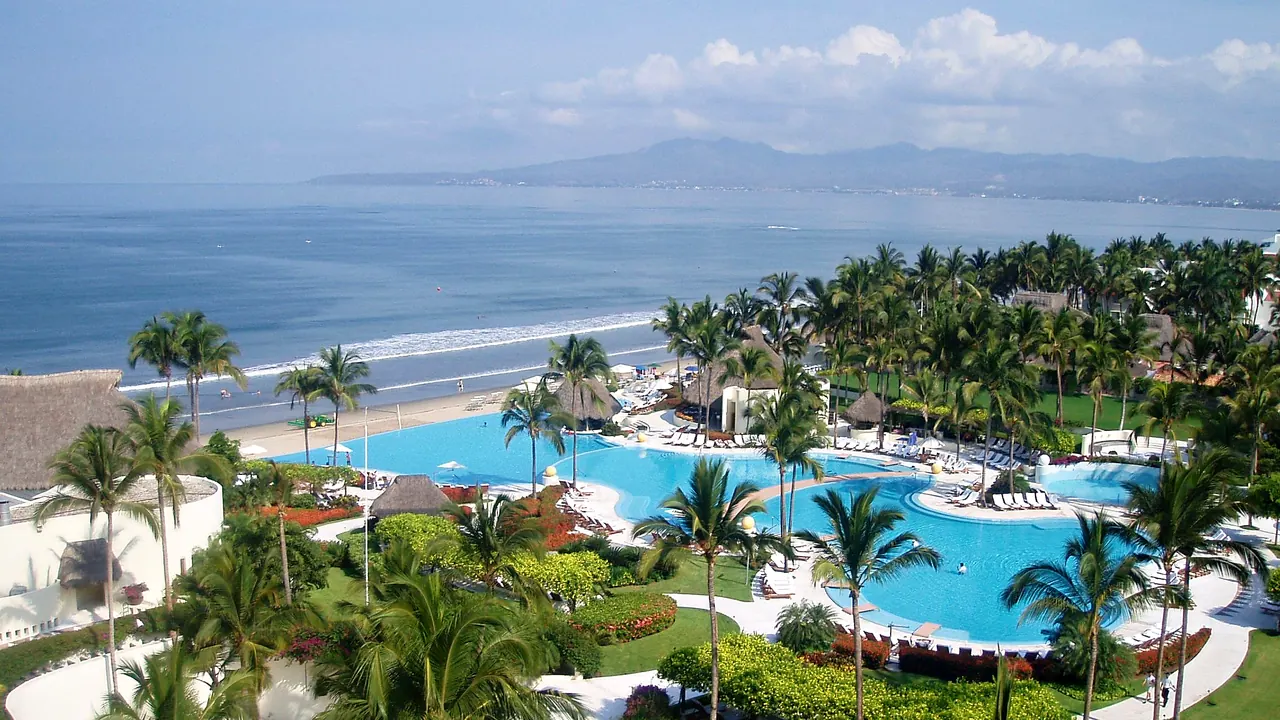
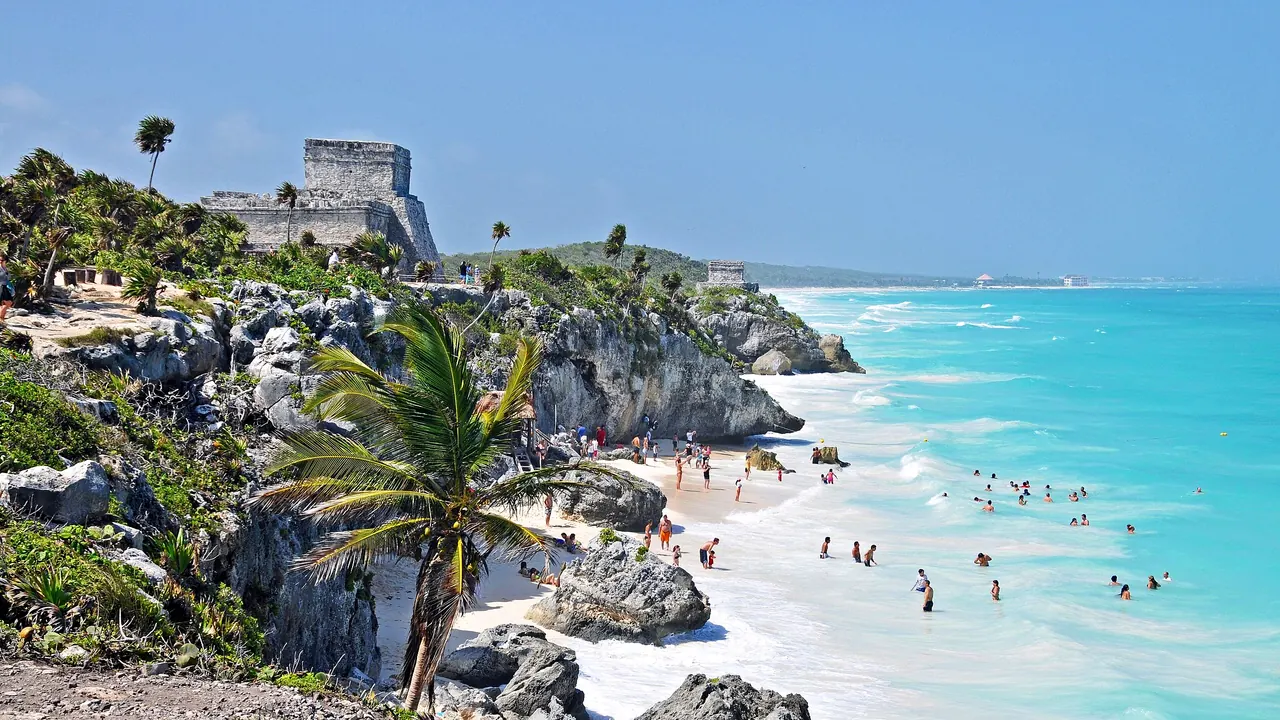
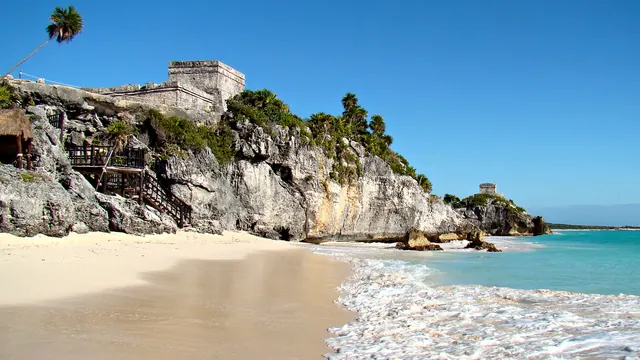
Photos: Nuevo Vallarta by Harpqueen, Public domain; Riviera Maya by Dennis G. Jarvis, CC BY-SA 2.0, cropped.
Nuevo Vallarta or Riviera Maya?
Our verdict in twelve categories, each scored against the same fixed benchmark cities, and the climate month by month, so you can choose for your trip.
Choose Nuevo Vallarta for
- prices
Nuevo Vallarta is for a settled resort stay with very little to organise. You fly in, transfer in minutes and spend the week on one long, calm beach with the pool close by. In winter there are humpback whales in Banderas Bay, and the forested Sierra Madre foothills rise behind the coast. Puerto Vallarta is close enough for the evenings when you want old streets, good seafood or a late night. It suits families and couples who want to unwind, as long as they don't expect much from the enclave itself.
Choose Riviera Maya for
- nightlife
- culture and sights
- getting around
The Riviera Maya gives you more to do, spread along a coast you travel up and down. The sea is clearer, the beaches vary more and there are cenotes and reef to swim in. Maya ruins stand right on the shore, and Playa del Carmen and Tulum have the nightlife, yoga and food that Nuevo Vallarta leaves to its neighbour. The cost is more planning, more time on the highway and the risk of seaweed in some summers. For anyone who wants a varied trip rather than a stay in one place, it is the stronger choice.
Scoreboard
Twelve categories on one fixed scale from 0 to 100. The shaded stretch is the gap between the two.
Your match
Pick a travel style or drag the sliders, and both match scores follow your weighting.
Wins on prices with your weighting.
Wins on nightlife and culture and sights with your weighting.
What matters to you?
Category by category
What the scores mean for a trip.
Beaches & swimming
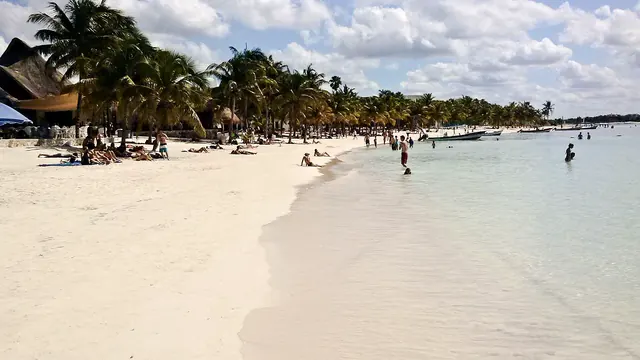
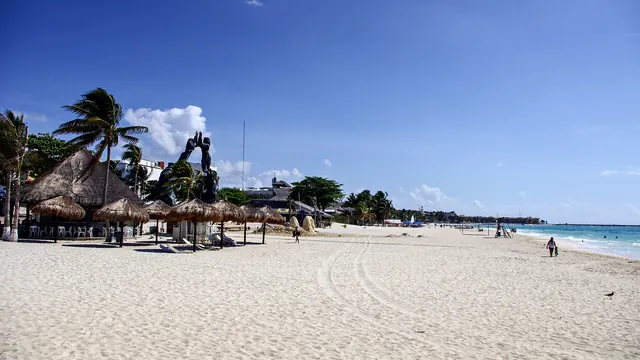
Both give you warm water and soft sand right outside the hotel, but the Riviera Maya's beaches are better and far more varied. Its white sand runs for over 100km. Along the way you get the town beach at Playa del Carmen, reef-sheltered bays at Akumal and Xpu-Ha where turtles graze, the coves below Tulum's ruins and empty stretches toward Sian Ka'an. The water is properly clear. Sargassum seaweed is the catch, piling up on public beaches in some years between spring and late summer.
Nuevo Vallarta has one long, wide golden strand on a calm bay, gently shelving and easy for swimmers. The water is greener and can turn murky near the river mouth after storms. For a change of scene you drive to the surf at Sayulita or the coves of Punta Mita.
Food & drink
The Riviera Maya gives you better food without leaving your base. Cochinita pibil, sopa de lima and panuchos are served in the taquerias a few streets back from Playa del Carmen's Quinta Avenida and in Tulum town. Tulum's beach road adds wood-fired kitchens with real ambition.
Nuevo Vallarta's own regional cooking is excellent: pescado zarandeado grilled over wood, aguachile and raicilla. To eat it, though, you go out to the seafood shacks of Bucerias or to Puerto Vallarta, because the enclave itself is mostly resort dining rooms and marina terraces. On both coasts, an all-inclusive guest who never leaves the hotel misses the point.
Culture & sights
Nuevo Vallarta is a planned resort zone with no history, museums or landmarks of its own. Any culture means a trip to Puerto Vallarta's cobbled old town and crowned church.
The Riviera Maya has real heritage, mostly in its Maya ruins. These include the walled city on Tulum's cliff above the sea, the tall pyramids and raised jungle roads of Coba, and smaller sites at Muyil and on Cozumel. Its towns are as modern as Nuevo Vallarta's, and colonial churches and plazas still mean a day inland. But a ruin before breakfast is something the Pacific side simply cannot give you.
Nightlife
Nights in Nuevo Vallarta are quiet. You get lobby bars, poolside shows and a drink by the marina, and the strip is largely asleep by midnight. A real night out is a taxi ride to Puerto Vallarta's malecon or the Zona Romantica, home to one of Mexico's best-known gay scenes.
The Riviera Maya has its nightlife on the doorstep. Calle 12 in Playa del Carmen has loud bars, rooftop terraces and clubs open into the early hours. Tulum draws a fashionable crowd to DJ nights in jungle clearings and beach clubs. Akumal and Puerto Morelos stay quiet, so pick your base to suit.
Nature & outdoors
The wildlife and scenery are about as good on both coasts, but very different. Nuevo Vallarta's highlights are at sea and in the hills. Humpback whales come into the bay in winter, the Marietas Islands are a protected park for snorkelling among seabirds and rock arches, and the Ameca mangroves have herons and crocodiles. Inland, the jungle foothills of the Sierra Madre have river canyons and zip-lines.
The Riviera Maya is flat, and its wonders are underwater. There are clear freshwater cenotes such as Dos Ojos, the Mesoamerican Reef runs offshore, and Cozumel has famous drift dives. Sian Ka'an's lagoons are reached by boat. Walkers and anyone after a view will prefer the Pacific side, while divers and snorkellers will prefer the Caribbean.
Day trips
From Nuevo Vallarta, most outings are short and easy, and none of them needs an early start. Puerto Vallarta's old town is half an hour south, and a string of small beach towns runs up the coast to the north, each good for a relaxed day. The one real journey is into the pine-covered mountains to the old silver-mining village of San Sebastian del Oeste. There are no major ruins or colonial cities within reach.
The Riviera Maya has fewer outings, but they take you into history. The big one is a long, early day inland to Chichen Itza and the colonial streets of Valladolid, or to Ek Balam for a quieter version of the same trip. Closer to hand, a ferry crosses to Cozumel and a boat from Cancun goes to Isla Mujeres. Choose the Pacific side for easy days in coastal towns, and the Caribbean side for one or two long days that you will remember.
Good for families
Both coasts are easy with children, and the Riviera Maya has more for them to do. Its reef-sheltered bays at Akumal, Xpu-Ha and Puerto Morelos let even young swimmers snorkel among turtles. A row of eco-parks offers underground rivers, zip lines and evening shows, and the ruins at Tulum and Coba are small enough for short legs.
Nuevo Vallarta is simpler: a quiet, partly gated enclave with kids' clubs and a gentle beach. Its standout outings are seasonal, with whale watching in winter and turtle hatchling releases at dusk. Summer heat limits time outdoors on both coasts.
Getting around
Nuevo Vallarta wins on arrival, with the airport about twenty minutes away. After that it is awkward. Resorts and golf courses are strung along a long boulevard, little is within walking distance and the highway buses are a hot walk from the beachfront, so most people rely on taxis and shuttles.
The Riviera Maya is easier to move around once you are there. Everything lies along one coastal highway, with colectivo vans stopping on request at beaches and cenote turnoffs and long-distance buses linking the towns. Playa del Carmen's centre is walkable and Tulum is easily done by bicycle. A hire car helps for Coba and the quieter beaches, and Tulum's taxis are expensive.
Shopping & style
Nuevo Vallarta itself has little more than resort boutiques, a modest mall and small plazas selling swimwear and souvenirs. The region's own craft is the beadwork and yarn painting of the Huichol, or Wixarika, people. Visitors find it in Puerto Vallarta's old town and river market and in Bucerias, alongside silver and Talavera, so buying it means an outing.
The Riviera Maya gives you more to browse without a taxi ride. Playa del Carmen's Quinta Avenida is a long pedestrian street of silver, Talavera and beachwear, though much of the stock repeats. Tulum's small boutiques have a different style, with linen, woven baskets, hammocks and design pieces. The coast's craft to bring home is the embroidered huipil, which is cheaper inland in Valladolid.
Affordability
Both are among Mexico's dearer places to stay, priced for international visitors, and neither suits a tight budget. In Nuevo Vallarta almost everything is resorts and condominiums, so an all-inclusive package keeps costs predictable. Savings come from stepping out to the taco stands of Bucerias by local bus.
On the Riviera Maya the costs pile up in different places: Tulum's design hotels and restaurants, eco-park tickets, diving and cenote fees. Budget travellers there can stay a few blocks back from the sea in Playa del Carmen or Puerto Morelos and travel by colectivo.
Live music & performing arts
Neither has a stage worth planning a trip around. There is no opera, orchestra or theatre on either coast, and evening entertainment is mostly made for hotel guests. Nuevo Vallarta's best-known show is a permanent acrobatic dinner theatre at one of its big resorts, and Puerto Vallarta adds cabaret and drag.
The Riviera Maya's eco-parks stage big evening spectacles with Maya ball games and folk dance. Bars in Playa del Carmen and Tulum have live Latin, reggae and rock bands.
Wellness & relaxation
Nuevo Vallarta is restful by nature, with long pool days and little to rush off for. Its spa offering depends on your resort, though some offer hydrotherapy and a temazcal sweat lodge.
The Riviera Maya treats wellness as a reason to travel. Tulum has jungle yoga shalas, retreats, breathwork and thatched spas along the beach road, temazcal ceremonies are held all along the coast, and a swim in a cool cenote does its own good. For real quiet, stay in Puerto Morelos or Akumal rather than central Playa del Carmen.
When should you go?
Pick your month. The climate figures are measured averages, not a forecast.
Nuevo Vallarta in July
Riviera Maya in July
Daytime high, °C
Rainfall in the month, mm
Where the figures come from
Nuevo Vallarta has no weather station within reach, so its figures come from a gridded climate model rather than a measured record, and read a broad area rather than one spot.
Riviera Maya has no weather station within reach, so its figures come from a gridded climate model rather than a measured record, and read a broad area rather than one spot.
Temperature and rainfall are climate normals, averaged over the years shown. Nuevo Vallarta: 1991-2020 normals, TerraClimate 4 km grid at the town, no weather station within 90 km. Riviera Maya: 2001-2020 normals, NASA POWER reanalysis grid, no weather station within 90 km.
Nuevo Vallarta has two sharp seasons. From December to May it is almost completely dry, with days around 30°C and a calm bay, though the sea is at its coolest in late winter and feels refreshing rather than warm. The rains arrive in June as heavy afternoon storms and build to nearly 300mm in September. Highs then reach 34°C, and with the humidity, walking the streets is hard work even though the sea is at its warmest. Winter is the time to go, and it is also whale season.
The Riviera Maya changes less through the year. On the coast, days are a few degrees cooler than on the Pacific side in every month, warm rather than hot in winter, and the sea stays around 28°C all year. Its winter and spring are less dry than Nuevo Vallarta's, with some showers even in the calmest months. From July to September, though, it is much the drier of the two, and its own wettest spell comes later, in October, at over 220mm. Winter and early spring are the most comfortable months on both coasts. In high summer the Caribbean side is the less oppressive choice.
Which traveller are you?
For a food and nightlife trip, the Riviera Maya is the clear pick. Playa del Carmen's bars run past 3am and Tulum hosts electronic nights in the jungle. Yucatecan cooking is a short walk from where you sleep. In Nuevo Vallarta both mean a taxi to Puerto Vallarta.
On a culture and arts trip, choose the Riviera Maya. Tulum's cliff-top ruins and the pyramids at Coba are within easy reach, and Chichen Itza with colonial Valladolid makes one long day out. Nuevo Vallarta has no heritage of its own and nothing like it within a day.
For whale watching, Nuevo Vallarta has what the Caribbean coast does not. From December to March humpbacks come into Banderas Bay to calve, and boats leave from the marina beside the resorts. Winter is also when the bay is driest and calmest.
Before you go
| Measure | Nuevo Vallarta | Riviera Maya |
|---|---|---|
| Official language | Spanish, Nahuatl, Yucatec Maya | Spanish, Nahuatl, Yucatec Maya |
| Currency | Mexican Peso (MXN) | Mexican Peso (MXN) |
| Sockets | AB127 V, 60 Hz | AB127 V, 60 Hz |
| Driving side | Right | Right |
| Time zone | UTC-6 | UTC-5 |
| Emergency number | 911 | 911 |
| Elevation | 3 m | - |
| Main airport | Puerto Vallarta International Airport (PVR)4 km from centre52 non-stop destinations | Cancún International Airport (CUN)136 non-stop destinations |
| Public holidays this year | 9 days | 9 days |
By the numbers
| Measure | Nuevo Vallarta | Riviera Maya |
|---|---|---|
| Population | 1,301 | - |
| Museums within 10 km | 0 | - |
| UNESCO World Heritage sites within 50 km | 1 | - |
| Swim season, months above 21 °C | 12 months | 12 months |
Where else could you go?
Every comparison below shares a destination with this one, so you can follow Nuevo Vallarta or Riviera Maya somewhere new.
- Puerto Vallartavs Nuevo Vallarta
- Cozumelvs Riviera Maya
- Sayulitavs Nuevo Vallarta
- Cancunvs Riviera Maya
- Isla Mujeresvs Riviera Maya
- Holboxvs Riviera Maya