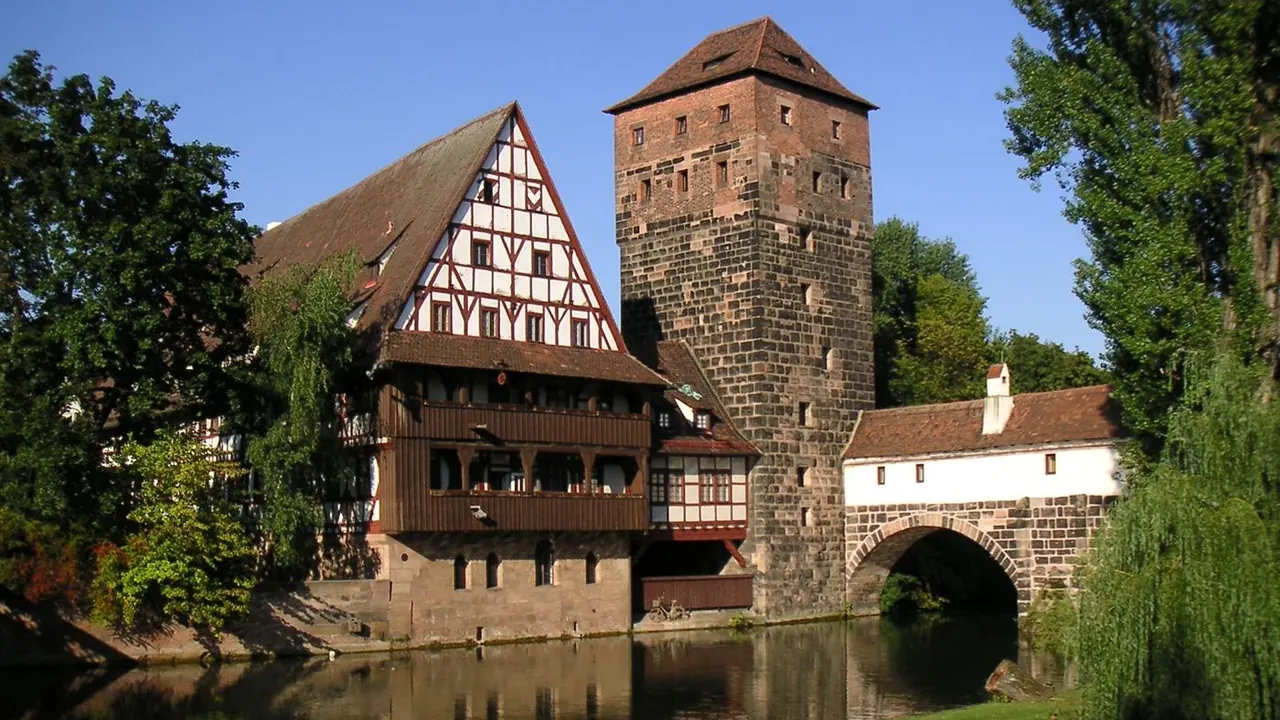
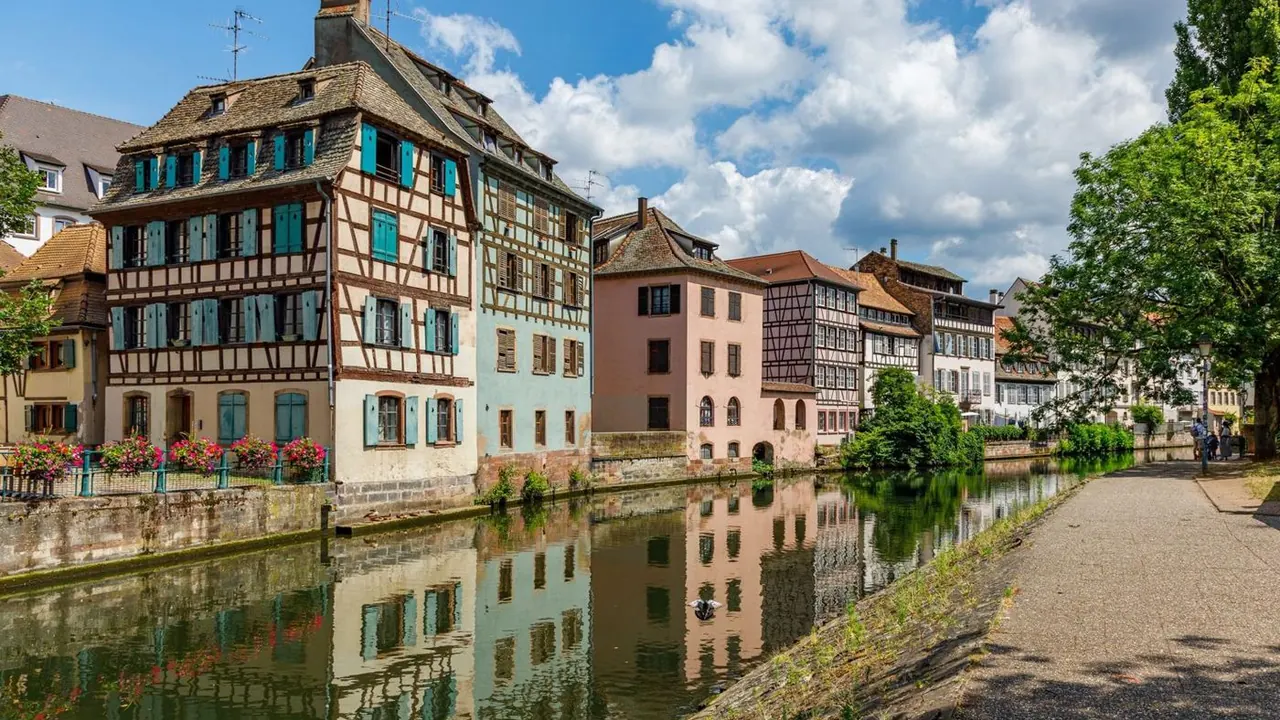
Photos: Nuremberg by Horst Gutmann, CC BY 2.0, cropped; Strasbourg by Edoardo Colombo, Pexels License.
Nuremberg or Strasbourg?
Our verdict in twelve categories, each scored against the same fixed benchmark cities, and the climate month by month, so you can choose for your trip.
Choose Nuremberg for
- prices
- beaches
Nuremberg suits travellers who want German history in layers: an imperial castle above a walled medieval town, then the Rally Grounds and Courtroom 600, which make the twentieth century hard to ignore. It also suits beer drinkers and anyone watching costs. Franconia's small breweries and filling tavern food keep evenings simple, and on the regional trains Bamberg, Regensburg and Würzburg are easy to reach without a car.
Choose Strasbourg for
- food and drink
- wellness
- shopping
Choose Strasbourg if the table and the slower side of a trip matter most. The winstub, the Alsace wine villages to the south and a serious fine-dining tier give it the better food, and the city has a real arts season. Baden-Baden's thermal baths are close by and the shopping is more interesting. It costs a little more, but for a gentler trip mixing French and German culture it gives more back.
Scoreboard
Twelve categories on one fixed scale from 0 to 100. The shaded stretch is the gap between the two.
Your match
Pick a travel style or drag the sliders, and both match scores follow your weighting.
Wins on prices and beaches with your weighting.
Wins on food and drink and wellness with your weighting.
What matters to you?
Category by category
What the scores mean for a trip.
Beaches & swimming
Neither city is a swimming destination. Each makes do with freshwater lakes, but in different ways. Nuremberg's Franconian Lake District, centred on the Brombachsee, is about an hour away and makes a full day out with sandy strips and sailing. Strasbourg's gravel-pit lakes, such as the Baggersee, are on the edge of town and reachable by tram, with lifeguards in July and August, so a quick afternoon swim is easier there.
Food & drink
Strasbourg eats better. Alsatian cooking takes from both France and Germany: choucroute, baeckeoffe and tarte flambée in wood-panelled winstubs, with wine from the vineyards just to the south. The city also has a proper fine-dining tier and good markets for Munster and charcuterie.
Nuremberg's table is narrower and heavier. It is built around the little beechwood-grilled bratwurst, Schäufele and Lebkuchen. Its real strength is beer: Franconia's dense web of small breweries and the smoky Kellerbier in its beer gardens beat anything Strasbourg pours.
Culture & sights
These two are evenly matched, but the history they show is different. Nuremberg is a walled imperial city with the Kaiserburg, Dürer's house and the vast Germanisches Nationalmuseum. Its sobering twentieth-century sites, the Rally Grounds and Courtroom 600, have no equal in Strasbourg.
Strasbourg is centred on its pink sandstone cathedral and astronomical clock, with Petite France's locks and the German-built Neustadt around it. It spreads its art across several museums, the Palais Rohan's three among them, and the European institutions give it a present-day political role.
Nightlife
Evenings out are much alike. Both cities offer bars rather than clubs, filled by students. In Nuremberg, the place to go is Gostenhof just outside the walls, with alternative venues in old working-class streets, and the Erlangen crowd keeps weekends busier. Strasbourg's equivalent is Krutenau and Place Saint-Étienne, where riverside terraces are pleasant in summer, but the city goes quiet earlier on weeknights.
Nature & outdoors
Strasbourg has the stronger outdoors, mostly because it sits between two ranges. The Vosges, with castle ruins and the Mont Sainte-Odile ridge, lie to the west, and the higher Black Forest lies to the east. Level cycle routes run along the Rhine, through forests where storks and beavers live, though a car helps for the hills.
Nuremberg's countryside is gentler. The Reichswald pine forest starts at the edge of town. Franconian Switzerland, about an hour away, has limestone towers, caves and well-known climbing, and the southern lakes are good for paddling.
Day trips
Both are first-rate bases, with a different kind of trip from each. Nuremberg's are historic towns by train: Bamberg, Regensburg, Würzburg, the walled Romantic Road towns and Munich, all manageable without a car.
Strasbourg offers a cross-border mix. Colmar and the Alsace wine route villages lie south, and Baden-Baden, Freiburg and Basel lie over the Rhine. The vineyard villages are far easier with a car or a bike.
Good for families
Children do well in both. Nuremberg plays on its toy-making past with the Toy Museum, the railway museum's full-size locomotives and a large zoo in wooded old quarries, though the cobbled castle climb is hard work with a pushchair.
Strasbourg's flat, mostly car-free centre is easier to manage. Boat trips, the stork-filled Orangerie park and the Le Vaisseau science centre are in the city, and Europa-Park is about an hour away for a big day out.
Getting around
Getting around is equally easy in both, and neither needs a car in town. Nuremberg's walled centre is about 1.5km across, and one ticket covers the U-Bahn, trams and S-Bahn out to the Rally Grounds and on to Fürth. Regional trains handle most day trips as well. Strasbourg relies on trams and, above all, bikes, with separated lanes everywhere and a tram line over the Rhine to Kehl. The car becomes useful only for the wine villages.
Shopping & style
Strasbourg is the better place to shop. The lanes near the cathedral hold independent shops, delicatessens and bookshops, and the regional goods to take home are more varied: Alsace wine, Soufflenheim pottery, printed linens and foie gras.
Nuremberg's main streets are mostly chain stores. What is worth buying is specific: Lebkuchen in tins, wooden toys and tin figures, and crafts from the Handwerkerhof. Both cities have a famous Christmas market that turns December into the main shopping season.
Affordability
Nuremberg is the cheaper of the two. Tavern meals and local beer cost little, as does transport, and the city is easier on the wallet than Munich. Strasbourg is fair rather than cheap. A pichet of wine and a tarte flambée are good value, and the cathedral and old streets cost nothing.
In both, hotels are the problem, and the dates to avoid differ. In Nuremberg it is the big trade fairs, the toy fair above all, and Advent. In Strasbourg it is the Christmas market and the weeks when the European Parliament sits.
Live music & performing arts
The two are close, but Strasbourg's season carries more weight. The Opéra national du Rhin, the Théâtre National de Strasbourg and the autumn Musica festival of contemporary music draw serious audiences, though you need to plan around the calendar.
Nuremberg's Staatstheater, in its Art Nouveau opera house, is solid but more regional. The city is stronger in summer outdoors, with a free folk weekend at the Bardentreffen, the orchestras' open-air concert in the Luitpoldhain and a large rock festival at the Zeppelinfeld.
Wellness & relaxation
Strasbourg is the better choice for slowing down. It has its own historic bathhouse, the tiled Bains municipaux with a hammam, and Baden-Baden's grand thermal baths are under an hour away. Nuremberg has no historic baths of its own. It sends you to a modern thermal spa in Fürth, mixed nude saunas on the city's edges or the saline pools of Bad Windsheim, and a slow afternoon in a beer garden does much of the rest.
When should you go?
Pick your month. The climate figures are measured averages, not a forecast.
Nuremberg in July
Strasbourg in July
Daytime high, °C
Rainfall in the month, mm
Temperature and rainfall are climate normals, averaged over the years shown. Nuremberg: 1991-2020 normals, Nuernberg (5.5 km from centre). Strasbourg: 1991-2020 normals, Strasbourg (9.1 km from centre).
The two cities have almost the same year, with Strasbourg a degree or two milder in most months. Late May, June and September are the best months for walking the old towns, with warm, sunny days that never get tiring. July and August are the months for swimming, with highs of about 25°C in Nuremberg and 26°C in Strasbourg. In Nuremberg that means the city's outdoor pools or a day out at the Franconian lakes about an hour south. Strasbourg's gravel-pit lakes are on the edge of town.
Summer is also the wettest season in both, but the rain peaks in different months. Nuremberg's wettest month is July, at around 77mm. Strasbourg gets much the same amount earlier, in May, so pack for showers in either city. December and January are grey and cold, with very little sun. Highs are only about 4°C in Nuremberg and a little higher in Strasbourg, so these months suit the Christmas markets and tavern meals better than long days outdoors.
Which traveller are you?
For a food and nightlife trip, Strasbourg is the better pick. Its winstubs, Riesling by the pichet, foie gras and fine dining in the nearby villages give it more depth than Nuremberg. Evenings out are much alike in both, mainly student bars and riverside terraces.
On a trip on a tight budget, Nuremberg goes further. Tavern meals are filling, local beer is cheap, the integrated transport costs little and the sights are modestly priced. Avoid the trade-fair weeks and Advent, and rooms are fairly priced too.
For a relaxing and wellness trip, Strasbourg has the edge. Its tiled early twentieth-century Bains municipaux are right in the city, and the Friedrichsbad and Caracalla baths in Baden-Baden are under an hour away. Nuremberg relies on a modern spa in Fürth and mixed nude saunas.
Before you go
| Measure | Nuremberg | Strasbourg |
|---|---|---|
| Official language | German | French |
| Currency | Euro (EUR) | Euro (EUR) |
| Sockets | CF230 V, 50 Hz | CE230 V, 50 Hz |
| Driving side | Right | Right |
| Time zone | UTC+1, UTC+2 in summer | UTC+1, UTC+2 in summer |
| Emergency number | 112 | 112 |
| Elevation | 209 m | 132 m |
| Main airport | Nuremberg Airport (NUE)5 km from centre56 non-stop destinations | Strasbourg Airport (SXB)10 km from centre43 non-stop destinations |
| Public holidays this year | 12 days | 11 days |
By the numbers
| Measure | Nuremberg | Strasbourg |
|---|---|---|
| City population | 531,159 | 293,771 |
| People per km² | 2,848 | 3,752 |
| Museums within 10 km | 50 | 21 |
| UNESCO World Heritage sites within 50 km | 1 | 1 |
Where else could you go?
Every comparison below shares a destination with this one, so you can follow Nuremberg or Strasbourg somewhere new.