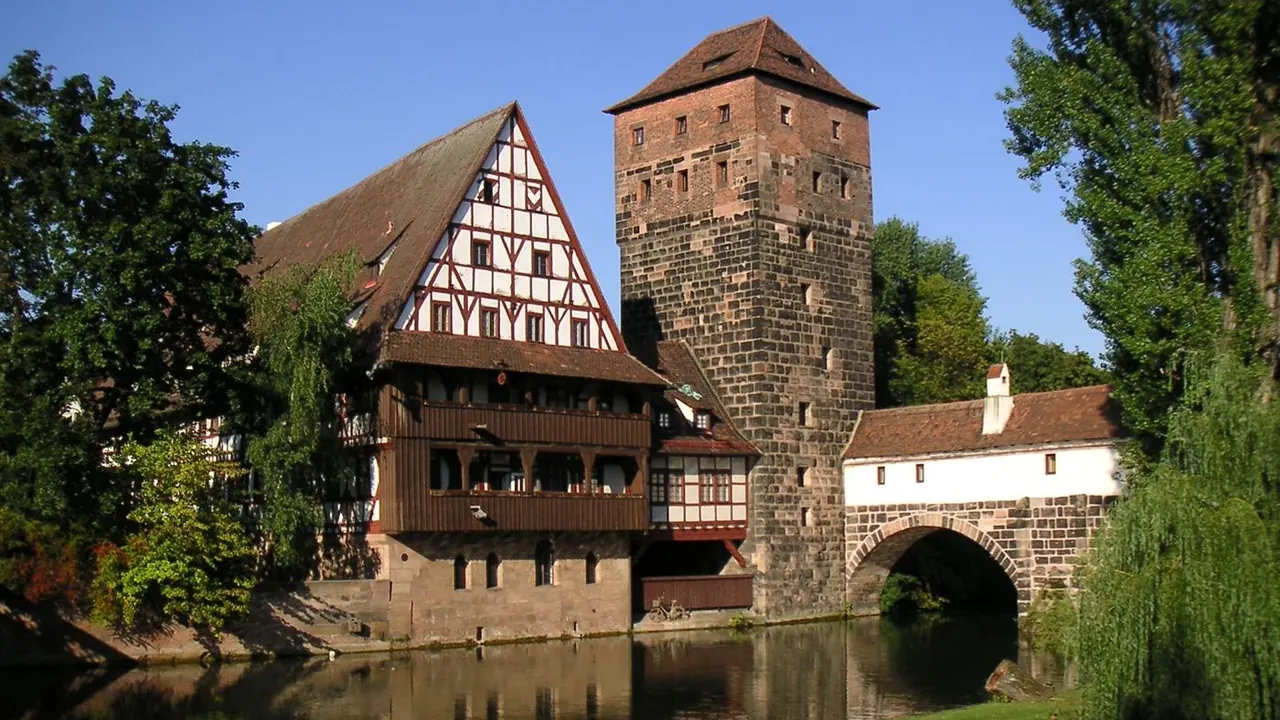
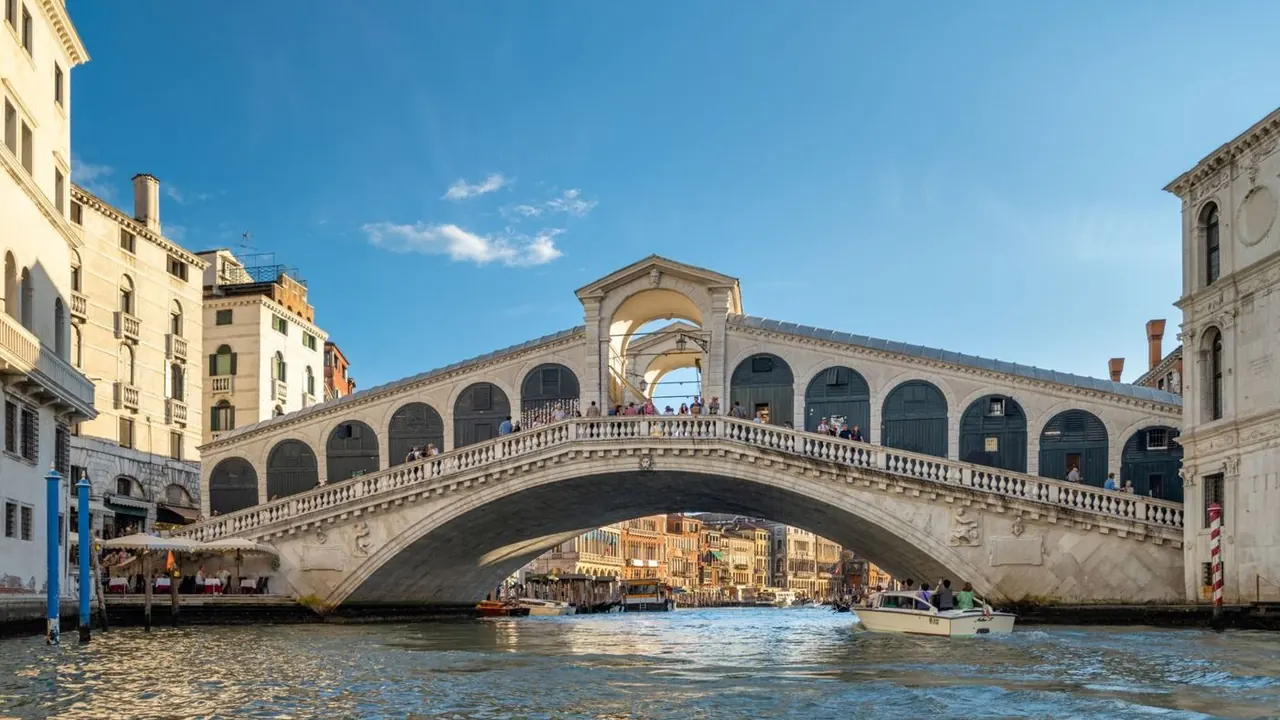
Photos: Nuremberg by Horst Gutmann, CC BY 2.0, cropped; Venice by David Vives, Pexels License.
Nuremberg or Venice?
Our verdict in twelve categories, each scored against the same fixed benchmark cities, and the climate month by month, so you can choose for your trip.
Choose Nuremberg for
- prices
- families
- nightlife
Nuremberg is for travellers who want a sturdy, easy base rather than a single overwhelming sight. The walled old town is compact and simple to walk, a single ticket covers the trains and trams, and the regional trains reach Bamberg, Regensburg and Würzburg. Families do well with the toy and railway museums and the zoo, and beer drinkers will find Franconian taverns and beer gardens good company. It also costs a good deal less than Venice once you avoid the trade fair weeks.
Choose Venice for
- beaches
- culture and sights
- shopping
Choose Venice if the trip is about beauty and art above all. The city on the water, with San Marco, the Grand Canal and Titian and Tintoretto in its churches, is in a different class from anything in Franconia, and La Fenice and the Lido add evenings and a beach day. In return you pay far more, cope with crowds and stepped bridges, and accept that the city goes quiet early.
Scoreboard
Twelve categories on one fixed scale from 0 to 100. The shaded stretch is the gap between the two.
Your match
Pick a travel style or drag the sliders, and both match scores follow your weighting.
Too close to call, 1 point apart
Wins on prices and families with your weighting.
Wins on beaches and culture and sights with your weighting.
What matters to you?
Category by category
What the scores mean for a trip.
Beaches & swimming
Nuremberg has no swimming of its own beyond outdoor pools. The nearest open water is the Franconian Lake District, about an hour south, where reservoirs such as the Brombachsee have grassy shores and small strips of sand for a hot summer afternoon.
Venice has a real sea beach a short boat ride away. The Lido has kilometres of fine sand along the Adriatic, with shallow, warm water that suits children, though it is greenish rather than clear and largely laid out in rows of cabanas. Quieter Pellestrina and the larger resorts at Jesolo are also within reach.
Food & drink
Nuremberg eats heavily and drinks well: finger-sized bratwurst grilled over beechwood, Schäufele with crackling and dumplings, Lebkuchen, and above all Franconia's small-brewery lagers and smoky Kellerbier in taverns and beer gardens. Beyond that tradition, its restaurants are unremarkable.
Venice offers more to the curious eater, provided they avoid the picture-menu places around San Marco. Cicchetti eaten standing at bacari near the Rialto and in Cannaregio, together with lagoon dishes such as black cuttlefish risotto and soft-shell crab, give it a lighter, seafood-led kitchen that Nuremberg has nothing to compare with.
Culture & sights
Nuremberg has plenty to see. There are the medieval walls, the Kaiserburg, St Sebaldus and St Lorenz, Dürer's house and the vast Germanisches Nationalmuseum, along with the sobering twentieth-century history of the Rally Grounds and Courtroom 600. Much of the old town, though, is a careful post-war rebuild.
Venice is in another league. Six centuries of palaces and churches stand intact on the water, with no cars to break the view. Its art runs from Titian in the Frari and Tintoretto at San Rocco to the Guggenheim and the Biennale, and a week barely covers it.
Nightlife
Nuremberg gives you the better night out, though neither city is a party destination. Students fill the old town squares and riverbanks in summer, Gostenhof has small bars and alternative venues, and the crowd from Erlangen keeps a few clubs busy at weekends.
Venice centres on the early-evening spritz at bacari along the Fondamenta della Misericordia, with a few later bars around Campo Santa Margherita. After midnight the canals fall silent. That makes for a lovely late walk, but anyone wanting to dance has to head to the mainland.
Nature & outdoors
Nuremberg has the better country for walkers and cyclists. The Reichswald pine forest starts at the edge of town, and Franconian Switzerland, about an hour away, offers limestone towers, caves, village-to-village trails and well-known rock climbing.
Venice's outdoors is the lagoon. Herons, egrets and flamingos feed in the marshes around Torcello and Sant'Erasmo, which you can explore by kayak or in a Venetian rowing lesson, and the sea walls of the Lido and Pellestrina make for flat cycling. Hills, let alone mountains, are an hour or more away.
Day trips
Both are excellent bases. From Nuremberg, Bamberg, Regensburg and Würzburg are each about an hour by train, and the walled towns of Rothenburg and Dinkelsbühl are a little further.
Venice has a slight edge because its options come both faster and closer. Padua is half an hour away and Verona and Vicenza a little further, while Murano, Burano and Torcello make a day out across the lagoon with no train needed at all.
Good for families
Nuremberg is far easier with children. As an old toy-making city, it has a Toy Museum, a railway museum with the first German train, a zoo with a dolphin and manatee house, and a play park with water play just outside town. The steep, cobbled castle climb is the only real effort.
Venice delights children with boats, glass-blowing on Murano and the shallow Lido, but practical life is hard. Pushchairs have to be carried over stepped bridges, there are few playgrounds, and summer is hot and crowded. It suits a short stay with older children best.
Getting around
In Nuremberg, the walled centre is only about 1.5km across, and beyond it U-Bahn, trams and S-Bahn trains run on one ticket to the zoo, the Rally Grounds and Fürth.
Venice is also walked, but with more friction. Alleys dead-end at canals and get people lost, and hundreds of bridges with steps punish wheeled luggage. The vaporetto is a pleasure on the Grand Canal but slow and crowded as everyday transport.
Shopping & style
Venice gives shoppers more to look for. Murano glass, Burano lace, papier-mâché masks, marbled paper and velvet furlane are all still made in workshops in Dorsoduro, Castello and on Murano, and fashion houses line the Mercerie. The challenge is avoiding the cheap imports sold as local along the main routes.
Nuremberg's high streets are mostly chain stores. What is worth carrying home is Lebkuchen in decorated tins, wooden toys and crafts from the Handwerkerhof, and in Advent the stalls of the Christkindlesmarkt.
Affordability
Nuremberg is much the cheaper stay. Meals, beer and transport cost little, and hotels are only a problem during the big trade fairs and the Advent market weeks.
Venice is among Italy's most expensive cities in almost every respect, from hotel rooms near San Marco to boat fares and church entry. The ways to save are to eat cicchetti at the counter, stay in Mestre or the quieter sestieri, and come in late autumn or winter.
Live music & performing arts
Venice has the grander stage. La Fenice, where Verdi and Rossini premiered works, runs a full season of opera, ballet and concerts, and on most evenings there is Vivaldi played in churches and scuole in the city where he worked, though the quality varies.
Nuremberg's Staatstheater, in an Art Nouveau opera house, offers solid repertory, and summer brings the open-air orchestral concert in the Luitpoldhain and free folk music at the Bardentreffen. It is good regional fare rather than a reason to travel.
Wellness & relaxation
Nuremberg is a little better for proper bathing. A large thermal spa with sauna gardens is a short U-Bahn ride away in Fürth, and the saline floating pools of Bad Windsheim are about an hour away, though expect the German custom of nude, mixed saunas.
Venice relies on hotel spas, and its nearest thermal towns, Abano and Montegrotto, are about an hour away near Padua. Its real calm comes from the absence of traffic, felt in early mornings in Castello, Cannaregio or on Giudecca, well away from the crowds around San Marco.
When should you go?
Pick your month. The climate figures are measured averages, not a forecast.
Nuremberg in July
Venice in July
Daytime high, °C
Rainfall in the month, mm
Where the figures come from
Venice has no rain gauge within 25 km of the centre, so its rainfall comes from a gridded climate dataset read at the city rather than from a gauge further away.
Venice's sunshine is measured 26 km from the centre, at Treviso / S. Angelo.
Temperature and rainfall are climate normals, averaged over the years shown. Nuremberg: 1991-2020 normals, Nuernberg (5.5 km from centre). Venice: 1991-2020 normals, Venezia / Tessera (6.7 km from centre).
Nuremberg has a continental climate. Summer days reach about 25°C in July and August, which is warm enough for beer gardens and a swim in the Franconian lakes, though midsummer is also its wettest stretch, with heavy showers. May, June and September are the most comfortable months for walking the old town. Winter is properly cold, with highs around 4°C from December to February and short, grey days.
Venice runs warmer and sunnier through the year. July and August reach about 30°C and feel humid on the alleys, but the Adriatic off the Lido warms to around 26°C, so those are the beach months. Late spring and September are better for sightseeing, although autumn brings the heaviest rain, with September reaching 78mm. Venice's winters are milder than Nuremberg's but still chilly and damp.
Which traveller are you?
On a culture and arts trip, Venice is the clear choice. The whole city is the sight, from the Doge's Palace to the Accademia and the Frari, and La Fenice and the Biennale give it a depth of art and performance that Nuremberg's castle and museums cannot match.
On a family trip with young children, Nuremberg is easier. It has the Toy Museum, full-size locomotives, a zoo in wooded quarries and a play park nearby. Getting around is flat and simple, while Venice's stepped bridges make every outing with a pushchair hard work.
For a trip on a tight budget, Nuremberg goes much further. Tavern meals are filling, local beer and transport are cheap and ordinary hotel rooms are fairly priced. In Venice, rooms in the historic centre, water transport and entry to churches and sights all add up quickly.
Before you go
| Measure | Nuremberg | Venice |
|---|---|---|
| Official language | German | Italian |
| Currency | Euro (EUR) | Euro (EUR) |
| Sockets | CF230 V, 50 Hz | CFL230 V, 50 Hz |
| Driving side | Right | Right |
| Time zone | UTC+1, UTC+2 in summer | UTC+1, UTC+2 in summer |
| Emergency number | 112 | 112 |
| Elevation | 209 m | 2 m |
| Main airport | Nuremberg Airport (NUE)5 km from centre56 non-stop destinations | Venice Marco Polo Airport (VCE)7 km from centre103 non-stop destinations |
| Public holidays this year | 12 days | 13 days |
By the numbers
| Measure | Nuremberg | Venice |
|---|---|---|
| City population | 531,159 | 250,369 |
| People per km² | 2,848 | 602 |
| Museums within 10 km | 50 | 52 |
| UNESCO World Heritage sites within 50 km | 1 | 5 |
| Swim season, months above 21 °C | - | 4 months |
Where else could you go?
Every comparison below shares a destination with this one, so you can follow Nuremberg or Venice somewhere new.