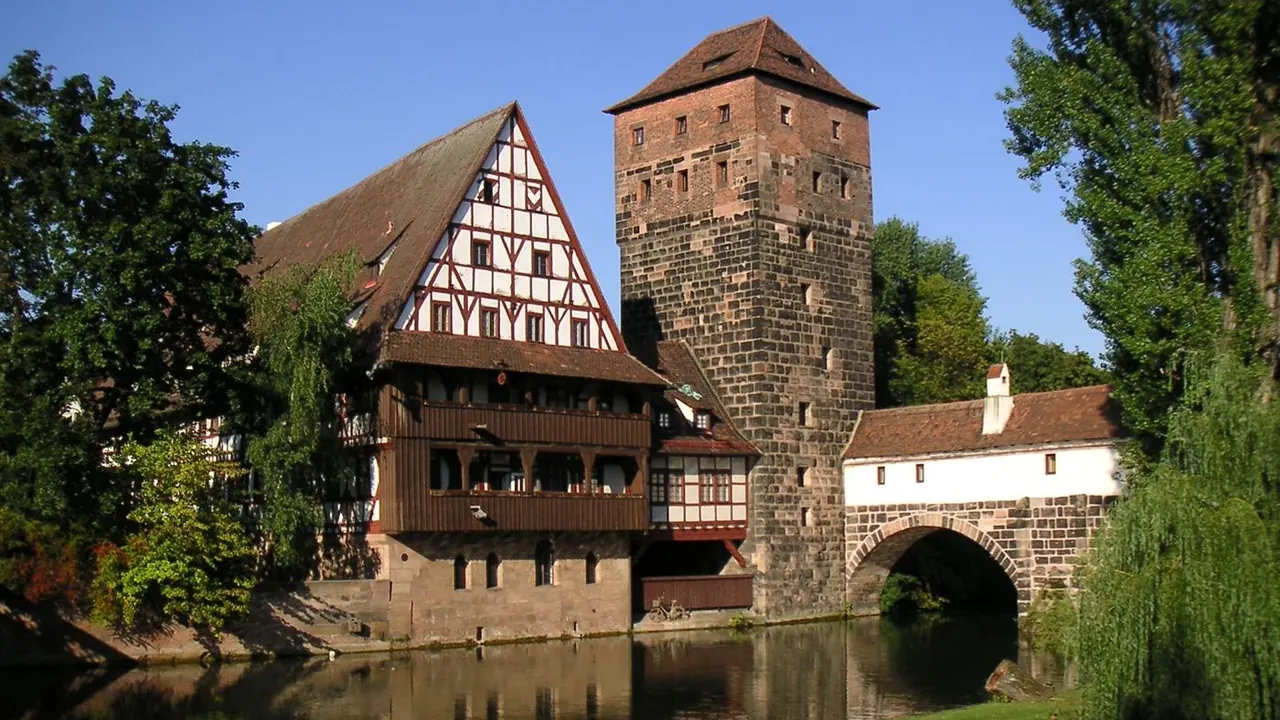
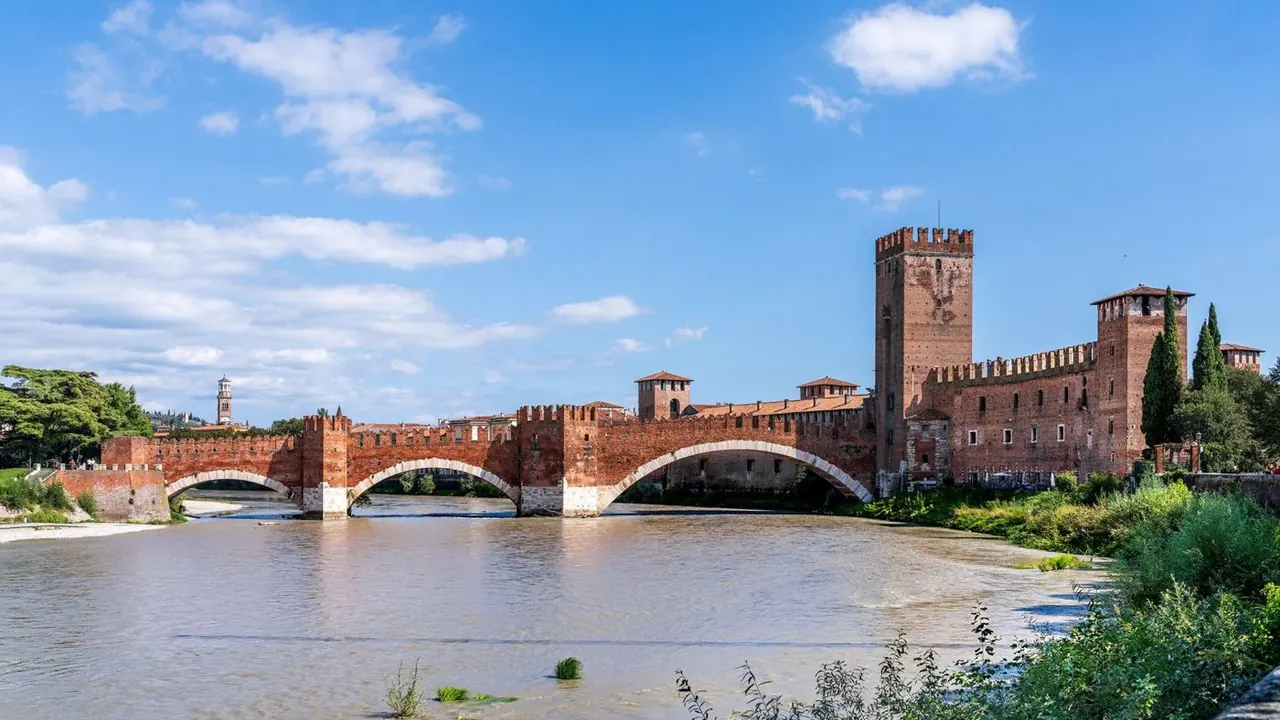
Photos: Nuremberg by Horst Gutmann, CC BY 2.0, cropped; Verona by NorbertNagel, CC BY-SA 4.0, cropped.
Nuremberg or Verona?
Our verdict in twelve categories, each scored against the same fixed benchmark cities, and the climate month by month, so you can choose for your trip.
Choose Nuremberg for
- getting around
- prices
- nightlife
Nuremberg suits a traveller who wants German history in depth and an easy stay without a car. The walled old town, the Kaiserburg and the Germanisches Nationalmuseum sit alongside the Rally Grounds and Courtroom 600, and you can reach Bamberg, Regensburg and Würzburg by train. Beer lovers and anyone coming in Advent for the Christkindlesmarkt will feel it was the right choice.
Choose Verona for
- beaches
- live music and the arts
- food and drink
Verona is the stronger pick for a warm-weather trip with more variety. Its Roman and Romanesque centre is richer, opera on the Arena's stone tiers is a reason to come in itself, and Lake Garda, the Valpolicella wineries and Venice, Padua and Vicenza are all within easy reach. In return you get hot afternoons in high summer, and some of the hill and lake outings work best with a car.
Scoreboard
Twelve categories on one fixed scale from 0 to 100. The shaded stretch is the gap between the two.
Your match
Pick a travel style or drag the sliders, and both match scores follow your weighting.
Wins on getting around and prices with your weighting.
Wins on beaches and live music and the arts with your weighting.
What matters to you?
Category by category
What the scores mean for a trip.
Beaches & swimming
Neither city is on the coast, but the gap between them is real. From Nuremberg, a swim means an hour's trip to the Franconian Lake District reservoirs such as the Brombachsee, with grassy banks and small sandy strips for a short summer season. On ordinary days that leaves the city's outdoor pools.
Verona has Lake Garda about half an hour away, warmer and clear, with lidos, lawns running down to the water, pebble coves and the flat rocks at Sirmione from June to September. It is still a day out rather than a beach base, but a much better one.
Food & drink
This is beer country against wine country. Nuremberg eats heavy Franconian food: finger-sized bratwurst grilled over beechwood, Schäufele with dumplings, and Lebkuchen all year. Its real pleasure is the small-brewery lager and Kellerbier in the taverns and beer gardens along the Pegnitz.
Verona eats better and with more variety. There is risotto made with Amarone, bigoli with duck, and bollito misto with pearà, served in plain osterie around Piazza delle Erbe and in Veronetta. Valpolicella, Soave and Bardolino are poured by the glass at the counter, although the restaurants by the Arena are best avoided.
Culture & sights
Nuremberg's sights fall into two separate halves, far apart in time and on the map. Inside the walls is the medieval imperial city: the Gothic churches of St Sebaldus and St Lorenz, the Beautiful Fountain on the Hauptmarkt, Dürer's house and the half-timbered lanes along the Pegnitz. Much of it had to be rebuilt after the Second World War, so many of the façades are faithful postwar copies rather than the original stone. The other half lies out in the south-east at the Rally Grounds and their documentation centre, which deserve a separate half day.
Verona's past survives in its original stone, and its centre is the richer of the two to walk through. The Arena on Piazza Bra is a Roman amphitheatre still in use, the Roman theatre climbs the hill below Castel San Pietro, and the della Scala lords left their tombs beside Piazza dei Signori. With San Zeno's bronze doors and Scarpa's setting for the Castelvecchio collection, this UNESCO-listed loop of the Adige fills two or three unhurried days, and Juliet's balcony is the least of it.
Nightlife
Evenings are relaxed in both cities and neither is a reason to travel. They differ in style. Nuremberg's livelier nights are in Gostenhof, where small bars and alternative venues fill the old working-class streets, there are a few clubs, and Erlangen's students keep weekends busy.
Verona's evening is the aperitivo, with a spritz or Valpolicella in Piazza delle Erbe followed by the cheaper wine bars of Veronetta. On summer nights the opera crowd leaving the Arena near midnight briefly brings the centre back to life.
Nature & outdoors
Nuremberg's outdoors is gentle. The Reichswald pine forest begins at the edge of town, and the Pegnitz valley makes for easy riverside cycling. An hour to the north-east, Franconian Switzerland adds wooded valleys, limestone towers, caves and well-known rock climbing, which is good country for walkers but has no high ground.
Verona has more varied country around it. The Valpolicella hills of vineyards and cypresses start just north of town, and Monte Baldo rises steeply above Lake Garda with ridge walks and paragliding. The north end of the lake has some of Europe's most reliable wind for sailing, and the Lessinia plateau offers beech woods and gorges. The Alpine foothills give it a height and drama that Nuremberg's forests lack.
Day trips
Both are excellent bases, and Verona's choice is the more remarkable. Venice is reachable for a full day by train, Vicenza's Palladian villas and Padua's Scrovegni Chapel are even closer, and Mantua, the Garda towns and the cellars of Valpolicella and Soave are all within easy range.
Nuremberg's list is strong in its own right: Bamberg's smoked-beer taverns in under an hour, Regensburg on the Danube, Würzburg's Residence, the walled towns of Rothenburg and Dinkelsbühl, and Munich by fast train. It is a mostly German, medieval circuit rather than Verona's mix of art cities and lakes.
Good for families
Both cities work well with children, but in different places. In Nuremberg most of it is in town and reachable by public transport: the Toy Museum, the railway museum with Germany's first train, and the large zoo in old quarries. There is also a toy brand's play park in nearby Zirndorf, and in Advent a children's Christmas market. The steep cobbled climb to the castle is the one effort.
Verona's centre is flat and easy with a pushchair, but its big draws, Gardaland, Parco Natura Viva and the shallow lake, are all outside town and easiest by car.
Getting around
Nuremberg is the easier city to get around. The main station sits right outside the southern gate, the walled centre is walkable, and U-Bahn lines, trams and S-Bahn trains on one ticket reach the zoo, the Rally Grounds, Fürth and Erlangen. Regional trains then handle the day trips, so no car is needed.
Verona's centre is just as walkable, flat and mostly free of traffic, but the station is about twenty minutes' walk from Piazza Bra and there is no metro or tram. Rail serves Venice, Milan and Peschiera well, while the wine villages and the Lessinia are much easier by car.
Shopping & style
Neither is a shopping destination, but Verona is the more pleasant place to browse. Via Mazzini's marble paving and Italian labels, plus the boutiques and jewellers of Corso Porta Borsari, feel smarter than Nuremberg's chain-store run from the station to the Hauptmarkt.
The souvenirs differ too. Nuremberg sends you home with Lebkuchen in tins, wooden toys and crafts from the Handwerkerhof, with the Christkindlesmarkt as its seasonal peak. Verona's best buys are Amarone, Garda olive oil and pandoro.
Affordability
The two cost about the same, and in both the bill depends on the room. Nuremberg's taverns, local beer and transport are cheap, but hotels become scarce during the big trade fairs and Advent.
In Verona, wine counters and Veronetta's student osterie keep meals fair, and local wine is good value. Rooms in the centre are expensive, though, and opera nights and trade fairs push them higher. Staying near the station or across the river helps.
Live music & performing arts
Verona has the bigger draw: grand opera in the Roman Arena on most summer evenings, with thousands on the ancient tiers and candles lit at dusk. The Roman theatre adds Shakespeare, dance and jazz outdoors, and the Teatro Filarmonico keeps a smaller season going in the cooler months.
Nuremberg's programme is solid and spread more evenly across the year. The Staatstheater stages opera, ballet and drama in its Art Nouveau house, and summer brings the free Bardentreffen folk weekend, an open-air orchestral concert in the Luitpoldhain and a large rock festival by the Zeppelinfeld.
Wellness & relaxation
Nuremberg offers German sauna culture, and Verona has warm springs in the open air. On the Nuremberg side, a large thermal spa with sauna gardens is a short U-Bahn ride away in Fürth, and the leisure pools on the edge of town have saunas that are nude and mixed. An hour west, Bad Windsheim's saline pools let you float.
Verona's springs rise around Lake Garda. Sirmione's sulphurous thermal centre has pools facing the lake, near Lazise a spring-fed lake lies in an old villa garden, and the springs at Caldiero have been used since Roman times. In town, the terraces of the Giardino Giusti and an evening passeggiata along the Adige do the rest.
When should you go?
Pick your month. The climate figures are measured averages, not a forecast.
Nuremberg in July
Verona in July
Daytime high, °C
Rainfall in the month, mm
Temperature and rainfall are climate normals, averaged over the years shown. Nuremberg: 1991-2020 normals, Nuernberg (5.5 km from centre). Verona: 1991-2020 normals, Verona / Villafranca (11.6 km from centre).
Nuremberg is at its best from May to September, when highs of around 25°C in July and August make the old town and the beer gardens comfortable all day and sunshine is at its most generous. Summer is also its wettest stretch, so expect some showers. From November to February it is cold and grey, with highs near 4°C, which suits Advent more than lazy days outdoors.
Verona runs several degrees warmer all year. April, May, late September and October are ideal for walking the centre. July and August reach about 30°C under long, sunny skies, which is good for swimming in Lake Garda and evenings at the Arena but heavy going for sightseeing at midday. The rain comes mostly in autumn, peaking at about 85mm in September, and winters are mild next to Nuremberg's but still cool.
Which traveller are you?
On a beach and sun trip, Verona is the clear choice. Lake Garda's southern shore is about half an hour away, with lidos, lawns and Sirmione's limestone shelves. Nuremberg's Franconian lakes are an hour off and have a shorter, cooler season.
For a culture and arts trip, Verona edges ahead. It has the Arena, the Roman theatre, San Zeno and Castelvecchio, plus summer opera under the stars. Nuremberg answers with the Kaiserburg, a great national museum and a sobering twentieth-century history Verona cannot match.
For a short city break, Nuremberg is the easier of the two. The station is at the southern gate, nearly everything lies inside walls about 1.5km across, and one ticket covers the U-Bahn and trams out to the Rally Grounds and Courtroom 600.
Before you go
| Measure | Nuremberg | Verona |
|---|---|---|
| Official language | German | Italian |
| Currency | Euro (EUR) | Euro (EUR) |
| Sockets | CF230 V, 50 Hz | CFL230 V, 50 Hz |
| Driving side | Right | Right |
| Time zone | UTC+1, UTC+2 in summer | UTC+1, UTC+2 in summer |
| Emergency number | 112 | 112 |
| Elevation | 209 m | 59 m |
| Main airport | Nuremberg Airport (NUE)5 km from centre56 non-stop destinations | Verona Villafranca Valerio Catullo Airport (VRN)10 km from centre96 non-stop destinations |
| Public holidays this year | 12 days | 13 days |
By the numbers
| Measure | Nuremberg | Verona |
|---|---|---|
| City population | 531,159 | 255,588 |
| People per km² | 2,848 | 1,285 |
| Museums within 10 km | 50 | 18 |
| UNESCO World Heritage sites within 50 km | 1 | 5 |
Where else could you go?
Every comparison below shares a destination with this one, so you can follow Nuremberg or Verona somewhere new.