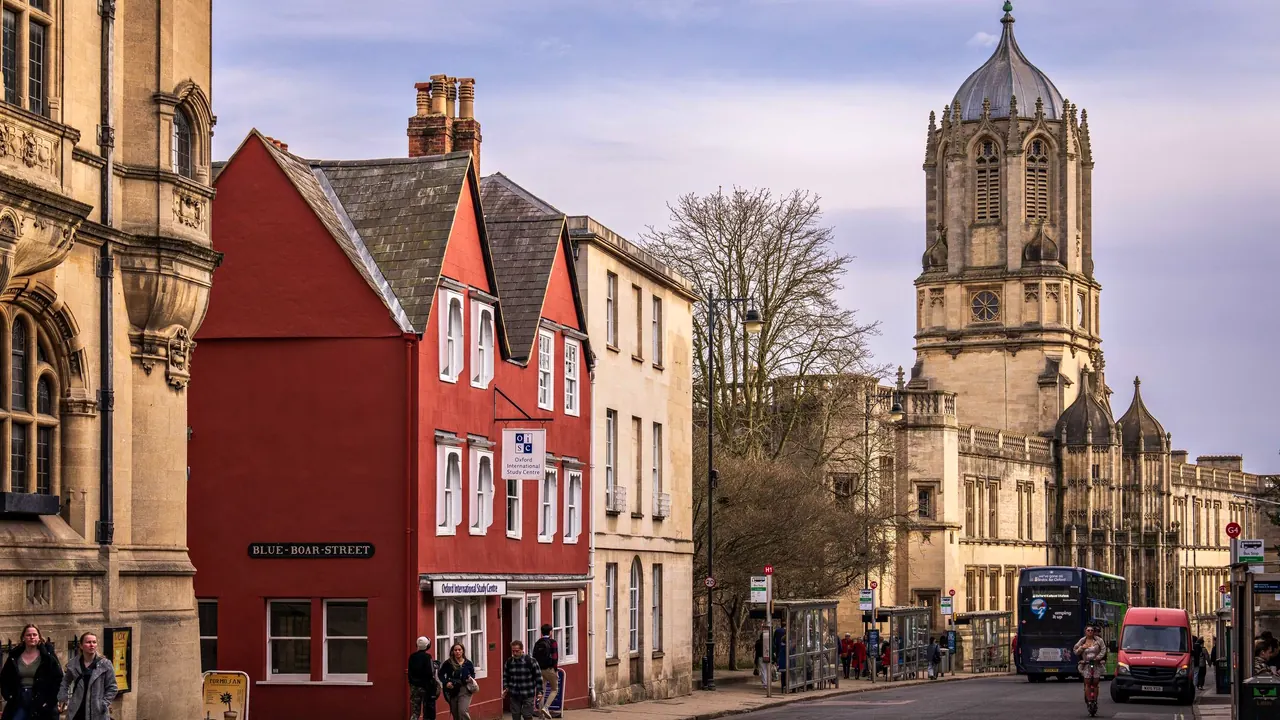

Photos: Oxford by Mark Stebnicki, Pexels License; St Andrews by Holger Uwe Schmitt, CC BY-SA 4.0, cropped.
Oxford or St Andrews?
Our verdict in twelve categories, each scored against the same fixed benchmark cities, and the climate month by month, so you can choose for your trip.
Choose Oxford for
- culture and sights
- live music and the arts
- shopping
Oxford is the stronger choice for a trip built around sights. It has college quadrangles, the Ashmolean and the Pitt Rivers, Evensong in a candlelit chapel, and a railway station that puts London, Blenheim and the Cotswolds within easy reach. It suits travellers who want two or three full days of looking, a pub supper by the river afterwards, and plenty of varied outings from one base.
Choose St Andrews for
- beaches
- nature and the outdoors
- wellness
Choose St Andrews for sea air and open space. It is a smaller, slower town where the ruined cathedral, the clifftop castle and the Old Course sit beside long sandy beaches, and the Fife Coastal Path, Tentsmuir's seals and the East Neuk harbours fill the days. Golfers, walkers and anyone happy with quiet evenings will get more from it than from Oxford, as long as they accept that the town itself takes only a day or two to see.
Scoreboard
Twelve categories on one fixed scale from 0 to 100. The shaded stretch is the gap between the two.
Your match
Pick a travel style or drag the sliders, and both match scores follow your weighting.
Wins on culture and sights and live music and the arts with your weighting.
Wins on beaches and nature and the outdoors with your weighting.
What matters to you?
Category by category
What the scores mean for a trip.
Beaches & swimming
Neither town is a swimming destination, but St Andrews does have real beaches. West Sands is a long, pale strand below the dunes, East Sands is a sheltered beach by the harbour and Castle Sands lies under the cliffs, all within walking distance of the centre. The North Sea stays cold, though, so they are for walks, kites and a brisk dip.
Oxford is about as far from the coast as you can get in England. Swimming there means river water at Port Meadow and on the Cherwell, or the open-air pool at Hinksey. That is pleasant on a hot afternoon, but it is no substitute for sand.
Food & drink
Both towns eat well without being worth the journey for food alone, and in both the pub and the café carry most meals. The difference is in kind. Oxford offers range: the Covered Market's counters, cheap Middle Eastern, South Asian and Caribbean food along Cowley Road, and neighbourhood bistros in Jericho.
St Andrews offers a sense of place instead. It has Fife lamb, East Neuk crab and lobster, fish and chips by the harbour and smoked fish down the coast, and on summer evenings people queue for ice cream.
Culture & sights
Oxford has far more to see. Its colleges, the Bodleian, the Radcliffe Camera and the Sheldonian make a working medieval university town packed into a few streets, and the Ashmolean, the Pitt Rivers and the Natural History Museum hold collections of national importance. Allow two or three full days.
St Andrews' heritage is smaller in scale and partly in ruins. It has the cathedral and St Rule's Tower, the clifftop castle with its bottle dungeon and siege tunnels, and St Salvator's Chapel, plus the golf heritage of the Old Course and the British Golf Museum. A day or two does it justice.
Nightlife
Neither town suits a big night out, and in both an evening out means the pub. Oxford gives you more choice: historic taverns, riverside pubs on summer evenings, late bars and a couple of small clubs on Cowley Road, and cocktail bars in Jericho.
St Andrews is quieter still, with traditional bars, golfers' lounges and the students' union. Anyone after something livelier goes to Dundee or Edinburgh. Both towns go quiet when the students leave for the summer.
Nature & outdoors
St Andrews has the wilder setting. The Fife Coastal Path runs past cliffs, dunes and rocky shore, wading birds gather on the Eden estuary, seals haul out beyond Tentsmuir Forest, and the Lomond Hills offer proper hill walking a drive away. Golf on the links is the town's defining outdoor pursuit.
Oxford's countryside is gentler but begins right in town, with Port Meadow, Christ Church Meadow and the riverside paths, and punting and rowing on the Thames and the Cherwell. The Cotswolds, the Chilterns and the Ridgeway are within an hour for long, mild walks.
Day trips
Both make good bases, but Oxford's reach is wider and easier. Blenheim Palace is twenty minutes away, the Cotswold villages are within an hour and London is an hour by train. Stratford, Warwick, Windsor and Bath all make comfortable days out.
St Andrews has fine trips of its own: the East Neuk harbours, Falkland Palace, Dundee's V&A and the ship Discovery, and Edinburgh as a full day out. Most of the inland castles and abbeys need a car, though, and without one the outings take some planning around buses.
Good for families
Both are small, safe and easy to walk with children. Oxford comes out ahead thanks to the free Natural History Museum with its dinosaurs, the curiosities of the Pitt Rivers, punting on the Cherwell and the Harry Potter connections at Christ Church, with Blenheim's maze a short trip out.
St Andrews swaps museums for the seaside. Children can build sandcastles and search rock pools on East Sands, visit the small aquarium, crawl through the castle's siege tunnels and ride the miniature railway at Craigtoun Park. The weather can cut those days short, though.
Getting around
In both towns you walk almost everywhere. Oxford does better on connections: its station is a short walk from the centre with direct trains to London and the Midlands, buses run out to the suburbs and bicycles are everywhere. A car is more of a nuisance than a help.
St Andrews has no station of its own, so trains arrive and leave at Leuchars, about 8km away by bus or taxi. Buses cover the coast, but the inland countryside is much easier with a car.
Shopping & style
Oxford has more depth. Alongside a shopping centre and the usual chains there are the Covered Market's small traders, independent shops in Jericho and on Little Clarendon Street, antique map sellers and the enormous Blackwell's bookshop. The Bicester outlet village is twenty minutes away for designer labels.
St Andrews is an afternoon's browse along its three main streets. It is strongest in golf gear, cashmere, knitwear and tartan, and serious shoppers go on to Edinburgh.
Affordability
Both are expensive places to stay, for similar reasons: there are few rooms, and demand rises sharply around graduations, with Oxford's conferences and St Andrews' golf tournaments on top. Once you are there, Oxford's free museums and Cowley Road cafés keep daily costs down, though college entry fees and library tours add up.
In St Andrews the sights cost little and takeaway fish and chips keep lunches modest, but a round on the famous courses is a serious expense.
Live music & performing arts
Oxford's great draw is Evensong sung by the choirs of Christ Church, Magdalen and New College. It also has orchestral concerts at the Sheldonian and chamber music and jazz at the historic Holywell Music Room, while the Playhouse and the New Theatre bring touring drama and musicals.
St Andrews has a modest programme built around the Byre Theatre and the university's concerts and choral evenings in term, with folk sessions in a few pubs. For orchestras or bigger productions, visitors go to Edinburgh or Dundee.
Wellness & relaxation
Neither is a spa town, and both offer calm rather than treatments. Oxford's calm is green and enclosed: the Botanic Garden, the walled college gardens, Addison's Walk and a slow afternoon on a punt. St Andrews' calm is open and bracing, with long walks on West Sands, a cold dip off East Sands with the locals, and full spas at the golf resorts that are open to non-residents.
When should you go?
Pick your month. The climate figures are measured averages, not a forecast.
Oxford in July
St Andrews in July
Daytime high, °C
Rainfall in the month, mm
Where the figures come from
Oxford's temperatures are measured 37 km from the centre, at Fairford Royal Air Force Base.
Oxford has no rain gauge within 25 km of the centre, so its rainfall comes from a gridded climate dataset read at the city rather than from a gauge further away.
Oxford's sunshine is measured 57 km from the centre, at Lyneham.
Temperature and rainfall are climate normals, averaged over the years shown. Oxford: 1961-1990 (sunshine 1991-2020, rainfall 1991-2020) normals, Fairford Royal Air Force Base (37 km from centre). St Andrews: 1991-2020 normals, Leuchars (6.5 km from centre).
Oxford has the warmer and sunnier summer. July reaches about 22°C, and June to August are the months for riverside pubs, punting and a dip at Port Meadow. St Andrews peaks a little lower, at about 19°C in July and August, and the North Sea only reaches 14°C, so even in summer the beach is mostly for walking. Both towns are comfortable for exploring on foot from May to September.
Winters are cool and short of daylight in both, and Oxford is the colder in January at around 5°C. Rain falls fairly evenly through the year, but autumn is the wettest stretch, especially in St Andrews, where October brings about 80mm. May is equally bright in both. From June to August Oxford gets noticeably more sunshine, while the sky over the Fife coast is more often grey.
Which traveller are you?
For a culture and arts trip, Oxford is the clear pick. The colleges, the Bodleian and three fine museums fill several days, and Evensong in a college chapel or a concert at the Sheldonian makes for evenings that St Andrews cannot match.
On an outdoors trip, St Andrews suits walkers who want long coastal days straight from their door, wildlife to watch and proper hills a drive away, and who do not mind the wind. Oxford fits an easier pace of flat riverside cycling, punting and mild country rambles.
For golfers, St Andrews is the obvious choice. The Old Course, the Swilcan Bridge and the links all around town make it a pilgrimage, and the British Golf Museum, the public putting green and the golf shops fill the hours off the course. Oxford has nothing comparable.
Before you go
| Measure | Oxford | St Andrews |
|---|---|---|
| Official language | English | English |
| Currency | Pound Sterling (GBP) | Pound Sterling (GBP) |
| Sockets | G230 V, 50 Hz | G230 V, 50 Hz |
| Driving side | Left | Left |
| Time zone | UTC, UTC+1 in summer | UTC, UTC+1 in summer |
| Emergency number | 112 or 999 | 112 or 999 |
| Elevation | 73 m | 24 m |
| Main airport | London Heathrow Airport (LHR)63 km from centre224 non-stop destinations | Edinburgh Airport (EDI)56 km from centre163 non-stop destinations |
| Public holidays this year | 8 days | 10 days |
By the numbers
| Measure | Oxford | St Andrews |
|---|---|---|
| City population | 147,500 | 16,460 |
| People per km² | 3,235 | - |
| Museums within 10 km | 11 | 5 |
| UNESCO World Heritage sites within 50 km | 1 | 0 |
| Swim season, months above 21 °C | - | None |
Where else could you go?
Every comparison below shares a destination with this one, so you can follow Oxford or St Andrews somewhere new.
- Edinburghvs St Andrews
- Londonvs Oxford
- Bathvs Oxford
- Bristolvs Oxford
- Aberdeenvs St Andrews
- Glasgowvs St Andrews