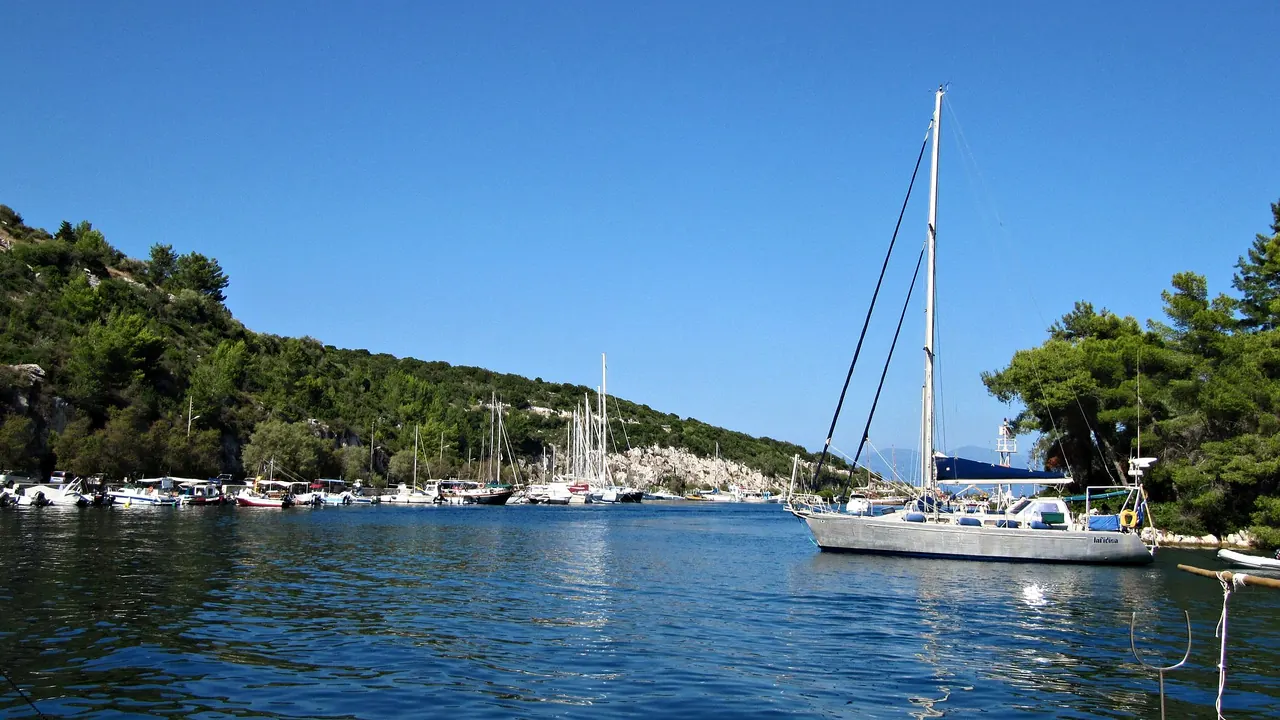
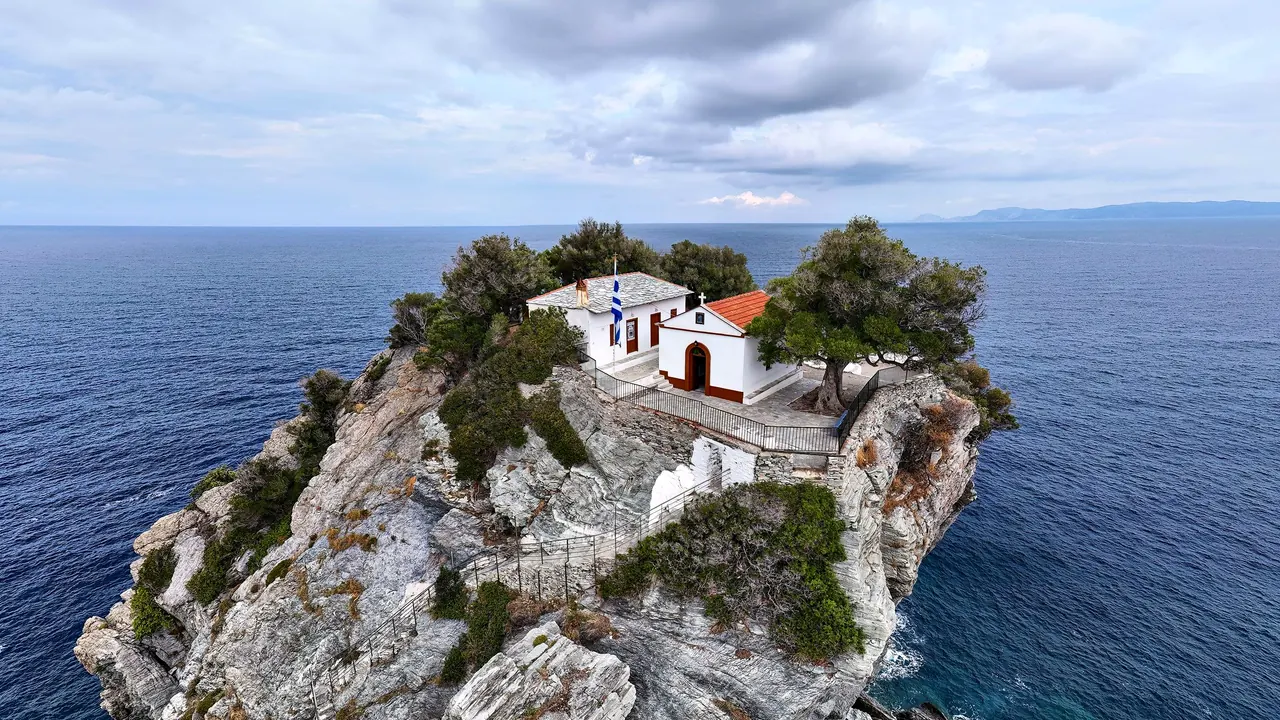
Photos: Paxos by Poiesia, CC BY-SA 4.0, cropped; Skopelos by Giles Laurent, CC BY-SA 4.0, cropped.
Paxos or Skopelos?
Our verdict in twelve categories, each scored against the same fixed benchmark cities, and the climate month by month, so you can choose for your trip.
Choose Paxos for
- wellness
- getting around
- day trips
Paxos is for travellers who want very little to happen. It suits a villa among the olive groves, a hired motorboat and days spent moving between pebble coves and the pale sand of Antipaxos, with the white cliffs of the west coast seen from the water. It is quieter and better for doing nothing well, and getting between its three small harbours is simple. In return you pay more and give up most sights and evening life.
Choose Skopelos for
- prices
- culture and sights
- nature and the outdoors
Skopelos gives more to do once you are ashore. Its tiered harbour town, its monasteries on Mount Palouki and its pine-covered hills make it the better island for walking, for a little history and for boat trips into a marine park with monk seals and dolphins. It is also the easier island on the budget, with family-run rooms and tavernas. The beaches are just as good, but spread along one road rather than tucked into coves you reach by boat.
Scoreboard
Twelve categories on one fixed scale from 0 to 100. The shaded stretch is the gap between the two.
Your match
Pick a travel style or drag the sliders, and both match scores follow your weighting.
Wins on wellness and getting around with your weighting.
Wins on prices and culture and sights with your weighting.
What matters to you?
Category by category
What the scores mean for a trip.
Beaches & swimming
These are two equally strong swimming islands, and the difference is in the shape of the coastline. Paxos keeps its beaches on the sheltered east side, mostly small pebble coves such as Kipiadi and Monodendri, with calm sandy shallows in the round bay at Lakka. Its best sand is across the water on Antipaxos, at Voutoumi and Vrika, so a hired motorboat becomes part of the routine.
Skopelos spreads its beaches along the south and west coasts, with pine forest running down to the shingle at Panormos, Milia and Kastani and sand at Limnonari. Most can be reached by road. Paxos favours a day spent hopping between coves by boat, while Skopelos favours a different beach each day by car or bus, keeping to the south shore when the meltemi blows.
Food & drink
Neither island is a reason to travel for food, and both rely on harbour tavernas serving grilled fish and simple island cooking that closes down outside summer. Paxos leans on Ionian dishes such as bourdeto and sofrito, its own olive oil and a few kitchens doing more careful, modern cooking for villa guests.
Skopelos has more that belongs to it alone: the coiled cheese pie, fried rather than baked, plums and prunes worked into savoury dishes, and almond sweets from the town bakeries. Add goat and lamb in the hill villages and tsipouro with mezze, and it has the slightly more distinctive table, while Paxos has the slightly more polished one.
Culture & sights
Skopelos has more to see. Its main town is a sight in itself, slate-roofed houses climbing from the harbour to a Venetian castle, and the monasteries of Evangelistria and Prodromos on Mount Palouki make good half-day outings. Glossa adds a second old village, and the Agios Ioannis chapel on its rock draws fans of Mamma Mia.
Paxos has little beyond the view from Gaios harbour to the Venetian fort ruins and the Panagia monastery on their islets, plus a small museum of island life. Its old olive presses and stone houses are things you pass on a walk, and anyone wanting real history takes the boat to Corfu Town.
Nightlife
Both islands go quiet after dinner, but Skopelos keeps a little more going. Its small bars tucked into the lanes of the main town play Greek music late in July and August, which gives an evening more of a shape than a single harbour drink. On Paxos the night is mostly a waterfront bar in Gaios or Lakka beside the moored yachts, with one or two places to dance in high summer and almost nothing outside it.
Nature & outdoors
Skopelos is the greener and more varied island. Aleppo and black pine cover it up to Mount Delfi, old mule tracks run between chapels and bays, and the National Marine Park of the Northern Sporades on its doorstep offers the chance of monk seals and dolphins.
Paxos is low and covered in ancient olive groves, with a waymarked trail running its whole length. Its real drama is the limestone west coast, the Erimitis cliffs at sunset, the Tripitos arch and sea caves best reached by kayak or boat, but beyond that the range is narrow.
Day trips
Both islands rely on boats for their outings, and the choice is about what lies at the other end. From Paxos the fast ferry reaches the UNESCO-listed old town of Corfu in about an hour, and excursion boats cross to Parga and the coves around Sivota, so a proper town and the mainland are within reach.
Skopelos looks to its neighbours instead: lively Skiathos one way and quieter Alonissos with its hilltop old village the other, often combined with swimming stops in the marine park. The mainland is too far for a day, so Paxos gives the richer single outing and Skopelos the more island-hopping kind.
Good for families
Neither island has attractions built for children, and both suit a simple beach stay best. Paxos offers the calm, shallow bay at Lakka for small children, but most other beaches are pebble with steep paths and many villas need a car.
Skopelos has more gently shelving bays with tavernas close by, at Limnonari, Panormos and Agnontas, which makes a stay on the south coast easy with little ones. Its stepped town is hard with a pushchair, though, and on both islands older children who enjoy boats, snorkelling and kayaking get the most from the trip.
Getting around
Paxos is the easier island to get around. At only about 10km long, nothing is far, its three villages are linked by footpaths through the olive groves, and a hired boat reaches the coves the roads miss. Arrival is the weak point, a ferry from Corfu or the mainland that rough seas can cancel.
Skopelos is larger and depends on one main road from the town to Glossa, with summer buses to the known beaches and a car or scooter needed for the north coast and monasteries on narrow, sometimes unpaved roads. Reaching it means a flight to Skiathos and then a boat, or a long ferry from Volos or Agios Konstantinos.
Shopping & style
Shopping is an evening stroll on both islands rather than a reason to go. Paxos has summer boutiques with linen, jewellery and beachwear in the lanes of Gaios and Lakka, and its olive oil is the thing to bring home. Skopelos has similar small shops behind its harbour, with a wider choice of edible souvenirs: prunes, herbal teas, honey and almond sweets.
Affordability
Skopelos is the clearly cheaper island. Family-run studios and rooms are moderately priced, and an evening of grilled fish, salad and local wine stays reasonable, even if the ferry and a hire car add up.
Paxos costs a good deal more. Stays are mostly in private villas that fill early, harbourside restaurants charge for their setting, and a boat and ferry crossings are hard to avoid. Self-catering and the shoulder months help on both islands, but they help more on Paxos, where the gap is widest in high summer.
Live music & performing arts
There is very little on either island, and what there is happens in summer. Paxos has the edge in organised events, with a small chamber music festival at the end of summer in churches and village squares, as well as the August feast of the Panagia in Gaios. Skopelos has no festival of that kind but more regular music, with rebetiko and island songs in the tavernas and bars of the main town on summer nights and dancing at the village saints' days.
Wellness & relaxation
Paxos does relaxation better. Its calm runs deeper, with no high-rise building, very few cars and villas among the olive trees looking out to sea. It also has a few treatment rooms in larger villas and hotels, and yoga or retreat weeks on some estates.
Skopelos relaxes you through slow days, late breakfasts and shaded tavernas, but it offers little beyond a few hotel spas and seasonal massage, and nothing in the way of retreats. On both islands June and September are the most peaceful months.
When should you go?
Pick your month. The climate figures are measured averages, not a forecast.
Paxos in July
Skopelos in July
Daytime high, °C
Rainfall in the month, mm
Where the figures come from
Paxos's temperatures are measured 52 km from the centre, at Kerkyra Airport.
Paxos has no rain gauge within 25 km of the centre, so its rainfall comes from a gridded climate dataset read at the destination rather than from a gauge further away.
Skopelos's temperatures are measured 68 km from the centre, at Skyros Airport.
Skopelos has no rain gauge within 25 km of the centre, so its rainfall comes from a gridded climate dataset read at the destination rather than from a gauge further away.
Temperature and rainfall are climate normals, averaged over the years shown. Paxos: 1991-2020 normals, Kerkyra Airport (52.1 km from centre). Skopelos: 1998-2025, 11 years observed (rainfall 1991-2020) normals, Skyros Airport (67.7 km from centre).
Both islands are summer places, with the sea warm enough for swimming from June to early October and at its warmest in August. Paxos gets hotter. Its afternoons reach 32°C in July and August, which makes the inland lanes hard work in the middle of the day, while Skopelos stays nearer 29°C. Paxos is also very sunny, with long, clear days from May to August.
The bigger difference comes in autumn and winter. On Paxos the rain arrives early: September is already noticeably wetter and November is the wettest month at about 163mm, so the season ends abruptly. Skopelos stays dry through September and its winters are far less wet, which makes October more dependable there. For walking, Paxos is at its best in April and May, before the heat builds, and again on the drier days of October. Skopelos is pleasant in April and May too, and its milder, drier autumn keeps the paths comfortable from late September well into October.
Which traveller are you?
For a relaxing and wellness trip, Paxos is the better choice. Villas set among olive groves, slow harbours, very few cars and the occasional yoga or retreat week on an estate give it a deeper calm than Skopelos, which has only a handful of hotel spas.
On a trip on a tight budget, Skopelos goes much further. Family-run studios and taverna meals are moderately priced, while Paxos is one of the dearer Greek islands, with villa stays, harbourside prices and ferry and boat hire all adding to the cost.
For an outdoors trip, Skopelos has more country to explore. Pine forest climbs to Mount Delfi, waymarked mule tracks link monasteries and bays, and boats head into the Northern Sporades marine park. Paxos has fine sea cliffs and caves, but its walking is mostly through low olive groves.
Before you go
| Measure | Paxos | Skopelos |
|---|---|---|
| Official language | Greek | Greek |
| Currency | Euro (EUR) | Euro (EUR) |
| Sockets | CF230 V, 50 Hz | CF230 V, 50 Hz |
| Driving side | Right | Right |
| Time zone | UTC+2, UTC+3 in summer | UTC+2, UTC+3 in summer |
| Emergency number | 112 | 112 |
| Main airport | Corfu Ioannis Kapodistrias International Airport (CFU)88 non-stop destinations | Skiathos Island National Airport (JSI)37 non-stop destinations |
| Public holidays this year | 15 days | 15 days |
By the numbers
| Measure | Paxos | Skopelos |
|---|---|---|
| Population | 2,300 | - |
| People per km² | 91 | - |
| Swim season, months above 21 °C | 5 months | 5 months |
Where else could you go?
Every comparison below shares a destination with this one, so you can follow Paxos or Skopelos somewhere new.
- Skiathosvs Skopelos
- Corfuvs Paxos
- Lefkadavs Paxos
- Halkidikivs Skopelos
- Kefaloniavs Paxos
- Aeginavs Skopelos