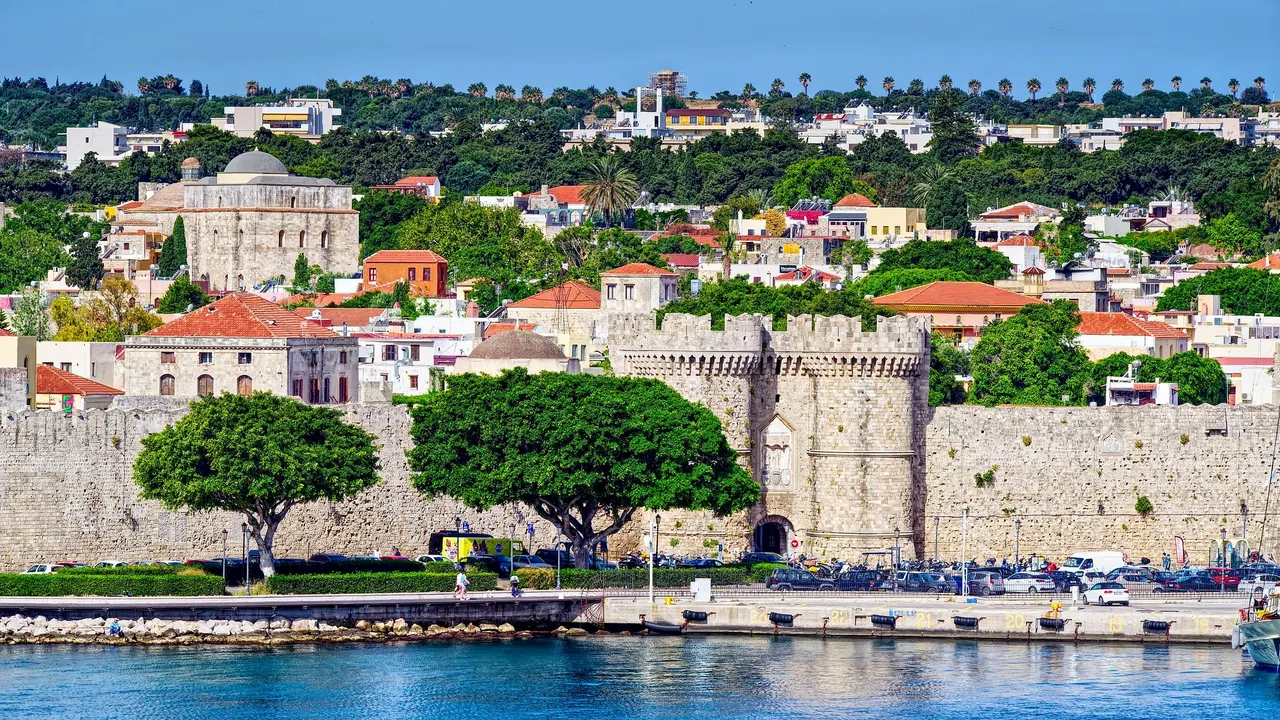
Photos: Rhodes by Mark Thomas, Pexels License.
Peloponnese or Rhodes?
Our verdict in twelve categories, each scored against the same fixed benchmark cities, and the climate month by month, so you can choose for your trip.
Choose Peloponnese for
- nature and the outdoors
- live music and the arts
- day trips
The Peloponnese suits travellers who want to move around and see a great deal: Mycenae, Epidaurus, Olympia and Mystras, the mountain gorges of Arcadia and the long sandy Messinian coast. It works best with a hire car and two or three bases. In return you get better country cooking, lower costs and quieter evenings than on Rhodes.
Choose Rhodes for
- nightlife
- families
- getting around
Rhodes is the easier trip, built around one base and the sea. The sheltered bays of the east coast, resort hotels with kids' clubs and short distances make it simpler with young children. Buses cover the main coast, and the walled Old Town gives you a medieval town to explore on foot. If you want bars after dinner, Faliraki, Rhodes Town and Lindos have far more of them.
Scoreboard
Twelve categories on one fixed scale from 0 to 100. The shaded stretch is the gap between the two.
Your match
Pick a travel style or drag the sliders, and both match scores follow your weighting.
Wins on nature and the outdoors and live music and the arts with your weighting.
Wins on nightlife and families with your weighting.
What matters to you?
Category by category
What the scores mean for a trip.
Beaches & swimming
Both make an excellent beach vacation, and in high summer the sea is about as warm in one as in the other. The difference is in how the beaches are spread out. The Peloponnese has them on separate coasts: the sand of Voidokilia and the long Messinian shore, the turquoise shallows of Elafonisos and the rocks of the Mani. A stay usually means picking one coast or driving between them.
Rhodes has most of its swimming on one sheltered east coast, from Faliraki to Lindos, where one bay follows another and the sand is often mixed with shingle. You can try several beaches from a single hotel, but the best-known ones are crowded with sunbeds in high summer. Many Peloponnese beaches empty out outside July and August.
Food & drink
The Peloponnese is the better choice for food. Its cooking comes from the land around it, from Kalamata olives and oil to the Mani's cured pork. It also has two serious wine areas, Nemea with its Agiorgitiko reds and the Tripoli plateau with its Moschofilero whites. Kalamata's covered market and the choice of places in Nafplio add to it.
Rhodes has dishes worth looking for, such as pitaroudia, matsi pasta and the anise spirit souma, but to find them you have to leave the resort belt and the main lanes of the Old Town. Fine dining is limited in both places. On the Peloponnese, though, there are far fewer tourist menus between you and a good taverna.
Culture & sights
Rhodes has one major sight in the walled Old Town of the Knights, along with Lindos, Kamiros and the stadium on Monte Smith. All of it is within easy reach of a single base, which is a real strength on a shorter stay.
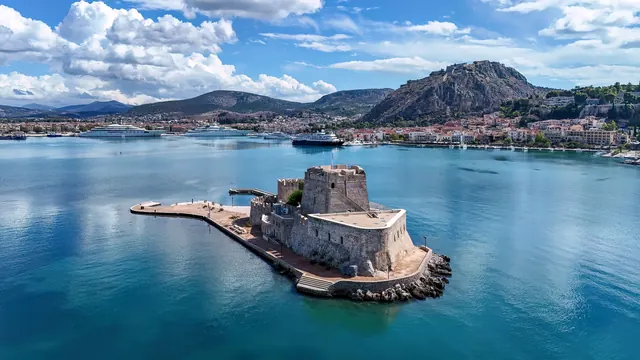
The Peloponnese has far more to see. There are Olympia, Mycenae, Tiryns, Epidaurus, Messene and Bassae, then the Byzantine town of Mystras, the rock of Monemvasia and the Venetian castles of the southwest. The cost is distance: Nafplio covers the Argolid, but Olympia and the south need bases of their own.
Nightlife
Rhodes has much more going out in summer. Faliraki's strip runs until dawn for a young crowd, the Old Town and Mandraki have late bars and a few clubs, and Lindos has rooftop and courtyard bars for an older crowd.
On the Peloponnese, evenings mostly mean a long dinner and a drink on the waterfront in Nafplio or Kalamata. Only Patras, a university city on the north coast away from most visitors' routes, has a real club scene.
Nature & outdoors
The gap is wide here. The Peloponnese has real mountains: Taygetos rises to about 2,400m, the Lousios gorge has monasteries cut into its cliffs, and the Menalon Trail is long and well marked. In the north there is the rack railway through the Vouraikos gorge and winter skiing on Chelmos. Add the bare walking country of the Mani and the bird lagoon at Gialova.
Rhodes is gentler, with pine-covered hills, one real climb on Attavyros and shaded walks in the Valley of the Butterflies and at Seven Springs. Its outdoor strength is wind rather than walking, and Prasonisi is one of the best-known windsurfing and kitesurfing spots in the Mediterranean.
Day trips
From Nafplio alone, the Peloponnese offers ferries to Hydra and Spetses, the Nemea wine villages and even Athens. The Messinian coast adds Pylos, Methoni and the Mani villages, and from the south you can reach Monemvasia and Elafonisos. Nearly all of these trips need a car.
Rhodes has fewer outings, but the best one is memorable: a boat to Symi's harbour, often combined with the monastery of Panormitis, or the crossing to Marmaris in Turkey. The list on the island itself is short, and the boat trips depend on summer schedules and calm seas.
Good for families
Rhodes gives families more to do away from the sand. The shaded Valley of the Butterflies and a walk along the Old Town ramparts usually go down well with children. Its drawbacks are the heat of July and August for small children and the steep, stepped lanes of Lindos, which are hard work with a pushchair.
On the Peloponnese, Nafplio is the easy town for a pushchair stroll, and Tolo and Elafonisos have shallow, sandy water. Its great sights are harder going for young children. Mycenae and Olympia have little shade and are best seen early in the morning, so they suit older children better.
Getting around
Rhodes is simpler to get around. Buses run well along the east coast to Faliraki and Lindos, the Old Town is car-free, and even the drive to the southern tip takes only about an hour and a half. A car is useful for a few days rather than the whole stay.
On the Peloponnese a car is close to essential. Motorways make the main towns quick to reach, but roads through the mountains and the Mani are slow. Buses rarely reach beaches or sites, and passenger trains barely reach the region at all.
Shopping & style
Neither is a shopping destination, but Rhodes is the better place to browse. Sokratous Street in the Old Town packs jewellery, leather and sponges into one lane. The new town around Mandraki adds ordinary high-street fashion and a few better boutiques, and hand-painted Lindian ceramics are made in Archangelos and around Lindos.
The Peloponnese has fewer shops, and they are spread across the region. Nafplio's old lanes are the best place for jewellery, worry beads and ceramics. Its real strength is food to take home: Kalamata olive oil, mountain honey and wine bought directly from the Nemea wineries.
Affordability
The Peloponnese makes a budget go further. Family-run rooms in the Mani and Arcadian villages, taverna meals and local wine are cheap, though a hire car, fuel and entry fees at the major sites add up.
Rhodes is middle-priced. Package hotels and buses keep the east coast reasonable, but Lindos and the boutique hotels of the Old Town are expensive. July and August push room prices up in both.
Live music & performing arts
The Peloponnese has the one outstanding performance of the two: ancient drama on summer weekend nights in the theatre of Epidaurus. Concerts at the Little Theatre nearby and Kalamata's dance festival in July add to it. Rhodes has folk dance in a small Old Town theatre and occasional open-air concerts in the moat or the ancient stadium, but no regular season, and outside summer neither has much to offer.
Wellness & relaxation
Neither is a spa destination, but the Peloponnese has real thermal water: the old spa towns of Loutraki and Methana and the sulphur-fed lake at Kaiafas, as well as the slow pace of its villages. On Rhodes, the Kallithea rotunda is only a sight, and wellness means the spas of the resort hotels. For quiet on Rhodes, go to southern villages such as Lahania and Asklipio, far from the noise of the northern resorts.
When should you go?
Pick your month. The climate figures are measured averages, not a forecast.
Peloponnese in July
Rhodes in July
Daytime high, °C
Rainfall in the month, mm
Where the figures come from
Peloponnese's temperatures are measured 89 km from the centre, at Kalamata Airport.
Peloponnese has no rain gauge within 25 km of the centre, so its rainfall comes from a gridded climate dataset read at the destination rather than from a gauge further away.
Rhodes has no rain gauge within 25 km of the centre, so its rainfall comes from a gridded climate dataset read at the destination rather than from a gauge further away.
Temperature and rainfall are climate normals, averaged over the years shown. Peloponnese: 1991-2020 normals, Kalamata Airport (89 km from centre). Rhodes: 1991-2020 normals, Rhodes Airport (12.6 km from centre).
Both are almost dry from June to August. The Peloponnese runs a little hotter, with highs around 32°C in July and August, which makes the open ancient sites hard going at midday. Rhodes peaks a degree or so lower. In both places the sea is warm enough to swim from June to October, and on Rhodes it stays warm a little longer into November. On the Peloponnese the long, very sunny days last from May to September.
The wet seasons differ. On Rhodes the rain starts in October and is heavy in midwinter, about 171mm in January. The Peloponnese stays fairly dry through October and has its wettest months in November and December, at around 95mm. April and May suit walking and sightseeing in both, and spring is especially good in the Peloponnese mountains. October is also good on the Peloponnese, but on Rhodes it is still warm and brings the first real rain, so expect some wet days.
Which traveller are you?
On a culture and arts trip, the Peloponnese is the richer choice. Mycenae, Olympia, Epidaurus and Mystras are among the great sites of Greece, and in summer you can see ancient drama at Epidaurus. Rhodes has its walled medieval Old Town, which is compact and easy to see.
On a family trip with young children, Rhodes is the easier choice. It has calm sandy bays along the east coast, resort pools and kids' clubs, a water park and an aquarium, all within short distances. The Peloponnese means long drives and has nothing built for children.
For an outdoors trip, choose the Peloponnese. It has mountain walking in the Lousios gorge, on Taygetos and along the long Menalon Trail, best in spring and autumn. Rhodes is the better choice only for windsurfers and kitesurfers, who head for the steady winds at Prasonisi.
Before you go
| Measure | Peloponnese | Rhodes |
|---|---|---|
| Official language | Greek | Greek |
| Currency | Euro (EUR) | Euro (EUR) |
| Sockets | CF230 V, 50 Hz | CF230 V, 50 Hz |
| Driving side | Right | Right |
| Time zone | UTC+2, UTC+3 in summer | UTC+2, UTC+3 in summer |
| Emergency number | 112 | 112 |
| Main airport | Athens Eleftherios Venizelos International Airport (ATH)176 non-stop destinations | Rhodes International Airport "Diagoras" (RHO)136 non-stop destinations |
| Public holidays this year | 15 days | 15 days |
By the numbers
| Measure | Peloponnese | Rhodes |
|---|---|---|
| Population | - | 127,613 |
| People per km² | - | 91 |
| Swim season, months above 21 °C | 5 months | 6 months |
Where else could you go?
Every comparison below shares a destination with this one, so you can follow Peloponnese or Rhodes somewhere new.
- Kosvs Rhodes
- Zakynthosvs Peloponnese
- Milosvs Peloponnese
- Kefaloniavs Peloponnese
- Parosvs Peloponnese
- Mykonosvs Peloponnese