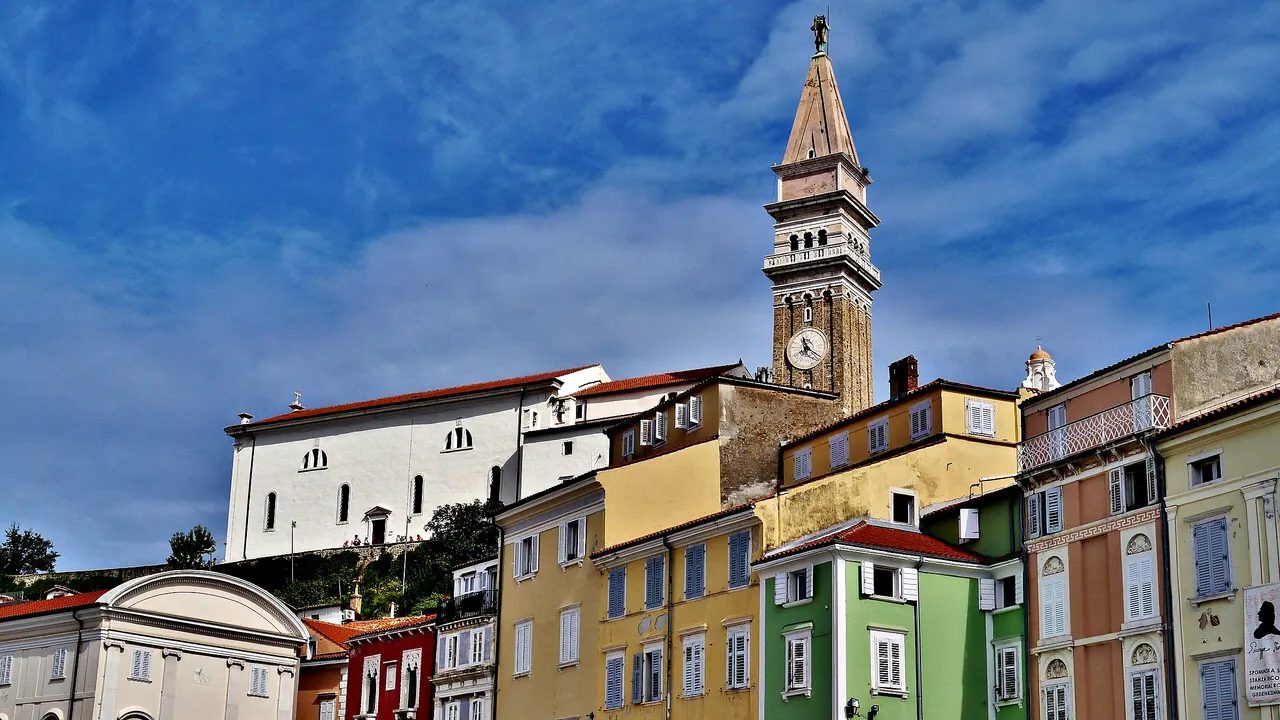
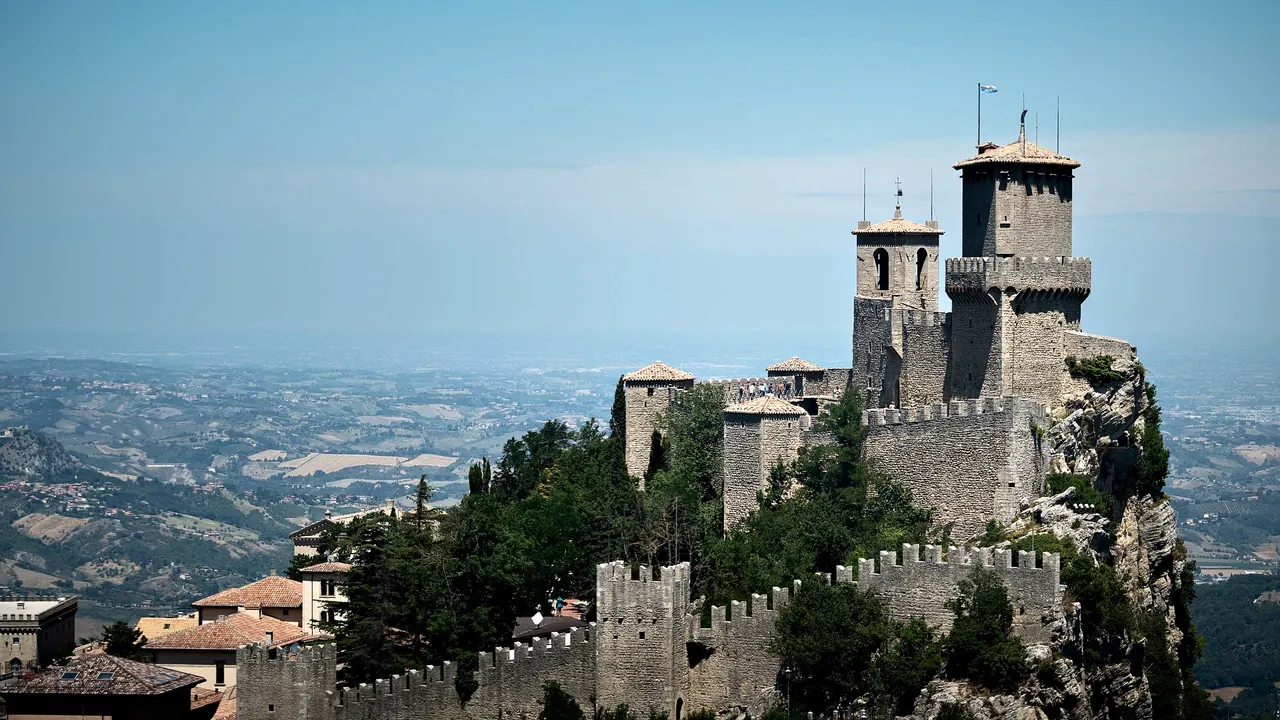
Photos: Piran by Zairon, CC BY-SA 4.0, cropped; San Marino by Tibor Szabo, Pexels License.
Piran or San Marino?
Our verdict in twelve categories, each scored against the same fixed benchmark cities, and the climate month by month, so you can choose for your trip.
Choose Piran for
- wellness
- getting around
- nature and the outdoors
Piran suits travellers who want to live beside the sea for a few days. You swim off the rocks below the old walls, walk everywhere on foot in a car-free town, lie in salt mud at the spa among the pans, and finish the day with wine on Tartini Square. It is the better choice for a slow, restorative coastal stay. It also makes a good base for crossing into Italy and Croatia.
Choose San Marino for
- shopping
- prices
- culture and sights
San Marino is for someone more drawn to a dramatic ridge-top citadel and the story of an ancient republic than to the water. It costs a little less, the duty-free streets and outlet centre give shoppers more to do, and the Romagna beaches and theme parks are a short drive below. Choose it if you have a car and want to mix mountain mornings with Urbino, San Leo and Ravenna.
Scoreboard
Twelve categories on one fixed scale from 0 to 100. The shaded stretch is the gap between the two.
Your match
Pick a travel style or drag the sliders, and both match scores follow your weighting.
Wins on wellness and getting around with your weighting.
Wins on shopping and prices with your weighting.
What matters to you?
Category by category
What the scores mean for a trip.
Beaches & swimming
Piran is the place for actual sea time. You climb down ladders from the seafront platforms around the Punta into clear water, and Fiesa cove is a short walk away. Sand is scarce, though, and the nearest is at Portoroz.
San Marino has no shore of its own. Its beaches are the long, organised strips of Rimini and Riccione, with sun umbrellas in rows and shallow water. They are easier for toddlers than Piran's ledges, but they mean a drive or bus ride every time.
Food & drink
Neither is a place to come for the food, and they differ mostly in what is on the plate. Piran's konobas serve grilled fish, squid and scampi buzara with Istrian oil and Malvazija. San Marino cooks inland Romagna food: hand-rolled pasta, passatelli, grilled meats and piadina. In both, the better meals are away from the main tourist streets, in the Istrian hinterland or in the trattorias of Borgo Maggiore.
Culture & sights
The two are evenly matched, and in both the town itself is the main sight. Piran is a seaside Venetian Gothic peninsula, with lanes leading down to oval Tartini Square and St George's campanile above the bay.
San Marino is more dramatic and has more history behind it: three towers on the cliffs of Monte Titano, a ceremonial Palazzo Pubblico and the story of one of the world's oldest republics. Neither has major museums, and either can be seen in half a day to a day.
Nightlife
Both are quiet at night, but Piran has a little more going on. There are sunset drinks on the Punta, and Portoroz's beach bars and summer clubs are a few minutes away. San Marino's summit is close to silent once the coaches leave, and any real night out means driving down to the Riviera clubs of Rimini.
Nature & outdoors
Piran has more varied scenery close by. There are the flysch cliffs and clifftop path at Strunjan, wading birds on the Secovlje salt pans, kayaking along the coast and the Parenzana cycle route through the vineyards. The Karst and the Skocjan caves are about an hour away.
San Marino's outdoors is the ridge itself, with woodland paths between the towers and wide views to the Apennines. The Montefeltro hills are good for a drive or a gentle ride, but there is less to fill several active days.
Day trips
Both make strong bases, and they open up different kinds of trip. From Piran you can cross borders: Habsburg Trieste, the Istrian coast at Rovinj and Porec, the hill towns of Motovun and Groznjan, Predjama Castle, and summer boats to Venice.
San Marino keeps you in Italy, with Renaissance Urbino, the fortress of San Leo, Ravenna's mosaics and Rimini's Roman remains. From both places the hill towns really need a car.
Good for families
Both work for a short family stay, in different ways. Piran is flat along the water, free of cars, and has calm swimming and a small aquarium. San Marino has the castle side, with battlements, towers and a cable car ride, while the theme parks, waterparks and sandy beaches are down on the coast.
Pushchairs struggle on San Marino's steps, while in Piran it is the swimming spots without sand that limit the youngest children.
Getting around
Piran is the easier place to settle in. You can cross the whole peninsula on foot in about a quarter of an hour on almost level ground, and a shuttle and promenade take you to Portoroz.
San Marino's centre is also car-free but almost every street climbs, often by steps. Getting there without a car depends on the bus from Rimini. Neither has a railway, so at both a hire car is the practical way to explore further.
Shopping & style
San Marino has more to buy. Its streets are lined with duty-free perfume, watches, leather and spirits, it has a large outlet centre, and collectors come for its stamps and coins.
Piran is better for a few local things to take home: salt flower from the Secovlje pans, Istrian olive oil and coastal wine. Beyond that, a real shopping day there means going to Ljubljana or Trieste.
Affordability
San Marino comes out a little cheaper. It is priced like provincial central Italy, with moderate hotels and fair trattorias, and lower taxes also bring down the cost of fuel and spirits.
Piran costs more in July and August, when old-town rooms are scarce and the harbour restaurants charge for the view. In both, staying just outside the centre brings costs down, in Portoroz for Piran and the lower villages for San Marino.
Live music & performing arts
Piran's music belongs to the violinist Giuseppe Tartini, who was born here. Each summer the town holds classical concerts in his honour in its churches, in the Minorite monastery cloister and out on the square, and the small Tartini Theatre puts on the occasional play or recital. Outside summer there is very little on.
San Marino offers even less as formal performance: a small theatre and occasional concerts by local ensembles. Its best-known summer event, the Medieval Days festival, is costumed pageantry with crossbow contests and flag-throwers rather than a concert. For opera or a proper season, you go to Rossini's Pesaro or to Bologna.
Wellness & relaxation
For rest and treatments, Piran is clearly ahead. You can lie in brine and salt mud at the thalasso spa out on the salt pans, Portoroz has its spa tradition, and Strunjan has a seawater health resort. Add the seafront and the car-free lanes, and the whole stay feels unhurried.
San Marino offers only a few hotel spas. Its calm comes in the evening, walking the walls after the crowds have gone.
When should you go?
Pick your month. The climate figures are measured averages, not a forecast.
Piran in July
San Marino in July
Daytime high, °C
Rainfall in the month, mm
Where the figures come from
San Marino's temperatures are measured 52 km from the centre, at Frontone.
San Marino has no rain gauge within 25 km of the centre, so its rainfall comes from a gridded climate dataset read at the city rather than from a gauge further away.
Temperature and rainfall are climate normals, averaged over the years shown. Piran: 2005-2020 (sunshine 1991-2020, rainfall 1991-2020) normals, Portoroz (1.2 km from centre). San Marino: 1991-2020 normals, Frontone (51.5 km from centre).
Summers are much alike in the two places, with highs around 30°C in July and the Adriatic warm enough for swimming from June to September. At Piran that means mornings in the sea straight from town. San Marino's sea figures belong to the Rimini coast below, so swimming means a trip down from the mountain. Piran gets long, sunny summer days, and July is its sunniest month. San Marino's summer is a little drier, with July its driest month at 47mm.
Spring and autumn show more of a difference. The mountain is a few degrees cooler, so April and October there are crisp for climbing to the towers. Piran stays milder into October for walking the lanes. Both get wetter from September, and Piran's rain is heavier, peaking at 125mm in November. For sightseeing without the summer heat, May, June and September suit both.
Which traveller are you?
On a relaxing and wellness trip, Piran is the clear choice. Portoroz's seawater pools and brine baths, the open-air thalasso spa among the salt pans and the car-free lanes slow you down in a way that San Marino's few hotel spas cannot.
For a shopping trip, San Marino gives you more. Lower taxes fill its main streets with perfume, watches and leather goods, and a large outlet centre lies in the valley. Piran sells little beyond sea salt, olive oil and wine.
For a beach and sun trip, Piran wins if you want to swim every morning without travelling. San Marino's sandy Riviera beaches are half an hour downhill, so the sea becomes a day out rather than part of daily life.
Before you go
| Measure | Piran | San Marino |
|---|---|---|
| Official language | Slovene | Italian |
| Currency | Euro (EUR) | Euro (EUR) |
| Sockets | CF230 V, 50 Hz | CFL230 V, 50 Hz |
| Driving side | Right | Right |
| Time zone | UTC+1, UTC+2 in summer | UTC+1, UTC+2 in summer |
| Emergency number | 112 | 112 |
| Elevation | 7 m | 675 m |
| Main airport | Trieste Airport (TRS)34 km from centre32 non-stop destinations | Bologna Guglielmo Marconi Airport (BLQ)114 km from centre98 non-stop destinations |
| Public holidays this year | 21 days | 18 days |
By the numbers
| Measure | Piran | San Marino |
|---|---|---|
| City population | 3,787 | 4,040 |
| People per km² | 85 | 569 |
| Museums within 10 km | 5 | 19 |
| UNESCO World Heritage sites within 50 km | 4 | 2 |
| Swim season, months above 21 °C | 4 months | 4 months |
Where else could you go?
Every comparison below shares a destination with this one, so you can follow Piran or San Marino somewhere new.