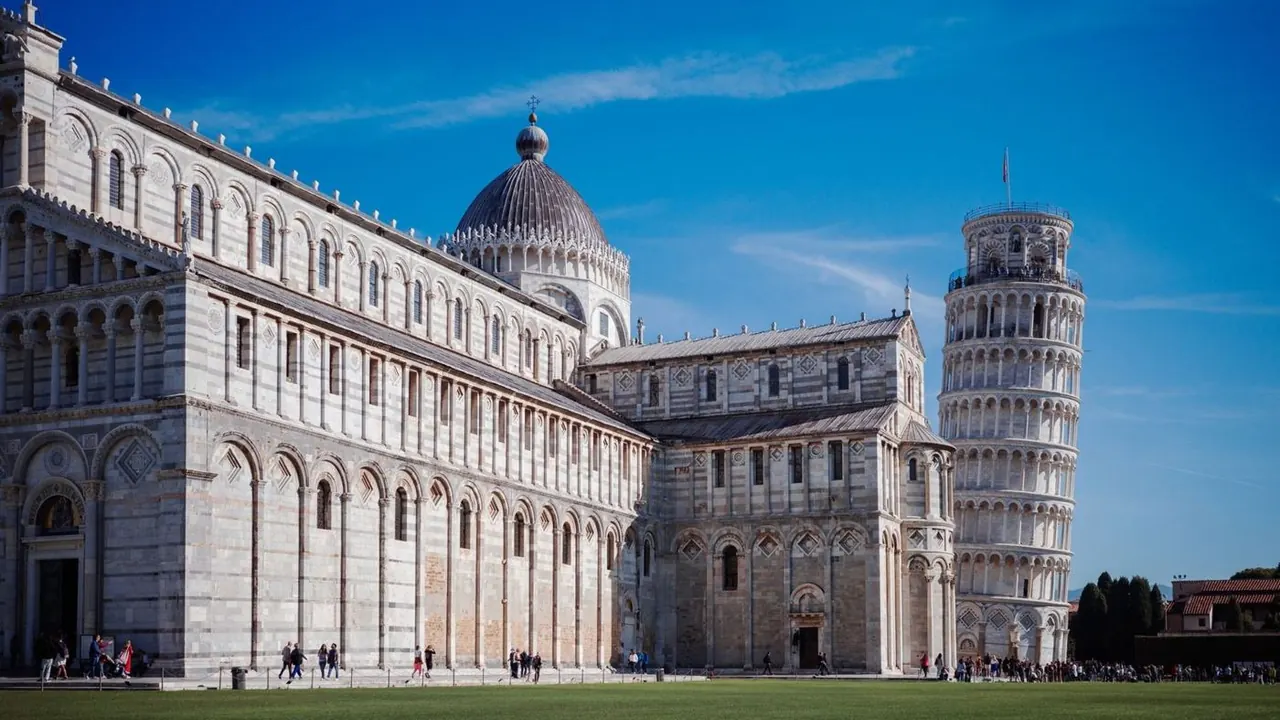
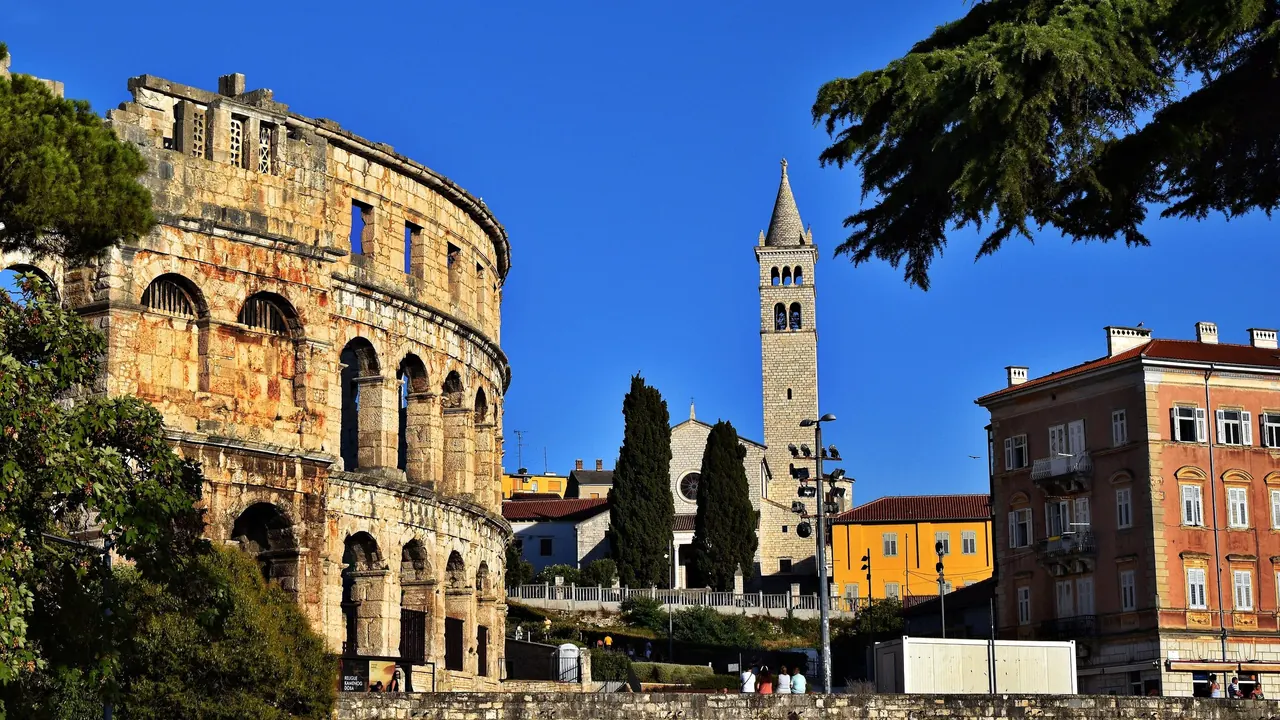
Photos: Pisa by Bruno Kraler, Pexels License; Pula by Miroslav.vajdic, CC BY-SA 4.0, cropped.
Pisa or Pula?
Our verdict in twelve categories, each scored against the same fixed benchmark cities, and the climate month by month, so you can choose for your trip.
Choose Pisa for
- getting around
- day trips
- wellness
Pisa suits travellers who want to see Tuscany on foot and by train. The cathedral square and the quieter city along the Arno take a couple of days. After that, Florence, Lucca and the Cinque Terre are easy rail trips from a station within walking distance of the centre, so there is no need for a car. It is the better base for a trip built around sightseeing, and for a short visit, since the airport is almost in town.
Choose Pula for
- beaches
- families
- nature and the outdoors
Choose Pula when the sea is the point of the trip. The clear water off the rocky coves of Verudela and Cape Kamenjak is better swimming than Pisa's sandy but cloudier shore, and the sheltered bays of Medulin suit young children. The Arena adds Roman grandeur above the harbour. To reach Istria's hill towns and quieter coves you need a hire car, so Pula suits a slower stay on the coast rather than hopping between towns by rail.
Scoreboard
Twelve categories on one fixed scale from 0 to 100. The shaded stretch is the gap between the two.
Your match
Pick a travel style or drag the sliders, and both match scores follow your weighting.
Wins on getting around and day trips with your weighting.
Wins on beaches and families with your weighting.
What matters to you?
Category by category
What the scores mean for a trip.
Beaches & swimming
Here the difference is sand against rock. Pisa's coast at Tirrenia and Calambrone has long, wide sandy beaches backed by pines, with shallow water that is easy for paddling. Most of it is rented out to beach establishments, though, and the water near the Arno mouth is rarely clear.
Pula has no sand at all, but it is the better place to swim. People swim off rocks, platforms and pebble coves into very clear water, and the best spots are among the wild inlets of Cape Kamenjak. Pack water shoes for the urchins. For young children, head to the gentler bays at Medulin.
Food & drink
The two cities eat equally well, but in different ways. Pisa's cooking is plain Tuscan: ribollita, game, salt cod and hot cecina from wood ovens. The best of it is in the student trattorias around Piazza delle Vettovaglie, not near the tower.
Pula belongs to the Istrian kitchen. Expect truffle-dressed fuži, scampi buzara and pršut, with Malvazija and Teran to drink. Its best meals are often outside the city, in hinterland taverns and harbour konobas, so eating well there tends to mean a drive.
Culture & sights
Pisa has more to see. The cathedral, baptistery, tower and Camposanto together make a set of buildings Pula cannot match. Beyond the square, there are Piazza dei Cavalieri, the Gothic Santa Maria della Spina and the medieval art in San Matteo.
Pula's strength is its Roman past. The Arena still stands to its full three storeys, and the Temple of Augustus is intact on the Forum. Venetian and Habsburg layers come on top, with a hilltop fortress and a ring of naval forts. The city is rewarding, but its interest is narrower.
Nightlife
Neither city is somewhere to go for a night out, and their busy seasons are opposite. Pisa is liveliest in term time, when students drink outside small bars around the old market until late. Pula comes alive in summer, on terraces near the Forum and at beach bars on Verudela, with a handful of small clubs on warm weekends. Out of season, both go quiet early.
Nature & outdoors
Both cities have good outdoors close by, but of different kinds. From Pisa you can cycle or ride through the forests and dunes of San Rossore, where fallow deer are common. There are olive-terrace paths on Monte Pisano, and serious mountain hiking in the Apuan Alps further out.
Pula's outdoors is mostly about the sea. You can walk or cycle the car-free Kamenjak headland, kayak among its islets, windsurf at Premantura and dive on naval-era wrecks. The nearest high ground, Učka, is further away than Pisa's hills.
Day trips
This is Pisa's biggest advantage. Florence is about an hour away by train and Lucca under half an hour, and the Cinque Terre, Viareggio and the marble towns of Carrara are on the same rail network. With a car you can also reach Volterra, San Gimignano and Siena.
Pula has a good choice of its own: Venetian Rovinj, the mosaics at Poreč, hill towns such as Motovun and Hum, and the boat trip to Brijuni. Buses are thin, though, so most of these trips depend on a car, and none of them carries the weight of Florence.
Good for families
Pula is better with children because there is more aimed at them. There is the aquarium inside a Habsburg fort, the Arena's stands and underground passages to explore, and the safari animals on Brijuni. A dinosaur park and a water park are within about an hour.
Pisa is simple to manage, being flat and compact, and the tower lawn gives children room to run. Little else is made for them, though. The family days end up at the Tirrenia beaches or cycling in San Rossore.
Getting around
Pisa is much easier without a car. Its flat centre is easy to walk, a shuttle train links the airport to the station, and that station is a rail hub for western Tuscany.
In Pula the old centre is just as walkable, but beyond it you need a car. The inland railway is of little use, regional buses are infrequent, and Kamenjak and the hill towns are hard to reach without your own wheels. Parking in summer is tight.
Shopping & style
Neither city is a shopping destination, but Pisa has a bit more to browse. Corso Italia has the chains, Borgo Stretto has smarter clothes and old pastry shops under its arcades, and a monthly antiques market sets up along the river. In Pula, the things worth carrying home are mostly edible: olive oil, truffle products, rakija and pršut from the market hall or straight from producers.
Affordability
Overall costs are much the same, but the costs fall in different places. In Pisa, student trattorias and walking everywhere keep spending down, and the tower climb and seaside loungers are the main extra costs.
Pula is good value in spring and autumn, when private apartments and simple konobas are easy to find. In July and August, though, rooms cost about as much as on Western European coasts. Car hire and boat trips, which most visitors end up needing, add up quickly.
Live music & performing arts
Neither city has much of a stage scene, and what separates them is when and where the evenings happen. Pisa's performances take place indoors at the Teatro Verdi, between autumn and spring, so a visitor in the cooler months can easily fit an evening of Italian opera or ballet in a historic house into a sightseeing trip. University chamber concerts and the odd church recital add smaller occasions. Anyone after a major production takes the train to Florence.
Pula is the other way round. Its memorable nights are in summer, with concerts and film screenings in the open air inside the Arena, though what is on depends on that season's programme. The rest of the year offers little beyond Croatian-language theatre at the Istrian National Theatre, which few visitors can follow, so anyone who wants live performance in Pula should plan around the summer months.
Wellness & relaxation
Pisa is the better choice for a restful stay, thanks to its thermal springs. San Giuliano Terme, just outside the city, has been used since Roman times and has a spa in its 18th-century bath palace. The larger public thermal pool at Casciana Terme is under an hour inland.
Pula has no bathing tradition, so wellness there means resort hotel spas on Verudela or in Medulin. What it does offer is calm. Pine-shaded coastal walks and slow coffees on the Forum make it easy to unwind outside high summer.
When should you go?
Pick your month. The climate figures are measured averages, not a forecast.
Pisa in July
Pula in July
Daytime high, °C
Rainfall in the month, mm
Where the figures come from
Pula's temperatures are measured 87 km from the centre, at Trieste.
Pula has no rain gauge within 25 km of the centre, so its rainfall comes from a gridded climate dataset read at the city rather than from a gauge further away.
Temperature and rainfall are climate normals, averaged over the years shown. Pisa: 1991-2020 normals, Pisa / S. Giusto (3.9 km from centre). Pula: 1991-2020 normals, Trieste (87 km from centre).
The two climates follow much the same pattern, and both are at their best for swimming from June to September. In July and August the sea reaches about 25°C off both coasts, and Pisa is a degree or two hotter on land, with highs around 30°C on its humid plain. That heat makes long days of street sightseeing in Pisa hard work in midsummer. In Pula the heat matters less, because the day is spent by the water. Pisa also has a little more sunshine all through the year.
The main difference comes in autumn. Pisa's rain arrives sharply from September, with November the wettest month at about 132mm. Pula's autumn is wet too, but much less so, which makes September and early October there a gentler time for late swims and countryside drives. For walking either city, May and late September are the best times: warm, sunny and not yet too hot. Winters are cool in both, and slightly milder in Pisa.
Which traveller are you?
On a beach and sun trip, Pisa's sandy shore is a bus ride from the centre and works best as an afternoon off from sightseeing. Pula is the clear choice, with far clearer water and the wild coves of Kamenjak close to town.
For a culture and arts trip, Pisa wins. The cathedral square, San Matteo's medieval painting and the palaces along the Lungarni have more depth than Pula's Roman centre, and Florence's galleries are about an hour away by train.
On a family trip with children, Pisa suits a short visit without a car, with older children who are keen on sightseeing. Pula is the better choice for a longer stay, where sea days and outings keep younger children busy, as long as you hire a car.
Before you go
| Measure | Pisa | Pula |
|---|---|---|
| Official language | Italian | Croatian |
| Currency | Euro (EUR) | Euro (EUR) |
| Sockets | CFL230 V, 50 Hz | CF230 V, 50 Hz |
| Driving side | Right | Right |
| Time zone | UTC+1, UTC+2 in summer | UTC+1, UTC+2 in summer |
| Emergency number | 112 | 112 |
| Elevation | 4 m | 5 m |
| Main airport | Pisa International Airport (PSA)4 km from centre82 non-stop destinations | Pula Airport (PUY)7 km from centre34 non-stop destinations |
| Public holidays this year | 13 days | 14 days |
By the numbers
| Measure | Pisa | Pula |
|---|---|---|
| City population | 88,737 | 52,220 |
| People per km² | 479 | 971 |
| Museums within 10 km | 27 | 4 |
| UNESCO World Heritage sites within 50 km | 4 | 1 |
| Swim season, months above 21 °C | 4 months | 4 months |
Where else could you go?
Every comparison below shares a destination with this one, so you can follow Pisa or Pula somewhere new.