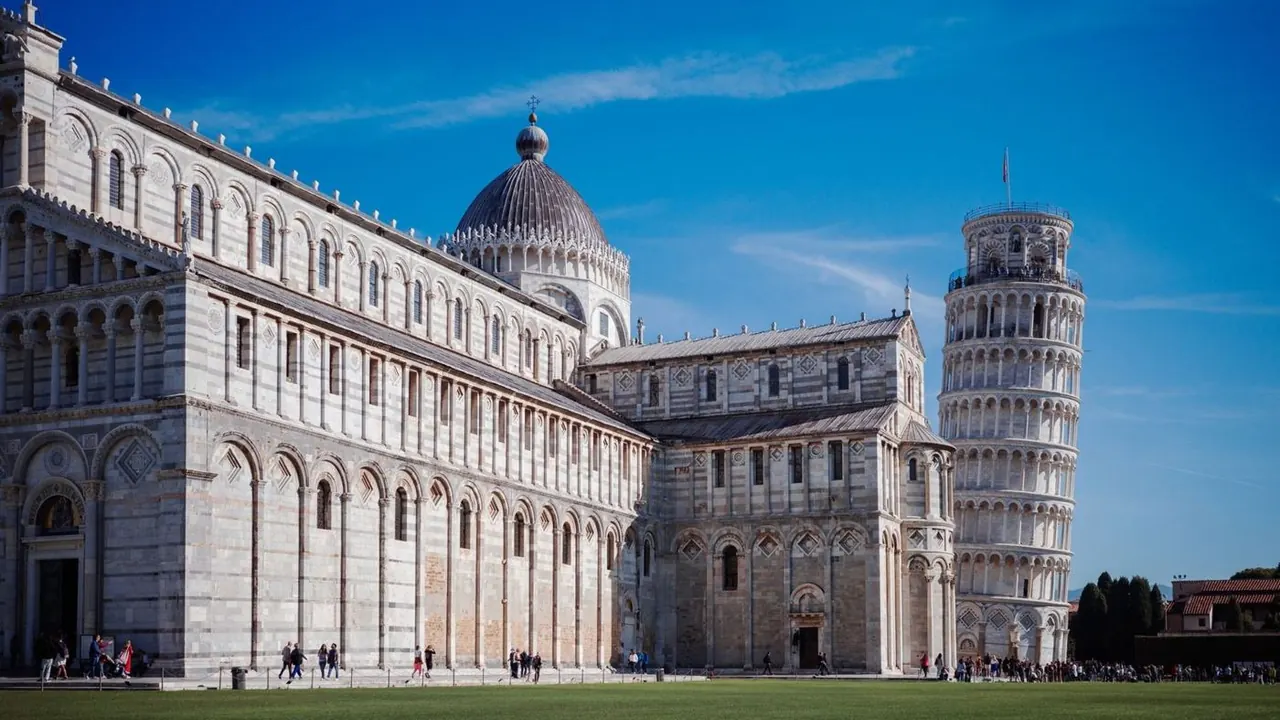
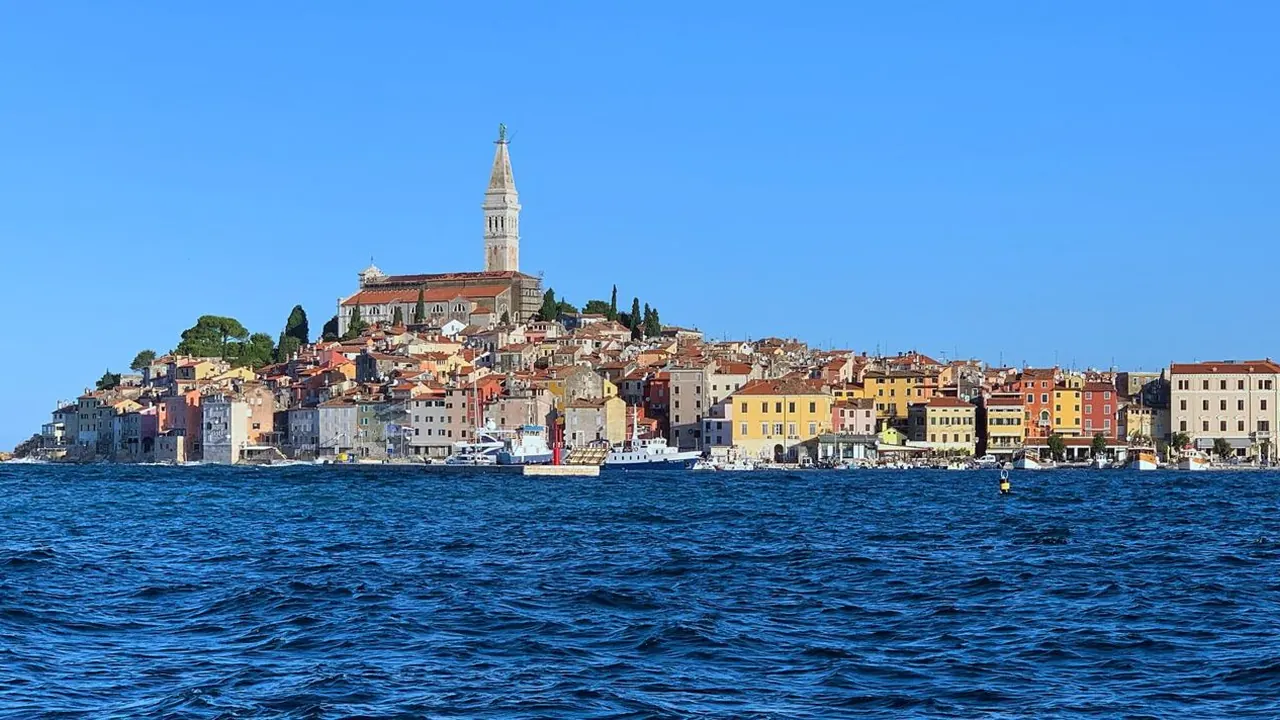
Photos: Pisa by Bruno Kraler, Pexels License; Rovinj by Vyacheslav Bukharov, CC BY-SA 4.0, cropped.
Pisa or Rovinj?
Our verdict in twelve categories, each scored against the same fixed benchmark cities, and the climate month by month, so you can choose for your trip.
Choose Pisa for
- culture and sights
- day trips
- live music and the arts
Pisa suits travellers who want to see a great deal of Tuscany without moving hotel. The cathedral square and the quieter old town fill two days, and then the station takes you to Florence, Lucca, the Cinque Terre and the marble coast without a car. It is also the cheaper and simpler of the two. The airport is almost in town and the student trattorias keep meals reasonable.
Choose Rovinj for
- beaches
Rovinj is the choice for a slower seaside week built around swimming. Clear Adriatic water starts at the rocks below the old town, the Golden Cape pines give shade, and taxi boats go out to the islands. In return you get fewer sights, higher summer prices and a hire car for anything beyond the town.
Scoreboard
Twelve categories on one fixed scale from 0 to 100. The shaded stretch is the gap between the two.
Your match
Pick a travel style or drag the sliders, and both match scores follow your weighting.
Wins on culture and sights and day trips with your weighting.
Wins on beaches with your weighting.
What matters to you?
Category by category
What the scores mean for a trip.
Beaches & swimming
For swimming, Rovinj is clearly better. It has very clear Adriatic water and a few kilometres of limestone ledges and pebble coves in the Golden Cape pines. You can swim directly below the old town walls. The catch is that there is no sand, so you need water shoes for the sea urchins.
Pisa has what Rovinj lacks: long, wide sandy beaches backed by pines at Tirrenia and Calambrone. These have gentle shallows for paddling, but they are 12km or more from town and the water near the Arno mouth is rarely clear. Pisa's coast is good for an afternoon at the beach, whereas in Rovinj swimming can fill the whole stay.
Food & drink
The two are about level for food, but the cooking is quite different. Pisa serves plain Tuscan dishes such as ribollita, wild boar, salt cod and hot cecina from wood ovens. The best of it is in the cheap student trattorias around the old market square.
Rovinj's food comes from the sea and the Istrian hinterland: scampi buzara, truffle pasta, peppery olive oil, Malvazija and Teran. It has a few more ambitious restaurants and country konobas worth driving to, but almost none of Pisa's cheap everyday eating.
Culture & sights
Pisa is in a different class for sights. The cathedral, baptistery, tower and Camposanto make up one of Italy's great architectural ensembles. Beyond them are Piazza dei Cavalieri, Santa Maria della Spina and the medieval collection at San Matteo, which is enough for two full days.
In Rovinj, the sight is the townscape itself: pastel Venetian houses climbing to St Euphemia, whose tower you can climb, and the Batana House on the local fishing boats. It is lovely to wander, but it fills an afternoon rather than two days.
Nightlife
Neither is a place to go for nightlife, but Pisa has more going on after dark thanks to its students. During term, the small squares around the old market are full of people drinking outside until late, and Borgo Stretto has an early-evening aperitivo crowd.
In Rovinj, an evening means a long dinner and a drink on the rocks at sunset. A few waterfront bars stay busy in summer, but the old town is mostly quiet by midnight and largely shuts down out of season.
Nature & outdoors
Pisa's outdoors is forest, dunes and hills, while Rovinj's is mostly on the water. From Pisa you can cycle or ride through the forest, wetland and wild dunes of San Rossore, where fallow deer are a common sight, and walk the olive-terrace paths on Monte Pisano. Proper mountain hiking in the Apuan Alps is within reach.
In Rovinj you kayak and paddleboard around the low islands of the archipelago, dive on reefs and wrecks, and take a boat up the steep green Lim Fjord. Inland there are gentle trails through the vineyards, but no high mountains.
Day trips
This is where Pisa is strongest. Florence is about an hour away and Lucca under half an hour, both by train, and the Cinque Terre, Viareggio and Carrara are on the same rail lines. Volterra, San Gimignano and Siena are within reach by car.
Rovinj has good day trips too: Pula's amphitheatre, the mosaics of the Euphrasian Basilica in Porec, and the hill towns of Motovun and Groznjan. Trieste is about an hour and a half away. Most of these need a car, though, and nothing nearby compares with Florence.
Good for families
For families the two come out even, but their drawbacks differ. Pisa's centre is flat and compact, and the sandy, shallow beaches at Tirrenia and Calambrone are ideal for small children. On the other hand, younger children cannot climb the tower, and little else is aimed at them.
Rovinj is better set up for a resort-style family vacation, with campsites and hotels that have pools and playgrounds, boat trips to the islands and shady park paths for pushchairs. Against that, the shore is rock and concrete, and the old town is a steep climb on polished cobbles.
Getting around
Pisa is far easier to get around and to use as a base. It is flat and walkable, a shuttle train runs from the airport to the station, and the station is a main rail hub for western Tuscany. You can manage a whole trip without a car.
Rovinj is easy on foot as long as you stay in town, with a car-free old town and a waterfront promenade into the park. There is no railway, though. Buses only link the bigger towns, and the hill towns and wineries in practice need a car.
Shopping & style
Pisa has the better shopping, but it is ordinary Italian high-street fare. Corso Italia has chain stores and Borgo Stretto has smarter boutiques and pastry shops under its arcades. A monthly antiques market sets up by the river.
Rovinj has no fashion streets at all. What it has are artists' studios and small galleries along Grisia, and Istrian truffle products and brandies to take home, though the choice thins out after summer.
Affordability
Pisa is noticeably cheaper overall. Mid-range rooms, trattorias full of students and a centre you can walk cover most of a stay. The main expenses are the tower climb and the cafés beside the monuments.
Rovinj in July and August costs what a fashionable Mediterranean resort costs, and harbourside fish sold by weight soon adds up. You can save by staying in private apartments or campsites and by going in late spring or September.
Live music & performing arts
Pisa has a proper season at the Teatro Verdi, a 19th-century horseshoe-shaped opera house. From autumn to spring it puts on opera, symphony concerts and ballet, and university chamber series add to it.
Rovinj's live performance is limited to summer: occasional concerts in St Euphemia, music on the harbour, and sometimes the unaccompanied bitinada singing. Out of season there is almost nothing on, so the Verdi alone puts Pisa ahead.
Wellness & relaxation
Pisa offers thermal springs, while Rovinj offers resort spas and calm by the sea. Just outside Pisa, the springs of San Giuliano Terme have been used since Roman times and feed a spa in an 18th-century bath palace. Casciana Terme has a larger public thermal pool.
Rovinj has no springs of its own, but some of its resort hotels have well-equipped spas that outside guests can use. Its real calm comes from late swims off the rocks and walks in the pines in May, June and September.
When should you go?
Pick your month. The climate figures are measured averages, not a forecast.
Pisa in July
Rovinj in July
Daytime high, °C
Rainfall in the month, mm
Where the figures come from
Rovinj's temperatures are measured 64 km from the centre, at Trieste.
Rovinj has no rain gauge within 25 km of the centre, so its rainfall comes from a gridded climate dataset read at the city rather than from a gauge further away.
Temperature and rainfall are climate normals, averaged over the years shown. Pisa: 1991-2020 normals, Pisa / S. Giusto (3.9 km from centre). Rovinj: 1991-2020 normals, Trieste (63.7 km from centre).
Both have the same kind of year: hot, sunny summers, then a wet season that starts in September and lasts until November. Pisa has the drier summer, with only about 32mm of rain in July and more hours of sunshine. Rovinj gets more summer showers and is a degree or two colder in winter. The sea at both is warm enough to swim from June to September. It is at its warmest off Rovinj in August, at around 26°C, slightly warmer than off Pisa.
For walking Pisa's streets and taking day trips across Tuscany, May and June are the most comfortable months. In July and August the plain reaches about 30°C and feels humid. In Rovinj, June is the easiest month, warm enough to swim but not yet at its hottest. In September the sea is still warm at both, but it is already one of the wettest months, with more than 100mm of rain in Pisa and 85mm in Rovinj, so expect to lose some days to rain. October and November stay wet in both places and are the weakest time to visit either.
Which traveller are you?
On a culture and arts trip, Pisa is far richer. The cathedral square, the Camposanto, San Matteo's medieval painting and a season at the Teatro Verdi are all in one small city, and Florence is an easy train ride away. Rovinj's sights fill an afternoon.
For a beach and sun trip, Rovinj is the better choice. You can swim off clean limestone ledges straight from town, the water is clear, and taxi boats go out to quiet island coves. From Pisa, the beach is a bus ride to the coast, where the water is less clear.
On a trip with a tight budget, Pisa makes it easier to spend less. Rooms are mid-range, student trattorias keep meals cheap, and trains cover the day trips. In summer, Rovinj charges resort prices, fish is sold by weight, and getting into the hinterland means hiring a car.
Before you go
| Measure | Pisa | Rovinj |
|---|---|---|
| Official language | Italian | Croatian |
| Currency | Euro (EUR) | Euro (EUR) |
| Sockets | CFL230 V, 50 Hz | CF230 V, 50 Hz |
| Driving side | Right | Right |
| Time zone | UTC+1, UTC+2 in summer | UTC+1, UTC+2 in summer |
| Emergency number | 112 | 112 |
| Elevation | 4 m | 0 m |
| Main airport | Pisa International Airport (PSA)4 km from centre82 non-stop destinations | Pula Airport (PUY)31 km from centre34 non-stop destinations |
| Public holidays this year | 13 days | 14 days |
By the numbers
| Measure | Pisa | Rovinj |
|---|---|---|
| City population | 88,737 | 12,968 |
| People per km² | 479 | - |
| Museums within 10 km | 27 | 1 |
| UNESCO World Heritage sites within 50 km | 3 | 1 |
| Swim season, months above 21 °C | 4 months | 4 months |
Where else could you go?
Every comparison below shares a destination with this one, so you can follow Pisa or Rovinj somewhere new.