Poland
Warsaw
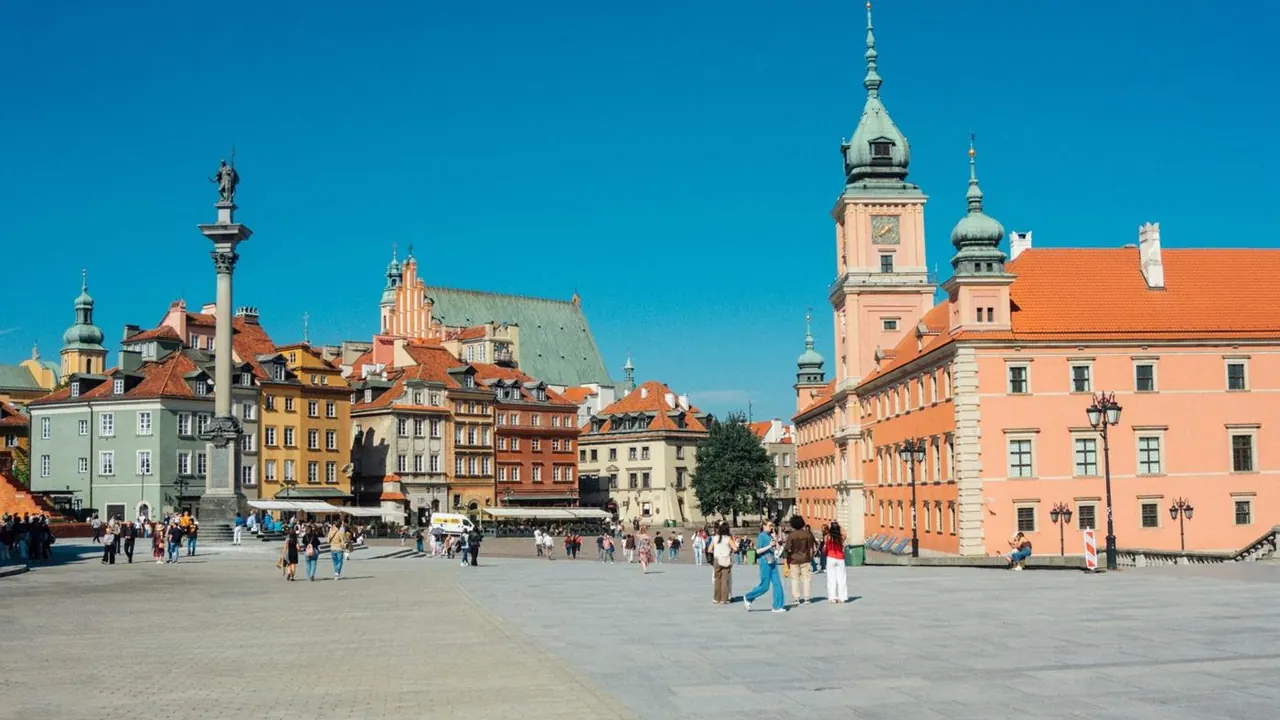
Castle Square and the Royal Castle
- Getting around72
- Culture & sights70
- Nightlife66
Photo: Raymond Petrik, Pexels License
Match
55
Every category weighted equally
- Beach & sun48
- Culture & arts61
- Food & nightlife59
- Family trip53
- Outdoors51
- Relax & unwind49
- Shopping & style58
- On a budget56
Warsaw in twelve categories
Our verdict on each, scored 0 to 100 against the same fixed benchmark cities, so a score means the same thing on every page.
Beaches & swimming. Scores 12 out of 100.
Food & drink. Scores 60 out of 100.
Culture & sights. Scores 70 out of 100.
Nightlife. Scores 66 out of 100.
Nature & outdoors. Scores 47 out of 100.
Day trips. Scores 52 out of 100.
Good for families. Scores 62 out of 100.
Getting around. Scores 72 out of 100.
Shopping & style. Scores 55 out of 100.
Affordability. Scores 64 out of 100.
Live music & performing arts. Scores 63 out of 100.
Wellness & relaxation. Scores 35 out of 100.
Warsaw category by category
Beaches & swimming
12Warsaw is an inland city, and the Baltic coast is a long train journey away, so it is not a beach destination. In summer, people lounge on the sandy banks of the Vistula, mostly on the wilder Praga side, but the river is for sunbathing and drinks at the water's edge, not for swimming.
For actual swimming, locals go to the Zegrze reservoir north of the city, to lakes and lidos on the outskirts, or to the city's outdoor pools. These are fine on a hot July afternoon, but water won't be a big part of a stay.
Food & drink
60Eating well in Warsaw costs less than you might expect. The base is traditional Polish cooking: pierogi, żurek sour rye soup, beetroot barszcz, and duck or pork knuckle served in old-fashioned dining rooms. Milk bars (bar mleczny), which date from communist times, serve simple home cooking at canteen counters. Alongside them is a confident modern scene, where chefs turn forest mushrooms, game, fermented vegetables and river fish into tasting menus.
Converted industrial buildings and market halls hold food courts and wine bars. The coffee is good, and cake shops line the main streets. Vodka is taken seriously and is best tried in small bars that serve it with herring and pickles. There is plenty of international food, though not much of it stands out. Summer brings street stalls piled with strawberries and blueberries. On Fat Thursday, just before Lent, the whole city queues for pączki, Poland's filled doughnuts.
Culture & sights
70Warsaw's sights tell the story of a city destroyed and rebuilt. About 85 per cent of the centre was razed in 1944. The Old Town and Royal Castle were reconstructed so carefully from paintings and records that the rebuild itself is UNESCO-listed. The Royal Route leads south past churches and palaces to Łazienki Park, with its Palace on the Isle, and on to the baroque Wilanów Palace.
The museums are the real strength. The Warsaw Rising Museum and POLIN, on the history of Polish Jews, are among the most powerful history museums in Europe. The National Museum, the Chopin Museum and the Palace of Culture and Science, a Stalin-era tower, complete the list. Remnants of the ghetto and the older streets of Praga add depth for visitors willing to look.
Nightlife
66Warsaw goes out late and with energy. Few people outside Poland know it as a nightlife city, but it has a busy one. In the centre, Mazowiecka Street and the area around Nowy Świat have bars and clubs that fill on weekends. Pavilions behind the main streets hold dozens of tiny bars where cheap drinks keep people out until morning. The Powiśle district, near the river, has a younger crowd. Across the river, Praga's courtyards and old factories host techno and alternative nights.
The cocktail and craft beer scenes are strong. In summer, the action moves to the Vistula boulevards and the beach bars on the riverbanks. Winter nights are darker and quieter, but the clubs keep going.
Nature & outdoors
47The landscape around Warsaw is flat lowland. What it offers is space and wildness rather than drama. Kampinos National Park starts just beyond the north-western suburbs, with pine forest, inland sand dunes, marshes and elk. Its long marked trails suit walkers and cyclists. Unusually for a capital, the Vistula is largely untamed: the eastern bank is a strip of willow scrub, sandbars and birdlife facing the skyline.
In the city, Łazienki, with its peacocks and red squirrels, and the long Pole Mokotowskie offer green space. Cycle paths are extensive. Kayaking on smaller rivers nearby is popular in summer. There are no mountains or sea within reach, and the winter is grey and cold.
Day trips
52Warsaw is a fair base for day trips, but the best-known Polish destinations are a little too far. Kraków and Toruń are better as overnight trips. Łódź, a red-brick textile city with grand factory palaces and a long main street, is a little over an hour away by train. Lublin's old town and its castle are about two hours east. Kazimierz Dolny, a painterly Renaissance town on the Vistula, is a popular outing by car.
Closer in are Żelazowa Wola, where Chopin was born, and the aristocratic palace and gardens at Nieborów and Arkadia. The Treblinka memorial is a sober trip of about an hour and a half. It is a decent mix, though it thins out quickly.
Good for families
62Warsaw is easy with children: the pavements are wide, the city is safe and clean, and there are plenty of parks. The Copernicus Science Centre on the riverbank is one of the best hands-on science museums in Europe and can fill a whole day. Its planetarium is next door. The city zoo is large and green, and the Łazienki and Saxon Gardens have squirrels, playgrounds and space to run around.
The Vistula boulevards have play areas and fountain shows in summer, and indoor water parks get families through the winter. Many of the historical museums are heavy for young children, and there is no theme park nearby. Still, family facilities are common, and restaurants welcome children.
Getting around
72Warsaw is easy to get around, but it is spread out. The Old Town and the Royal Route are walkable. Distances grow quickly beyond them, and the post-war avenues are wide and made for traffic rather than strolling. Trams are the backbone, and two metro lines cross the city north-south and east-west. Buses fill the gaps, and one ticket covers them all. Contactless payment works on board.
Wilanów and parts of Praga take a tram or bus ride. Cycle lanes are good, and the city bikes are useful in summer. A car is never needed and parking is a nuisance. The airport has a direct train to the centre.
Shopping & style
55Shopping in Warsaw is solid rather than special. Big modern malls are its strength, including one glass-roofed complex next to the central station. A luxury department store and the boutiques and Polish designer labels along Mokotowska Street give the city centre some style. Polish fashion and design are worth seeking out.
The Hala Mirowska market hall sells produce, flowers and everyday goods. Weekend flea markets sell communist-era objects and old posters. Typical things to take home are amber, hand-painted stoneware, linen and vodka. Many of the souvenir shops in the Old Town are tourist traps, and the city has no historic arcades or great shopping streets.
Affordability
64Warsaw is good value for a European capital, though it costs more than other Polish cities. Public transport is cheap, and museum tickets are modest. Many museums are free one day a week. Eating out is reasonable: milk bars and food halls keep a casual meal cheap, and even ambitious restaurants cost much less than in Western Europe.
Hotels are where prices rise. The city has many business visitors, so central rooms are pricier on weekdays and during big trade fairs. Rates are often lower on weekends. Drinks are cheap, especially away from the main squares.
Live music & performing arts
63Music is where Warsaw's cultural life comes alive for a visitor. The Grand Theatre on Theatre Square houses the national opera and ballet on one of Europe's largest stages, in a neoclassical building facing the Old Town. The National Philharmonic has a full season. Chopin is everywhere: small recitals in palaces run all year, and on summer Sundays there are free open-air concerts at his monument in Łazienki Park. The International Chopin Piano Competition, held every five years, is one of the great events in classical music.
The jazz scene has deep roots, from a long-running autumn festival to cellar clubs. Polish theatre is admired, but most of it is in Polish.
Wellness & relaxation
35Warsaw has no bathing tradition of its own. Relaxing here means hotel spas, day spas and the large sauna zones at indoor water parks, where Polish sauna rituals with aromatic towel-waving are taken surprisingly seriously. Konstancin-Jeziorna, a leafy spa town on the southern edge of the city, has a saltwater graduation tower and a park made for slow walks.
Inside the city, the best way to slow down is a morning in Łazienki or an afternoon on the riverbanks. Otherwise Warsaw is a working capital with a brisk pace.
When should you go?
Pick a month to see what it is like. The climate figures are measured averages, not a forecast.
Warsaw in July
Daytime high, °C
Rainfall in the month, mm
The whole year
Shaded against this city’s own year: the deepest cell is its best month for that figure and the palest its weakest.
Temperature and rainfall are climate normals, averaged over the years shown. Warsaw: 1991-2020 normals, Warszawa-Okecie (7.7 km from centre).
Before you go
| Measure | Warsaw |
|---|---|
| Official language | Polish |
| Currency | Zloty (PLN) |
| Sockets | CE50 Hz |
| Driving side | Right |
| Time zone | UTC+1, UTC+2 in summer |
| Emergency number | 112 |
| Elevation | 118 m |
| Main airport | Warsaw Chopin Airport (WAW)8 km from centre172 non-stop destinations |
| Public holidays this year | 14 days |
By the numbers
| Measure | Warsaw |
|---|---|
| City population | 1,862,402 |
| People per km² | 3,601 |
| Museums within 10 km | 117 |
| UNESCO World Heritage sites within 50 km | 1 |
Compare Warsaw with
Every comparison with a written verdict behind it.