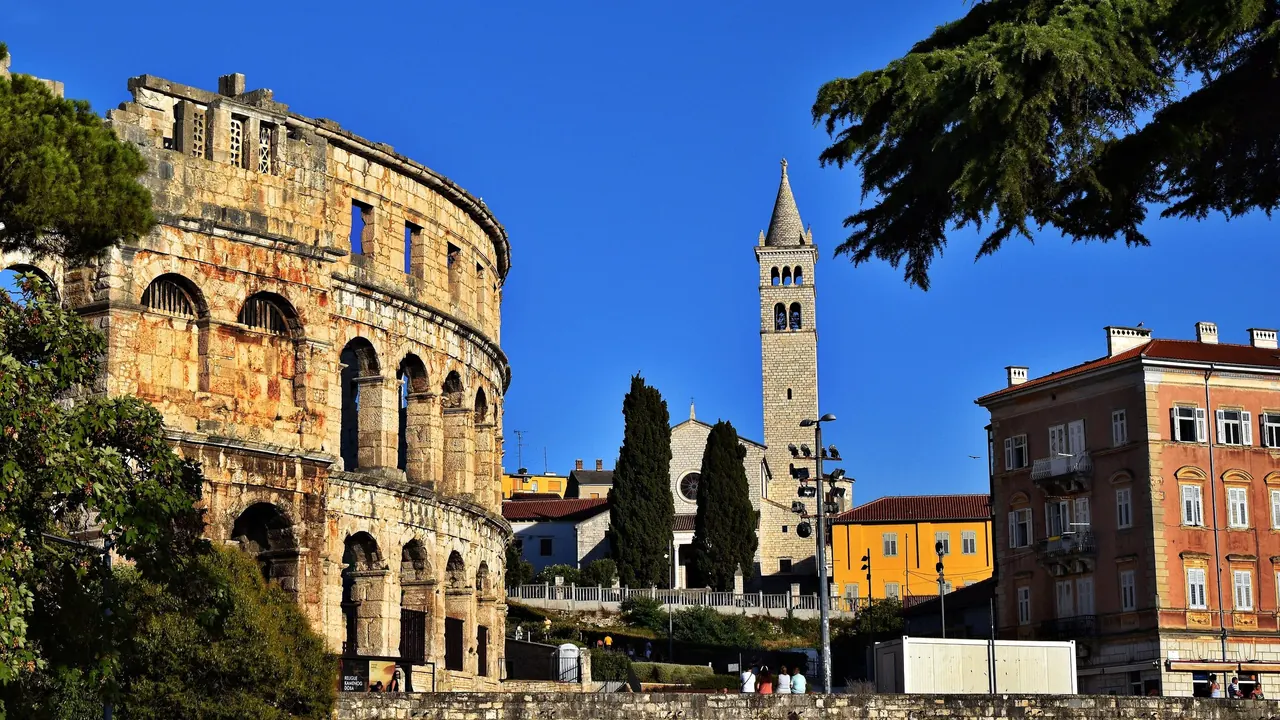
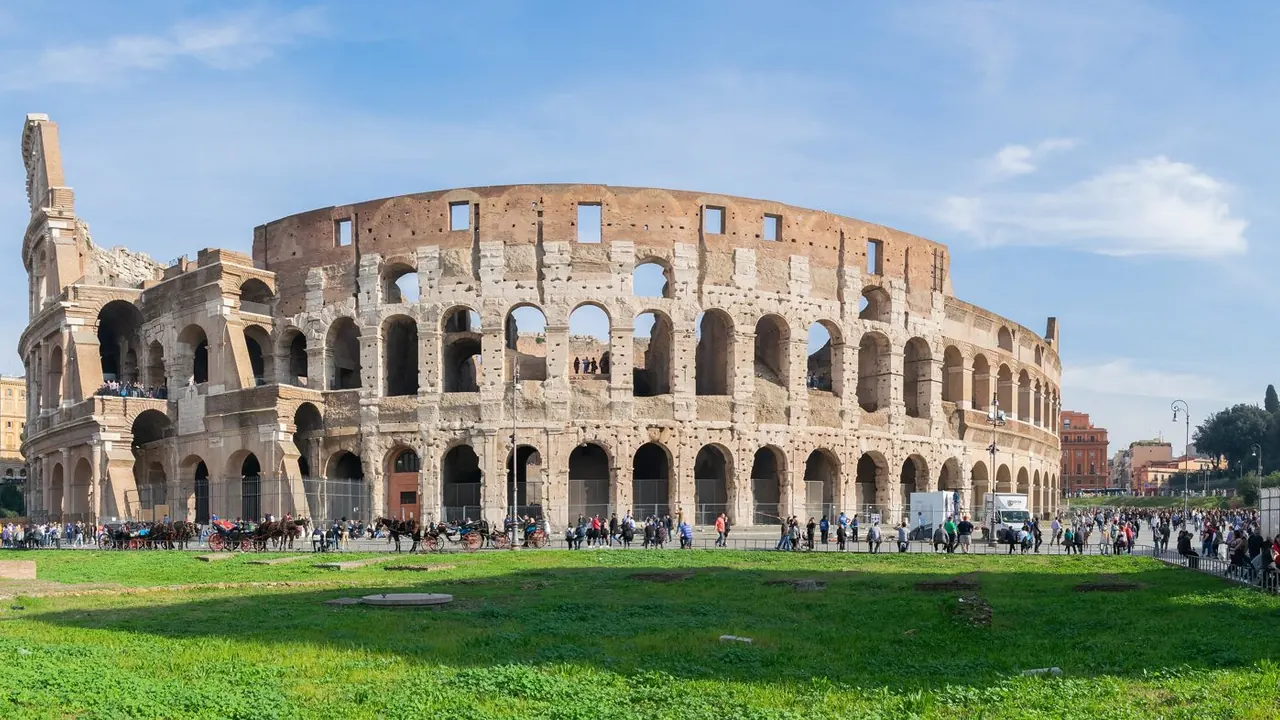
Photos: Pula by Miroslav.vajdic, CC BY-SA 4.0, cropped; Rome by Tournasol7, CC BY-SA 4.0, cropped.
Pula or Rome?
Our verdict in twelve categories, each scored against the same fixed benchmark cities, and the climate month by month, so you can choose for your trip.
Choose Pula for
- beaches
- prices
- families
Pula suits a slower summer trip built around the sea. You get clear water off rocks and pebble coves, the wild headland of Kamenjak, a Roman Arena that takes a morning rather than a week, and Istrian villages a short drive inland. It is easier with children and kinder on the budget, and it works best with a hire car.
Choose Rome for
- shopping
- culture and sights
- live music and the arts
When the trip is about the city itself, Rome is the choice. Its ancient monuments, Vatican collections and Baroque churches are matched almost nowhere, and the trattorias, evenings in the piazzas, opera and shops fill every day. The sea is a train outing rather than part of the stay, and rooms cost more.
Scoreboard
Twelve categories on one fixed scale from 0 to 100. The shaded stretch is the gap between the two.
Your match
Pick a travel style or drag the sliders, and both match scores follow your weighting.
Wins on beaches and prices with your weighting.
Wins on shopping and culture and sights with your weighting.
What matters to you?
Category by category
What the scores mean for a trip.
Beaches & swimming
In Pula, swimming is part of daily life. People swim off rocks, concrete platforms and pebble coves around Verudela and Stoja, the water is very clear, and pines grow almost to the shore. Kamenjak, about 10km south, has the wildest coves, and Medulin's sheltered bays suit small children. There is no sand, and water shoes are a good idea.
Rome's sea is half an hour away by train at Ostia, or at Fregene. The sand is dark and volcanic, most of it is divided into paid lidos, and the water is warm but rarely clear. The beach is a day out from the city rather than the point of the stay, and the prettier coves at Sperlonga need a longer journey.
Food & drink
Pula's cooking is Istrian and distinctive: truffle fuži, scampi buzara, pršut and a glass of Malvazija. The city's own restaurants are few, though, and those around the Arena lean towards tourist menus. The best meals are a drive away, in konobas in the hinterland and taverns by the harbours.
In Rome you eat better within walking distance. There is carbonara and cacio e pepe in the trattorias of Testaccio and Trastevere, artichokes fried the Jewish way in the Ghetto, and supplì and pizza al taglio from the counter. Good food is easy to find at any hour, as long as you walk away from the menus beside the big sights.
Culture & sights
Both cities have a Roman amphitheatre at their heart, and that is where the likeness ends. Pula's Arena is remarkably complete. Add the Temple of Augustus, the Arch of the Sergii and the Venetian fortress, and the city makes a rewarding day or two.
Rome has the Colosseum, the Forum, the Palatine and the Pantheon. On top of them come early Christian mosaics, Renaissance palaces, Bernini's piazzas and Caravaggios in side chapels, and then the Vatican Museums and the Borghese Gallery. Even a week means leaving things out.
Nightlife
Neither city is a clubbing destination. Pula's evenings are mostly a summer affair, spent on terraces around the Forum and at beach bars on Verudela and around Medulin. Out of season the town goes quiet early.
Rome has more going on and more choice all year. Aperitivo spills into the piazzas, the wine bars of Trastevere stay crowded late, Monti has small cocktail bars, and San Lorenzo and Pigneto draw student and arty crowds. It is still a city for a late glass outdoors rather than dancing until dawn.
Nature & outdoors
Pula's outdoors starts at the edge of town and offers more active days by the water. You can walk and cycle on the car-free Kamenjak headland, kayak around its islets, windsurf at Premantura and dive on naval-era wrecks. Inland there are cycling routes through red-earth farmland, and Učka has proper hiking.
Rome's nature is parkland and hills rather than coast. There are the villa parks of Borghese and Pamphili, the Appian Way by bike past tombs and aqueducts, and the crater lakes of the Alban Hills. The Apennines are about ninety minutes away, with skiing at Terminillo in winter.
Day trips
Pula is a good base for Istria. Rovinj, the Byzantine mosaics of Poreč, the hill towns of Motovun and Hum with their truffle and wine estates, and the Brijuni islands are all within reach, with Piran and Trieste further out. Buses are thin, so most of this needs a car.
Rome offers more variety, and it is easier to reach. Ostia Antica, Hadrian's Villa and Villa d'Este at Tivoli, the Etruscan tombs, Orvieto and the Castelli Romani are all close. Fast trains put Florence and Naples about ninety minutes away, so you never need to drive.
Good for families
With children, Pula is the easier choice because the days revolve around the sea. There are shallow, sheltered bays at Medulin and Premantura, the aquarium in a Verudela fort and the Arena's underground passages, with a dinosaur park and a water park within an hour. The drawbacks are rocky shores, summer heat and needing a car.
Rome welcomes children in every trattoria, and gladiators, catacombs, gelato and the Bioparco in Villa Borghese all help. Its sights are aimed at adults, though, the queues are long, and cobbles, crowds and traffic wear out young legs and pushchairs.
Getting around
Pula's centre is small and flat, and the Arena, the Forum and the harbour are only minutes apart on foot. The problem is everything beyond it: Kamenjak, the hill towns and most beaches really need a car or a scooter, because regional buses are scarce.
Rome's walkable core is much larger and can fill whole days on its own. The metro, buses, trams and fast trains reach the Vatican, Termini and the day-trip towns without a car. The metro barely enters the historic centre and buses get stuck in traffic, but you can manage an entire stay without driving.
Shopping & style
Most of what is worth buying in Pula is edible: olive oil, truffles, wine, rakija and honey from the market hall or straight from producers. Beyond that there is a main street of chains and souvenir shops.
Rome is a real shopping city. The Italian fashion houses line Via Condotti, Monti has independent designers and vintage, Via dei Coronari has antique dealers, and there are handmade shoes and leather to buy, plus the sprawling Porta Portese market on Sundays.
Affordability
Pula is easier on the wallet, especially in spring and autumn, when private apartments and simple konobas keep costs down. In July and August, rooms and harbour-front restaurants come close to Western European prices, and car hire adds up.
Rooms in central Rome are small and costly, and the Vatican, the Colosseum and the Borghese Gallery all charge substantial entry fees. Standing espresso, pizza al taglio, free water from the fountains and free entry to the churches keep daily spending down, but the total bill is higher.
Live music & performing arts
Pula has one great stage. On summer nights the Arena hosts touring concerts, classical galas and screenings for the Pula Film Festival under its Roman arches. For the rest of the year there is the Istrian National Theatre, performing in Croatian, and little else.
Rome has music all year. The Teatro dell'Opera stages opera and ballet and moves outdoors to the Baths of Caracalla in summer. The Santa Cecilia orchestra plays at the Auditorium Parco della Musica, and there are organ concerts in the churches and a long-running jazz scene.
Wellness & relaxation
Neither city has a bathing culture of its own today. In Pula, wellness means the spas of the resort hotels on Verudela and in Medulin, and most of the calm comes from coastal walks under the pines and quiet days out of season.
Rome has the edge thanks to real thermal water nearby. The sulphurous pools of Bagni di Tivoli are close, and free hot springs around Viterbo are about ninety minutes away. The centre is noisy, but the villa gardens and the Aventine are quiet places to stop.
When should you go?
Pick your month. The climate figures are measured averages, not a forecast.
Pula in July
Rome in July
Daytime high, °C
Rainfall in the month, mm
Where the figures come from
Pula's temperatures are measured 87 km from the centre, at Trieste.
Pula has no rain gauge within 25 km of the centre, so its rainfall comes from a gridded climate dataset read at the city rather than from a gauge further away.
Rome's sunshine is measured 31 km from the centre, at Vigna Di Valle.
Temperature and rainfall are climate normals, averaged over the years shown. Pula: 1991-2020 normals, Trieste (87 km from centre). Rome: 1991-2020 normals, Roma / Ciampino (15.1 km from centre).
Pula is a summer place. From June to September the days are warm enough for the beach, the sea reaches about 25°C in August, and July is the sunniest month of the year. May is the best time for walking and cycling, mild and fairly dry before the heat. The rain arrives in September and builds to more than 100mm in November. Winter is cool and grey, with highs of around 9°C.
Rome gets hotter in high summer, around 31°C in July and August, and it is almost dry, which makes walking between sights at midday hard going. The sea at Ostia warms as much as Pula's, but the beach is not why you go. The best months for sightseeing are May and late September, when it is warm without the worst of the heat and before the autumn rain. From October to December Rome has its heaviest rain. Its winter is still milder and sunnier than Pula's, so a winter city break works in Rome in a way it does not in Pula.
Which traveller are you?
For a beach and sun trip, Pula is the clear pick. Clear water, pine shade reaching down to the rocks and the wild coves of Kamenjak are part of every day, while Rome's sea means a train to crowded lidos on dark sand.
On a culture and arts trip, Rome wins outright. The Colosseum, the Vatican Museums and the Borghese Gallery can fill a week, and the evenings bring opera at the Baths of Caracalla or the Santa Cecilia orchestra. Pula's Roman remains take a day or two.
For a shopping trip, Rome is far ahead, with the fashion houses around the Spanish Steps, independent designers in Monti, artisan workshops and the Porta Portese flea market. Pula offers olive oil, truffles and wine, and little beyond its high-street chains.
Before you go
| Measure | Pula | Rome |
|---|---|---|
| Official language | Croatian | Italian |
| Currency | Euro (EUR) | Euro (EUR) |
| Sockets | CF230 V, 50 Hz | CFL230 V, 50 Hz |
| Driving side | Right | Right |
| Time zone | UTC+1, UTC+2 in summer | UTC+1, UTC+2 in summer |
| Emergency number | 112 | 112 |
| Elevation | 5 m | 21 m |
| Main airport | Pula Airport (PUY)7 km from centre34 non-stop destinations | Rome–Fiumicino Leonardo da Vinci International Airport (FCO)23 km from centre242 non-stop destinations |
| Public holidays this year | 14 days | 13 days |
By the numbers
| Measure | Pula | Rome |
|---|---|---|
| City population | 52,220 | 2,748,109 |
| People per km² | 971 | 2,135 |
| Museums within 10 km | 4 | 178 |
| UNESCO World Heritage sites within 50 km | 1 | 8 |
| Swim season, months above 21 °C | 4 months | 5 months |
Where else could you go?
Every comparison below shares a destination with this one, so you can follow Pula or Rome somewhere new.