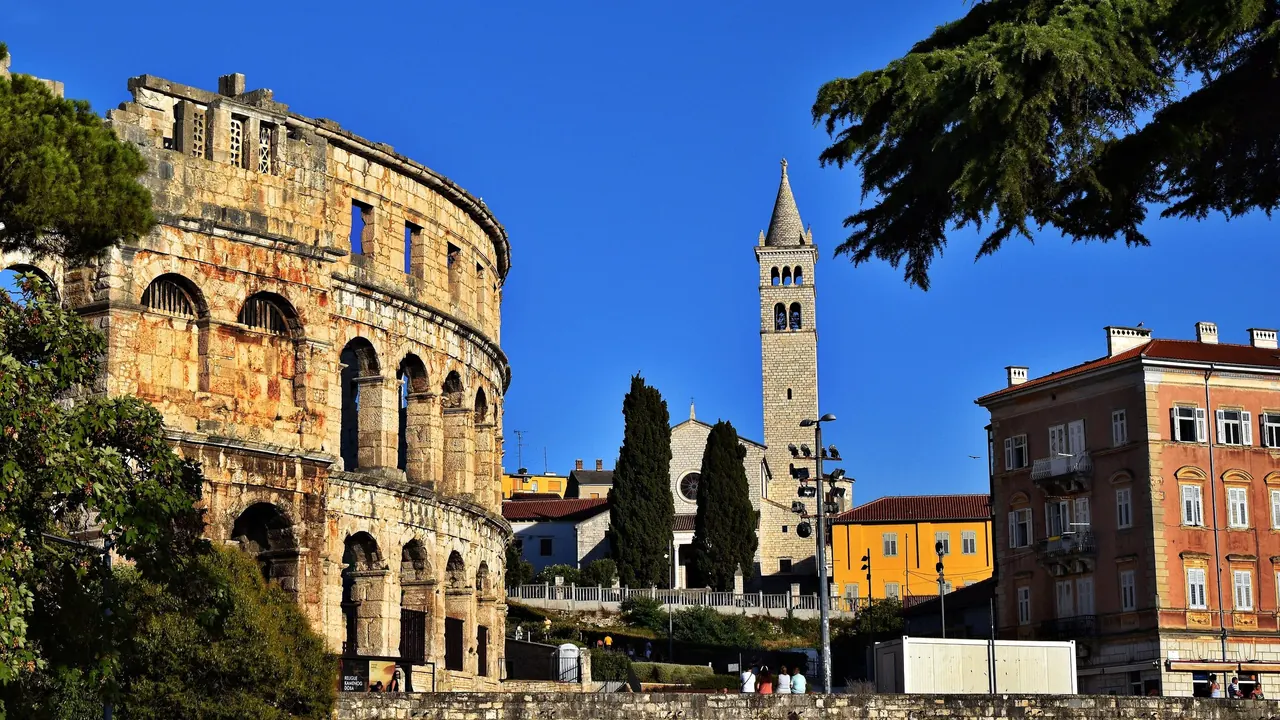
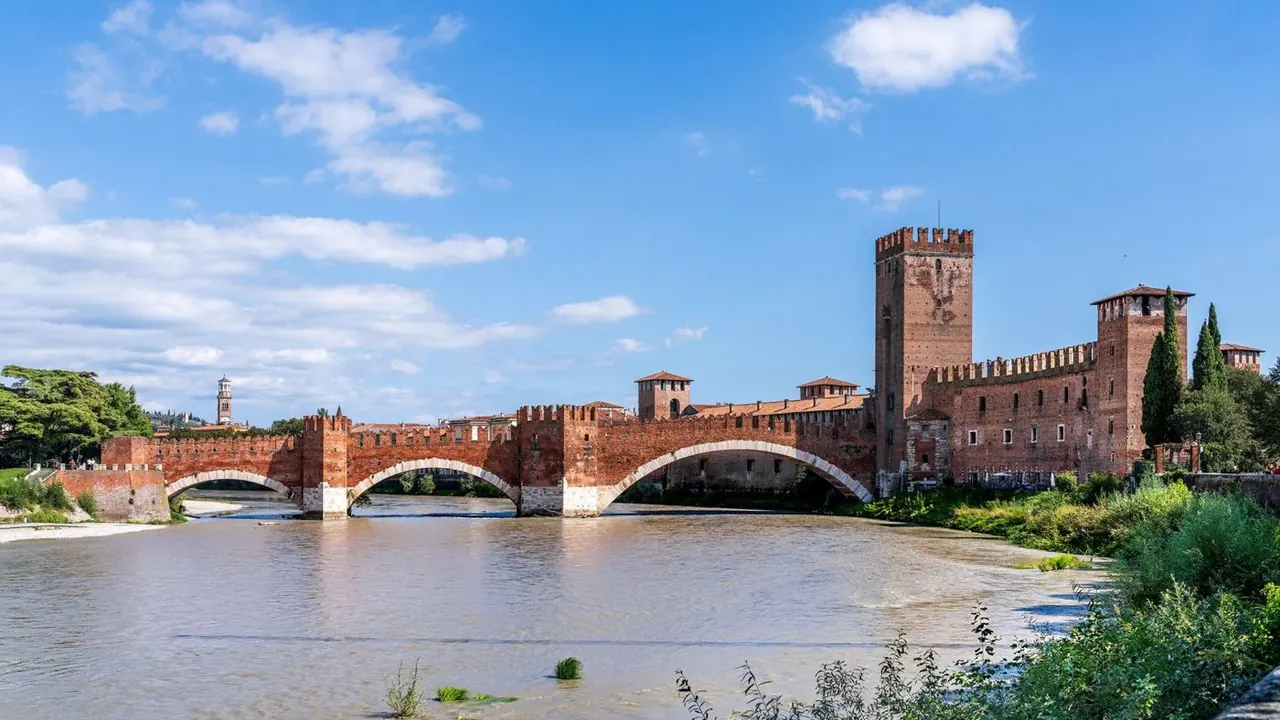
Photos: Pula by Miroslav.vajdic, CC BY-SA 4.0, cropped; Verona by NorbertNagel, CC BY-SA 4.0, cropped.
Pula or Verona?
Our verdict in twelve categories, each scored against the same fixed benchmark cities, and the climate month by month, so you can choose for your trip.
Choose Pula for
- beaches
- prices
- nightlife
Pula suits a summer by the sea with some Roman history on the side. Its rocky coves, the wild headland at Kamenjak and the shallow bays around Medulin give you clear water every day, and the Arena and the Forum fill a morning or two between swims. It works best for travellers with a car who want to tour Istria's hill towns and wine estates at an easy pace, and who don't need much from the city after dark.
Choose Verona for
- live music and the arts
- shopping
- getting around
Verona is the richer place for anyone who travels for art, architecture, opera and good wine. Its walkable centre inside the bend of the Adige, a summer evening of Verdi in the Arena and train lines to Venice, Padua and Vicenza make it ideal for a city-based trip with plenty of variety. Choose it if a swim in Lake Garda is a pleasant extra rather than the point of the trip.
Scoreboard
Twelve categories on one fixed scale from 0 to 100. The shaded stretch is the gap between the two.
Your match
Pick a travel style or drag the sliders, and both match scores follow your weighting.
Wins on beaches and prices with your weighting.
Wins on live music and the arts and shopping with your weighting.
What matters to you?
Category by category
What the scores mean for a trip.
Beaches & swimming
Pula is a real swimming destination. The indented coast south of town is lined with rocks, platforms and pebble coves under the pines, and Cape Kamenjak, about 10km away, has dozens of wild inlets in very clear water. It is rugged, though, so water shoes help, and families with small children tend to head for the gentler bays around Medulin.
Verona has no coast. Swimming means a trip to the southern shore of Lake Garda, where you'll find lidos, lawns and Sirmione's limestone shelves in calm water with no surf. It makes a pleasant afternoon out but not the backbone of a stay.
Food & drink
Verona has the better table. Its osterie around Piazza delle Erbe and in Veronetta serve Amarone risotto, bigoli with duck and bollito misto with pearà, and the great Valpolicella and Soave wines are made within a short drive. The habit of a glass with a snack at a counter adds to the pleasure of an evening.
Pula's Istrian cooking is just as distinctive, with truffle on fuži, scampi buzara and Malvazija wine. The choice in town is thinner and leans towards tourist menus near the Arena, though, and the best meals usually take a drive to a konoba in the hinterland.
Culture & sights
Both cities have a great Roman amphitheatre, but Verona builds far more around it. There is the Roman theatre below Castel San Pietro, the Scaliger tombs, the Romanesque masterpiece of San Zeno and Castelvecchio's art collection in its Scarpa setting, and the whole layered centre is a UNESCO site that rewards two or three days.
Pula's Arena is the more complete of the two, with its outer wall still standing in full. Add the Temple of Augustus, the Arch of the Sergii and the Austro-Hungarian naval legacy, and you have a strong but compact set of sights to cover in a day or two.
Nightlife
Neither city is a place to stay out late, and the difference is mostly the setting. In Pula it is a summer thing, moving from terraces by the Forum to beach bars on Verudela and around Medulin, where a few small clubs fill up on warm weekends. Verona is built around the aperitivo in Piazza delle Erbe, with younger wine bars in Veronetta that run later in term time, and it keeps a little life all year where Pula goes quiet out of season.
Nature & outdoors
Both offer gentle, rewarding outdoors on a similar scale, but the landscapes differ. Pula's is maritime: Kamenjak's car-free cliffs and islets, sea kayaking, windsurfing at Premantura and diving on naval-era wrecks, with the Učka range for real hiking.
Verona looks towards the mountains. It has vineyard walks in Valpolicella, the Adige cycle route, beech woods and gorges on the Lessinia plateau, and Monte Baldo's ridges and reliable sailing wind on Lake Garda.
Day trips
Verona is one of the best bases anywhere for days out. Venice, Padua, Vicenza and Mantua are all quick train rides away, the Garda towns and Soave are close by, and the Valpolicella cellars are on the doorstep, so you could fill a week without repeating a theme.
Pula has a good set of its own. There is Rovinj, the mosaics of Poreč, the hill towns of Motovun and Hum, and the Brijuni islands by boat, with Piran and Trieste for a longer day. Buses are sparse, however, so much of it depends on hiring a car.
Good for families
Verona has the edge for children, mainly thanks to what lies around it: Gardaland, the water parks on Garda's southern shore and the drive-through safari at Parco Natura Viva. The flat, largely car-free centre is easy with a pushchair.
Pula's family days revolve around the sea, with sheltered shallows at Medulin, the aquarium in a Verudela fort and the Brijuni safari by boat. The rocky shores and the reliance on a car make it more work.
Getting around
Both centres are small and flat, but Verona's is largely closed to traffic, and the station connects you to an excellent rail network for Venice, Milan and the lake. Most visitors can manage without a car.
In Pula, the walk between the Arena, the Forum and the harbour is short, and city buses reach Verudela. Beyond that, slow trains and infrequent regional buses make a car or scooter close to essential for Kamenjak, the coast and the interior.
Shopping & style
Verona offers more. Via Mazzini's marble-paved stretch of Italian fashion labels, along with the boutiques and jewellers on Corso Porta Borsari, give it a smart provincial feel, while Pula's main street offers little beyond chains and souvenirs. In both cities the best buys are edible: truffle products, olive oil and Malvazija from Istria, or Amarone and pandoro from Verona.
Affordability
Costs are broadly similar in both places, but the pressure points differ. In Pula, July and August push rooms up to Western European coastal levels, and the hidden costs are car hire and boat trips. Spring and autumn apartments are where the savings are.
In Verona, it is the hotels in the historic centre that cost most, especially on opera nights and during trade fairs. Cheap student osterie and a car-free sightseeing routine help keep the rest of the budget down.
Live music & performing arts
Both cities stage their best evenings in a Roman amphitheatre in summer, but Verona is well ahead in what it puts on there and in what remains once the season ends. In Pula, the Arena takes whatever the summer brings: touring pop and rock acts, classical galas and screenings for the Pula Film Festival. The programme changes from year to year, so it adds to a trip rather than being a reason to book one. From autumn to spring there is little for a visitor beyond the Istrian National Theatre, which plays mainly in Croatian.
Verona's Arena has one clear purpose, which is grand opera. It runs almost every night through the summer, with huge sets and choruses, and many visitors build their whole trip around a performance. The city also has more to fall back on. The Roman theatre holds its own summer festival of Shakespeare, dance and jazz, and in the colder months the Teatro Filarmonico keeps up a season of opera and concerts. That season is modest, but Pula has nothing to match it.
Wellness & relaxation
Verona can offer real thermal bathing nearby, with Sirmione's long-established spa waters facing Lake Garda, a spring-fed thermal park near Lazise and the Roman-era springs at Caldiero. In Pula, the spa options are limited to hotel pools and saunas on Verudela and in Medulin, so you'll find its calm on the pine-shaded coastal paths and in quiet days outside high summer.
When should you go?
Pick your month. The climate figures are measured averages, not a forecast.
Pula in July
Verona in July
Daytime high, °C
Rainfall in the month, mm
Where the figures come from
Pula's temperatures are measured 87 km from the centre, at Trieste.
Pula has no rain gauge within 25 km of the centre, so its rainfall comes from a gridded climate dataset read at the city rather than from a gauge further away.
Temperature and rainfall are climate normals, averaged over the years shown. Pula: 1991-2020 normals, Trieste (87 km from centre). Verona: 1991-2020 normals, Verona / Villafranca (11.6 km from centre).
Both cities warm up at about the same pace, with mild days by April and May and summer highs close to 30°C in July and August. The difference is the sea. Pula's water is warm enough for proper swimming from June to late September and peaks at around 25°C in August, when the long sunny days make it a true beach destination. Its summers are also fairly dry. The rain arrives in autumn and peaks in November at about 107mm, so late spring and early September are the sweet spots for walking the Roman streets and the coastal paths.
Verona gets more rain through the summer, with frequent thundery spells from April to September, and the midday heat in the stone piazzas can be tiring in July and August, even though that is opera season. May, June and September are the most comfortable months for sightseeing on foot. Winters in Verona are a little colder than on the Istrian coast, but drier, so a crisp January city visit is perfectly workable there, while Pula is very quiet by then.
Which traveller are you?
For a beach and sun trip, Pula is the clear choice. It has swimming right on its doorstep, from the pine-shaded rocks of Verudela to Kamenjak's wild coves. From Verona, by contrast, the water means a half-hour journey to narrow lake beaches that are busy at weekends.
On a culture and arts trip, Verona gives much more. It has a UNESCO-listed centre, San Zeno, Castelvecchio's museum and opera in the Arena on summer nights, and Venice, Padua and Vicenza are all within an easy train ride. Pula's Roman sights are fine but take only a day or two.
For a short city break, Verona works better. Everything from Piazza Bra to Piazza delle Erbe is a short stroll apart, the osterie and wine counters fill the evenings, and trains do the work. In Pula, a car is needed for almost everything beyond the compact centre.
Before you go
| Measure | Pula | Verona |
|---|---|---|
| Official language | Croatian | Italian |
| Currency | Euro (EUR) | Euro (EUR) |
| Sockets | CF230 V, 50 Hz | CFL230 V, 50 Hz |
| Driving side | Right | Right |
| Time zone | UTC+1, UTC+2 in summer | UTC+1, UTC+2 in summer |
| Emergency number | 112 | 112 |
| Elevation | 5 m | 59 m |
| Main airport | Pula Airport (PUY)7 km from centre34 non-stop destinations | Verona Villafranca Valerio Catullo Airport (VRN)10 km from centre96 non-stop destinations |
| Public holidays this year | 14 days | 13 days |
By the numbers
| Measure | Pula | Verona |
|---|---|---|
| City population | 52,220 | 255,588 |
| People per km² | 971 | 1,285 |
| Museums within 10 km | 4 | 18 |
| UNESCO World Heritage sites within 50 km | 1 | 5 |
| Swim season, months above 21 °C | 4 months | - |
Where else could you go?
Every comparison below shares a destination with this one, so you can follow Pula or Verona somewhere new.