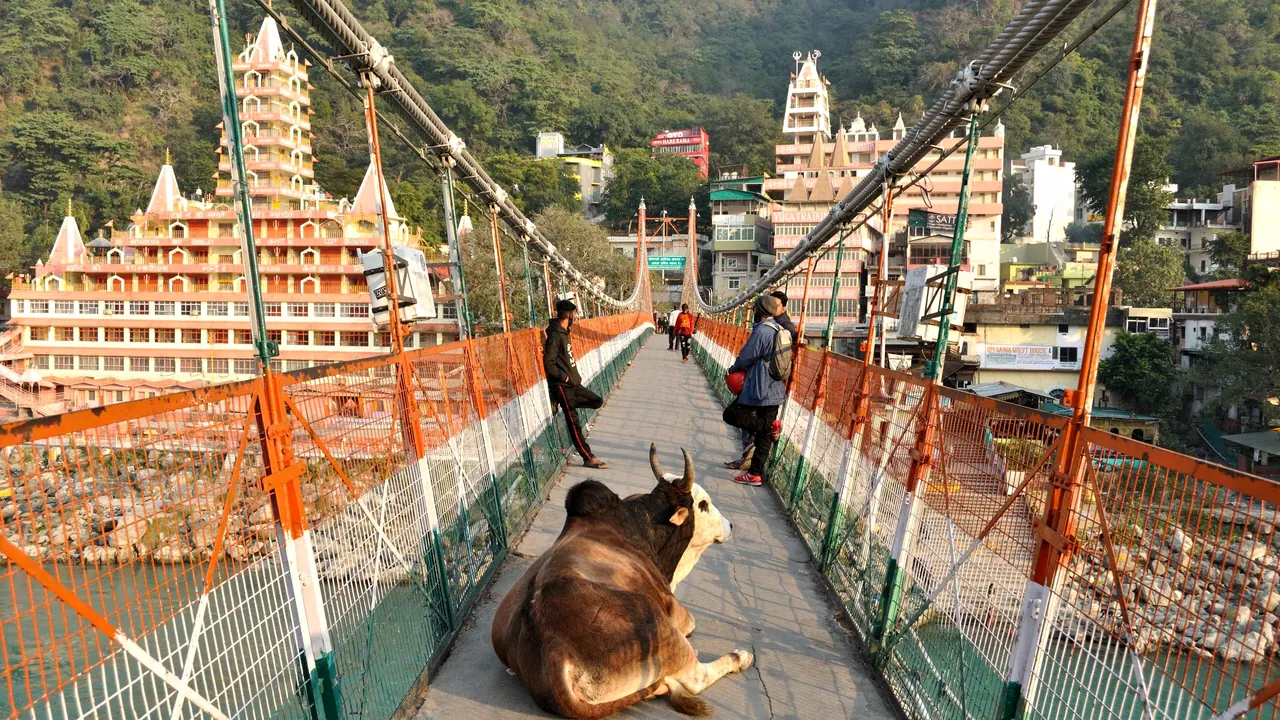
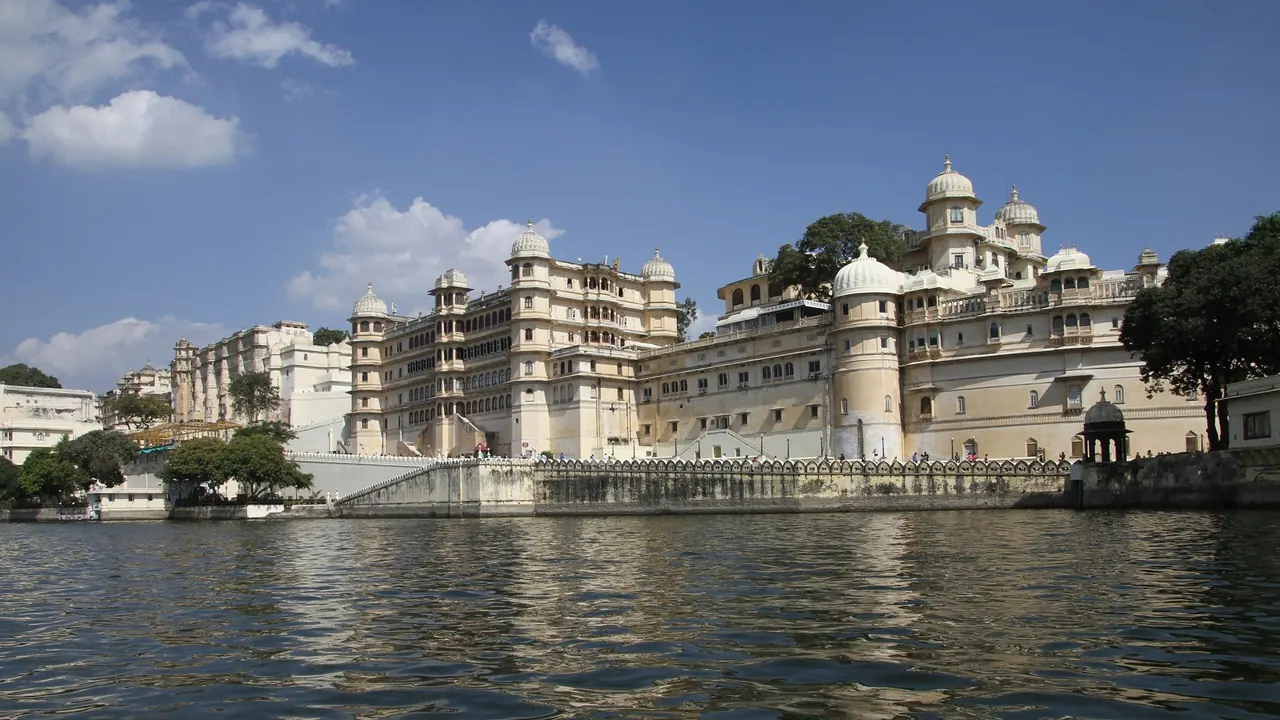
Photos: Rishikesh by Dey.sandip, CC BY-SA 4.0, cropped; Udaipur by Gerd Eichmann, CC BY-SA 4.0, cropped.
Rishikesh or Udaipur?
Our verdict in twelve categories, each scored against the same fixed benchmark cities, and the climate month by month, so you can choose for your trip.
Choose Rishikesh for
- wellness
- nature and the outdoors
- getting around
Rishikesh suits a trip built around body and mind. Its ashrams, meditation courses and Ayurvedic clinics are the reason to come, and the setting adds to them: dawn practice beside the Ganges, then afternoons rafting, walking to waterfalls or on safari in the forested hills. Choose it if you are happy with vegetarian food, no alcohol and early nights. It is also the cheaper of the two.
Choose Udaipur for
- culture and sights
- shopping
- nightlife
Travellers who want palaces, lakes and Rajput history will be happier in Udaipur. The City Palace, the white palaces on Lake Pichola and the forts within a day's drive make a far fuller sightseeing trip. The crafts bazaars, folk dance evenings and rooftop sunset drinks make it a romantic and unhurried stay rather than a spiritual retreat.
Scoreboard
Twelve categories on one fixed scale from 0 to 100. The shaded stretch is the gap between the two.
Your match
Pick a travel style or drag the sliders, and both match scores follow your weighting.
Too close to call, level with your weighting
Wins on wellness and nature and the outdoors with your weighting.
Wins on culture and sights and shopping with your weighting.
What matters to you?
Category by category
What the scores mean for a trip.
Beaches & swimming
Neither is a place to swim, but Rishikesh at least puts you beside moving water. The white sand banks along the Ganges and the camp beaches upstream at Shivpuri are good for sitting, and a ritual dip at the ghats, holding the chains, is part of a visit. The river is too cold and fast for a proper swim.
Udaipur's lakes are only for boating and looking at, so a swim means a hotel pool, ideally at one of the heritage hotels above Lake Pichola.
Food & drink
Both are cheap and easy for vegetarians, and neither is worth planning a trip around for the food. Rishikesh is strictly vegetarian and dry. You eat thalis at dhabas, puri and jalebi for breakfast and chai by the bridges, then visit terrace cafés in Tapovan where the menus of smoothie bowls, Tibetan and Israeli dishes repeat from place to place.
Udaipur has a little more range. There is Mewari cooking such as dal baati churma and gatte ki sabzi, laal maas for meat eaters, ghewar from the sweet shops, and a drink with dinner if you want one. Its lakefront rooftops are better for the view than the cooking.
Culture & sights
Rishikesh's sights are devotional rather than architectural. You cross the Ram Jhula footbridge to the painted ashrams of Swarg Ashram, see the tiered Tera Manzil temple and the evening aarti at Triveni Ghat, and find the overgrown Beatles ashram in the forest. It is about atmosphere more than monuments.
Udaipur has far more to see. The City Palace rises from Lake Pichola, the Lake Palace and Jag Mandir sit on the water, and the havelis around the Jagdish Temple form a coherent royal ensemble, with Bagore ki Haveli and the Monsoon Palace beyond. Both can be covered in two or three days, but Udaipur's days are much fuller.
Nightlife
Rishikesh is dry by rule. Alcohol is not sold in the holy town, so after the aarti on the ghats the evening means a long dinner on a café terrace or a candlelit chant, and most people are asleep early, ready for dawn yoga.
Udaipur has a little more to offer after dark. You can have a sunset drink on a rooftop above Lake Pichola, go to a hotel bar, or find one of the few lounges with music at weekends. There are still no clubs and the old city goes quiet early, so it is a place for a slow evening rather than a night out.
Nature & outdoors
Rishikesh is the far stronger outdoor base. The Ganges offers serious whitewater rafting from the Shivpuri camps, and the forested Shivalik ridges begin at the edge of town, with walks to Neer Garh falls. Rajaji National Park has jeep safaris with elephants and a chance of tigers, and there are ziplines, bungee jumping and sunrise over snow peaks from Kunjapuri.
Udaipur's outdoors is gentler. There are boat rides on the lakes, sunset viewpoints, the Sajjangarh sanctuary and cycling in the low Aravalli hills, with jungle walks at Kumbhalgarh further out. It is scenery to enjoy rather than adventure, and only in the cooler months.
Day trips
Rishikesh has one essential outing: Haridwar's huge aarti at Har Ki Pauri, under an hour away. Dehradun, the hill station of Mussoorie and the river confluence at Devprayag are also within a day, but most other places of interest lie several days into the mountains.
Udaipur offers more within a day's drive, almost all of it Mewar heritage. There are the temples of Eklingji and Nagda and the pilgrimage town of Nathdwara. The walls of Kumbhalgarh pair well with the marble Jain temple at Ranakpur, and the great fortress of Chittorgarh lies to the east. Expect long road days with a driver.
Good for families
Neither is easy with small children, and both suit older ones better. Rishikesh works for teenagers who want rafting, ziplines and safaris in Rajaji, but the cold, fast river, steep lanes and food-snatching macaques make it hard going with toddlers.
Udaipur works for a slightly wider range of ages. Boat rides, palaces, puppet shows and the cable car to the viewpoints appeal to younger children, and lakeside hotels with pools make a comfortable base. Visit in winter, as the heat from April onwards is punishing.
Getting around
Rishikesh is easier to manage without a driver. Footbridges and riverside paths link Tapovan, Lakshman Jhula, Ram Jhula and Triveni, shared vikrams run along the main road and ferries cross near Ram Jhula, though many walks are uphill.
Udaipur's old city is compact enough to walk, but its lanes are steep, narrow and full of motorbikes, and there is no public transport a visitor would use. Beyond the centre you depend on autorickshaws or ride-hailing. In both towns, outings into the hills need a hired car.
Shopping & style
Rishikesh's shops follow one theme. Around the two jhulas you find yoga clothes, malas, singing bowls, incense, Ayurvedic oils and philosophy books, and much of it repeats from stall to stall.
Udaipur is the better place to shop because it has real crafts. Miniature paintings come from workshops near the City Palace, alongside bandhani and block-printed textiles, silver jewellery and puppets, and the bazaars around Hathi Pol and the clock tower serve locals as well as visitors. Expect pushy selling near the palace, and no fashion shopping in either town.
Affordability
Both are very cheap from day to day, with thalis, autos and most sights costing little. Rishikesh stays cheaper over a whole stay because the usual bed is a simple guesthouse or ashram room, and even the extras, such as rafting or a teacher training, are modest.
In Udaipur, what makes the town famous is also what costs most. A lake palace or a heritage haveli with a view is priced as international luxury, though mid-range lakeside rooms sit comfortably in between.
Live music & performing arts
In Rishikesh, music is devotional and something you join in with. There are drums and singing at the aarti, kirtan sessions in ashrams and cafés, and the occasional sitar or bansuri recital. Udaipur has more to sit and watch: the evening folk dance show at Bagore ki Haveli, puppetry kept alive by Lok Kala Mandal and folk musicians at the Shilpgram fair in December. Neither has theatre or a concert season.
Wellness & relaxation
Wellness is Rishikesh's great strength. Dozens of ashrams run daily yoga, silent meditation and residential teacher trainings, Ayurvedic clinics offer detox treatments lasting several days, and Tapovan is full of breathwork and sound healing. The International Yoga Festival adds to this each spring. The bridges and main road are noisy, but the ashram gardens and the quieter stretches upriver are calm.
Udaipur is a pleasant place to unwind rather than a place to practise. It has Ayurvedic massage in the old city, easy yoga classes and elaborate spas in the palace hotels, and the most restful moment is sunset over the lake from a terrace. How much calm you find depends largely on your hotel.
When should you go?
Pick your month. The climate figures are measured averages, not a forecast.
Rishikesh in July
Udaipur in July
Daytime high, °C
Rainfall in the month, mm
Where the figures come from
Rishikesh has no weather station within reach, so its figures come from a gridded climate model rather than a measured record, and read a broad area rather than the city itself.
Udaipur has no rain gauge within 25 km of the centre, so its rainfall comes from a gridded climate dataset read at the city rather than from a gauge further away.
Temperature and rainfall are climate normals, averaged over the years shown. Rishikesh: 2001-2020 normals, NASA POWER reanalysis grid, no weather station within 90 km. Udaipur: 1978-2025, 10 years observed (rainfall 1991-2020) normals, Udaipur Dabok (20.6 km from centre).
Both are winter destinations, and neither works for a beach trip. Rishikesh is at its best in October and November, once the monsoon has passed and the air is dry and clear, and again in February and March. December and January are cool, with highs around 19°C and cold mornings, but this is when the snow peaks show from the hilltops. From April the heat builds to 39°C by May. Then the monsoon arrives, bringing 381mm in July alone, swelling the river and stopping the rafting.
In winter Udaipur is warmer and much drier, with highs near 25°C and almost no rain from October to March, which is ideal for walking the old city. In May it is as hot as Rishikesh, but its monsoon is lighter, peaking at about 257mm in July. The lakes look fullest and greenest just after the rains.
Which traveller are you?
For a relaxing and wellness trip, Rishikesh is the clear pick. Its ashrams, meditation courses and Ayurvedic clinics can fill weeks, and the town's alcohol-free, early-to-bed rhythm suits the practice. In Udaipur, calm comes mainly from hotel spas and lake views.
On a culture and arts trip, Udaipur gives far more. It has the City Palace, the island palaces on Lake Pichola, folk dance at Bagore ki Haveli and miniature painting workshops, with Kumbhalgarh, Ranakpur and Chittorgarh as day trips. Rishikesh's devotional sights are seen quickly.
For an outdoors trip, choose Rishikesh. Whitewater rafting on the Ganges, forest walks to waterfalls, jeep safaris in Rajaji National Park and Himalayan sunrises are all close to town. Udaipur's low hills and lake boat rides make pleasant outings rather than adventures.
Before you go
| Measure | Rishikesh | Udaipur |
|---|---|---|
| Official language | Hindi, English | Hindi, English |
| Currency | Indian Rupee (INR) | Indian Rupee (INR) |
| Sockets | CM230 V, 50 Hz | CM230 V, 50 Hz |
| Driving side | Left | Left |
| Time zone | UTC+5:30 | UTC+5:30 |
| Emergency number | 108 or 112 | 108 or 112 |
| Elevation | 372 m | 578 m |
| Main airport | Dehradun Jolly Grant Airport (DED)14 km from centre13 non-stop destinations | Maharana Pratap Airport (UDR)22 km from centre11 non-stop destinations |
By the numbers
| Measure | Rishikesh | Udaipur |
|---|---|---|
| City population | 70,499 | 451,100 |
| People per km² | 133 | 12,192 |
| Museums within 10 km | 0 | 3 |
| UNESCO World Heritage sites within 50 km | 0 | 0 |
Where else could you go?
Every comparison below shares a destination with this one, so you can follow Rishikesh or Udaipur somewhere new.
- Delhivs Rishikesh
- Jodhpurvs Udaipur
- Agravs Rishikesh
- Jaipurvs Udaipur
- Amritsarvs Rishikesh
- Jaipurvs Rishikesh