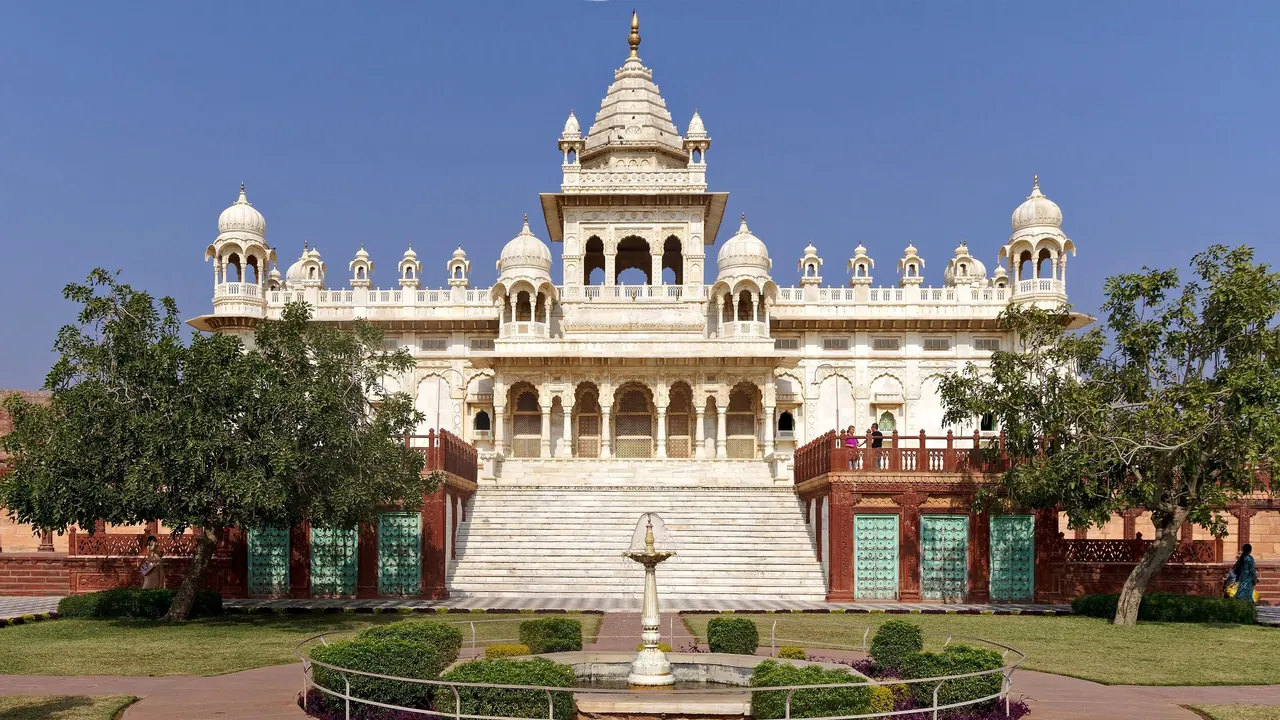
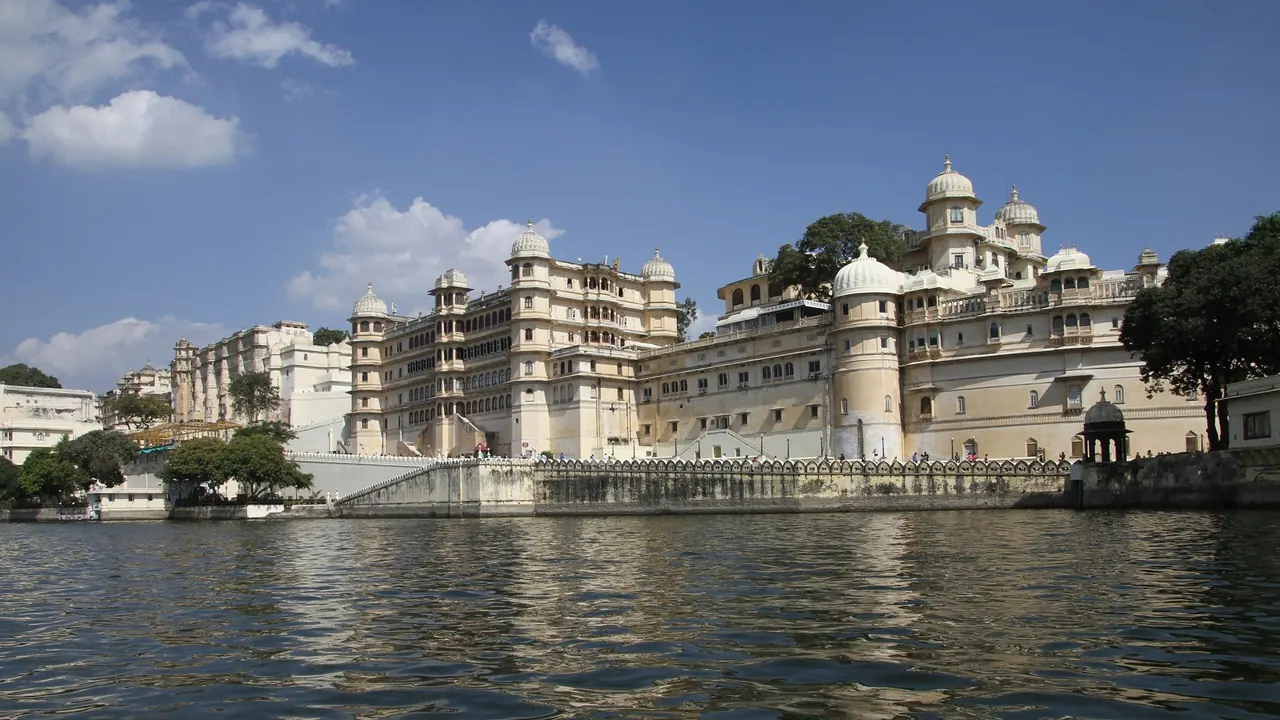
Photos: Jodhpur by Jakub Hałun, CC BY-SA 4.0, cropped; Udaipur by Gerd Eichmann, CC BY-SA 4.0, cropped.
Jodhpur or Udaipur?
Our verdict in twelve categories, each scored against the same fixed benchmark cities, and the climate month by month, so you can choose for your trip.
Choose Jodhpur for
- food and drink
- shopping
- culture and sights
Jodhpur suits the traveller who wants one tremendous monument and a city that still feels like a working desert town. Mehrangarh and its museum are the strongest single sight in this pair, the indigo lanes and Clock Tower market give more to eat and buy, and the Marwari snack culture is a real reason to linger. It is a place to go for two intense days, then move on.
Choose Udaipur for
- day trips
- wellness
- nature and the outdoors
Udaipur is the better pick for a slower, softer stay. The lakes, the island palaces and the Aravalli hills make it easier on the nerves, the spas and terraces are more restful, and the countryside around it holds Kumbhalgarh, Ranakpur and Chittorgarh. Anyone planning several nights with a driver for excursions will get more out of it.
Scoreboard
Twelve categories on one fixed scale from 0 to 100. The shaded stretch is the gap between the two.
Your match
Pick a travel style or drag the sliders, and both match scores follow your weighting.
Wins on food and drink and shopping with your weighting.
Wins on day trips and wellness with your weighting.
What matters to you?
Category by category
What the scores mean for a trip.
Beaches & swimming
Neither city offers any swimming beyond the hotel pool, since both sit far inland and their lakes are not for bathing. The difference lies in the setting: in Jodhpur a pool is usually tucked into a heritage courtyard as relief from the desert heat, while around Lake Pichola it often comes with a view across the water.
Food & drink
Jodhpur is the better city to eat in. Its breakfast of mirchi vada and pyaaz kachori, thick makhaniya lassi and desert dishes such as ker sangri give it a distinct Marwari identity, and the stalls around the Clock Tower are where to find it.
Udaipur shares much of the Rajasthani repertoire, with dal baati churma and generous thalis, but the good local food sits away from the lakefront, and the view-led rooftops serve pizza and pancakes alongside curry. Both cities are largely vegetarian and drink little.
Culture & sights
Jodhpur has the more powerful centrepiece. Mehrangarh grows out of its ridge and holds one of Rajasthan's best museums, and the blue city, Toorji ka Jhalra and Mandore's cenotaphs round out a compact two days.
Udaipur's strength is atmosphere rather than depth: the City Palace rising from Lake Pichola, the Lake Palace and Jag Mandir on the water, the Jagdish Temple and Bagore ki Haveli. It makes a lovelier picture, but there is less inside to study.
Nightlife
Neither is a place for a night out, and both old cities fall quiet early. Udaipur has slightly more to offer after dark, with a handful of lounge bars, some weekend music and sunset drinks over the lake. In Jodhpur the evening is mostly dinner facing the lit fort and perhaps a hotel bar.
Nature & outdoors
Udaipur has the greener surroundings. Its ring of Aravalli hills, chain of lakes, boat rides, Sajjangarh's forest and the jungle walks of Kumbhalgarh sanctuary give genuine variety, with cycling and short hikes among the hill villages.
Jodhpur's landscape is rocky desert scrub, best seen in the Desert Rock Park below the fort. Its distinctive outing is a jeep drive through Bishnoi country for blackbuck and chinkara, plus camel rides and ziplines, but there are no hills or forest to walk in.
Day trips
Udaipur is by far the better base for excursions. Eklingji, Nagda and Nathdwara are close, Kumbhalgarh and Ranakpur pair into one memorable day, and Chittorgarh's fortress lies about two hours east.
From Jodhpur the main outing is Osian's sandstone temples, about an hour and a half away, with Bishnoi and Salawas craft villages for shorter trips. The region's headline sights are three hours or more distant, and are usually seen on the way to Udaipur.
Good for families
Both suit older children in winter rather than toddlers in summer, with little built for kids and narrow lanes full of motorbikes and cows. The appeal differs: Jodhpur offers cannons, armour, ziplines and blackbuck safaris for adventurous children, while Udaipur leans gentler with boat rides, puppet shows and the cable car.
Getting around
Both are walkable at the core and car-dependent beyond it, with no public transport visitors use. In Jodhpur the market, blue city and stepwell sit together beneath a steep climb to the fort, and auto-rickshaw fares need agreeing first. Udaipur's old city around the palace and ghats is compact but hilly, and ride-hailing cars add an option for the outer areas.
Shopping & style
Jodhpur gives more scope, especially for larger purchases. Beyond Sardar Market's spices, bangles and silver, its outskirts hold warehouses of antique doors, chests and reclaimed-wood furniture that can be shipped home, and riding breeches can still be tailored.
Udaipur's speciality is miniature painting, bought from workshops near the City Palace, along with block prints, leather notebooks and puppets, and Shilpgram's December crafts fair. In both, touts push commission shops, so take your time.
Affordability
Costs run very close: street food, thalis, rickshaws and simple guesthouses are cheap in both, and the bill rises only if you choose a palace or haveli hotel. The splurge differs in kind, a fort-view haveli in Jodhpur against a lake-view palace room in Udaipur, where mid-range lakeside stays offer a comfortable middle ground.
Live music & performing arts
Both offer Rajasthani folk performance and little else. Jodhpur's is rooted in hereditary Manganiyar and Langa musicians playing in the fort and on hotel terraces, peaking with an autumn folk festival at Mehrangarh. Udaipur's centres on the nightly dance show at Bagore ki Haveli and the puppetry kept alive by Lok Kala Mandal.
Wellness & relaxation
Jodhpur keeps its quiet behind walls. The city slows down in a shaded haveli courtyard, a palace garden or on a rooftop at dusk below the lit fort, and treatments mean a massage room in the old town or a spa in a heritage hotel. Toorji ka Jhalra may look like a place to bathe, but it is a monument, and there is no bathing tradition to fall back on.
Udaipur is the easier place to unwind because its calm is in the open rather than shut away. The lakes give the eye somewhere to rest, a slow boat out on Pichola or an hour beside Fateh Sagar takes the edge off the day, and a lakeside hotel makes that view the backdrop to a longer stay. Away from the shore the lanes are as loud as Jodhpur's, so the gentler pace belongs to the water's edge.
When should you go?
Pick your month. The climate figures are measured averages, not a forecast.
Jodhpur in July
Udaipur in July
Daytime high, °C
Rainfall in the month, mm
Where the figures come from
Udaipur has no rain gauge within 25 km of the centre, so its rainfall comes from a gridded climate dataset read at the city rather than from a gauge further away.
Temperature and rainfall are climate normals, averaged over the years shown. Jodhpur: 1991-2020 normals, Jodhpur (1.3 km from centre). Udaipur: 1978-2025, 10 years observed (rainfall 1991-2020) normals, Udaipur Dabok (20.6 km from centre).
Both cities are at their best from November to February, when days are warm and dry and walking the old lanes is comfortable. Udaipur stretches a little further at each end, with October and March still manageable thanks to its hill setting. Jodhpur turns harsh sooner and stays that way longer: by May it reaches 41°C, and even after the rains September and October remain hot.
The monsoon also differs. Jodhpur gets a short, modest wet season with July at about 119mm, while Udaipur takes far heavier rain, around 257mm in July and still plenty in September. That rain is what fills and greens Udaipur's lakes, so the weeks just after it are lovely there, whereas Jodhpur stays dry and dusty for most of the year.
Which traveller are you?
On a culture and arts trip, Jodhpur edges ahead. Mehrangarh's palace courtyards and museum of miniatures, howdahs and arms, plus Jaswant Thada, the stepwell and Umaid Bhawan, make a denser set of sights than Udaipur's romantic but lighter lakeside ensemble.
For a relaxing and wellness trip, Udaipur is the clear choice. Ayurvedic treatments and yoga classes are easy to find, the lake hotels run proper spas, and sunset over Pichola calms you in a way Jodhpur's horns and heat rarely do.
On a shopping trip, Jodhpur gives more to hunt through. Sardar Market, tie-dyed textiles and mojari slippers sit alongside warehouses of antiques and carved furniture that will ship home, while Udaipur's appeal narrows mainly to miniature painting and smaller crafts.
Before you go
| Measure | Jodhpur | Udaipur |
|---|---|---|
| Official language | Hindi, English | Hindi, English |
| Currency | Indian Rupee (INR) | Indian Rupee (INR) |
| Sockets | CM230 V, 50 Hz | CM230 V, 50 Hz |
| Driving side | Left | Left |
| Time zone | UTC+5:30 | UTC+5:30 |
| Emergency number | 108 or 112 | 108 or 112 |
| Elevation | 231 m | 578 m |
| Main airport | Jodhpur Airport (JDH)5 km from centre7 non-stop destinations | Maharana Pratap Airport (UDR)22 km from centre11 non-stop destinations |
By the numbers
| Measure | Jodhpur | Udaipur |
|---|---|---|
| City population | 1,033,918 | 451,100 |
| People per km² | 4,437 | 12,192 |
| Museums within 10 km | 1 | 3 |
| UNESCO World Heritage sites within 50 km | 0 | 0 |
Where else could you go?
Every comparison below shares a destination with this one, so you can follow Jodhpur or Udaipur somewhere new.