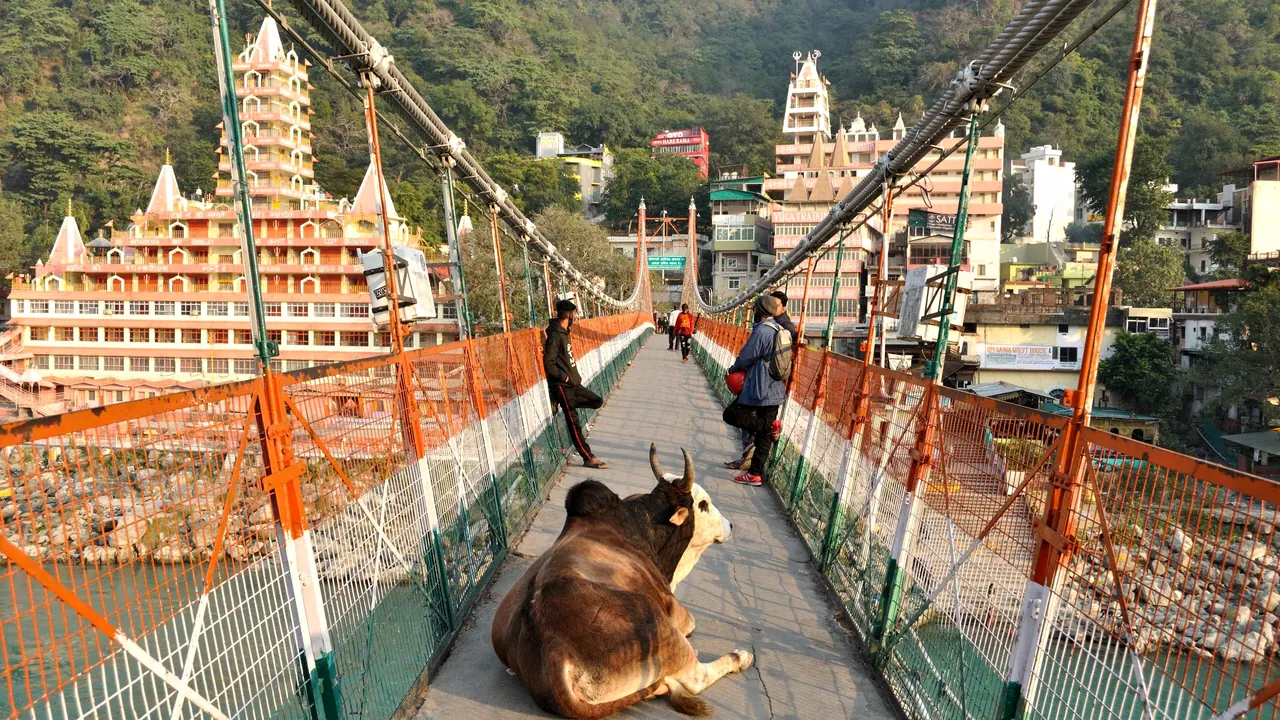
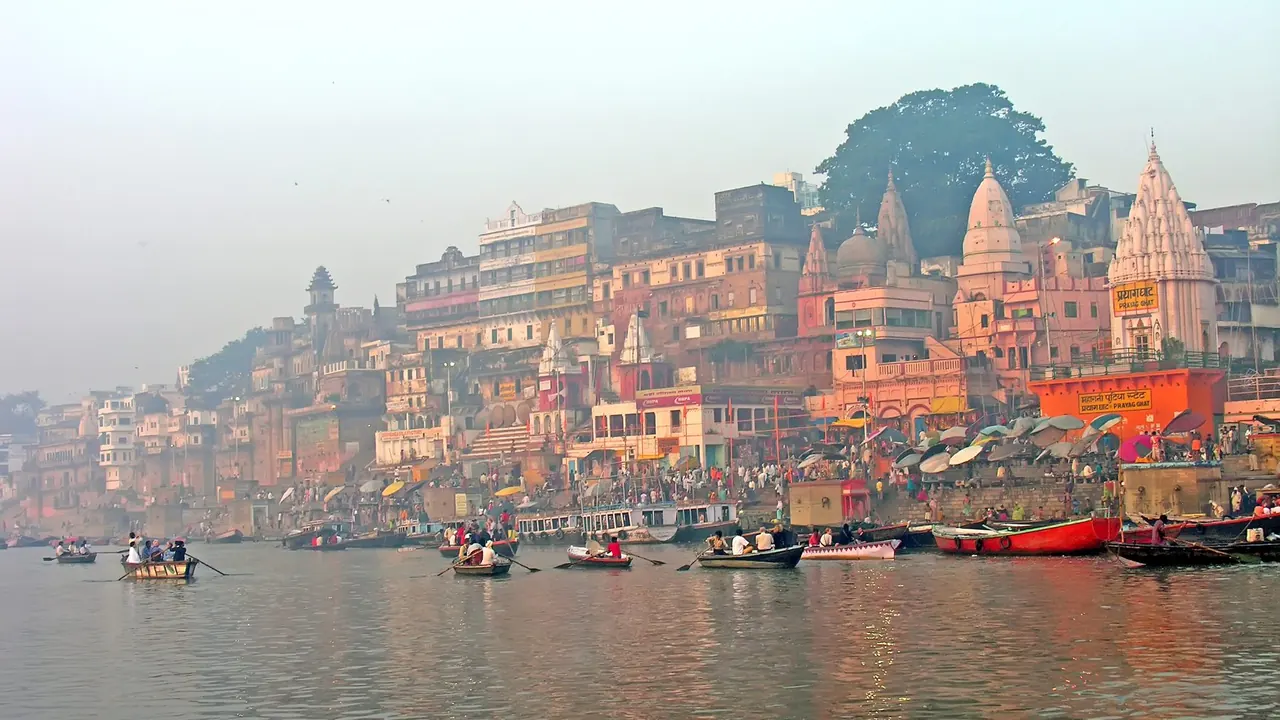
Photos: Rishikesh by Dey.sandip, CC BY-SA 4.0, cropped; Varanasi by Dennis G. Jarvis, CC BY-SA 2.0, cropped.
Rishikesh or Varanasi?
Our verdict in twelve categories, each scored against the same fixed benchmark cities, and the climate month by month, so you can choose for your trip.
Choose Rishikesh for
- nature and the outdoors
- wellness
- families
Rishikesh suits travellers who want to be active by day and rest early at night. You can do yoga at dawn, raft the Ganges where it leaves the mountains, take a jeep safari in Rajaji and hike to waterfalls in the forested Shivalik hills. It is the gentler of the two towns, more manageable with teenagers and much better for a long, quiet stay built around practice.
Choose Varanasi for
- culture and sights
- live music and the arts
- shopping
For a shorter, more intense trip about people and ritual rather than scenery, Varanasi is the stronger choice. Its ghats, cremation grounds, lanes leading to Kashi Vishwanath and long tradition of classical music make it one of India's most remarkable places, and it also has better street food and Banarasi silk to take home. It asks more of a visitor, and gives more back.
Scoreboard
Twelve categories on one fixed scale from 0 to 100. The shaded stretch is the gap between the two.
Your match
Pick a travel style or drag the sliders, and both match scores follow your weighting.
Wins on nature and the outdoors and wellness with your weighting.
Wins on culture and sights and live music and the arts with your weighting.
What matters to you?
Category by category
What the scores mean for a trip.
Beaches & swimming
Neither city is a place to swim. Rishikesh at least has white sand banks along the Ganges and river beaches by the rafting camps near Shivpuri, where the cold green water is lovely to sit beside, though the current rules out a proper swim.
Varanasi offers less. The river there is badly polluted as well as fast, so it is for watching pilgrims bathe rather than getting in yourself, and only a few of the larger hotels have a pool.
Food & drink
Both towns are vegetarian and largely alcohol-free, but Varanasi gives a food lover more to go looking for. The lanes around Godowlia and the Chowk serve kachori for breakfast, tamatar chaat, lassi in clay cups, malaiyo at dawn in winter and paan rolled to order.
Rishikesh feeds you well and cheaply with thalis and dhaba dal. Its Tapovan cafés, though, lean towards smoothie bowls, pizza and Israeli plates for the yoga crowd, and the menus start to blur after a few days.
Culture & sights
Varanasi is one of the great sights of India. More than eighty ghats line the curve of the river, cremations burn at Manikarnika, the maze of the old city leads to Kashi Vishwanath and Ramnagar Fort stands across the water. Daily ritual on that scale can fill several days.
Rishikesh's sights are gentler and fewer. The painted temples of Swarg Ashram, the tiers of Tera Manzil, the evening aarti at Triveni Ghat and the overgrown ashram where the Beatles stayed all have atmosphere, but two or three days are enough to see them.
Nightlife
Varanasi has a little more life after dark, though in both holy towns the evening is built around the riverside aarti and an early night rather than drinks. In Rishikesh no alcohol is sold and there are no bars at all. An evening means a long dinner on a café terrace above the Ganges or a candlelit chant session, and most people are asleep in good time for dawn yoga.
Varanasi keeps similar hours, but a drink is possible from a licensed shop or at a bar in one of the larger hotels in the cantonment. The cafés along Assi Ghat stay sociable into the evening over chai and music. Nothing runs late, though.
Nature & outdoors
Rishikesh is the outdoors town of the pair. It sits where the Ganges leaves the Himalayan foothills, with forested Shivalik ridges on both banks, rapids upstream for rafting and waterfall walks such as Neer Garh. Rajaji National Park, home to elephants and the occasional tiger, is right next door.
Varanasi lies on the flat, farmed Gangetic plain. Being outdoors there means a dawn boat along the ghats or a walk on the sandbank opposite. The nearest real scenery, the Vindhya hills and the waterfalls of Chandraprabha, is about two hours away.
Day trips
Rishikesh has more within a day's reach. Haridwar, under an hour away, holds a far larger aarti. Dehradun has the Forest Research Institute and the Mindrolling monastery, and Mussoorie and Devprayag take you up into the hills.
The best outing from Varanasi is Sarnath, half an hour away, where the Buddha gave his first sermon. Chunar Fort and the fifteenth-century mosques of Jaunpur come next, but after them the list runs out quickly.
Good for families
Neither town is easy with children, but Rishikesh works for families with teenagers. Rafting, ziplines and jeep safaris give them plenty to do, and the vegetarian food is gentle. Small children will still struggle with the cold river, the steep lanes and the macaques that snatch food.
Varanasi is harder at any age, with cremations in plain view, crowded lanes with open drains and extreme summer heat. Families who go usually keep the stay short: a dawn boat ride, a trip to Sarnath and a hotel away from the ghats.
Getting around
You see both towns mostly on foot beside the river, and neither has a metro. Rishikesh is easier to manage. Footbridges and riverside paths link Tapovan, Lakshman Jhula and Ram Jhula, and shared vikrams run along the main road, though the slopes are steep and trips out of town need a taxi.
In Varanasi the walk along the ghats from Assi to Raj Ghat is a pleasure. Away from the river, though, the old city's lanes are a maze and traffic in the newer city is heavy and loud, so you use rickshaws and autos, agreeing the fare first.
Shopping & style
Varanasi has one thing worth travelling for: Banarasi silk, bought from the weaving workshops or the silk houses of Godowlia. Brass ritual ware, painted wooden toys and musical instruments are sold alongside it. Touts steer buyers to particular shops, so it pays to choose your own.
Rishikesh sells a narrower range tied to yoga: cotton clothes for practice, malas, singing bowls, incense and books on philosophy. Much of it repeats from one stall to the next.
Affordability
Both are among the cheapest places you can travel. Guesthouses, chai and local transport cost little, and the evening aarti is free in each. The difference is where the money goes. In Rishikesh it is rafting, teacher trainings and riverside retreats. In Varanasi it is palace hotels on the ghats, private boats and the temptation of silk.
Live music & performing arts
Varanasi is one of the homes of Hindustani classical music, with its own gharanas and festivals such as the all-night Sankat Mochan Sangeet Samaroh and the Dhrupad Mela on Tulsi Ghat. Add small recitals in music schools and the month-long Ramlila at Ramnagar, and there is real performance to seek out.
Music in Rishikesh is devotional and informal. There is kirtan in ashrams and cafés, drumming at the aarti and the occasional sitar recital, but no concert hall or season to plan a trip around.
Wellness & relaxation
Rishikesh is built for this. Ashrams run daily classes, silent retreats and teacher trainings, Ayurvedic clinics offer oil massage and detox programmes, and the International Yoga Festival comes round each spring. The bridges and main road are noisy, but the ashram gardens and the quieter stretches upriver are truly calm.
Varanasi has yoga and massage around Assi Ghat, and a quiet boat at dawn can be restful. The city as a whole, though, is loud, crowded and intense, and few people leave it feeling rested.
When should you go?
Pick your month. The climate figures are measured averages, not a forecast.
Rishikesh in July
Varanasi in July
Daytime high, °C
Rainfall in the month, mm
Where the figures come from
Rishikesh has no weather station within reach, so its figures come from a gridded climate model rather than a measured record, and read a broad area rather than the city itself.
Varanasi has no weather station within reach, so its figures come from a gridded climate model rather than a measured record, and read a broad area rather than the city itself.
Temperature and rainfall are climate normals, averaged over the years shown. Rishikesh: 2001-2020 normals, NASA POWER reanalysis grid, no weather station within 90 km. Varanasi: 2001-2020 normals, NASA POWER reanalysis grid, no weather station within 90 km.
Both cities are at their best in the dry, cooler half of the year, but Rishikesh sits at the foot of the hills and stays several degrees cooler all year. The most comfortable months are October and November, then February and March, when the days are warm enough for walking and the river is open for rafting. December and January are mild by day, around 19°C, but the mornings are chilly. The heat builds from April. The monsoon arrives in June and peaks in July at about 381mm, which swells the river and ends the rafting season.
Varanasi is hotter and drier. The time to go is November to February, when highs in the mid-20s suit long walks along the ghats. By April and May the plain is fiercely hot, reaching around 43°C, and walking the streets is hard except in the early morning. The rains last from June to September, lighter than in Rishikesh but still heavy in July.
Which traveller are you?
On a culture and arts trip, Varanasi is the clear choice. Its ghats, temples and daily ritual work on a scale Rishikesh cannot match, and in the evenings there are classical recitals and festivals in a city with its own musical gharanas.
For an outdoors trip, choose Rishikesh. Forested ridges start at the edge of town, with white-water rafting from Shivpuri, waterfall hikes, sunrise at Kunjapuri and safaris in Rajaji National Park. Varanasi offers little beyond a boat on the river.
On a relaxing and wellness trip, Rishikesh again comes out ahead. Ashrams teach daily yoga and silent meditation, Ayurvedic clinics run detox treatments and early nights set the pace. Varanasi is loud and emotionally intense, so you would have to plan your own rest.
Before you go
| Measure | Rishikesh | Varanasi |
|---|---|---|
| Official language | Hindi, English | Hindi, English |
| Currency | Indian Rupee (INR) | Indian Rupee (INR) |
| Sockets | CM230 V, 50 Hz | CM230 V, 50 Hz |
| Driving side | Left | Left |
| Time zone | UTC+5:30 | UTC+5:30 |
| Emergency number | 108 or 112 | 108 or 112 |
| Elevation | 372 m | 76 m |
| Main airport | Dehradun Jolly Grant Airport (DED)14 km from centre13 non-stop destinations | Lal Bahadur Shastri International Airport (VNS)21 km from centre16 non-stop destinations |
By the numbers
| Measure | Rishikesh | Varanasi |
|---|---|---|
| City population | 70,499 | 1,198,491 |
| People per km² | 133 | 14,598 |
| Museums within 10 km | 0 | 2 |
| UNESCO World Heritage sites within 50 km | 0 | 1 |
Where else could you go?
Every comparison below shares a destination with this one, so you can follow Rishikesh or Varanasi somewhere new.
- Delhivs Rishikesh
- Agravs Rishikesh
- Pokharavs Varanasi
- Kathmanduvs Varanasi
- Amritsarvs Rishikesh
- Jaipurvs Rishikesh