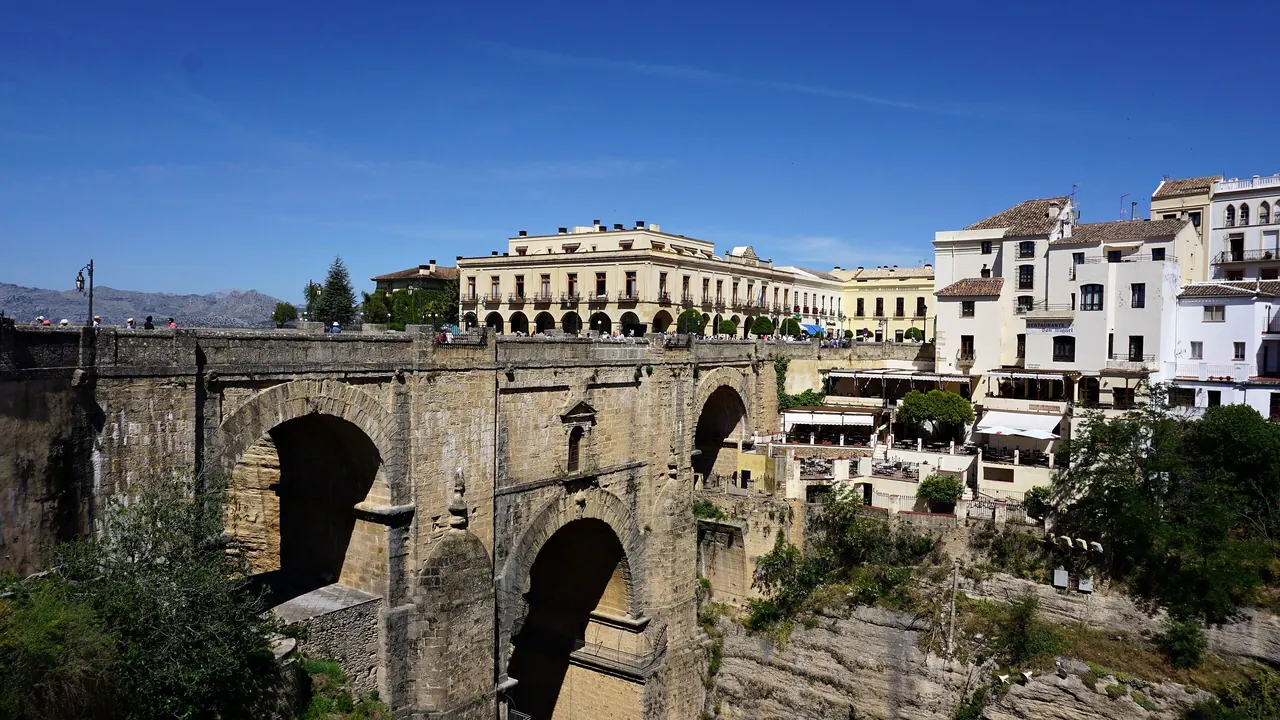
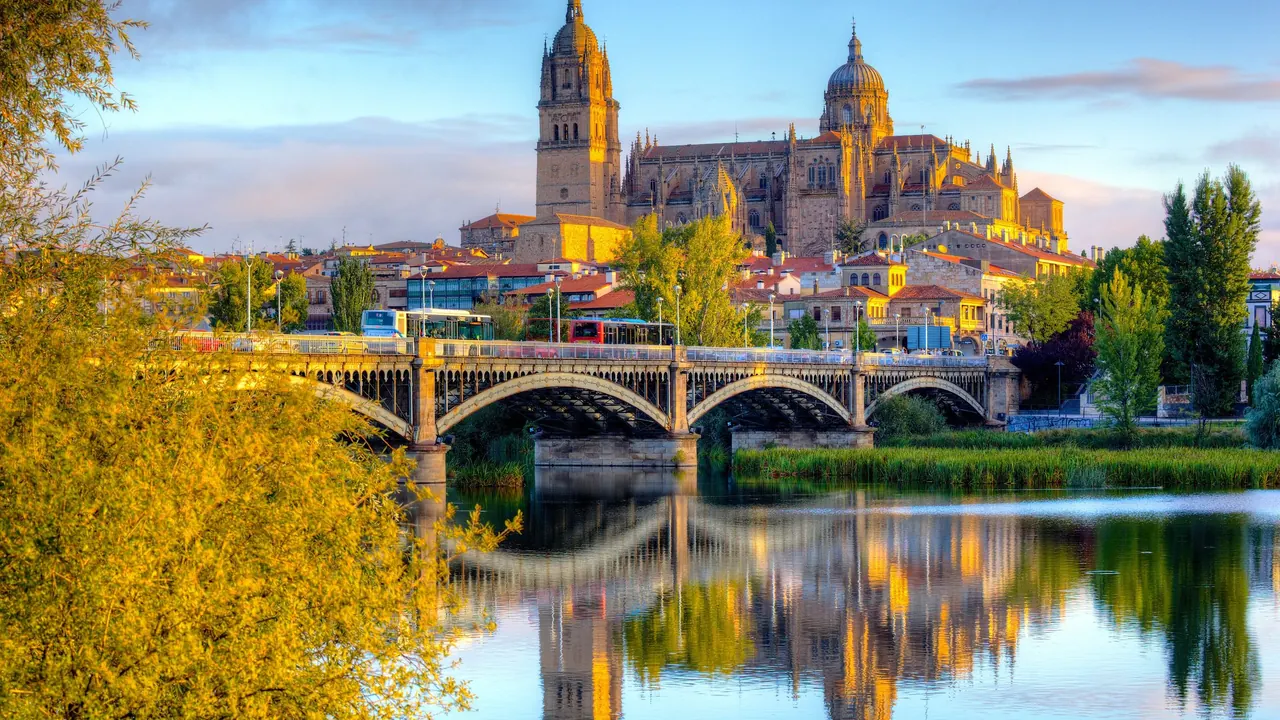
Photos: Ronda by Julia Kostecka, CC BY 2.0, cropped; Salamanca by Jiuguang Wang, CC BY-SA 3.0 ES, cropped.
Ronda or Salamanca?
Our verdict in twelve categories, each scored against the same fixed benchmark cities, and the climate month by month, so you can choose for your trip.
Choose Ronda for
- nature and the outdoors
- beaches
- day trips
Ronda suits travellers who come for landscape. The town sits on either side of a deep gorge, and the Sierra de Grazalema, the Sierra de las Nieves and a ring of white villages lie close around it, so it works best as a base for walking, driving through the hills and staying in a country house with a pool. Evenings are a long dinner and an early night. If your idea of a good day ends on a mountain path, Ronda is the better choice.
Choose Salamanca for
- nightlife
- getting around
- food and drink
Salamanca is the better pick for anyone who wants a city to explore on foot. Its golden sandstone old town is grander and more varied than Ronda's few sights, the bar-counter food culture is richer, and the student population keeps the streets full late into the night from Thursday to Saturday. It is also easier to reach and get around without a car, which makes it the stronger choice for a short break built on monuments, tapas and evenings out.
Scoreboard
Twelve categories on one fixed scale from 0 to 100. The shaded stretch is the gap between the two.
Your match
Pick a travel style or drag the sliders, and both match scores follow your weighting.
Wins on nature and the outdoors and beaches with your weighting.
Wins on nightlife and getting around with your weighting.
What matters to you?
Category by category
What the scores mean for a trip.
Beaches & swimming
Neither is a beach destination, but Ronda can at least reach the sea. The long, built-up sandy beaches around Estepona and San Pedro de Alcántara are about 50km away down a winding mountain road, which is a full day out with a car.
Salamanca is far inland on the Meseta, so swimming means the municipal pools or a river beach on the Tormes on a hot afternoon. In both places most visitors simply cool off in a pool.
Food & drink
Salamanca eats better and more widely. Ibérico ham from nearby Guijuelo, hornazo pastry and roast suckling pig are served at busy bar counters around the Plaza Mayor and Calle Van Dyck, and the Mercado Central is a good stop for cheese and charcuterie. Wines from Toro and Ribera del Duero are close at hand.
Ronda's mountain cooking is hearty and distinctive, with oxtail stew, game and autumn chestnuts and mushrooms from the Genal valley, but the good tapas bars are concentrated in the Mercadillo, and the terraces by the gorge mostly sell set menus to day-trippers. A couple of evenings covers it.
Culture & sights
Ronda's heritage is mostly its setting: the Puente Nuevo across El Tajo, the cliff-top paths, and a small group of monuments around them, including the old Maestranza bullring, the Arab baths and the rock-cut stairway of the Casa del Rey Moro. It is striking, but one or two days is enough.
Salamanca has far more to see. The whole old town is built in glowing sandstone, from the baroque Plaza Mayor to the carved University façade, the paired Old and New Cathedrals and the Casa de las Conchas, with the Casa Lis museum for Art Nouveau. It fills two or three days and looks finest after dark under floodlights.
Nightlife
Ronda's evenings are tapas and a late dinner around the Plaza del Socorro, a drink afterwards, and quiet streets by the early hours, except during the September fair.
Salamanca is one of Spain's classic student towns, and from Thursday to Saturday the old centre fills with bars around Calle Bordadores and Gran Vía, then dance bars and small clubs open well past 3am. It is young and cheap rather than sophisticated, and it quietens in high summer when term ends.
Nature & outdoors
This is Ronda's strongest suit. A path drops straight from town to the foot of the gorge, climbers use its cliffs, and the crags and vultures of the Sierra de Grazalema and the fir forests of the Sierra de las Nieves are close by. The Caminito del Rey is about an hour's drive.
Salamanca stands on an open plain, with only the riverside paths of the Tormes nearby. The Sierra de Francia, Las Batuecas, Gredos and the granite canyon of the Arribes del Duero are fine country, but each is a drive of an hour or more.
Day trips
Both make excellent bases, with a different flavour. From Ronda the outings are Andalusian: white villages such as Setenil de las Bodegas and Zahara de la Sierra, the Palaeolithic paintings of the Cueva de la Pileta, the dolmens of Antequera, and Seville or Málaga on a long day.
Salamanca opens up Old Castile instead: the walls of Ávila, Zamora's Romanesque churches, fortified Ciudad Rodrigo and the half-timbered villages of La Alberca and Mogarraz. Valladolid is an easy train ride, while in both regions the villages really need a car.
Good for families
Salamanca is the easier town with children. Its centre is compact and largely pedestrian, and hunting for the frog on the University façade and the astronaut on the New Cathedral, climbing the towers and running along the Tormes paths keep younger visitors busy.
Ronda appeals more to older children who will enjoy the gorge walk, the rock-cut stairway and the caves nearby. Its steep cobbled lanes are hard with a pushchair and some viewpoints are exposed, so families usually do best in a country house with a pool.
Getting around
Salamanca is the simpler place to manage without a car. You can cross the old town on foot in about 20 minutes, and trains to Madrid and Valladolid make arrival straightforward.
Ronda is walkable too, but the lanes down to La Ciudad and the gorge are steep, and its trains and buses are slow and infrequent. The villages, parks and gorges that make Ronda worth staying in are reached by car, and old-town parking is tight.
Shopping & style
Salamanca has a little more choice. The pedestrian streets running north from the Plaza Mayor carry chains and a department store, and charro silver filigree is a local craft worth buying.
Ronda's Carrera Espinel is a modest high street, with ceramics and leather near the bridge. In both towns the best souvenirs are edible: ham and cheese from Salamanca, and wine, olive oil and convent sweets from Ronda.
Affordability
The two cost much the same, and both are cheaper than Spain's big cities. In Ronda the spending goes on the hire car, which the surrounding area almost requires, and on rooms overlooking the gorge.
In Salamanca the student crowd keeps bar prices low, often with a free tapa alongside a drink, and no car is needed. Instead, admission to the cathedrals, towers and university adds up over a day of sightseeing.
Live music & performing arts
Salamanca has the fuller evening programme. The Teatro Liceo and a municipal arts centre host touring theatre, dance and concerts, the university stages choral music in its historic halls, and the caped student tunas sing under the arcades of the Plaza Mayor.
Ronda offers flamenco in small venues and a modest municipal theatre, and its standout event is the Corrida Goyesca at the September fair. Neither has opera or a resident orchestra.
Wellness & relaxation
Salamanca has the edge for anyone who wants to bathe. The old balneario at Ledesma, built over mineral springs, is about half an hour away, and the Roman thermal springs of Baños de Montemayor are about an hour away. In town, the cloisters of San Esteban and Las Dueñas are quiet places to sit.
Ronda's Arab baths are a monument, not a spa, so treatments mean a hotel spa. Its strength is retreat instead: a farmhouse in the olive groves with a pool and a view, once the day-trippers have gone.
When should you go?
Pick your month. The climate figures are measured averages, not a forecast.
Ronda in July
Salamanca in July
Daytime high, °C
Rainfall in the month, mm
Where the figures come from
Ronda has no weather station within reach, so its figures come from a gridded climate model rather than a measured record, and read a broad area rather than the city itself.
Temperature and rainfall are climate normals, averaged over the years shown. Ronda: 1991-2020 normals, TerraClimate 4 km grid at the town, no weather station within 90 km. Salamanca: 1991-2020 normals, Salamanca / Matacan (13.9 km from centre).
Ronda is at its best in April and May and again in late September and early October, when the days are warm enough for the gorge paths and the hills without the midsummer heat. Its wet season runs from October to March and peaks in December at around 120mm, though winter days stay fairly mild. Salamanca follows a similar pattern but is much drier from autumn through spring. Up on the Castilian plain its winters are colder, with January days of about 9°C. Spring and early autumn are the best times to walk the streets in both towns.
In summer the rain pattern flips. From June to August Ronda is almost completely dry, while Salamanca still gets the odd shower. Both are hot, with afternoons around 32°C in Ronda and only a little cooler in Salamanca, where the summer days are long and very sunny. That heat suits a pool better than sightseeing. If you want to swim in the sea from Ronda, the coast is warmest in August, at about 22°C. Salamanca has no sea, only river beaches and reservoirs.
Which traveller are you?
On an outdoors trip, Ronda is clearly ahead. Limestone sierras, the green Grazalema ravines, Spanish fir forests and the Caminito del Rey are all within an hour, while Salamanca's mountains and the Arribes canyon need longer drives off the plain.
For a food and nightlife trip, choose Salamanca. Its tapas bars around Calle Van Dyck and the Plaza Mayor serve Guijuelo ham generously, and the student crowd keeps bars and small clubs open long after Ronda has gone quiet.
On a culture and arts trip, Salamanca offers more. A whole UNESCO-listed old town, two cathedrals, the university and evening concerts and theatre give several full days. Ronda's gorge and bridge are unforgettable, but its sights take only a day or two.
Before you go
| Measure | Ronda | Salamanca |
|---|---|---|
| Official language | Spanish | Spanish |
| Currency | Euro (EUR) | Euro (EUR) |
| Sockets | CF230 V, 50 Hz | CF230 V, 50 Hz |
| Driving side | Right | Right |
| Time zone | UTC+1, UTC+2 in summer | UTC+1, UTC+2 in summer |
| Emergency number | 112 | 112 |
| Elevation | 724 m | 798 m |
| Main airport | Málaga-Costa del Sol Airport (AGP)60 km from centre166 non-stop destinations | Adolfo Suárez Madrid–Barajas Airport (MAD)184 km from centre239 non-stop destinations |
| Public holidays this year | 12 days | 12 days |
By the numbers
| Measure | Ronda | Salamanca |
|---|---|---|
| City population | 33,671 | 146,110 |
| People per km² | 87 | 3,690 |
| Museums within 10 km | 5 | 13 |
| UNESCO World Heritage sites within 50 km | 0 | 1 |
| Swim season, months above 21 °C | 1 month | - |
Where else could you go?
Every comparison below shares a destination with this one, so you can follow Ronda or Salamanca somewhere new.