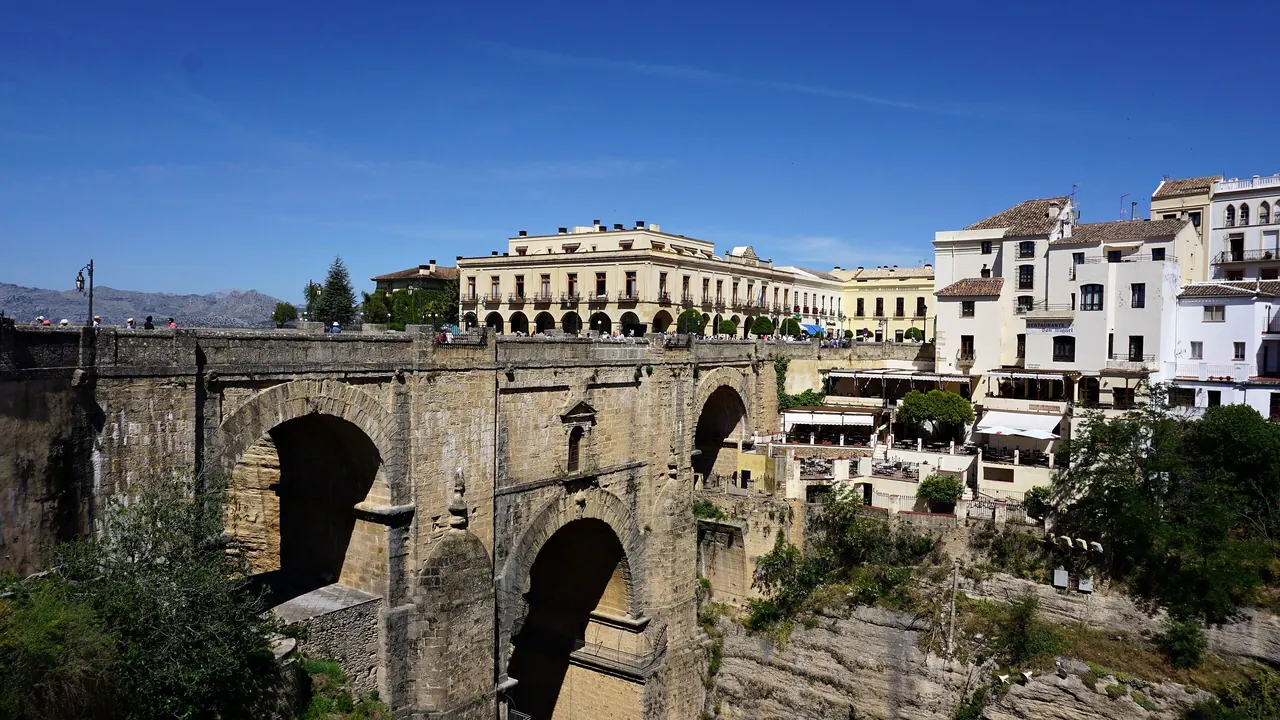
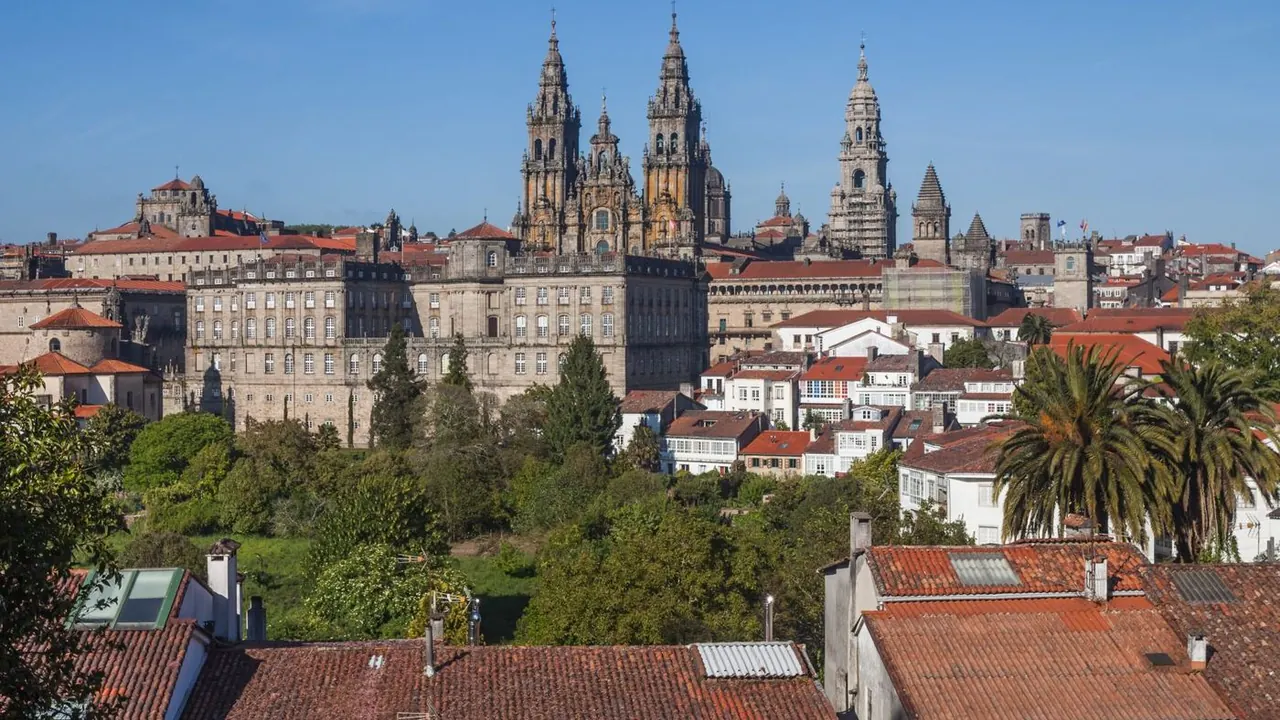
Photos: Ronda by Julia Kostecka, CC BY 2.0, cropped; Santiago de Compostela by Luis Miguel Bugallo Sánchez (Lmbuga), CC BY-SA 3.0, cropped.
Ronda or Santiago de Compostela?
Our verdict in twelve categories, each scored against the same fixed benchmark cities, and the climate month by month, so you can choose for your trip.
Choose Ronda for
- nature and the outdoors
- day trips
Ronda is the choice for travellers who want landscape more than a city. The gorge it is built across, the limestone sierras of Grazalema and Las Nieves on either side and the white villages scattered through the hills make it a base for walking, climbing and driving country roads. It suits a few slow days in a farmhouse with a pool more than a long list of sights, and it rewards anyone who arrives with a hire car and walking boots.
Choose Santiago de Compostela for
- nightlife
- food and drink
- live music and the arts
Santiago de Compostela gives more to anyone who wants a proper small city. The cathedral and its granite old town have more depth than Ronda's compact group of monuments. Galician seafood and the Abastos market make eating a reason to come, and a student crowd keeps the bars full late into the night in term. Trains to A Coruña, Vigo and Ourense also let you see the region without a car, but you have to accept the rain.
Scoreboard
Twelve categories on one fixed scale from 0 to 100. The shaded stretch is the gap between the two.
Your match
Pick a travel style or drag the sliders, and both match scores follow your weighting.
Wins on nature and the outdoors and day trips with your weighting.
Wins on nightlife and food and drink with your weighting.
What matters to you?
Category by category
What the scores mean for a trip.
Beaches & swimming
Neither city is for a beach vacation, but Santiago makes the better beach day. The sheltered white-sand inlets of the Ría de Muros e Noia and the Ría de Arousa are about 35km away and can be reached by bus. The catch is Atlantic water that stays cold even in August.
The sea below Ronda is warmer, but getting there takes a full day on hairpin bends over the Serranía. The beaches at San Pedro and Estepona are long but heavily built up. Most visitors in Ronda stay up in the hills and swim in a pool instead.
Food & drink
Santiago eats much better. Galician seafood is the draw: octopus with paprika, scallops and razor clams, some of them cooked straight from the stalls of the granite Mercado de Abastos. The taverns along Rúa do Franco serve Padrón peppers and tetilla cheese, and there is tarta de Santiago to finish.
Ronda cooks the hearty food of the mountains, such as oxtail stew, lamb, game, hams and autumn chestnuts, with local Sierras de Málaga wine to drink. It is satisfying but narrower, and the best of it is in the Mercadillo's tapas bars rather than on the terraces overlooking the gorge.
Culture & sights
Santiago has more to see in more depth. The Romanesque cathedral with its Pórtico da Gloria and the shrine of Saint James stands on the grand Praza do Obradoiro. Around it is a whole UNESCO-listed old town of monasteries and arcades, along with the Museo do Pobo Galego and the Cidade da Cultura.
Ronda's great monument is its setting: the Puente Nuevo across a gorge more than 100m deep. Around it is a small, fine collection that includes one of Spain's oldest bullrings, the well-preserved Arab baths and the rock-cut stairway of the Casa del Rey Moro. The museums are small, so one or two days covers them.
Nightlife
In term, students give Santiago a proper late night. The evening starts with wine along Rúa do Franco and moves on to folk sessions in the bars near Praza de Cervantes. On Thursdays the clubs in the old town and the Ensanche stay open into the early morning, although things calm down in summer when the pilgrims take over.
A night in Ronda is a late dinner and maybe one drink near Plaza del Socorro. Apart from the September fair, the town is asleep long before the clubs in Santiago get busy.
Nature & outdoors
This is where Ronda pulls clearly ahead. The town stands on cliffs that climbers use, with a path down to the floor of the gorge. To the west are the crags and vultures of the Sierra de Grazalema and the Garganta Verde. To the east, the Sierra de las Nieves has rare Spanish fir forest, and the El Chorro gorge with the Caminito del Rey is about an hour away.
Santiago's countryside is softer: rain-fed oak hills, Camino paths leading out of town and, further out, the cliffs of the Costa da Morte and the ancient woods of the Fragas do Eume. It is good for gentle walks and kayaking in the rías, but there are no mountains.
Day trips
Both are excellent bases, but the trips are different. Ronda's outings are into the countryside: Setenil with its houses built under the rock, Zahara below its castle, the Roman ruins of Acinipo and the cave paintings of La Pileta. Most of these really need a car, and Seville or Málaga take a long day.
Santiago's outings are mostly to other towns, and many can be done by train. You can see the Tower of Hercules in A Coruña, the Roman walls of Lugo and the thermal springs of Ourense, with Albariño country and Fisterra open to anyone who drives.
Good for families
Neither town has much made for children, but Santiago does a little more for them. It has the Alameda and Bonaval parks, and the aquarium and science museums of A Coruña are a short train ride away. Its downside is rain that can last several days.
Older children enjoy Ronda's bridge, the walk down into the gorge and the cave visits. Its steep cobbles and high, exposed viewpoints are harder work with small children, and most families end up at a country house with a pool.
Getting around
Santiago is easier to get around. You can cross the pedestrian old town in about twenty minutes, buses run to the station and the airport, and frequent trains along the coast reach A Coruña, Pontevedra, Vigo and Ourense. Only the beaches and the Costa da Morte really need a car.
Ronda's centre is just as walkable, though the lanes down into La Ciudad are steep. Its trains and buses are slow and infrequent, and the villages, parks and gorges are car territory, with little parking near the old town.
Shopping & style
Santiago has more worth carrying home. Black jet is carved and sold along the Azabachería, there is silver around the Praterías and blue-and-white Sargadelos ceramics, and the delicatessens sell tinned seafood, tetilla cheese and tarta de Santiago.
In Ronda, Carrera Espinel has everyday chain shops and there are souvenirs near the bridge. The best things to take home are wine, cured meats and olive oil.
Affordability
Both are good value for Spain, but in different ways. In Santiago, tapas often come free with a drink, entry to the cathedral itself costs nothing and pilgrim hostels keep beds cheap, but rooms cost more around the feast of Saint James in July.
Ronda's tapas and set lunches are just as fair. Its main extra cost is the hire car you will want for the countryside, and prices rise at Easter, during the September fair and in hotels overlooking the gorge.
Live music & performing arts
There is more to go to in Santiago. The Real Filharmonía de Galicia plays at the Auditorio de Galicia, the Teatro Principal stages drama and old-town bars hold bagpipe and folk sessions. Student tunas in black capes sing in the streets.
Ronda has flamenco in small venues for visitors and an occasional theatre programme. Its one great occasion is the Corrida Goyesca, a bullfight in eighteenth-century costume held in the historic bullring during the September fair.
Wellness & relaxation
Santiago has the better choice for real bathing, because Galicia is hot-spring country. The old spa towns of Caldas de Reis and Cuntis are about half an hour away, and the riverside thermal pools of Ourense are a train ride away, so a spa day fits easily into a stay.
Ronda's Arab baths are a monument to look at, not a place to bathe. Here, rest means a farmhouse in the hills with a pool, olive groves and a town that goes quiet once the coach parties leave.
When should you go?
Pick your month. The climate figures are measured averages, not a forecast.
Ronda in July
Santiago de Compostela in July
Daytime high, °C
Rainfall in the month, mm
Where the figures come from
Ronda has no weather station within reach, so its figures come from a gridded climate model rather than a measured record, and read a broad area rather than the city itself.
Temperature and rainfall are climate normals, averaged over the years shown. Ronda: 1991-2020 normals, TerraClimate 4 km grid at the town, no weather station within 90 km. Santiago de Compostela: 1991-2020 normals, Santiago / Labacolla (8.4 km from centre).
Ronda has a sharp, dry Andalusian pattern. May and early June, and then September, are the best months. They are warm enough for long walks in the sierras and see little rain. July and August are bone dry but reach 32°C, too hot for hiking or the steep lanes in the afternoon. That is also when the coast below is warmest, with the sea at about 22°C. The rain returns in October and lasts until March, heaviest in late autumn and early winter, and winter days are cool.
Santiago never gets that hot. Summer highs of about 25°C make July and August comfortable for walking the streets, and they are also its driest and sunniest months. The Atlantic stays cool, near 17°C at best. From October to March the city is very wet, with more than 200mm in the wettest months, and even spring needs a waterproof. Choose Ronda for late spring or early autumn and Santiago for high summer.
Which traveller are you?
On an outdoors trip, Ronda is the better base. Hiking trails start at the foot of the Tajo, and the crags of Grazalema, the fir forests of Las Nieves and the Caminito del Rey are all within easy driving distance. Santiago's gentle green hills and coastal walks can't match that drama.
For a food and nightlife trip, choose Santiago. It has percebes and pulpo at the Abastos market and Albariño along Rúa do Franco, then pub-like bars and late clubs filled by students. Ronda offers good mountain tapas and a late dinner, and then the town goes quiet.
On a culture and arts trip, Santiago has more to fill the days. There are the cathedral and the Pórtico da Gloria, a UNESCO old town, Galician museums and a season of orchestral concerts. Ronda's bridge, bullring and Arab baths are memorable but take a day or two.
Before you go
| Measure | Ronda | Santiago de Compostela |
|---|---|---|
| Official language | Spanish | Spanish |
| Currency | Euro (EUR) | Euro (EUR) |
| Sockets | CF230 V, 50 Hz | CF230 V, 50 Hz |
| Driving side | Right | Right |
| Time zone | UTC+1, UTC+2 in summer | UTC+1, UTC+2 in summer |
| Emergency number | 112 | 112 |
| Elevation | 724 m | 260 m |
| Main airport | Málaga-Costa del Sol Airport (AGP)60 km from centre166 non-stop destinations | Santiago-Rosalía de Castro Airport (SCQ)10 km from centre29 non-stop destinations |
| Public holidays this year | 12 days | 13 days |
By the numbers
| Measure | Ronda | Santiago de Compostela |
|---|---|---|
| City population | 33,671 | 100,965 |
| People per km² | 87 | 459 |
| Museums within 10 km | 5 | 6 |
| UNESCO World Heritage sites within 50 km | 0 | 2 |
| Swim season, months above 21 °C | 1 month | None |
Where else could you go?
Every comparison below shares a destination with this one, so you can follow Ronda or Santiago de Compostela somewhere new.