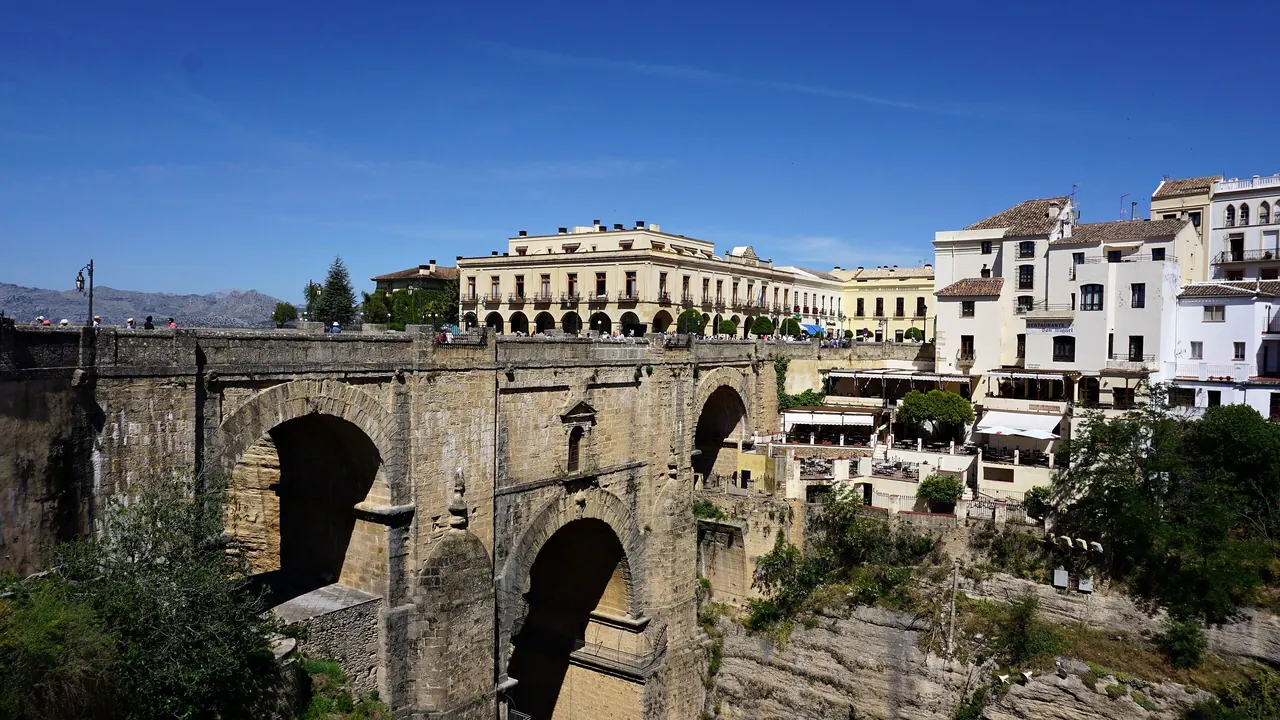
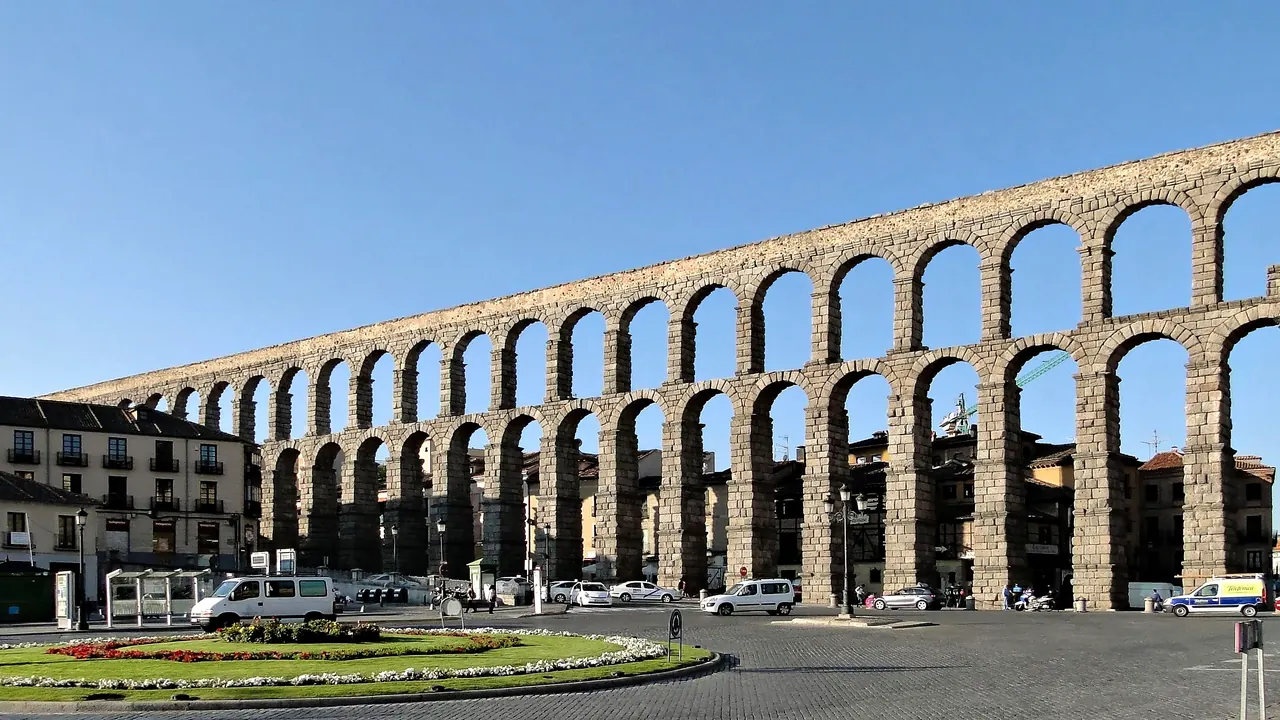
Photos: Ronda by Julia Kostecka, CC BY 2.0, cropped; Segovia by Bernard Gagnon, CC BY-SA 3.0, cropped.
Ronda or Segovia?
Our verdict in twelve categories, each scored against the same fixed benchmark cities, and the climate month by month, so you can choose for your trip.
Choose Ronda for
- beaches
- nature and the outdoors
- prices
Ronda is the better pick for travellers who want landscape as much as monuments. The town itself is the drama: a deep gorge, a stone bridge across it and paths down to the valley floor. Around it lie the white villages and two mountain parks, Grazalema and the Sierra de las Nieves. It suits a slow stay with a hire car and a country house with a pool, and the coast is within reach for a day.
Choose Segovia for
- culture and sights
- food and drink
- nightlife
Segovia gives you more history in a smaller space. The Roman aqueduct, the cathedral, the Alcázar and a string of Romanesque churches all line one ridge. Add the roast suckling pig, the gardens of La Granja and the fast train from Madrid, and it suits a city break with good lunches, families with a castle-loving child and anyone who would rather travel without a car.
Scoreboard
Twelve categories on one fixed scale from 0 to 100. The shaded stretch is the gap between the two.
Your match
Pick a travel style or drag the sliders, and both match scores follow your weighting.
Wins on beaches and nature and the outdoors with your weighting.
Wins on culture and sights and food and drink with your weighting.
What matters to you?
Category by category
What the scores mean for a trip.
Beaches & swimming
Neither is a beach destination, but Ronda can at least get you to the sea. The long, sandy and heavily built-up beaches near San Pedro de Alcántara and Estepona are about 50km away, down a winding mountain road. With a car, that makes a full day out.
Segovia is on the plateau far from any coast. The best it offers is a hotel pool, a municipal pool or a cold dip in a Guadarrama reservoir.
Food & drink
Segovia is the town people travel to for a meal. Its wood-oven roasts, suckling pig and milk-fed lamb, are a reason to visit in themselves, served with La Granja's big white beans and a Ribera del Duero red.
Ronda's mountain cooking is hearty but less of a draw: oxtail stew, game, cured hams, and chestnuts and mushrooms from the Genal valley in autumn. It is best eaten in the Mercadillo's tapas bars rather than on the gorge-view terraces. Both towns offer little beyond their regional food.
Culture & sights
Segovia has more heritage per street. A Roman aqueduct, a late Gothic cathedral, the Alcázar on its rock and a run of arcaded Romanesque churches together make a UNESCO old town that easily fills a day and repays a second.
Ronda's main sight is its setting: the Puente Nuevo over El Tajo, with the Moorish town on one side and the Mercadillo on the other. Around it are a few strong sights, including one of Spain's oldest bullrings, very well preserved Arab baths and the rock-cut stairway at the Casa del Rey Moro. In both towns the museums are small.
Nightlife
Neither town is for a big night out, but Segovia stays up a little later. Its university students keep a few bars open past midnight at weekends, after the tapas round on Plaza Mayor.
In Ronda the evening ends with a late dinner and a drink around Plaza del Socorro. The town is quiet by the early hours, except during the September fair.
Nature & outdoors
Ronda has more to offer outdoors. Grazalema's unusually green limestone sierra and the Spanish fir forests of the Sierra de las Nieves lie on either side of the town. You can walk from the town into the gorge, the cliffs draw climbers, and El Chorro's walkway is an easy drive away.
Segovia has fine mountains too. The Guadarrama's pine forests at Valsaín, the high passes and the glacial lakes below Peñalara are all close. Its winter snow adds a season that Ronda lacks.
Day trips
Segovia has the slight edge, mostly because so much is reachable without a car. Madrid is under half an hour by fast train, Ávila and La Granja's palace gardens are close, and with a car you can add Pedraza, Sepúlveda and El Escorial.
Ronda's outings are white villages such as Setenil, Zahara and Grazalema, with Acinipo and the painted cave of La Pileta close by. These are lovely, but they really need a hire car. Seville and Málaga each take one and a half to two hours.
Good for families
Segovia is easier with children. Its cliff-top Alcázar looks like a storybook castle and has a tower to climb, the aqueduct impresses even small children, and La Granja's gardens give them room to run.
Ronda's attractions for children, the bridge, the walk down the gorge and the nearby caves, suit older children better, and its high, exposed viewpoints call for care. Families tend to stay in the countryside with a pool. Both towns have steep cobbles that make pushchairs hard work.
Getting around
Both towns are easy to explore on foot, and the difference is how you arrive. Segovia's sights run along one ridge, and its high-speed station is a bus ride from the centre, with fast trains to Madrid.
Ronda's station is in town, but its trains and buses are slow and infrequent, so a car does most of the exploring, and parking in the old town is tight.
Shopping & style
There is little shopping in either town, and the best things to take home are edible. In Ronda that means local wine, cured meats and convent sweets from Carrera Espinel and the streets near the bridge. In Segovia it means boxed ponche cake and La Granja beans along Calle Real, and Madrid is close enough for real shopping.
Affordability
Costs are much the same, but they rise at different times. Ronda costs more at Easter, during the September fair and in hotels overlooking the gorge, and a hire car is the main extra.
Segovia costs more on summer weekends, when visitors arrive from Madrid, and the famous roast dinners by the aqueduct are expensive. Midweek in winter it is a cheap place to stay.
Live music & performing arts
Segovia has more to see, mostly at festival times. In spring the Titirimundi puppet festival fills its squares, summer brings concerts to churches and palace gardens, and the Teatro Juan Bravo hosts touring shows.
Ronda offers small-scale flamenco for visitors, and its big event is the Corrida Goyesca, a bullfight in eighteenth-century costume at the September fair.
Wellness & relaxation
Neither town has a spa culture, and Ronda's Arab baths are a monument rather than a place to bathe. The quiet is found in different places. In Ronda it comes from farmhouses among olive groves with pools and wide views. In Segovia it comes from evening walks along the walls and the pine-scented air of the sierra.
When should you go?
Pick your month. The climate figures are measured averages, not a forecast.
Ronda in July
Segovia in July
Daytime high, °C
Rainfall in the month, mm
Where the figures come from
Ronda has no weather station within reach, so its figures come from a gridded climate model rather than a measured record, and read a broad area rather than the city itself.
Temperature and rainfall are climate normals, averaged over the years shown. Ronda: 1991-2020 normals, TerraClimate 4 km grid at the town, no weather station within 90 km. Segovia: 1991-2020 normals, Segovia (0.3 km from centre).
Ronda is at its best in late April, May and the second half of September, when the days are warm enough for long walks and rain is light. July and August reach about 32°C with almost no rain, too hot for hiking in the afternoon. The autumn rains return in October, and from then until March the weather is wet and cool, with December the wettest month at around 120mm. For a day on the coast, June to September works best, and the sea reaches about 22°C in August.
Segovia is higher and colder. Winter highs stay near 8°C, and midsummer peaks at about 30°C with long hours of sunshine. Rain is spread more evenly through the year, and Segovia has nothing like Ronda's wet winter. May and October are its dampest months but are still fine for walking. Late spring and September suit both towns. In deep winter Segovia is the colder of the two but much drier.
Which traveller are you?
On an outdoors trip, Ronda is the stronger base. Grazalema's crags and vultures, the fir forests of the Sierra de las Nieves, climbing on the Tajo cliffs and the Caminito del Rey within an hour's drive give more variety than Segovia's Guadarrama trails.
For a culture and arts trip, Segovia offers more to see. The aqueduct, the Alcázar, the cathedral, the Jewish quarter and many Romanesque churches fill two full days, and spring puppet theatre and summer concerts in churches add to the calendar.
On a family trip with children, Segovia works better. A turreted castle with a tower to climb, the giant aqueduct arches and space to run in the La Granja gardens hold children's attention. In Ronda, the high viewpoints and long gorge walk suit older children best.
Before you go
| Measure | Ronda | Segovia |
|---|---|---|
| Official language | Spanish | Spanish |
| Currency | Euro (EUR) | Euro (EUR) |
| Sockets | CF230 V, 50 Hz | CF230 V, 50 Hz |
| Driving side | Right | Right |
| Time zone | UTC+1, UTC+2 in summer | UTC+1, UTC+2 in summer |
| Emergency number | 112 | 112 |
| Elevation | 724 m | 1,002 m |
| Main airport | Málaga-Costa del Sol Airport (AGP)60 km from centre165 non-stop destinations | Adolfo Suárez Madrid–Barajas Airport (MAD)68 km from centre241 non-stop destinations |
| Public holidays this year | 12 days | 12 days |
By the numbers
| Measure | Ronda | Segovia |
|---|---|---|
| City population | 33,671 | 52,375 |
| People per km² | 87 | 320 |
| Museums within 10 km | 5 | 11 |
| UNESCO World Heritage sites within 50 km | 0 | 2 |
| Swim season, months above 21 °C | 1 month | - |
Where else could you go?
Every comparison below shares a destination with this one, so you can follow Ronda or Segovia somewhere new.
- Marbellavs Ronda
- Malagavs Ronda
- Madridvs Segovia
- Jerez de la Fronteravs Ronda
- Sevillevs Ronda
- Cadizvs Ronda