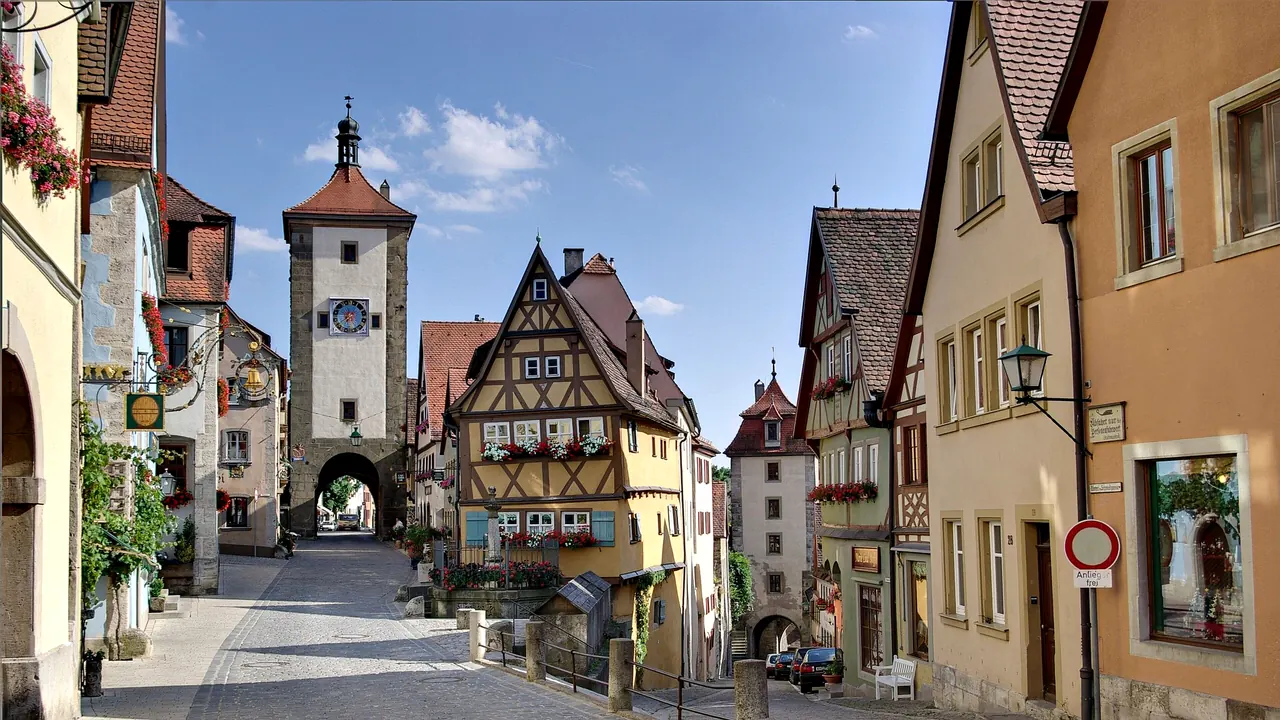
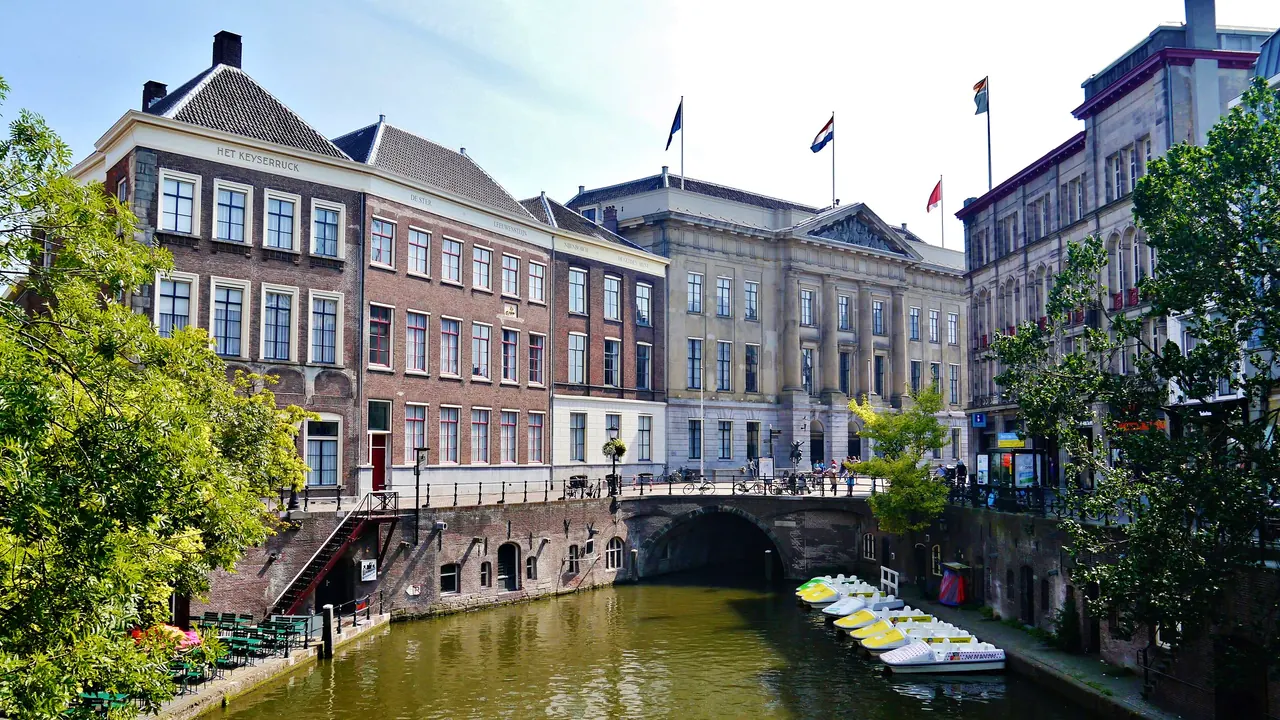
Photos: Rothenburg ob der Tauber by Berthold Werner, Public domain; Utrecht by Zairon, CC BY-SA 4.0, cropped.
Rothenburg ob der Tauber or Utrecht?
Our verdict in twelve categories, each scored against the same fixed benchmark cities, and the climate month by month, so you can choose for your trip.
Choose Rothenburg ob der Tauber for
- prices
- culture and sights
Rothenburg suits travellers who want to step inside a complete walled medieval town and are happy for evenings to end with dinner in a timbered inn. It works best as a night or two on a Romantic Road drive, with a car for Dinkelsbühl and Nördlingen, or as a December trip built around its Christmas market and year-round decoration shops. Rooms and meals are also a little kinder on the budget, especially if you sleep outside the walls.
Choose Utrecht for
- live music and the arts
- nightlife
- shopping
Choose Utrecht if you want a base that still has things to do after a week. Its rail hub puts Amsterdam, Rotterdam and Delft within easy reach, and the old centre starts as soon as you step off the train. Evenings bring canal-side bars, concerts at TivoliVredenburg and a varied food scene kept going by the students. Families will find more to do and nobody needs a car, though a bed here costs more.
Scoreboard
Twelve categories on one fixed scale from 0 to 100. The shaded stretch is the gap between the two.
Your match
Pick a travel style or drag the sliders, and both match scores follow your weighting.
Wins on prices and culture and sights with your weighting.
Wins on live music and the arts and nightlife with your weighting.
What matters to you?
Category by category
What the scores mean for a trip.
Beaches & swimming
Swimming is an afterthought in both. Rothenburg is hundreds of kilometres from any coast, so on a hot day the choice is the town's outdoor pool or an hour's drive to the Altmühlsee and the other Franconian lakes.
Utrecht has a little more within reach. There are recreation lakes such as the Maarsseveense Plassen on the edge of the city, the Loosdrecht lakes a little further out, and the North Sea at Zandvoort or Scheveningen about an hour away by train, although the water stays cool even in high summer.
Food & drink
Rothenburg's food is hearty but the choice is narrow: Schäufele, bratwurst and dumplings, Silvaner in its round-bellied Bocksbeutel, and the sugary Schneeball pastry. Many kitchens near the Marktplatz cook for coach parties, so the better meals are in family guesthouses and wine taverns away from the square.
Utrecht has more variety, even without a cuisine of its own. Indonesian and Surinamese kitchens, bistros in Lombok and on the Twijnstraat, and terraces in the old wharf cellars of the Oudegracht give you more choice over several evenings. Neither city is a place for fine dining.
Culture & sights
Both have superb medieval centres, but they feel very different. Rothenburg is an intact walled town that you take in by walking its ramparts and lanes. Riemenschneider's Holy Blood Altar and the Medieval Crime Museum are the highlights, and the whole visit is short.
Utrecht is a working city built around the free-standing Dom Tower and the two-level Oudegracht. It adds modern design to the medieval core, with the De Stijl collection at the Centraal Museum and the Rietveld Schröder House, so it fills two or three days rather than one.
Nightlife
A night out in Rothenburg means a wine tavern, an inn dining room or the night watchman's tour, and the lanes are quiet well before midnight. For anything livelier you have to drive to Würzburg or Nuremberg.
In Utrecht the students keep the bars and canal terraces around the Neude and the Janskerkhof busy even on weeknights, and there are a few clubs as well. It is a scene of bars and terraces rather than clubs, and Amsterdam is close by train for a bigger night.
Nature & outdoors
Both sit in gentle countryside rather than wild country. Around Rothenburg that means the Tauber valley below the walls, with mills and orchards and a well-known family cycle path through vineyards, and the rolling Frankenhöhe beyond.
Utrecht offers more variety. Bike routes follow the Vecht past country estates and windmills, the wooded ridges and heath of the Utrechtse Heuvelrug suit walking and mountain biking, and you can sail on the Loosdrecht lakes. Flat land and a dense cycle network make it easy to get out into the countryside.
Day trips
Rothenburg has excellent places nearby. Dinkelsbühl, Nördlingen inside its meteorite crater, Würzburg's Residenz and Nuremberg are all within about an hour. The catch is transport: trains run on a branch line and buses are sparse, so you really need a car.
Utrecht is easier and offers more choice. As the hub of the Dutch rail network, it has Amsterdam under half an hour away and Rotterdam, The Hague, Delft and Gouda a short train ride off, so you can see much of the country without changing hotels.
Good for families
Rothenburg charms children for a day or two. They can walk the ramparts, climb the Rathaus tower and follow the lantern-carrying night watchman, and older ones love the torture devices in the Crime Museum. But the cobbles and steep paths are hard on pushchairs, and little is made specifically for children.
Utrecht holds their interest for longer. The Railway Museum and the Miffy museum are aimed squarely at children, the barrel organs at the Speelklok please every age, and Dutch life takes children everywhere. The steady flow of bikes is the one thing to watch.
Getting around
Both centres are walkable. You can cross Rothenburg's walled town in a quarter of an hour on cobbles, with a steep climb back up from the valley. Leaving town is the hard part: trains mean a change at Steinach, so a car is more practical.
Utrecht is easier both in town and beyond. The country's busiest station sits on the edge of the old town, the flat streets suit walking and cycling, trams and buses use the same tap-in card as the trains, and you never need a car.
Shopping & style
Rothenburg's shops are mostly about Christmas, with baubles, nutcrackers, smoking men and carvings along the Herrngasse and Schmiedgasse, plus teddy bears and cuckoo clocks. It is a fine place to shop for that and little else.
Utrecht is a real place for browsing. Independent fashion, design and book shops line the Twijnstraat and the Elisabethstraat, the chains are in Hoog Catharijne, and there are flower and textile markets. Only the luxury brands are missing.
Affordability
Rothenburg is the cheaper of the two, though not cheap. Guesthouses inside the walls charge a tourist premium, highest in December and on summer weekends, but local wine and beer are reasonably priced and a room in a nearby village saves a good deal.
In Utrecht the main cost is the bed. Central hotels are few and priced like those in a major Western European city, and restaurant meals add up quickly. Walking everywhere, cheap student cafés and modest museum fees keep the rest of the day manageable.
Live music & performing arts
In Rothenburg, performance is mostly about the town's history: the costumed Meistertrunk play, an open-air theatre in summer and organ concerts in St Jakob's. On most evenings there is nothing on.
Utrecht has a real music life. TivoliVredenburg stacks several halls with programmes running from the Radio Philharmonic to pop and jazz, the Festival Oude Muziek draws early-music lovers from across Europe, and the Stadsschouwburg puts on theatre and dance, mostly in Dutch.
Wellness & relaxation
Neither city has a bathing tradition, and both are calmest once the day visitors leave. Rothenburg's escape is the quiet of early morning on the walls or in the Tauber valley, and for spa time there is the salt-water Franken-Therme at Bad Windsheim or the spa town of Bad Mergentheim, both about an hour away.
Relaxing in Utrecht is more sociable: slow evenings on the canal wharves, the Pandhof cloister garden beside the Dom, and large Dutch sauna complexes a short ride out in the green belt.
When should you go?
Pick your month. The climate figures are measured averages, not a forecast.
Rothenburg ob der Tauber in July
Utrecht in July
Daytime high, °C
Rainfall in the month, mm
Where the figures come from
Rothenburg ob der Tauber's sunshine is measured 27 km from the centre, at Feuchtwangen-heilbronn.
Temperature and rainfall are climate normals, averaged over the years shown. Rothenburg ob der Tauber: 1991-2020 normals, Rothenburg ob der Tauber (0.9 km from centre). Utrecht: 1991-2020 normals, De Bilt (4.3 km from centre).
Rothenburg has the sharper seasons. Winters are cold, with daytime highs around 3°C in January, which suits a Christmas market visit better than long walks on the walls. From May to September it is comfortable for walking, and July and August are the warmest and sunniest months. Rain stays moderate all year. Late spring and early autumn, with blossom or autumn colour in the Tauber valley and mild days, give the best balance.
Utrecht's climate is milder and more even. Winters are less bitter, and summers peak a little cooler, at around 23°C. It is the wetter of the two, and from July to December rain runs at around 80mm a month, so the second half of the year brings more damp days. Spring is drier: April is the driest month at 42mm, with March and May not far behind, and May is also the sunniest, which makes spring the best season for cycling out into the countryside. The North Sea reaches only about 19°C in August, so beach days are for the hardy. Neither city ever gets too hot for walking the streets.
Which traveller are you?
For a food and nightlife trip, Utrecht is the clear choice. Students fill the bars around the Neude and on the Oudegracht wharves every night of the week, and you can eat anything from Surinamese food to a modern bistro meal. Rothenburg's lanes are silent by eleven.
On a family trip with children, Utrecht keeps them busy for longer, with the Railway Museum, the Miffy museum and Kasteel de Haar, all reachable without a car. Rothenburg's ramparts and lantern-carrying night watchman delight children, but they fill only a day or two.
For a Christmas market trip, Rothenburg is the one to pick. Its market on the Marktplatz, surrounded by gabled houses, is among the most atmospheric in Germany, and its shops sell baubles, nutcrackers and Erzgebirge carvings all year. Utrecht has no Christmas tradition to match it.
Before you go
| Measure | Rothenburg ob der Tauber | Utrecht |
|---|---|---|
| Official language | German | Dutch |
| Currency | Euro (EUR) | Euro (EUR) |
| Sockets | CF230 V, 50 Hz | CF230 V, 50 Hz |
| Driving side | Right | Right |
| Time zone | UTC+1, UTC+2 in summer | UTC+1, UTC+2 in summer |
| Emergency number | 112 | 112 |
| Elevation | 430 m | 5 m |
| Main airport | Nuremberg Airport (NUE)66 km from centre56 non-stop destinations | Amsterdam Airport Schiphol (AMS)34 km from centre287 non-stop destinations |
| Public holidays this year | 12 days | 11 days |
By the numbers
| Measure | Rothenburg ob der Tauber | Utrecht |
|---|---|---|
| City population | 11,331 | 359,370 |
| People per km² | 272 | 3,619 |
| Museums within 10 km | 6 | 28 |
| UNESCO World Heritage sites within 50 km | 2 | 5 |
| Swim season, months above 21 °C | - | None |
Where else could you go?
Every comparison below shares a destination with this one, so you can follow Rothenburg ob der Tauber or Utrecht somewhere new.
- Amsterdamvs Utrecht
- Haarlemvs Utrecht
- Rotterdamvs Utrecht
- The Haguevs Utrecht
- Nurembergvs Rothenburg ob der Tauber
- Bambergvs Rothenburg ob der Tauber