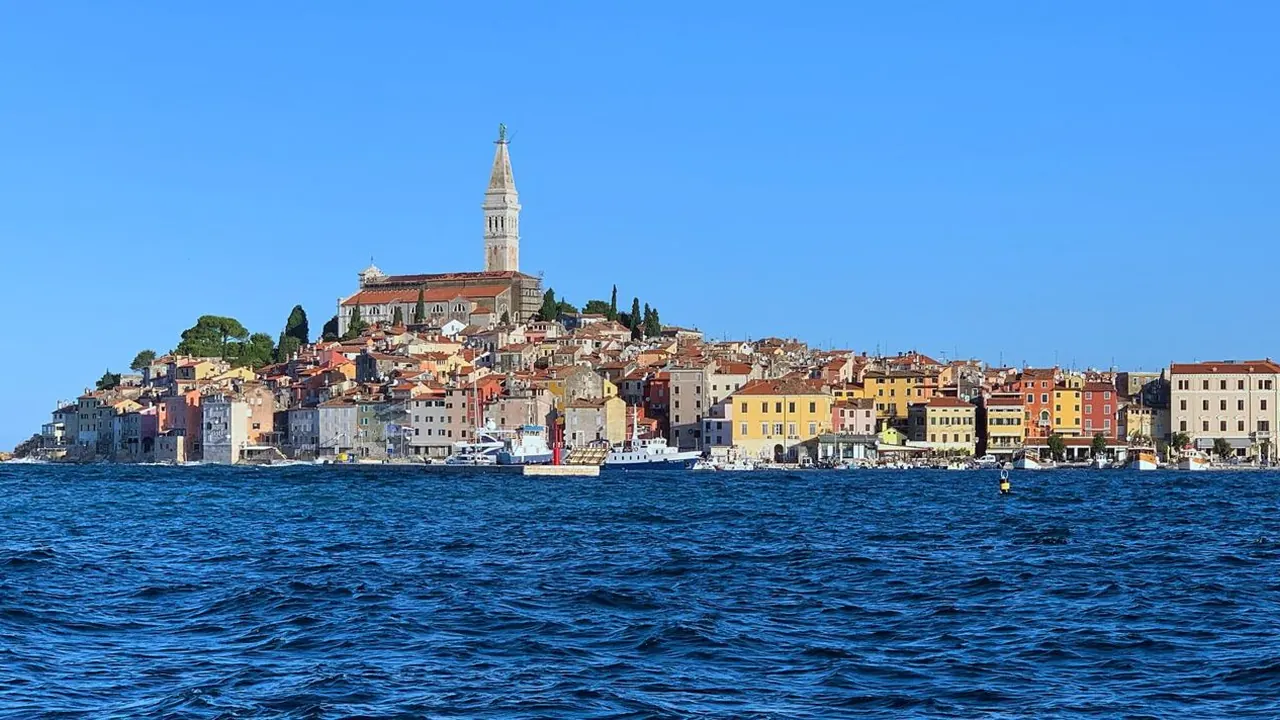
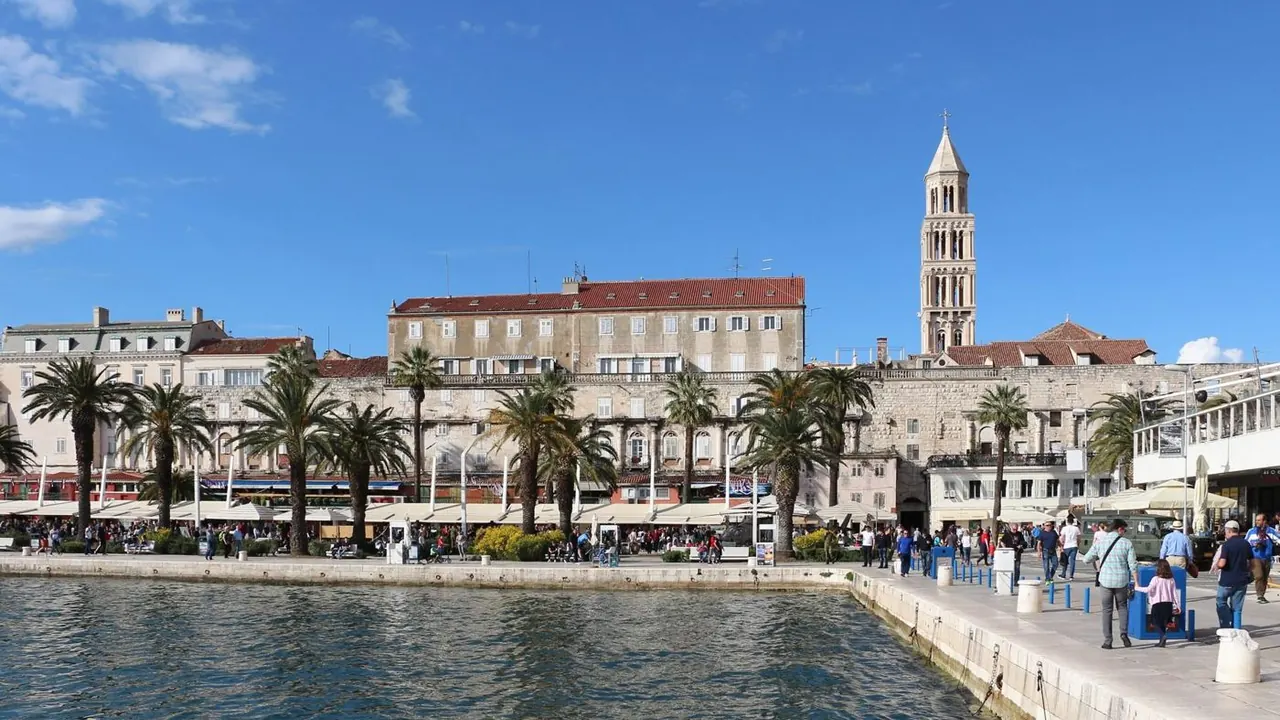
Photos: Rovinj by Vyacheslav Bukharov, CC BY-SA 4.0, cropped; Split by Bernard Gagnon, CC BY-SA 4.0, cropped.
Rovinj or Split?
Our verdict in twelve categories, each scored against the same fixed benchmark cities, and the climate month by month, so you can choose for your trip.
Choose Rovinj for
- wellness
Rovinj suits couples and families who want a small, pretty town and a slower pace: dinner on the harbour, swimming off the rocks below the walls and quiet nights. It is also the better base for a driving vacation through Istria, with truffle country, hill towns and Roman Pula within reach. You will need a car and a slightly larger budget.
Choose Split for
- culture and sights
- nightlife
- live music and the arts
Choose Split for a fuller, busier trip. The Roman palace gives it real history, the evenings run later, and the mountains, canyons and islands give you far more to do outdoors. Ferries, buses and trains all leave from the harbour, so you can explore widely without driving, and it is the gentler of the two on the wallet.
Scoreboard
Twelve categories on one fixed scale from 0 to 100. The shaded stretch is the gap between the two.
Your match
Pick a travel style or drag the sliders, and both match scores follow your weighting.
Wins on wellness with your weighting.
Wins on culture and sights and nightlife with your weighting.
What matters to you?
Category by category
What the scores mean for a trip.
Beaches & swimming
Both have clear Adriatic water and swimming within a short walk of the old town, so the difference lies in the shore itself. Rovinj swims off limestone ledges and concrete platforms under the pines of the Golden Cape, with taxi boats to St Catherine and Red Island for quieter coves. There is almost no sand, and water shoes are a must.
Split has the one thing Rovinj lacks: Bačvice, a shallow sandy bay where locals play picigin in knee-deep water. Its quieter, pine-shaded coves lie around Marjan, and Brač and Hvar have longer beaches a ferry ride away, though the city beaches are packed in high summer.
Food & drink
Both are fish-and-wine towns with too many tourist menus in the old centre, but Split has more good food in everyday reach. Its fish market and the Pazar, the bell-baked peka, pašticada with gnocchi and the family konobas of Varoš give you more to explore, and burek and bakeries keep breakfast simple.
Rovinj's strength is its region: Istrian pasta with truffle, peppery olive oil, Malvazija and Teran, and countryside konobas worth the drive. In town itself there is little cheap everyday eating, so the best meals mean taking the car or paying more.
Culture & sights
Split's Diocletian's Palace is a sight of a different order: a Roman emperor's residence that is still lived in, with a cathedral inside his mausoleum, vaulted halls beneath and the Meštrović Gallery up on Marjan. It fills two good days.
In Rovinj the old town is the sight: pastel Venetian houses climbing to St Euphemia, whose bell tower you can climb, plus the small Batana House on the town's fishing boats. It is a lovely place to wander, but one slow afternoon covers it.
Nightlife
Split has a real night out in summer: bars in the stone alleys and stairways of the palace that stay full late, and beach bars and clubs at Bačvice that run into the small hours. Rovinj's evening is a long dinner, then a drink on the rocks at sunset or in one of a few waterfront wine and cocktail bars, and the old town is mostly quiet by midnight. Both fade out of season, Rovinj more completely.
Nature & outdoors
Each has a pine-forest park on its doorstep, the Golden Cape in Rovinj and Marjan in Split, but beyond that Split's setting is far wilder. Ridge hikes on Mosor and Kozjak, the Biokovo range rising to over 1,700m, rafting and canyoning in the Cetina gorge and the waterfalls of Krka are all within about an hour.
Rovinj's outdoors is gentler: flat gravel paths for cycling, kayaking and diving around the low islands of its archipelago, the green Lim Fjord and quiet vineyard roads inland. It suits easy days on a bike or in the water rather than mountain walking.
Day trips
Both are strong bases, but Split's trips are easier and you can do them without a car. Trogir, the ruins of Salona and Klis Fortress are close by, Šibenik's cathedral is about an hour away, and ferries from the harbour reach Hvar, Brač and Vis.
Rovinj's surroundings are just as rewarding: Pula's amphitheatre, the mosaics of the Euphrasian Basilica in Porec, the hill towns of Motovun and Groznjan, and even Piran and Trieste across the border. Almost all of it, though, means hiring a car.
Good for families
Rovinj's shore is rock and concrete, so small children swim in water shoes under close watch, whereas Split has a shallow sandy bay right in the city where toddlers can paddle. Rovinj makes up for it with its large campsites and resorts, which have pools and playgrounds, and with the flat, shaded paths of the Golden Cape, good for pushchairs and bikes. The old town itself is a steep climb on polished cobbles, and the coast's waterparks are a drive north.
Split's extras suit older children better: the Roman walls, the underground halls of the palace and a ferry ride to an island, which is often the best day of the trip. July and August bring hard heat and packed beaches, and the palace streets are full of steps. That is why many families rent an apartment outside the centre and come in for the old town.
Getting around
Rovinj has intercity buses to Pula, Porec and Zagreb but no railway, so once you leave town a car is close to essential, and parking near the old town is tight in summer. Split has its ferry port, intercity bus station and railway station side by side on the harbour, and local buses run out to Solin and Trogir, so you can travel a long way without driving.
Inside town the two are much alike. Rovinj's car-free old town and its waterfront promenade into the Golden Cape put everything within walking distance, with bikes for the coast paths and taxi boats to the islands. In Split the palace, the Riva, Varoš, the markets and Bačvice are all within about fifteen minutes' walk of one another. Split's weak point is the coast road, which is slow with traffic in summer.
Shopping & style
Neither is a place to shop, and in both the best buys are olive oil, wine and local brandy. Rovinj has more character in the galleries and artists' studios along Grisia, and it sells Istrian truffle products. Split adds the mainstream chains on Marmontova and the Pazar by the palace gate for honey and dried figs.
Affordability
Neither is cheap in July and August, but Split is the easier one on the budget. Bakeries, the green market, local buses and inexpensive palace sights keep daily costs down, and outside high summer Split is a modestly priced city.
Rovinj is one of the dearer resorts on the Croatian coast, and its harbour restaurants charge for the view. Private apartments, the campsites and a visit in late spring or September are the ways to spend less there.
Live music & performing arts
Split has a proper stage: the 19th-century Croatian National Theatre with opera and ballet in season, and the Split Summer Festival performing in the Peristyle. Klapa, the local harmony singing, often fills the domed vestibule of the palace. Rovinj offers only summer concerts in St Euphemia and on its squares, plus the occasional bitinada singing linked to the batana boats, and for anything larger people go to Pula's arena.
Wellness & relaxation
Neither town has a bathing tradition, so in both a spa day means a hotel, and both are calmest in May, June and September. The difference lies in where you find it. In Rovinj the wellness areas belong to the larger resort hotels on the Golden Cape and along the shore, so a sauna or treatment comes with a walk back under the pines. In a town this small, a quiet stretch of shore is never far from the harbour.
Split offers two kinds of spa: hotel spas in the resorts east of the centre, and massage studios in the city itself. Its calm is more a local habit than a place. Dalmatians call it fjaka, the slow idleness of hour-long coffees on the Riva and empty streets in the afternoon heat. In high summer, though, real rest means the pine woods of Marjan or a ferry to an island, not the old town.
When should you go?
Pick your month. The climate figures are measured averages, not a forecast.
Rovinj in July
Split in July
Daytime high, °C
Rainfall in the month, mm
Where the figures come from
Rovinj's temperatures are measured 64 km from the centre, at Trieste.
Rovinj has no rain gauge within 25 km of the centre, so its rainfall comes from a gridded climate dataset read at the city rather than from a gauge further away.
Temperature and rainfall are climate normals, averaged over the years shown. Rovinj: 1991-2020 normals, Trieste (63.7 km from centre). Split: 1991-2020 normals, Split / Marjan (0.9 km from centre).
Both towns have the same beach season, June to September, when the sea in each is warm enough for long swims. Split is the hotter, drier and sunnier of the two. Its July and August highs reach 31°C and July brings only about 25mm of rain, which makes midday walks through the palace streets hard going. Rovinj peaks a little cooler at 29°C, with more summer showers, and its sea is at its warmest in August at 26°C.
In autumn and winter they draw apart. Rovinj turns wet from September, with 85mm or more a month through November, while Split stays drier into October. In winter Split is also milder and brighter, with a warmer sea. For walking and hiking, May and late September suit both. Rovinj's spring is the gentler, and Split is the more pleasant of the two in winter.
Which traveller are you?
For a culture and arts trip, Split is the clear choice. Diocletian's Palace is a Roman monument people still live in, the Meštrović Gallery rewards the walk up Marjan, and the National Theatre and summer festival offer opera and ballet that Rovinj cannot match.
On a food and nightlife trip, Split again comes out ahead. Its konobas in Varoš, peka dishes and two markets give more variety at every meal. After dinner the palace bars and Bačvice clubs keep going long after Rovinj's old town has gone to bed.
For a relaxing vacation, Rovinj is the better fit. It is a small town that falls quiet by midnight, with sunset swims off the rocks, pine walks in the Golden Cape and resort spas nearby. Split's old town, by contrast, stays loud late into summer nights.
Before you go
| Measure | Rovinj | Split |
|---|---|---|
| Official language | Croatian | Croatian |
| Currency | Euro (EUR) | Euro (EUR) |
| Sockets | CF230 V, 50 Hz | CF230 V, 50 Hz |
| Driving side | Right | Right |
| Time zone | UTC+1, UTC+2 in summer | UTC+1, UTC+2 in summer |
| Emergency number | 112 | 112 |
| Elevation | 0 m | 0 m |
| Main airport | Pula Airport (PUY)31 km from centre34 non-stop destinations | Split Saint Jerome Airport (SPU)12 km from centre69 non-stop destinations |
| Public holidays this year | 14 days | 14 days |
By the numbers
| Measure | Rovinj | Split |
|---|---|---|
| City population | 12,968 | 160,577 |
| Museums within 10 km | 1 | 11 |
| UNESCO World Heritage sites within 50 km | 1 | 4 |
| Swim season, months above 21 °C | 4 months | 4 months |
Where else could you go?
Every comparison below shares a destination with this one, so you can follow Rovinj or Split somewhere new.