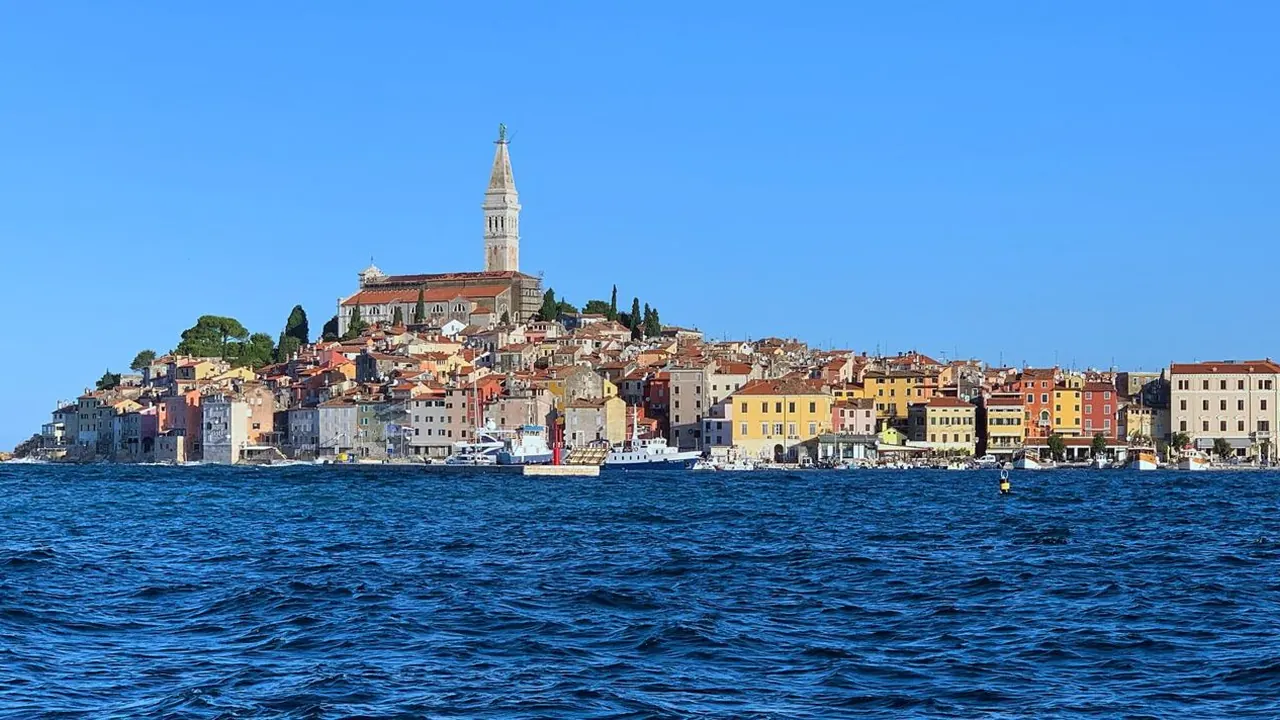
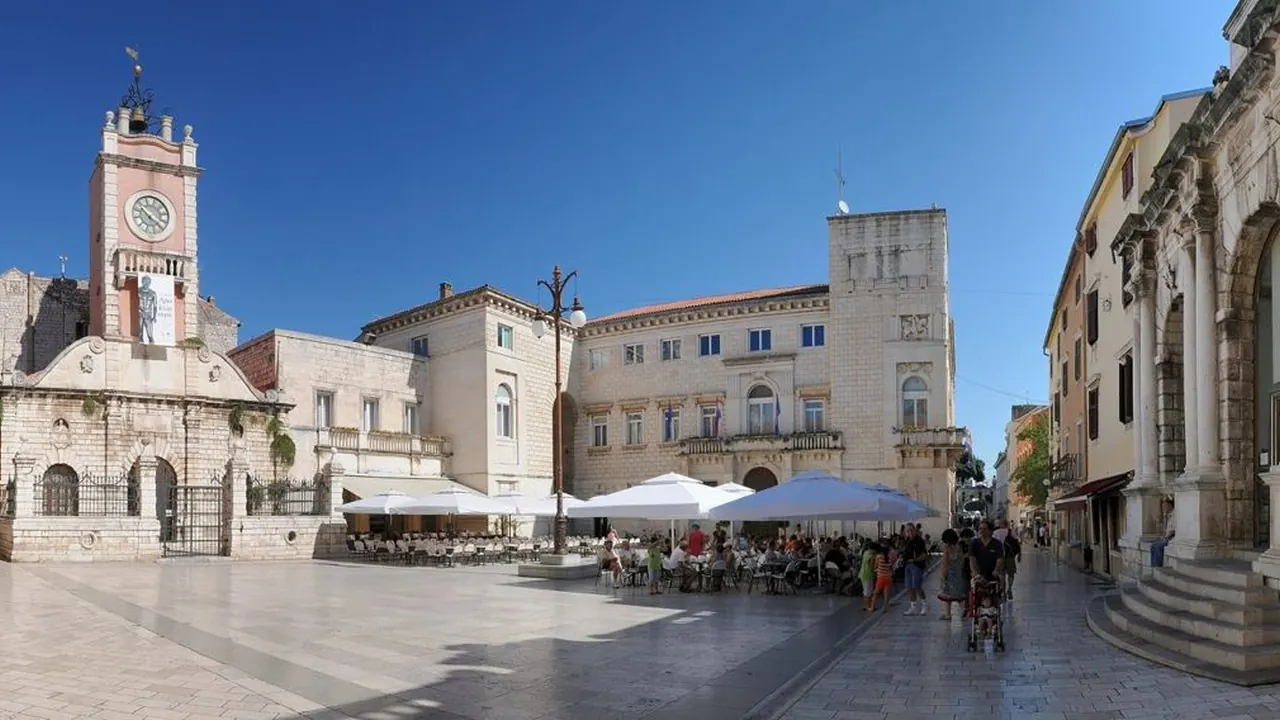
Photos: Rovinj by Vyacheslav Bukharov, CC BY-SA 4.0, cropped; Zadar by Böhringer Friedrich, CC BY-SA 2.5, cropped.
Rovinj or Zadar?
Our verdict in twelve categories, each scored against the same fixed benchmark cities, and the climate month by month, so you can choose for your trip.
Choose Rovinj for
- wellness
- food and drink
- shopping
Rovinj suits couples and slower travellers who want one beautiful small town rather than a list of sights. You get swimming off pine-shaded rocks, Istrian truffle cooking and wine, a well-equipped resort spa, and drives to Pula, Porec and the hill towns. It makes a gentle, rather polished week, as long as you accept higher costs and quiet nights.
Choose Zadar for
- nature and the outdoors
- culture and sights
- prices
For active travellers, history lovers and anyone watching costs, Zadar is the stronger base. Its Roman and medieval peninsula has more to see, and the Velebit, the Kornati and Krka are all within reach. Island ferries leave from the edge of the old town, there are sandy beaches at Nin, and there is a little more going on after dark.
Scoreboard
Twelve categories on one fixed scale from 0 to 100. The shaded stretch is the gap between the two.
Your match
Pick a travel style or drag the sliders, and both match scores follow your weighting.
Wins on wellness and food and drink with your weighting.
Wins on nature and the outdoors and culture and sights with your weighting.
What matters to you?
Category by category
What the scores mean for a trip.
Beaches & swimming
Neither town has a sandy shore of its own, and the swimming is about as good in both, but it works differently. In Rovinj you swim off limestone ledges and concrete platforms along several kilometres of pine-shaded shore in the Golden Cape park, or right below the old town walls. Taxi boats run out to St Catherine and Red Island for quieter coves.
Swimming in Zadar itself is busier and more urban: off the stone promenade, at Kolovare or at Borik. Its advantage is sand within easy reach, with the long, shallow beaches at Nin twenty minutes north and Sakarun on Dugi Otok a ferry ride away. Rovinj has nothing like them.
Food & drink
The two eat about equally well, from different kitchens. Rovinj cooks Istrian: fuži and pljukanci with truffle, scampi buzara, peppery olive oil, and Malvazija and Teran wines. Zadar cooks Dalmatian, with black risotto, lamb or octopus under the peka bell, Pag cheese and pršut, and Maraschino, the cherry liqueur once made here for European courts.
Rovinj has a slight edge in ambition, with a handful of refined restaurants and country konobas worth the drive. On Zadar's peninsula the menus are more alike. Both towns have harbour menus aimed at passing visitors, and in both the morning market by the old town is the visit worth making.
Culture & sights
Zadar gives a culture-minded visitor much more to do. Its peninsula holds the open Roman forum, the round ninth-century Church of St Donatus, the Romanesque cathedral and the UNESCO-listed Venetian walls. There are small but good museums of ancient glass, archaeology and church silver, and the Sea Organ on the waterfront. Altogether that fills two full days.
Rovinj's appeal is the whole townscape rather than a list of sights. Pastel Venetian houses climb to St Euphemia, whose bell tower you can climb, and Grisia and the Balbi Arch are the lanes to walk. Add the town museum and the Batana House, and a slow afternoon covers it all.
Nightlife
Zadar has the livelier evenings, though neither is a party town. Sunset at the Sea Organ leads on to café-bars along Kalelarga and terrace bars on the walls, and people stay out fairly late. For real clubbing, Zrće on Pag is about an hour away in high summer.
Rovinj's evenings are quieter and suit couples better. After dinner there is a drink on the rocks below the old town or in one of a few wine and cocktail bars, and most lanes are quiet by midnight.
Nature & outdoors
Zadar is clearly ahead here. The Velebit range rises behind it, the gorges of Paklenica offer serious hiking and some of Croatia's best rock climbing, and boat trips run to the bare Kornati islands and the cliffs of Telašćica. Krka's waterfalls and Plitvice Lakes are within a day's reach.
Rovinj's outdoors is gentler and closer to hand. Flat gravel paths run through the Golden Cape forest park, you can kayak and dive among the islets of the archipelago, and the green Lim Fjord is a short drive north. It is pleasant country, but without mountains or wilderness.
Day trips
Both are well placed, for different kinds of outing. Rovinj sits among Roman and medieval Istria: the amphitheatre at Pula, the mosaics of the Euphrasian Basilica in Porec, and the hill towns of Motovun, Groznjan and Hum. Piran and Trieste are across the border. Almost all of it needs a car.
Zadar's trips run along the Dalmatian coast and out to sea. Šibenik's cathedral and the tiny royal town of Nin are easy outings, and Split and Trogir make long days. Ferries go straight from the harbour to Ugljan, Pašman and car-free Silba, so island days are easy without a car.
Good for families
Neither town has much made just for children, and they are roughly equal for families, with different drawbacks. Zadar's old town is flat and car-free, the Sea Organ and the light-up tiles of the Greeting to the Sun delight children, and Nin's shallow sand is ideal for toddlers.
Rovinj's strength is its large resorts and campsites with pools and playgrounds, and the shady, level paths of the Golden Cape for bikes and pushchairs. Against that, the shore is all rock and concrete, so young children need water shoes. The old town's steep, polished cobbles are hard work with a pushchair.
Getting around
You walk rather than drive in both towns, and beyond them a car makes everything easier. Rovinj's old town lanes are steep and slippery, though the promenade into the Golden Cape is level and taxi boats serve the islands. There is no railway, only intercity buses to Pula, Porec and Zagreb.
Zadar's peninsula is flat and takes a quarter of an hour to cross. Basic local buses reach Borik, and the island ferries leave from the edge of the old town. For the national parks, a hire car or an organised excursion still beats the regional buses.
Shopping & style
Shopping is small-scale in both, and nobody should come for it. What gives Rovinj some character is the galleries and artists' studios on Grisia, along with regional food and drink such as truffles, olive oil and Teran. Zadar has slightly more conventional choice, with jewellers and chains on marble Kalelarga and malls on the edge of town, and its own local goods to take home: Maraschino, Pag cheese and Pag lace.
Affordability
Zadar is noticeably easier on the budget. Private apartments are good value outside July and August, konobas and bakeries are fairly priced, and ferries and local buses cost little, though national park entry and boat trips add up.
Rovinj is one of the more expensive places on the Croatian coast. In high summer, old town rooms and resort hotels cost what a sought-after Mediterranean resort does, and fish on the harbour is sold by weight. Campsites, apartments and the quieter months of late spring and September bring costs down.
Live music & performing arts
Neither town has much performing arts, but Zadar has more to look for. Each summer its Musical Evenings in St Donatus bring early and chamber music into the ninth-century church. There are also klapa singing, concerts in churches and squares, and a small national theatre staging drama in Croatian.
In Rovinj there are occasional concerts in St Euphemia and music on the harbour, and you may catch a performance of bitinada, the singing tied to the batana boats. For anything bigger, people drive to summer concerts in Pula's Roman arena.
Wellness & relaxation
Rovinj is slightly the better place to wind down. The resort hotels along the Golden Cape have well-equipped spas open to outside guests, and in May, June and September long lunches, late swims and walks in the pines set an easy rhythm.
Zadar has no spa tradition either. Its hotel spas are mostly at Borik, and at the lagoon in Nin people have long coated themselves in mineral-rich mud. The calm comes from long café mornings and sunsets on the steps of the Sea Organ, and it is easiest to find outside high summer.
When should you go?
Pick your month. The climate figures are measured averages, not a forecast.
Rovinj in July
Zadar in July
Daytime high, °C
Rainfall in the month, mm
Where the figures come from
Rovinj's temperatures are measured 64 km from the centre, at Trieste.
Rovinj has no rain gauge within 25 km of the centre, so its rainfall comes from a gridded climate dataset read at the city rather than from a gauge further away.
Zadar has no rain gauge within 25 km of the centre, so its rainfall comes from a gridded climate dataset read at the city rather than from a gauge further away.
Temperature and rainfall are climate normals, averaged over the years shown. Rovinj: 1991-2020 normals, Trieste (63.7 km from centre). Zadar: 1999-2020 (rainfall 1991-2020) normals, Zadar / Zemunik (9.9 km from centre).
In both towns the sea is warm enough for swimming from June to September. Rovinj's summer is a little milder, with highs of 29°C in July and August against 31°C in Zadar. July and August are also Rovinj's sunniest months, though showers come through the whole summer. Zadar's summer is much drier, with only 29mm of rain in July, and its midday heat makes walking the streets harder work.
May and late September are the best months for walking and sightseeing in both, warm without the midsummer heat. The autumn rain starts in September, sooner and more heavily in Rovinj, and November is the wettest month in each, at around 100mm. Winters are cool in both towns. Zadar stays a degree or two milder, and its sea stays noticeably warmer than Rovinj's.
Which traveller are you?
On an outdoors trip, Zadar can fill a whole active week from one base, with mountain days in between days at sea among the islands. Rovinj's gentle coast is better for an easy ride or paddle between swims than for a week of hard exercise.
For a relaxing and wellness trip, Rovinj asks the least of you. You can swim a few minutes from your door, the nights are early and quiet, and the town is beautiful enough that doing very little feels like plenty.
On a tight budget, Zadar keeps more of the trip cheap or free. Its main sights are in the open air, from the forum to the Sea Organ, and ferries reach the islands. In Rovinj, getting to the islands means taxi boats, and seeing the region means a car.
Before you go
| Measure | Rovinj | Zadar |
|---|---|---|
| Official language | Croatian | Croatian |
| Currency | Euro (EUR) | Euro (EUR) |
| Sockets | CF230 V, 50 Hz | CF230 V, 50 Hz |
| Driving side | Right | Right |
| Time zone | UTC+1, UTC+2 in summer | UTC+1, UTC+2 in summer |
| Emergency number | 112 | 112 |
| Elevation | 0 m | 5 m |
| Main airport | Pula Airport (PUY)31 km from centre34 non-stop destinations | Zadar Airport (ZAD)10 km from centre66 non-stop destinations |
| Public holidays this year | 14 days | 14 days |
By the numbers
| Measure | Rovinj | Zadar |
|---|---|---|
| City population | 12,968 | 70,779 |
| Museums within 10 km | 1 | 1 |
| UNESCO World Heritage sites within 50 km | 1 | 2 |
| Swim season, months above 21 °C | 4 months | 4 months |
Where else could you go?
Every comparison below shares a destination with this one, so you can follow Rovinj or Zadar somewhere new.