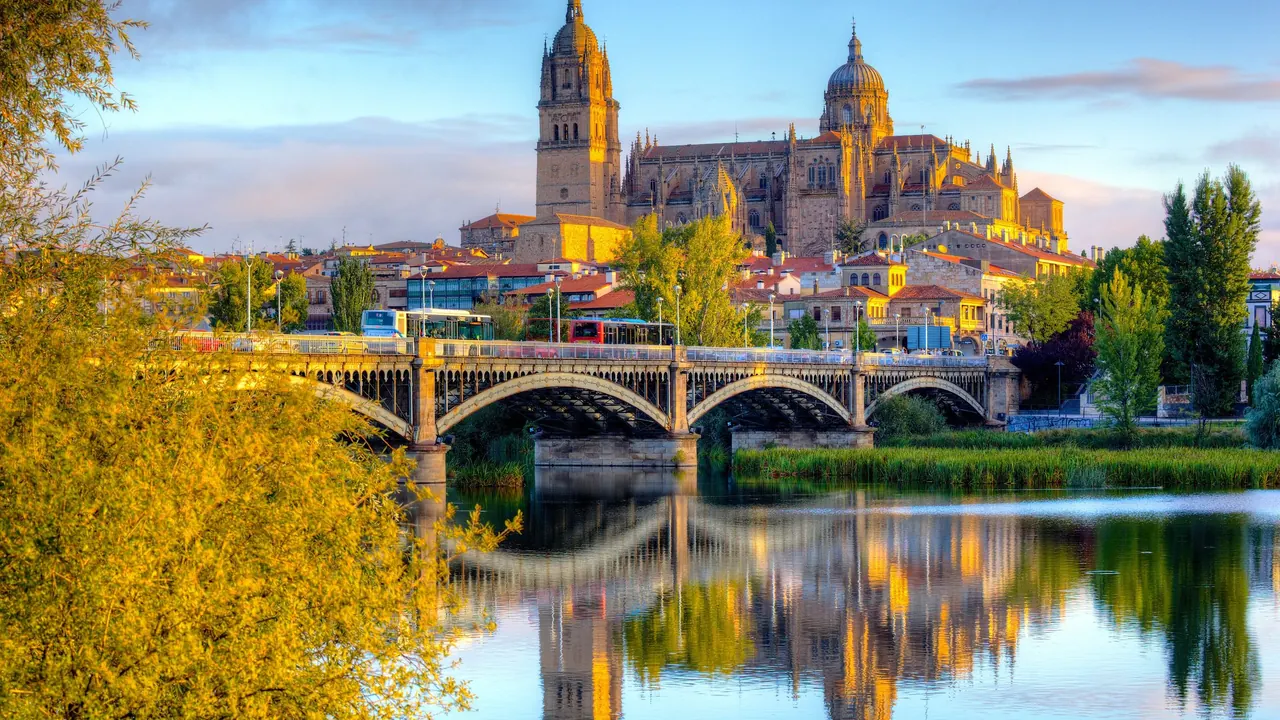
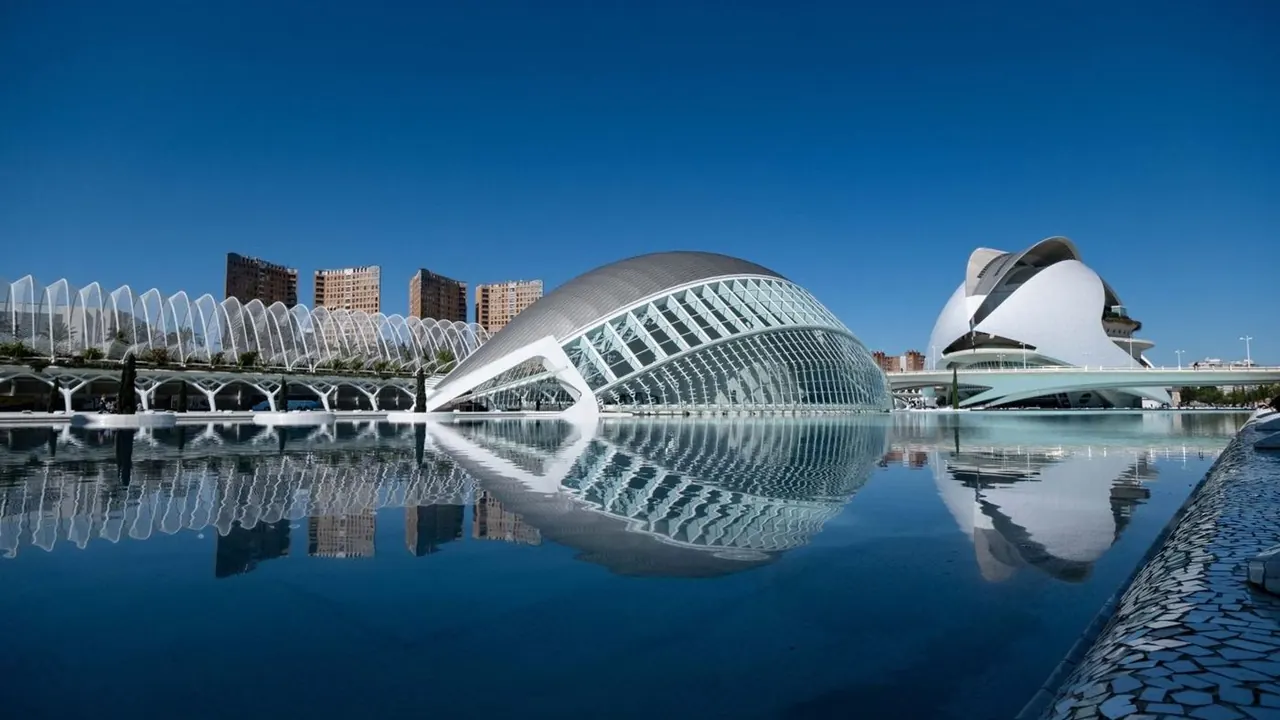
Photos: Salamanca by Jiuguang Wang, CC BY-SA 3.0 ES, cropped; Valencia by Francesco Ungaro, Pexels License.
Salamanca or Valencia?
Our verdict in twelve categories, each scored against the same fixed benchmark cities, and the climate month by month, so you can choose for your trip.
Choose Salamanca for
- prices
- culture and sights
Salamanca suits travellers who want a historic city to walk around and nothing else to think about. Its golden sandstone old town, the university and the two cathedrals all sit within a short stroll of one another, and student bars keep evenings cheap and lively. It works best as a stop on a road trip through Old Castile, in spring or autumn, for adults who are happy to do without beaches, big museums and attractions made for children.
Choose Valencia for
- beaches
- families
- shopping
Valencia is the better choice for a longer, more varied trip. It has a real city beach, the home cooking of paella, an opera house, and an aquarium and science museum that keep children busy for days. Families, beach lovers and anyone who wants sea and sightseeing on the same trip will find far more to do here, at a slightly higher cost.
Scoreboard
Twelve categories on one fixed scale from 0 to 100. The shaded stretch is the gap between the two.
Your match
Pick a travel style or drag the sliders, and both match scores follow your weighting.
Wins on prices and culture and sights with your weighting.
Wins on beaches and families with your weighting.
What matters to you?
Category by category
What the scores mean for a trip.
Beaches & swimming
Salamanca has no beach worth the name. It lies far inland on the Castilian plain, and in summer locals cool off in municipal pools or at river beaches along the Tormes, which are fine for an afternoon but nothing to plan a trip around.
Valencia has a long stretch of fine golden sand right on its edge. Las Arenas and Malvarrosa are reached by tram from the centre, and the pine-backed dunes of El Saler and La Devesa lie further south for a quieter day. The calm, shallow water stays good for swimming from early summer well into autumn.
Food & drink
Valencia has the richer table. It is the home of paella and of a whole family of rice dishes, from arroz negro to fideuà, eaten at lunch in beachfront restaurants or in the Albufera villages. Its modernista Mercado Central overflows with huerta vegetables and seafood, and Ruzafa adds a serious creative restaurant scene. Summer brings horchata from the old horchaterías of Alboraya.
Salamanca has a market of the same name, but here it is all about ham and charcuterie. Ibérico from nearby Guijuelo, hornazo and roast suckling pig set the tone, eaten at tapas counters around the Plaza Mayor. It is generous and satisfying food, but there is little seafood and not much range beyond Castilian cooking.
Culture & sights
Both cities reward two or three days of sightseeing, but in different ways. Salamanca is a single, unified ensemble: a UNESCO old town built in golden stone, with the baroque Plaza Mayor, the Plateresque university façade and the Old and New Cathedrals side by side, all glowing under floodlights after dark. Its museums are slight, with Casa Lis the only real draw.
Valencia covers more centuries and more media. The Gothic Lonja de la Seda and the cathedral, home to the chalice venerated as the Holy Grail, sit in Ciutat Vella. Across the old riverbed stands the white, futuristic City of Arts and Sciences, and the Museo de Bellas Artes and IVAM give art lovers far more to see indoors.
Nightlife
The two are about equal for going out, but the crowd is different. Salamanca's nights belong to its students. From Thursday to Saturday the bars around the Plaza Mayor and Calle Bordadores fill with young people and Spanish-language learners, ending in small dance clubs. The city goes quiet in high summer, when term is over.
Valencia's scene is older and more varied: cocktail and wine bars in Ruzafa, rougher student bars in El Carmen. Summer is its peak rather than its lull, when open-air clubs near the port and Malvarrosa run until dawn.
Nature & outdoors
Valencia has more nature on its doorstep. The Albufera lagoon, with its rice fields, herons and sunset boat trips, begins about 10km from the centre, the Devesa pine woods and dunes lie beyond it, and the Turia gardens give the city a long green corridor for running and cycling. For hills and climbing, Chulilla's gorge is about an hour inland.
Salamanca's surroundings are flat wheat plain, with only the river paths close at hand. Its better landscapes, the chestnut forests of the Sierra de Francia and Las Batuecas, the granite canyon of the Arribes del Duero and peaks above 2,000m, are all about an hour away and need a car.
Day trips
From Salamanca, most day trips are drives. Ávila's walls, Zamora's Romanesque churches and the ramparts of Ciudad Rodrigo are all within reach, along with the half-timbered mountain villages of La Alberca and Mogarraz. Many of these villages are hard to reach without a car, so plan to hire one if they are the point of the trip.
From Valencia, many outings are a train ride. Roman Sagunto and the castle of Xàtiva are about half an hour away, and high-speed rail reaches Cuenca's hanging houses in about an hour. The coast adds longer days out, from the castle of Peñíscola on its rock in the sea to the white towns of the Costa Blanca.
Good for families
Valencia is much easier with children. The Oceanogràfic aquarium, the hands-on science museum and the domed Hemisfèric cinema share one site, Bioparc houses African animals without visible bars, and the giant Gulliver figure in the Turia gardens is a playground in itself. Add shallow sandy beaches and most of a week fills itself.
Salamanca is safe and largely pedestrian, and children enjoy spotting the carved frog and astronaut and climbing the cathedral towers. Beyond that there is no zoo, aquarium or theme park, so it works best as a day or two within a wider trip.
Getting around
Salamanca is a city to walk, and Valencia is one to cycle. You can cross Salamanca's old town on foot in about twenty minutes, from the Plaza Mayor down to the Roman bridge, so most visitors never need a bus. Getting out into the province is harder, and the villages and sierras really call for a car.
Valencia is more spread out but flat, with bike lanes, a bike-share scheme and the car-free Turia gardens running from the centre to the City of Arts and Sciences. Metro and tram lines go to the airport, the port and the beaches, and you only need a car if you are heading into the hills.
Shopping & style
Valencia gives shoppers far more to do. The Ensanche around Calle Colón has international labels and luxury boutiques, and El Carmen and Ruzafa have vintage and independent design shops. The best local buys are Manises ceramics, porcelain figurines, hand-painted fans and silk.
Salamanca has little beyond the high-street chains on Calle Toro and Calle Zamora and university souvenirs. The things worth taking home are edible, ham and cheese from the market, or a piece of charro silver filigree, the province's traditional jewellery.
Affordability
Salamanca is the cheaper of the two. Student demand keeps bar prices low, a drink at the counter often comes with a free tapa, and since everything is within walking distance you spend almost nothing on transport. The main extra cost is admission to the cathedrals, towers and university.
Valencia is reasonable for a large city, and its multi-course set lunch is one of the best deals in Spain. Costs rise near the beach in summer and steeply during Fallas, and the City of Arts and Sciences attractions add up for a family.
Live music & performing arts
Valencia is the place for a proper night at the theatre or concert hall. The Palau de les Arts stages a serious opera and ballet season with its own highly regarded orchestra, and the Palau de la Música on the Turia gardens is home to the city orchestra. Below that sits a steady jazz circuit in Ruzafa and the wind bands heard all through Fallas.
Salamanca has the Teatro Liceo, university choirs and touring shows, but no opera season. Its signature sound is informal: caped student tunas singing under the arcades of the Plaza Mayor in the evening.
Wellness & relaxation
Neither city has its own bathing tradition, and in both a spa day means a hotel or an Arab-style bath house. The difference is what lies around them. Salamanca has real mineral springs within a short drive, at the old balneario of Ledesma and the Roman-era spa town of Baños de Montemayor, and an old town of siestas and quiet cloisters such as San Esteban.
Valencia relaxes by the water instead, with slow walks along the seafront promenade, shady paths in the Turia gardens and a mild winter. The resort hotels along the coast are the place for real pampering.
When should you go?
Pick your month. The climate figures are measured averages, not a forecast.
Salamanca in July
Valencia in July
Daytime high, °C
Rainfall in the month, mm
Temperature and rainfall are climate normals, averaged over the years shown. Salamanca: 1991-2020 normals, Salamanca / Matacan (13.9 km from centre). Valencia: 1991-2020 normals, Valencia (1.6 km from centre).
Salamanca sits high on an inland plain, so its seasons run to extremes. Winter days barely reach 9°C and feel bitterly cold. July and August climb to about 31°C, which makes afternoon walks through the streets hard going, although these are the driest and sunniest months of the year. May, June and September are the most comfortable for sightseeing. October brings the most rain of the year, so pack for showers if you go then.
Valencia is mild all year, with winter days around 17°C, so even January is fine for walking the streets while Salamanca is at its coldest. Swimming is comfortable from June into October. July and August are the surest months for the coast, almost dry and with the sea at its warmest, about 26°C, though the afternoons are hot in both cities. June is a gentler choice, with the water already warm enough to swim. The rain arrives in September and October, Valencia's wettest months, so beach days then are less certain.
Which traveller are you?
For a beach and sun trip, Valencia is the clear winner. You can spend the morning in the old town and the afternoon on the sand, and swimming is good for half the year. Salamanca is a long day's drive from any coast.
On a family trip with children, Valencia can easily fill a week, with attractions built for young visitors and calm, shallow water to splash in. In Salamanca the sights are churches and colleges, which hold a child's interest for a day or two at most.
On a tight budget, Salamanca makes your money go further. Food and drink are priced for students, and there are plenty of simple guesthouses close to the old town. In Valencia, room prices rise near the beach in summer and steeply during Fallas.
Before you go
| Measure | Salamanca | Valencia |
|---|---|---|
| Official language | Spanish | Spanish |
| Currency | Euro (EUR) | Euro (EUR) |
| Sockets | CF230 V, 50 Hz | CF230 V, 50 Hz |
| Driving side | Right | Right |
| Time zone | UTC+1, UTC+2 in summer | UTC+1, UTC+2 in summer |
| Emergency number | 112 | 112 |
| Elevation | 798 m | 15 m |
| Main airport | Adolfo Suárez Madrid–Barajas Airport (MAD)184 km from centre239 non-stop destinations | Valencia Airport (VLC)9 km from centre109 non-stop destinations |
| Public holidays this year | 12 days | 13 days |
By the numbers
| Measure | Salamanca | Valencia |
|---|---|---|
| City population | 146,110 | 840,792 |
| People per km² | 3,690 | 6,242 |
| Museums within 10 km | 13 | 45 |
| UNESCO World Heritage sites within 50 km | 1 | 2 |
| Swim season, months above 21 °C | - | 5 months |
Where else could you go?
Every comparison below shares a destination with this one, so you can follow Salamanca or Valencia somewhere new.
- Alicantevs Valencia
- Madridvs Salamanca
- Toledovs Salamanca
- Zaragozavs Valencia
- Portovs Salamanca
- Coimbravs Salamanca