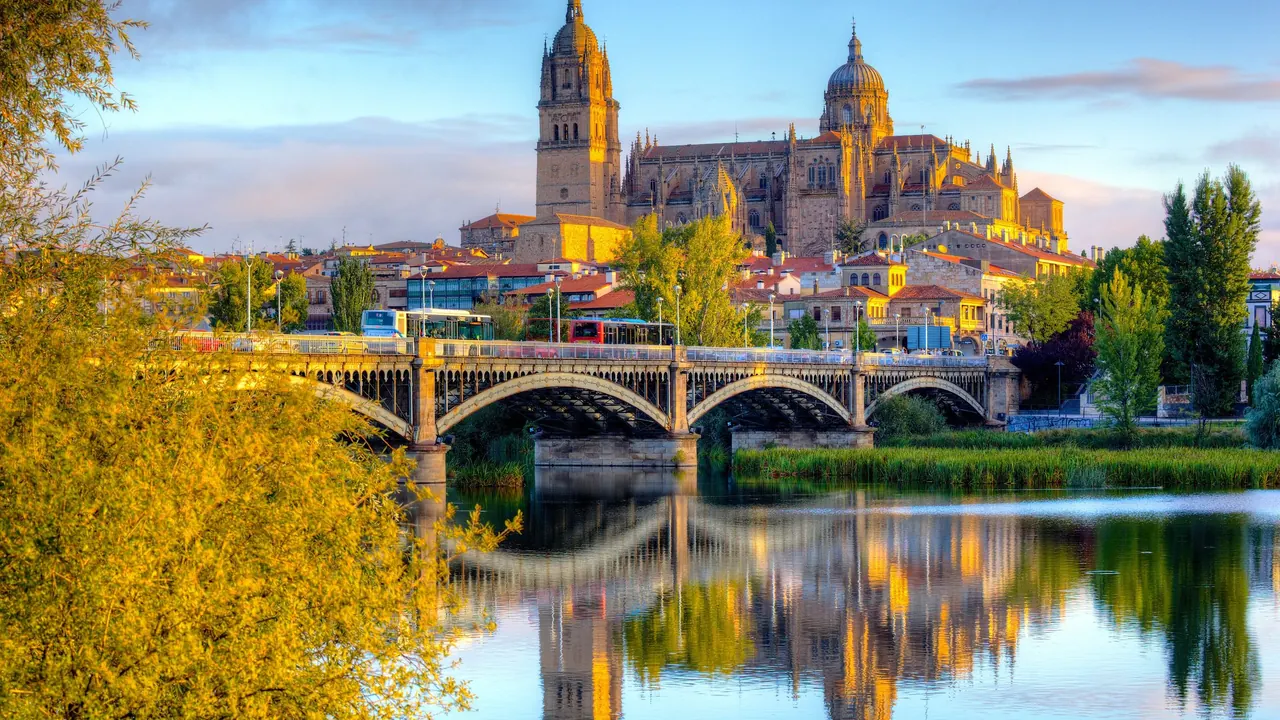
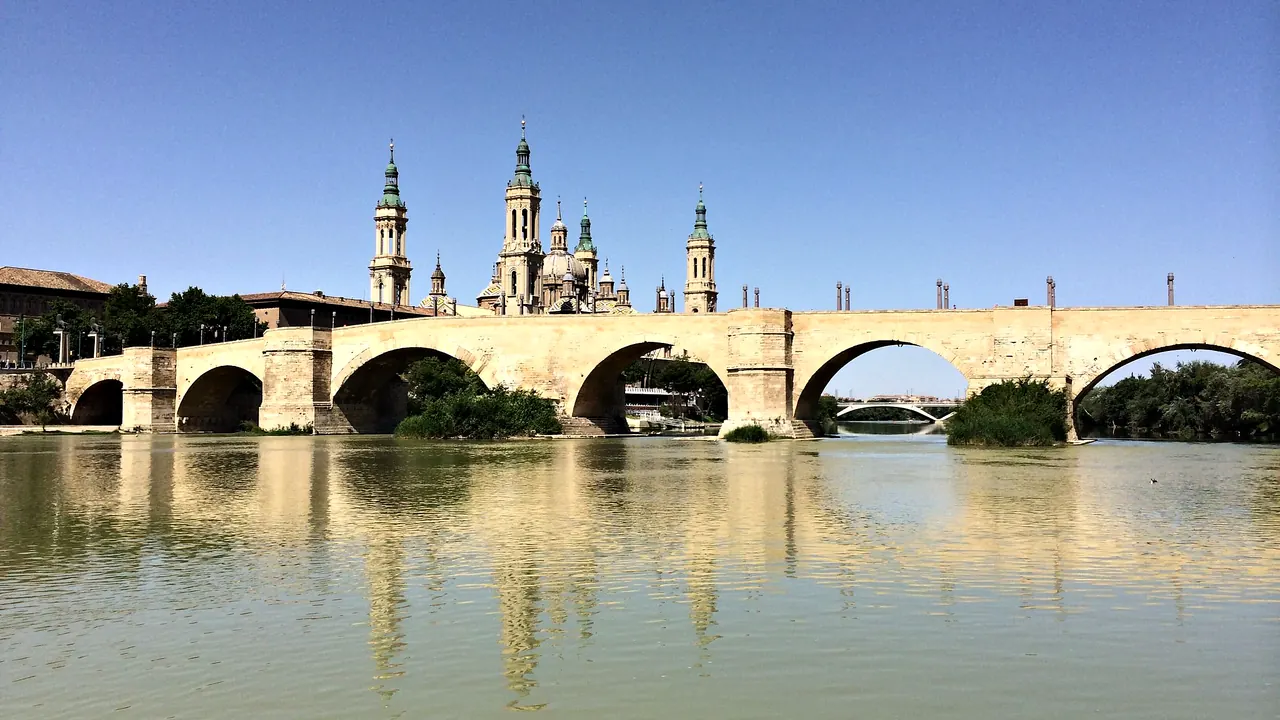
Photos: Salamanca by Jiuguang Wang, CC BY-SA 3.0 ES, cropped; Zaragoza by Pablo Alejandro Araujo Granda, CC BY-SA 2.0, cropped.
Salamanca or Zaragoza?
Our verdict in twelve categories, each scored against the same fixed benchmark cities, and the climate month by month, so you can choose for your trip.
Choose Salamanca for
- culture and sights
- nightlife
- wellness
Salamanca suits travellers who want the historic city itself to be the main event. The golden-stone old town, the university and the twin cathedrals all lie within a short walk of each other and glow after dark, and the student bars keep evenings going late. For couples and friends on a slow, atmospheric break, it is hard to beat.
Choose Zaragoza for
- families
- shopping
- live music and the arts
Families and travellers who want more variety should lean towards Zaragoza. Children have places of their own to visit, the shops and concert programme go further, and the high-speed line puts Madrid and Barcelona within reach for a day out. The Aljafería and the Pilar make sure culture is not short-changed.
Scoreboard
Twelve categories on one fixed scale from 0 to 100. The shaded stretch is the gap between the two.
Your match
Pick a travel style or drag the sliders, and both match scores follow your weighting.
Too close to call, 1 point apart
Wins on culture and sights and nightlife with your weighting.
Wins on families and shopping with your weighting.
What matters to you?
Category by category
What the scores mean for a trip.
Beaches & swimming
Neither city has anything for a beach trip. Both are well inland, and in summer locals in both cool off in open-air municipal pools. The small difference is that Salamanca has river beaches on the Tormes and in the province's reservoirs. Zaragoza's Ebro is not used for swimming, and the Mediterranean is more than 200km away.
Food & drink
Both cities eat best standing at a bar counter, but their bars work differently. In Salamanca the draw is ibérico ham from nearby Guijuelo, sliced everywhere, along with hornazo and roast suckling pig. The student crowds around the Plaza Mayor and Calle Van Dyck keep portions generous.
Zaragoza's El Tubo is a warren of specialists, each bar known for one thing, such as mushroom skewers or croquetas. The irrigated Ebro valley adds borage, fruit and ternasco lamb. Its Cariñena and Campo de Borja reds are a fair match for Salamanca's Toro wines, and neither city strays far beyond traditional regional cooking.
Culture & sights
In Salamanca the whole old town is the sight. It is a UNESCO-listed ensemble of golden Villamayor stone, where the Plaza Mayor, the University façade, the Old and New Cathedrals and the Casa de las Conchas sit within a few minutes of each other. The floodlit centre at night is part of the visit, though the museums are slight apart from the Casa Lis.
Zaragoza has the longer history, running from Roman Caesaraugusta to the Islamic Aljafería palace and the young Goya's ceilings in the Pilar. It also has the better museums, including the underground Roman sites and the Goya Museum. Its monuments, though, are scattered through a largely modern city, and you never get Salamanca's sense of walking through one intact historic place.
Nightlife
Salamanca has the bigger night out. Tens of thousands of university and language students fill the bars around the Plaza Mayor and Calle Bordadores from Thursday to Saturday, and the small clubs keep going past 3am. The crowd is cheap, young and international, but the city empties noticeably in high summer.
Zaragoza follows the same pattern of tapas first, then bars, around Plaza San Felipe and the Casco. It has a few more cocktail and music bars for an older crowd, but ordinary weeknights are calm. The exception is the Fiestas del Pilar in October, when the streets stay full until dawn.
Nature & outdoors
From both cities, the best landscapes are about an hour away across an open plain, and you need a car to reach them. From Salamanca you can head for the chestnut and oak forests of the Sierra de Francia and Las Batuecas, peaks above 2,000m in Béjar and Gredos, and the granite canyon of the Arribes del Duero.
Zaragoza's surroundings are starker and more varied. There are the beech woods of Moncayo, the climbing towers of the Mallos de Riglos and the Bardenas Reales badlands, with the Pyrenees about two hours north. It also has more green space in town, in Parque Grande and the Parque del Agua, though the cierzo wind can make the plain hard going.
Day trips
Zaragoza has the wider reach. The high-speed line puts Madrid and Barcelona about an hour and a half away by train, and rural Aragon adds Loarre castle, the ruins of Belchite, Mudéjar Tarazona and cliff-top Alquézar, with Albarracín and Teruel for a longer day.
Salamanca's outings are a tighter group of Castilian towns: walled Ávila, Romanesque Zamora and fortified Ciudad Rodrigo, plus the half-timbered villages of La Alberca and Mogarraz. They are excellent, but most are small places, and the villages are hard to reach without a car.
Good for families
Zaragoza works better with children. The river aquarium at the Expo site, the playgrounds of the Parque del Agua and the small amusement park at Parque Grande give them days of their own, and the flat centre is easy with a pushchair.
Salamanca is safe and compact, and children enjoy hunting for the frog and the astronaut carved in the stone and climbing the cathedral towers. There is no zoo or aquarium, though, and between the cobbled slopes, the summer heat and the bitter winters, it suits a day or two rather than a whole stay.
Getting around
Both cities are easy on foot, in different ways. Salamanca packs nearly everything into an old town you can cross in about 20 minutes, so few visitors ever need a bus, though some streets are cobbled and gently sloping.
Zaragoza's sights are more spread out, from the Pilar to the Aljafería, but the ground is flat, and a tram, buses and bike-share stations fill the gaps. For the countryside around either city, a car makes life far easier.
Shopping & style
Zaragoza is the better place to shop. As the capital of Aragon it is a far larger city, and its centre has the chain stores, department store floors and long-standing family shops that Salamanca's handful of pedestrian streets can't match. Its local goods are more varied too, from jars of candied frutas de Aragón to pottery from the village of Muel.
In Salamanca, shopping is something you do on the way between sights rather than an outing of its own. The old town has plenty of university-themed souvenirs, and the specialist food counters around the market are where time spent shopping pays off. Anyone after designer labels or independent boutiques will be disappointed in both cities.
Affordability
There is little between them on cost, and both are easy on the wallet. In Salamanca, student bars keep drinks cheap and often add a free tapa, but the cathedrals, the university and the towers each charge entry, and these add up.
In Zaragoza the Pilar basilica is free to enter and set lunch menus are generous. Rooms are the pressure point in both: in Zaragoza during the October fiestas, and in Salamanca around Easter and on festival weekends.
Live music & performing arts
Salamanca has the thinner programme of the two. The Teatro Liceo and the municipal arts centre take touring theatre, dance and flamenco, and the university puts on concerts and choral music, sometimes in its old halls and churches. There is no opera season or resident orchestra to plan an evening around, though. What the city offers instead is the tunas: student troupes in traditional dress who serenade the terraces under the Plaza Mayor arcades in the evenings, for anyone who stops to listen.
Zaragoza offers more across the board. A purpose-built concert hall gives it a real classical and jazz season, and the nineteenth-century Teatro Principal and the smaller old-town stages cover plays, dance and local bands. During the Fiestas del Pilar, Aragon's jota is sung and danced in the streets. The scene is still provincial, so plan around the calendar rather than expecting a choice every night.
Wellness & relaxation
Neither city is a spa destination. Both offer hotel spas and a small Arab-style bath house or two, and real thermal waters mean an outing. Salamanca's are closer: the old balneario at Ledesma is about half an hour away, and the Roman-era springs of Baños de Montemayor about an hour. Zaragoza's Alhama de Aragón takes a little over an hour.
The rest comes down to pace. Salamanca has quiet cloisters at San Esteban and Las Dueñas and a real afternoon siesta. Zaragoza's calm is found in Parque Grande and along the Ebro, though the summer heat and the cierzo wind wear it down.
When should you go?
Pick your month. The climate figures are measured averages, not a forecast.
Salamanca in July
Zaragoza in July
Daytime high, °C
Rainfall in the month, mm
Temperature and rainfall are climate normals, averaged over the years shown. Salamanca: 1991-2020 normals, Salamanca / Matacan (13.9 km from centre). Zaragoza: 1991-2020 (rainfall 1971-2000) normals, Zaragoza / Aeropuerto (11.2 km from centre).
Both cities sit on dry inland plains, with hot summers and cool winters, and both are at their best in May and June and again in September and October. In those months afternoons are warm enough for long walks and terrace lunches without wearing you out. Zaragoza runs a couple of degrees warmer all year and reaches 33°C in July, which makes midsummer sightseeing hard work. Salamanca stays a little cooler in summer but falls to 9°C in January, so winter there is cold and clear.
Rain is light in both, and July is close to dry. Salamanca's wettest month is October at 50mm, while Zaragoza spreads its rain more evenly through spring and autumn. Summer sunshine is long and almost the same in the two cities, and in winter Zaragoza gets slightly more of it.
Which traveller are you?
On a family trip with children, Zaragoza is the more rewarding base. It has attractions built for young visitors, riverside space to run, and parades of giants at fiesta time. Salamanca's sights are mostly churches and colleges, so it works better as one stop on a wider trip.
For a culture and arts trip, Salamanca has the stronger whole: a UNESCO old town of honey-coloured sandstone, where nearly every great building is a few minutes from the next. Zaragoza answers with the Aljafería, Roman ruins and better museums, but they sit in a largely modern city.
On a shopping trip, Zaragoza is the better pick. It is a larger city with a proper main shopping avenue and a big out-of-town complex. Salamanca is better for a few local buys to take home, such as ham or filigree silver, than for an afternoon of browsing.
Before you go
| Measure | Salamanca | Zaragoza |
|---|---|---|
| Official language | Spanish | Spanish |
| Currency | Euro (EUR) | Euro (EUR) |
| Sockets | CF230 V, 50 Hz | CF230 V, 50 Hz |
| Driving side | Right | Right |
| Time zone | UTC+1, UTC+2 in summer | UTC+1, UTC+2 in summer |
| Emergency number | 112 | 112 |
| Elevation | 798 m | 200 m |
| Main airport | Adolfo Suárez Madrid–Barajas Airport (MAD)184 km from centre239 non-stop destinations | Zaragoza Airport (ZAZ)13 km from centre12 non-stop destinations |
| Public holidays this year | 12 days | 12 days |
By the numbers
| Measure | Salamanca | Zaragoza |
|---|---|---|
| City population | 146,110 | 693,091 |
| People per km² | 3,690 | 712 |
| Museums within 10 km | 13 | 22 |
| UNESCO World Heritage sites within 50 km | 1 | 1 |
Where else could you go?
Every comparison below shares a destination with this one, so you can follow Salamanca or Zaragoza somewhere new.
- Madridvs Salamanca
- Toledovs Salamanca
- San Sebastianvs Zaragoza
- Biarritzvs Zaragoza
- Bilbaovs Zaragoza
- Valenciavs Zaragoza