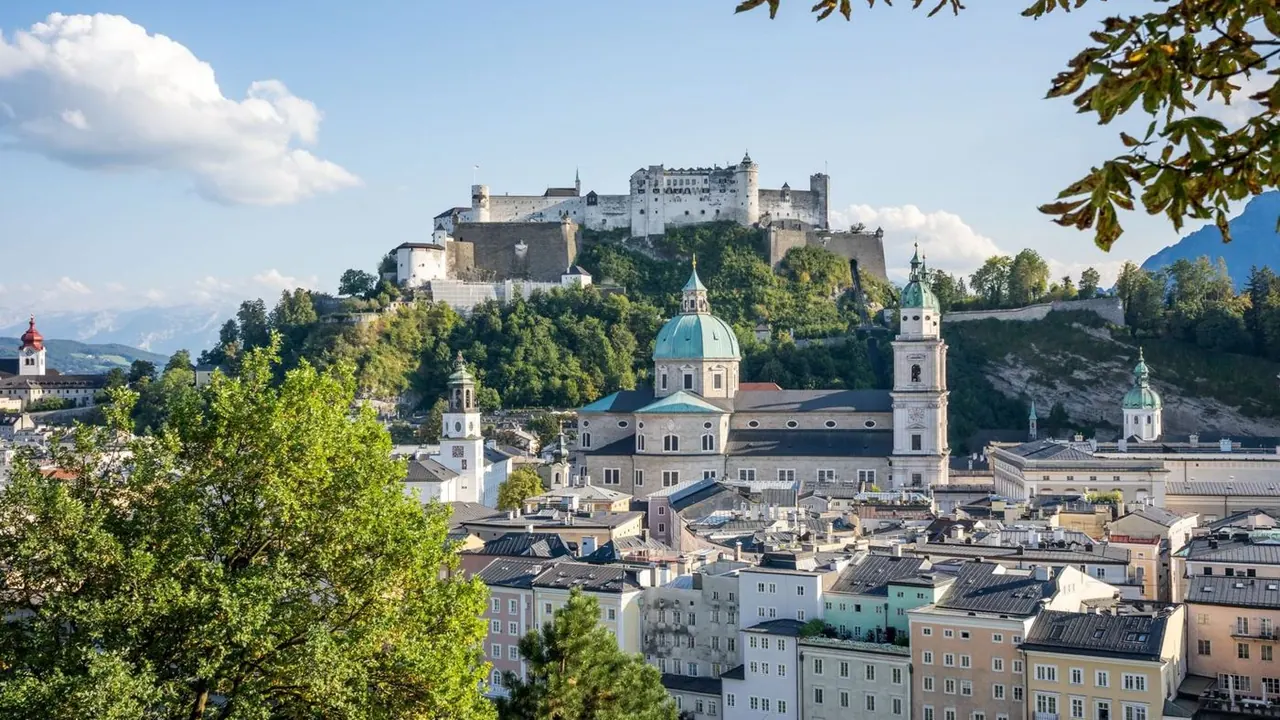
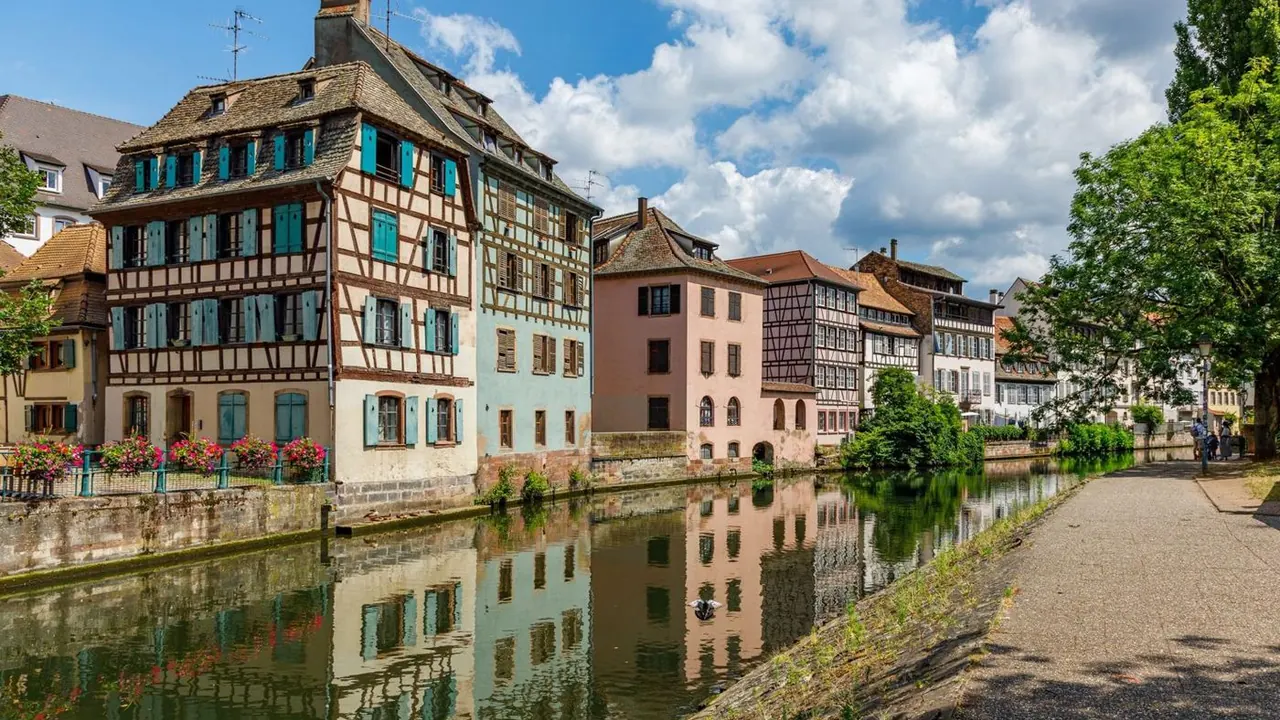
Photos: Salzburg by Leonhard Niederwimmer, Pexels License; Strasbourg by Edoardo Colombo, Pexels License.
Salzburg or Strasbourg?
Our verdict in twelve categories, each scored against the same fixed benchmark cities, and the climate month by month, so you can choose for your trip.
Choose Salzburg for
- beaches
- nature and the outdoors
- live music and the arts
Salzburg suits travellers who want mountains and music in the same trip. Wooded ridges rise inside the city, a cable car climbs the Untersberg, and the Salzkammergut lakes and Berchtesgaden are close by. Evenings belong to opera, orchestral concerts and Mozart rather than late bars. In return you pay more, eat more plainly and go to bed earlier.
Choose Strasbourg for
- food and drink
- nightlife
- prices
Strasbourg is the better pick if eating and drinking are a large part of why you travel. Alsatian cooking, winstub evenings over Riesling and the wine villages to the south give it the stronger table. It is also cheaper, easier to cross by tram and bike, and livelier after dark thanks to its student quarter. The countryside around it is gentler, and its stage programme is more modern than grand.
Scoreboard
Twelve categories on one fixed scale from 0 to 100. The shaded stretch is the gap between the two.
Your match
Pick a travel style or drag the sliders, and both match scores follow your weighting.
Too close to call, 1 point apart
Wins on beaches and nature and the outdoors with your weighting.
Wins on food and drink and nightlife with your weighting.
What matters to you?
Category by category
What the scores mean for a trip.
Beaches & swimming
Neither city has a beach, but Salzburg has the better swimming. Fuschlsee, Wolfgangsee and Mondsee lie under steep green hills, half an hour to forty-five minutes away, with clear water entered from lawns and wooden jetties.
Strasbourg's swimming is in old gravel pits such as the Baggersee, which you can reach by tram. They have grassy banks and lifeguards in high summer. They are handy for cooling off, but they are flat and suburban, not a day out in their own right.
Food & drink
Strasbourg has much the better food. Alsace draws on both French and German kitchens, so a meal might be choucroute, baeckeoffe or tarte flambée in a wood-panelled winstub, with local Riesling and a strong fine-dining tier above that. The covered market adds Munster and charcuterie to take away.
Salzburg's cooking is hearty Austrian fare: schnitzel, Kasnocken and the cloud-like Salzburger Nockerl. It is at its best in the coffee houses and in the Augustiner brewery's garden in Mülln. The range is narrow, and in both cities the restaurants by the main sights mostly serve tour-group menus.
Culture & sights
These two are about equal for sightseeing, but the sights are of different kinds. Salzburg is a Baroque showpiece built by the prince-archbishops, with the cathedral, the Residenz and the arcaded squares packed together under the Hohensalzburg fortress. The Mozart houses give it a single strong theme.
Strasbourg's draws are its pink sandstone Gothic cathedral with the astronomical clock, the half-timbered lanes of Petite France and the imperial avenues of the German-built Neustadt. It also has more museums: the Palais Rohan alone holds three. The European institutions add a modern side. Both are well seen in two or three days.
Nightlife
Strasbourg keeps going later. Its large university fills the Krutenau and the streets around Place Saint-Étienne with student bars and beer cellars, and summer terraces along the quays stay busy into the night. Clubs are few, though.
Salzburg's evenings usually mean a concert, a late dinner and then a litre mug in a beer hall. A few bars on Rudolfskai stay open late at weekends during term, and anyone after a real night out takes the train to Munich.
Nature & outdoors
Salzburg is much the stronger choice for the outdoors. The Mönchsberg and Kapuzinerberg ridges have walking paths in the middle of town, the Untersberg cable car rises to about 1,800m, and the Gaisberg draws hikers and paragliders. Berchtesgaden National Park and the ski areas are within about an hour.
Strasbourg is flat. Its best outdoor pleasures are the Orangerie park, the Rhine forests with their storks and beavers, and long, level cycle routes. The Vosges and the Black Forest offer good hiking about an hour away. Trains and buses reach the main trailheads, but a car makes the outings much easier.
Day trips
Both cities make excellent bases, but the trips are very different. From Salzburg the outings are Alpine: Hallstatt and the lake villages, salt mines at Hallein and Berchtesgaden, the clifftop fortress at Werfen, and Munich for a city day. Many of the lake villages are much easier by car.
From Strasbourg you visit wine villages and old towns. Colmar is half an hour by train, villages such as Riquewihr line the Alsace wine route, and Baden-Baden, Freiburg, Heidelberg and Basel lie across the border. More of these can be done comfortably by rail.
Good for families
Families will manage well in either city, and the differences are practical. Salzburg's cobbles and steep lanes are hard going with a pushchair. Its rewards are the trick fountains and zoo at Hellbrunn, the Haus der Natur, and the miners' slides in the nearby salt mines.
Strasbourg's centre is flat and easy to cover by tram, with boat trips, rowing boats and storks at the Orangerie, and the Le Vaisseau science centre. It also has what Salzburg lacks: a major theme park, Europa-Park, about an hour away.
Getting around
Strasbourg is the easier city to get around. Its tram network runs from the centre to the station, the European quarter and across the Rhine to Kehl, and separated cycle lanes make a hired bike the quickest way about.
Salzburg's core is walkable in a quarter of an hour, and trolleybuses cover the rest, but it has no tram or metro. The slow regional buses to the lakes push many visitors into a hire car.
Shopping & style
Neither city makes a serious shopping trip, so the difference lies in what you bring home. Salzburg's speciality is Tracht: dirndls and loden jackets, often made to measure in old-town workshops, near Getreidegasse with its wrought-iron guild signs. Its Advent market on Domplatz is one of the best known in the region.
Strasbourg has the fuller high street, with chain stores and a department store around Place Kléber and bookshops and delicatessens in the lanes by the cathedral. Alsace wine, Soufflenheim pottery and printed linens are the things to take home. Its Christmas market is among the oldest in Europe, though many stalls sell mass-produced goods.
Affordability
Strasbourg is the cheaper stay. Winstub meals, wine by the pichet and the tram are fairly priced, and the cathedral and old streets cost nothing. Hotels are the main expense, and rates jump during the Christmas market and the weeks when the European Parliament sits.
Salzburg is expensive for its size all year, and costs climb further during the summer festival and Advent. The usual ways to save are staying across the river or in the suburbs, eating in the outer inns and buying the city card.
Live music & performing arts
For classical music Salzburg is in a different league. The summer festival fills the Grosses Festspielhaus and the Felsenreitschule, carved into the cliff, and Jedermann is played in front of the cathedral. Mozart Week and the Easter Festival add two more seasons, and the Mozarteum and the Marionette Theatre perform all year.
Strasbourg's programme is smaller, but it is broader in drama and modern work. The Théâtre National de Strasbourg is one of France's leading stages, the Musica festival is devoted to contemporary music, and there is a jazz festival, which Salzburg barely matches.
Wellness & relaxation
The two are evenly matched here, and in the same way. Neither has hot springs, but each has a characterful public bath: Salzburg's Paracelsus Bad, with its pool looking onto the Kapuzinerberg, and Strasbourg's tiled early twentieth-century Bains municipaux, with a hammam.
For a proper spa day, Strasbourg's choice is Baden-Baden and its thermal baths. From Salzburg you can go to the brine spa of Bad Reichenhall or the radon springs of the Gastein valley. Strasbourg's calm goes in December, when the Christmas market crowds fill the centre.
When should you go?
Pick your month. The climate figures are measured averages, not a forecast.
Salzburg in July
Strasbourg in July
Daytime high, °C
Rainfall in the month, mm
Temperature and rainfall are climate normals, averaged over the years shown. Salzburg: 1991-2020 normals, Salzburg (3.4 km from centre). Strasbourg: 1991-2020 normals, Strasbourg (9.1 km from centre).
Salzburg and Strasbourg warm up at almost the same pace, with July and August highs of about 25°C and 26°C. Lake swimming near Salzburg runs from June to early September, while Strasbourg's gravel-pit lakes have lifeguards only in July and August. The big difference is rain. Salzburg sits against the Alps and is wet from May to August, with up to 168mm in June. Strasbourg's wettest month is May, at about 77mm. It also gets more summer sunshine, so a midsummer city break there is far less likely to be spent under an umbrella.
For walking the streets, Salzburg is best in April and October, which are mild and much less rainy than its summer. September is also pleasant, though showers are still common. Strasbourg suits walking from April right through to September, with no month that is truly wet. Winters are cold in both, and Salzburg is the colder, with snow often reaching the town. Strasbourg is a little milder but greyer. From October to February it gets clearly less sunshine than Salzburg, with only about 42 hours in December.
Which traveller are you?
On an outdoors trip, Salzburg is the clear choice. Ridge paths begin in the city centre, the Untersberg and Gaisberg offer hiking and paragliding, and Königssee and the Salzkammergut lakes are close. Strasbourg's Vosges and Black Forest hills are gentler and farther away.
For a food and nightlife trip, Salzburg's schnitzel, coffee houses and early evenings in the beer halls lose out to Strasbourg. Alsatian cooking, winstub taverns and wine from the vineyards to the south give it the better table. Its Krutenau student bars and riverside terraces also stay open later.
On a tight budget, the cost of getting out of town matters as much as the city itself. Salzburg's lake villages are slow to reach by bus, so many people hire a car. From Strasbourg, Colmar and Basel are easy train rides, Kehl is a tram ride away, and a hired bike covers the flat city.
Before you go
| Measure | Salzburg | Strasbourg |
|---|---|---|
| Official language | German, Austrian Sign Language | French |
| Currency | Euro (EUR) | Euro (EUR) |
| Sockets | CF230 V, 50 Hz | CE230 V, 50 Hz |
| Driving side | Right | Right |
| Time zone | UTC+1, UTC+2 in summer | UTC+1, UTC+2 in summer |
| Emergency number | 112 | 112 |
| Elevation | 424 m | 132 m |
| Main airport | Salzburg Airport (SZG)3 km from centre64 non-stop destinations | Strasbourg Airport (SXB)10 km from centre43 non-stop destinations |
| Public holidays this year | 16 days | 11 days |
By the numbers
| Measure | Salzburg | Strasbourg |
|---|---|---|
| City population | 155,021 | 293,771 |
| People per km² | 2,360 | 3,752 |
| Museums within 10 km | 38 | 21 |
| UNESCO World Heritage sites within 50 km | 3 | 1 |
Where else could you go?
Every comparison below shares a destination with this one, so you can follow Salzburg or Strasbourg somewhere new.