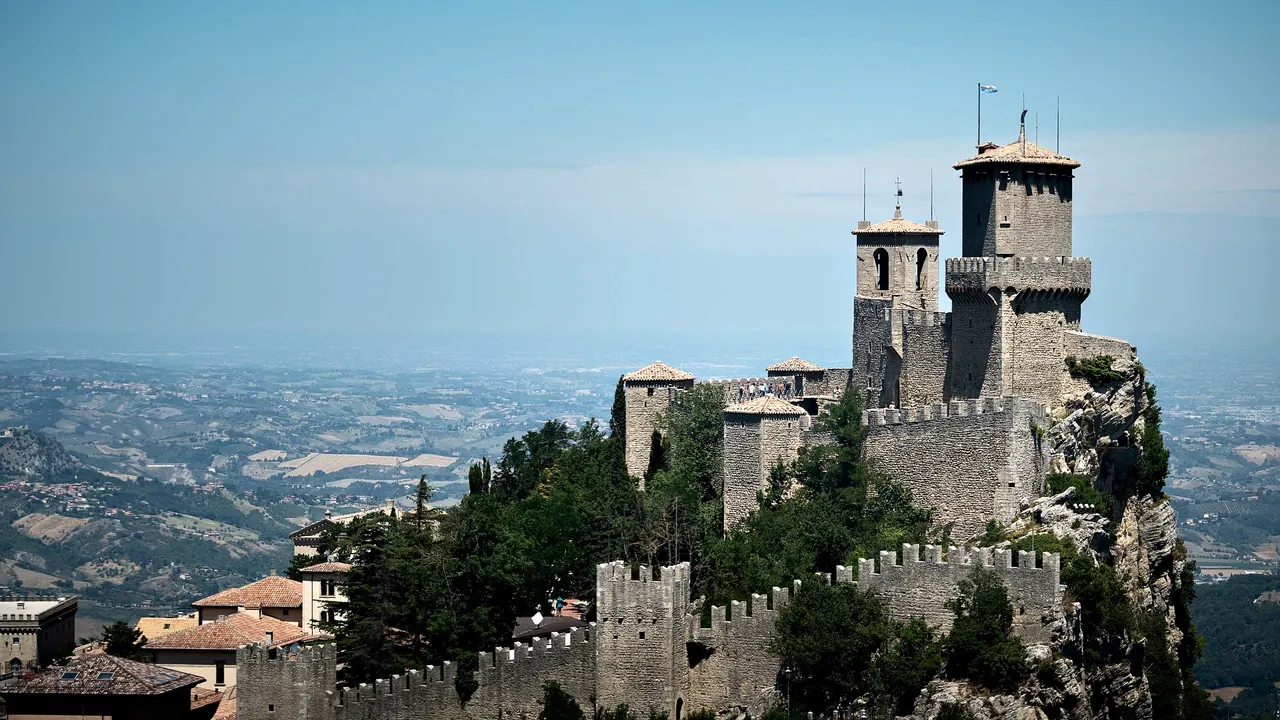
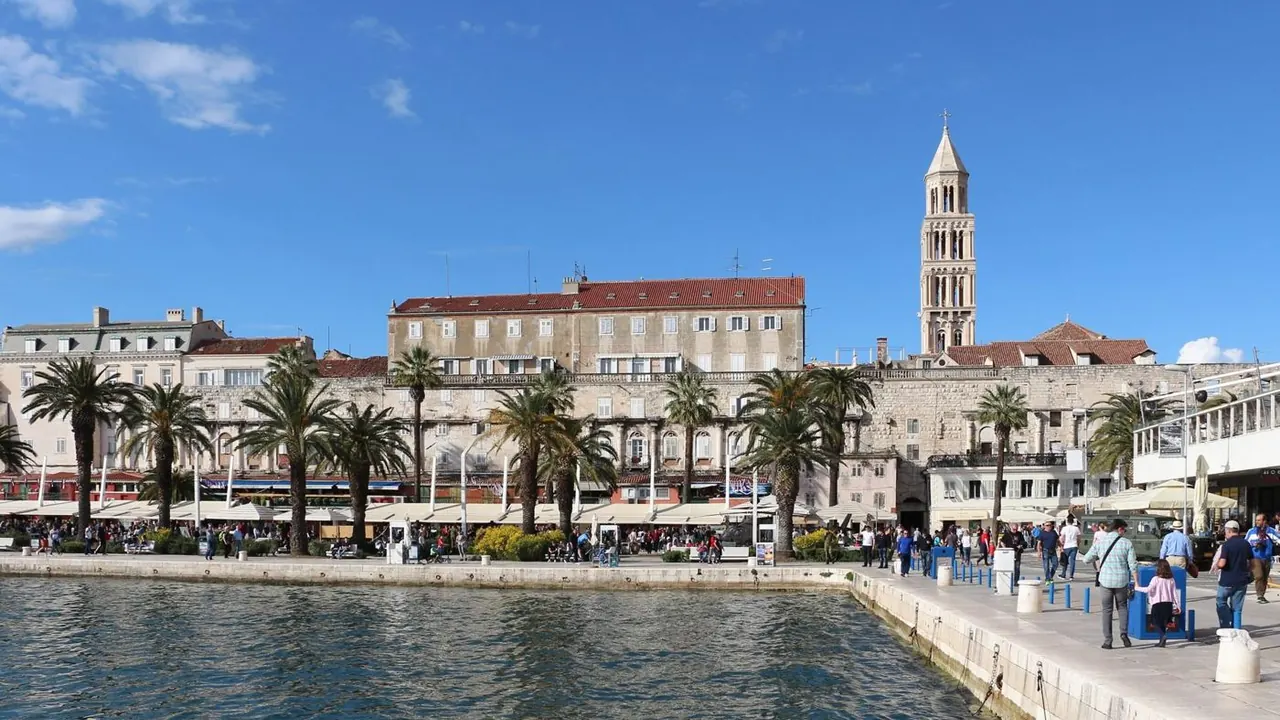
Photos: San Marino by Tibor Szabo, Pexels License; Split by Bernard Gagnon, CC BY-SA 4.0, cropped.
San Marino or Split?
Our verdict in twelve categories, each scored against the same fixed benchmark cities, and the climate month by month, so you can choose for your trip.
Choose San Marino for
- prices
San Marino suits a traveller touring central Italy by car who wants a striking hilltop stop and a quiet base for excursions. The walled summit, its towers and the story of an ancient republic fill a memorable half day. From there Urbino, San Leo, Ravenna and the Romagna coast are all within an easy drive, and it is a little gentler on the budget. Expect calm evenings rather than a night out, and go down to the sea instead of waking up beside it.
Choose Split for
- nightlife
- nature and the outdoors
- beaches
Split is the stronger choice for a summer trip built around the sea and the outdoors. You can walk from a Roman emperor's palace to a swim, climb Marjan before breakfast, catch a ferry to Hvar or Brač, and find bars still busy in the palace alleys late at night. It has more to do on almost every front, though high summer brings heat, crowds and higher room costs.
Scoreboard
Twelve categories on one fixed scale from 0 to 100. The shaded stretch is the gap between the two.
Your match
Pick a travel style or drag the sliders, and both match scores follow your weighting.
Wins on prices with your weighting.
Wins on nightlife and nature and the outdoors with your weighting.
What matters to you?
Category by category
What the scores mean for a trip.
Beaches & swimming
In San Marino the sea is a view from the walls, and swimming means a half-hour drive down to Rimini or Riccione. There you find long sandy beaches with rows of umbrellas and shallow water, good for an afternoon out but never part of daily life.
Split puts the Adriatic on your doorstep. Bačvice, a sandy bay just east of the harbour, is a short walk from the palace, and the pine-shaded pebble coves around Marjan have deeper, clearer water. The ferries to Brač, Šolta and Hvar add calmer beaches, but expect pebbles and concrete platforms rather than the Riviera's wide sand.
Food & drink
Split eats better. Its kitchen is built on the sea, with grilled fish, squid, black risotto and octopus under the peka bell, and the fish market and the Pazar by the palace walls set the rhythm. Family konobas in Varoš serve it well, with Plavac Mali and Pošip to drink.
San Marino offers the hearty inland cooking of Romagna and Montefeltro: hand-rolled pasta, passatelli in broth, piadina and the Tre Monti wafer cake. The summit terraces lean on the view, though, so the good meals mean heading down to Borgo Maggiore or over the border.
Culture & sights
Both are small historic towns seen in a short visit, but Split's centrepiece is in another league. Diocletian's Palace is a Roman complex still lived in, with the cathedral in the emperor's mausoleum, vaulted substructures below and Venetian lanes around it. The Meštrović Gallery adds a fine museum.
San Marino's appeal is the setting and the idea. The three towers along the cliff edge, the Palazzo Pubblico and the basilica tell the story of one of the oldest surviving republics, but the museums are modest and half a day covers it.
Nightlife
After dark, San Marino offers a glass of wine on a terrace with the coast's lights below and little else. A real night out means driving down to the Riviera clubs at Rimini and Riccione.
Split has a proper summer scene of its own. Bars spill into the palace's stone alleys and stairways, and the beach bars and clubs around Bačvice run into the early hours. Out of season it shrinks to a few bars and coffee with locals.
Nature & outdoors
Split's landscape is far wilder. Marjan's forest park is on foot from the centre, Mosor and Kozjak rise behind the city, and Biokovo climbs above 1,700m an hour to the south. Add rafting in the Cetina canyon at Omiš, Krka's travertine falls and sailing among the islands, and the range is wide.
San Marino has Monte Titano, a limestone ridge of about 740m with cliff-edge paths, woodland walks down to Borgo Maggiore and views to the Apennines. The Montefeltro hills suit a scenic drive or a bike ride, but there is nothing demanding nearby.
Day trips
From San Marino the outings lead to Italian art cities and fortress towns: San Leo on its rock across the valley, Urbino's Renaissance court, Gradara's castle and the hill towns of Santarcangelo and Verucchio. Those really need a car. The coast is different. The bus down to Rimini brings you to its Roman arch and bridge and to the train for Ravenna's Byzantine mosaics and for Bologna.
Split comes out a little ahead because more of it works without driving. Buses reach medieval Trogir, Šibenik's cathedral and the Roman ruins at Salona, with Klis Fortress close by. Ferries from the harbour turn Hvar, Brač and Vis into easy island days. In winter the timetables need more planning.
Good for families
Split is slightly easier with children in daily life. You can walk to shallow Bačvice for paddling, let them run in Marjan's shade, and a ferry ride to an island usually becomes the highlight. There are no theme parks, though, and July and August are hot and packed.
San Marino's towers, battlements and cable car thrill children, but the steep steps make pushchairs hard work. The purpose-built fun lies down on the coast, at Italia in Miniatura, Fiabilandia and the Riccione waterparks, which suits a family with a car.
Getting around
Split is much simpler on foot. The palace, Riva, markets, Varoš and Bačvice lie within about fifteen minutes of each other, and the port and the bus and train stations sit together at the harbour. A car only matters for inland trailheads.
In San Marino, nearly every street climbs or drops by steps, and the cable car links the summit with Borgo Maggiore. The bus from Rimini is the only practical public link, so exploring the surrounding hills really means driving.
Shopping & style
Neither is a shopping destination, but the appeal differs. San Marino trades on lower taxes, with perfume, watches, leather and spirits along its main streets, collectors' stamps and coins, and an outlet centre in the valley. Split is better for edible souvenirs: honey, dried figs, brandies, olive oil and Dalmatian wine from the Pazar market by the palace gate.
Affordability
San Marino is the slightly cheaper stay, priced like provincial central Italy, with moderate hotels outside August and fairly priced trattorias below the summit. Cheaper fuel helps on a driving trip, though the view terraces up top charge for the panorama.
Split swings with the season. In July and August, old-town rooms and fish sold by weight are expensive, and island ferries add up for a family. In May, June, late September and winter it is far more reasonable, and bakeries, markets and the palace sights stay inexpensive all year.
Live music & performing arts
Split has a real stage. The Croatian National Theatre beside the palace runs opera, ballet and drama, the summer festival puts opera in the Peristyle courtyard, and klapa singers often fill the domed vestibule with unaccompanied harmonies.
San Marino has a small theatre, occasional local concerts and its summer Medieval Days, with costumed musicians, crossbow contests and flag-throwers. For opera it sends you to Pesaro or Bologna.
Wellness & relaxation
Neither has a bathing tradition, so spas mean hotel facilities in both. Split offers more ways to slow down: fjaka, the Dalmatian habit of long coffees on the Riva, the pine woods of Marjan and a quick escape to a quieter island.
San Marino's calm comes in the evening, once the day visitors leave and the walls are yours for a walk above the plain. Summer days around the towers are crowded, and the thermal spas are a separate trip into Romagna or the Apennines.
When should you go?
Pick your month. The climate figures are measured averages, not a forecast.
San Marino in July
Split in July
Daytime high, °C
Rainfall in the month, mm
Where the figures come from
San Marino's temperatures are measured 52 km from the centre, at Frontone.
San Marino has no rain gauge within 25 km of the centre, so its rainfall comes from a gridded climate dataset read at the city rather than from a gauge further away.
Temperature and rainfall are climate normals, averaged over the years shown. San Marino: 1991-2020 normals, Frontone (51.5 km from centre). Split: 1991-2020 (sunshine 1971-2000, rainfall 1981-2010) normals, Split / Marjan (0.9 km from centre).
San Marino is a mountain town with a continental edge. Winters are cold, with daytime highs around 7°C in January, and spring warms slowly. June to August are hot enough for beach days on the Riviera below, where the sea reaches about 26°C in August. September is still warm for walking the walls, but from then on the rain builds steadily, and November is the wettest month of the year.
Split is milder and brighter all year. Winter days stay several degrees warmer, and July and August are the driest, sunniest months, with highs of about 31°C and the sea warm enough for long swims. That heat makes midsummer hard going for hiking or sightseeing at midday, so May, June and September suit walkers best, and the sea stays pleasant into October. Like San Marino, it turns wet from October into winter.
Which traveller are you?
On an outdoors trip, Split is the clear pick. Marjan's trails start from the old town, Biokovo and the Mosor ridges offer real hikes, and the Cetina canyon, Krka's waterfalls and island sailing add rafting, swimming and kayaking that Monte Titano's gentle paths cannot match.
For a food and nightlife trip, choose Split. Dalmatian fish, peka and black risotto in Varoš konobas beat the summit's view-led terraces, and summer nights run late through the palace bars and Bačvice clubs, while San Marino goes quiet once the coaches leave.
On a trip on a tight budget, San Marino goes a little further. Hotels and trattorias in the lower villages are moderately priced and lower taxes make fuel cheaper, whereas Split's old-town rooms and fish restaurants get expensive in July and August.
Before you go
| Measure | San Marino | Split |
|---|---|---|
| Official language | Italian | Croatian |
| Currency | Euro (EUR) | Euro (EUR) |
| Sockets | CFL230 V, 50 Hz | CF230 V, 50 Hz |
| Driving side | Right | Right |
| Time zone | UTC+1, UTC+2 in summer | UTC+1, UTC+2 in summer |
| Emergency number | 112 | 112 |
| Elevation | 675 m | 0 m |
| Main airport | Bologna Guglielmo Marconi Airport (BLQ)114 km from centre98 non-stop destinations | Split Saint Jerome Airport (SPU)12 km from centre69 non-stop destinations |
| Public holidays this year | 18 days | 14 days |
By the numbers
| Measure | San Marino | Split |
|---|---|---|
| City population | 4,040 | 160,577 |
| People per km² | 569 | - |
| Museums within 10 km | 19 | 11 |
| UNESCO World Heritage sites within 50 km | 2 | 4 |
| Swim season, months above 21 °C | 4 months | 4 months |
Where else could you go?
Every comparison below shares a destination with this one, so you can follow San Marino or Split somewhere new.
- Assisivs San Marino
- Florencevs San Marino
- Bolognavs San Marino
- Mostarvs Split
- Sienavs San Marino
- Zadarvs Split