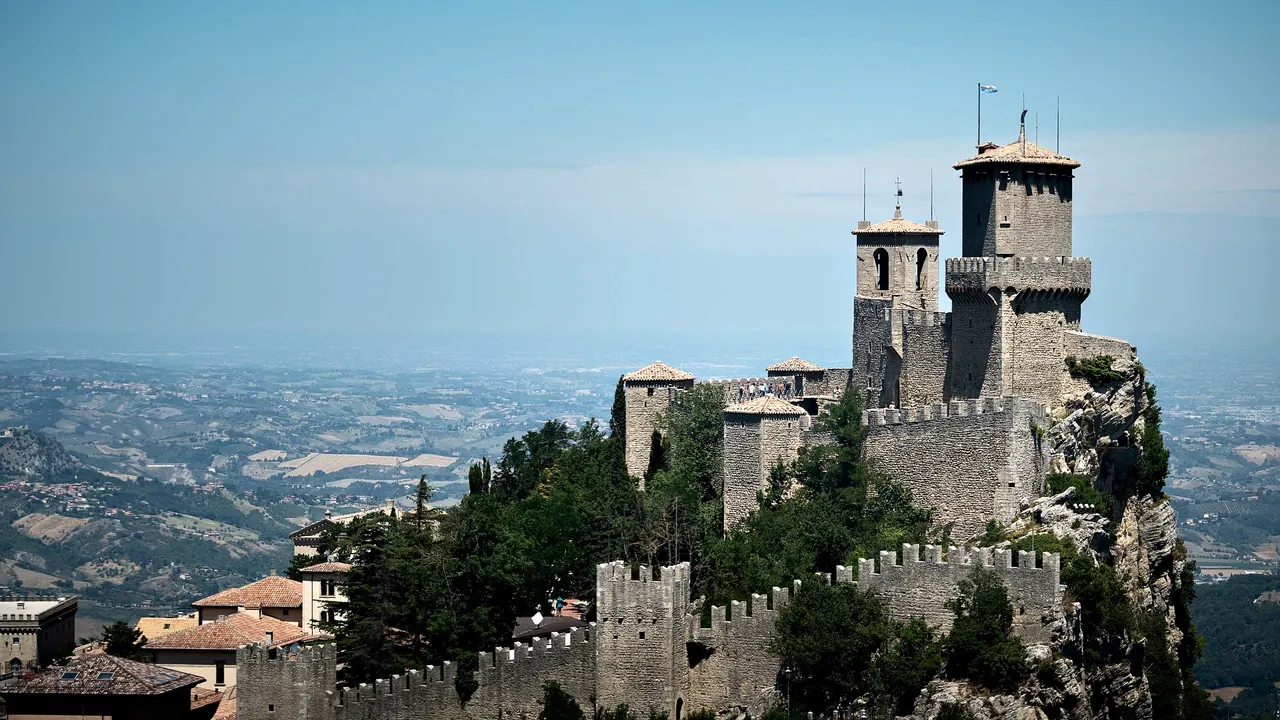
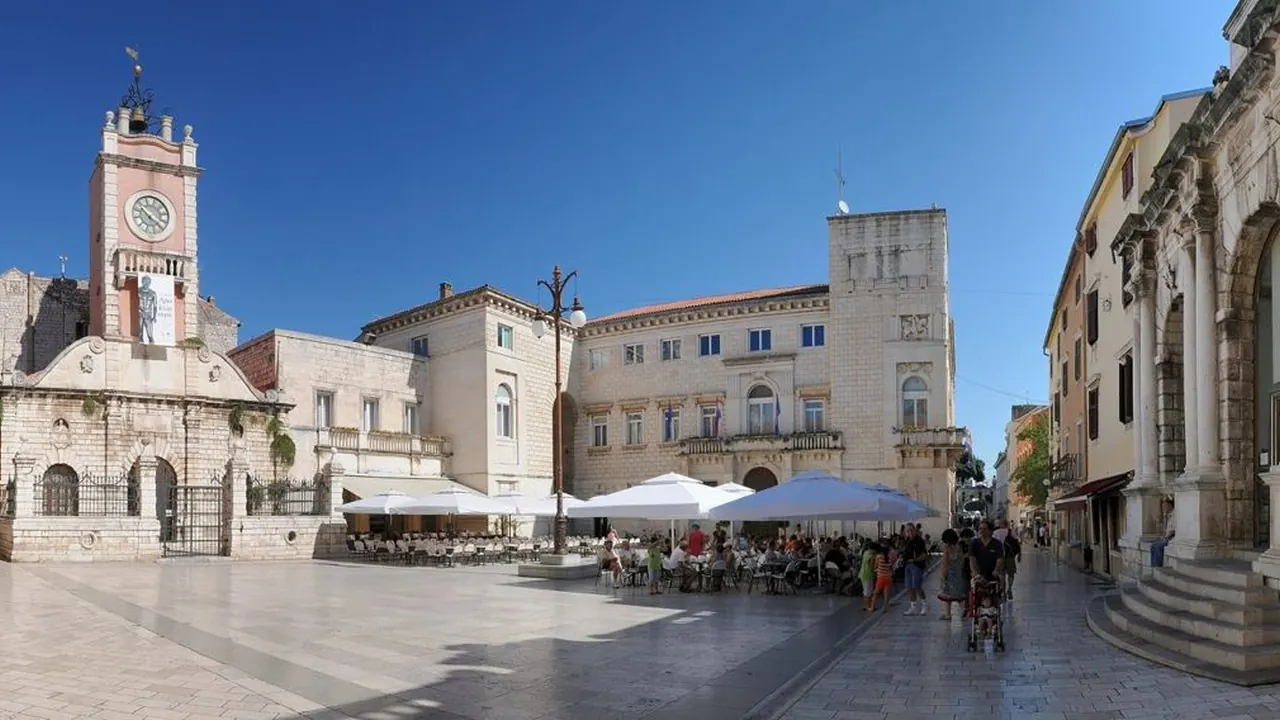
Photos: San Marino by Tibor Szabo, Pexels License; Zadar by Böhringer Friedrich, CC BY-SA 2.5, cropped.
San Marino or Zadar?
Our verdict in twelve categories, each scored against the same fixed benchmark cities, and the climate month by month, so you can choose for your trip.
Choose San Marino for
- day trips
- shopping
San Marino suits a traveller who wants a few days in the hills of central Italy, with a striking mountain republic at the centre of them. The walled ridge of Monte Titano takes about half a day to see, so its real strength is as a base: Urbino, San Leo, Ravenna and the Romagna coast are all within reach, ideally with a car. The summit goes quiet once the coaches leave, which suits couples looking for calm evenings more than groups looking for a night out.
Choose Zadar for
- nature and the outdoors
- nightlife
- beaches
For almost any summer trip built around the sea and the outdoors, Zadar is the better choice. You swim off the promenade, take ferries to island coves and drive to Paklenica's gorges or the Krka waterfalls, then come back to a Roman forum, good small museums and sunset bars on the Riva. It also has more going on after dark, and its old town is flat and car-free, so it is easy to walk.
Scoreboard
Twelve categories on one fixed scale from 0 to 100. The shaded stretch is the gap between the two.
Your match
Pick a travel style or drag the sliders, and both match scores follow your weighting.
Wins on day trips and shopping with your weighting.
Wins on nature and the outdoors and nightlife with your weighting.
What matters to you?
Category by category
What the scores mean for a trip.
Beaches & swimming
This is the clearest divide between the two. Zadar lives by the water: people swim from the promenade on the peninsula, Kolovare and Borik are close by, and Nin and the islands add sand and quieter coves.
San Marino has no shore of its own. The sea is half an hour down the mountain at Rimini and Riccione, whose long sandy beaches suit small children better than Zadar's pebble and concrete platforms. Still, you go there for the day rather than waking up beside the water.
Food & drink
Neither is a reason to travel, but you eat a little better in Zadar. Grilled fish, black risotto, dishes slow-cooked under the peka bell, Pag cheese and a proper market by the walls give its meals a sense of place, even if the menus repeat from one konoba to the next.
San Marino's tagliatelle, passatelli and piadina are honest Romagna cooking. The trouble is that the summit terraces sell the view, and the better trattorias are down in Borgo Maggiore or over the border.
Culture & sights
Zadar has more to see and keeps you busy for longer. The Roman forum, the round Church of St Donatus, the Venetian walls and the Museum of Ancient Glass fill two full days, and the Sea Organ brings something modern to the waterfront.
San Marino is one great sight rather than many: three towers on a cliff edge and the Palazzo Pubblico of an ancient republic. It is dramatic, but half a day covers it.
Nightlife
Zadar has a real if modest evening scene: sunset on the Riva, café-bars along Kalelarga and terrace bars on the walls, with the clubs of Zrće on Pag for anyone who wants to dance. After dark San Marino offers little more than a glass of wine above the lights of the coast, and a proper night out means driving down to Rimini.
Nature & outdoors
Zadar is a genuine base for the outdoors. Paklenica's gorges and climbing walls, the Kornati by boat, Krka and Plitvice inland, and kayaking among the islands give you enough to fill a whole trip.
San Marino has a limestone ridge of about 740m, with cliff-top paths between the towers and gentle walks and cycling roads in the Montefeltro hills. That makes a fine morning out, but not an outdoor vacation in itself.
Day trips
Both make good bases, and the difference is in the kind of outing. From San Marino the trips go into Italian history: the fortress of San Leo, Renaissance Urbino, Ravenna's Byzantine mosaics and the castle at Gradara. These are best done by car, because the only regular bus goes to Rimini.
Zadar's outings mix towns with the sea. There is Šibenik's cathedral, the royal town of Nin and, on a longer day, Split and Trogir. Ferries from the harbour also run to Ugljan, Pašman and car-free Silba, and those trips need no car at all.
Good for families
Zadar is a little easier with children. The flat, car-free old town and wide promenade suit pushchairs, the Greeting to the Sun lights up underfoot after dark, and Nin's shallow sand is close by.
San Marino's towers, battlements and cable car thrill children, but its steep steps are hard work. Where it helps is the coast below, where Italia in Miniatura, Fiabilandia and the waterparks offer the kind of purpose-built attractions Zadar lacks.
Getting around
Zadar is the simpler place to manage without a car. The peninsula is flat and pedestrian, Kolovare beach is a short walk away and the island ferries leave from the edge of the old town. The national parks still call for a hire car or an organised excursion.
In San Marino almost every street climbs, often by steps, and the cable car to Borgo Maggiore only goes so far. The bus from Rimini is the one regular link, so the hill towns around it realistically need a car.
Shopping & style
Neither is a shopping destination, and the difference is in what you take home. San Marino trades on lower taxes, with perfume, watches, leather goods and spirits along its main streets, an outlet centre in the valley, and stamps and coins for collectors. Zadar's best buys are edible or handmade: Maraschino, Pag cheese and lace, and olive oil and figs from the market by the walls.
Affordability
Overall costs come out much the same, neither cheap nor a strain. In San Marino you pay extra for height: summit hotels and view terraces cost more than places a few kilometres down the slope. In Zadar you pay extra in high season: rooms near the peninsula cost far more in July and August, and boat trips and national park entry add up.
Live music & performing arts
Zadar has the one truly memorable event: the Musical Evenings in St Donatus, early and chamber music inside a ninth-century church, along with klapa singing and summer concerts in the squares. San Marino's calendar is thinner. Its best-known event is the costumed Medieval Days, with crossbow contests and flag-throwers, which is more a pageant than a performance.
Wellness & relaxation
Neither place has a bathing tradition, so the difference is in how easily the days slow down, and Zadar does that better. In San Marino calm comes only once the day visitors leave. On summer afternoons the lanes around the towers are crowded, and it is the evening stroll along the walls above the darkening plain that feels peaceful. For a spa you choose one of a handful of hotels or make a separate trip down to the thermal baths on the coast or in the Apennine valleys.
Zadar is unhurried from morning to night. People linger over coffee, rest through the hottest hours and gather on the waterfront at dusk as the islands fade into silhouette, so the quiet does not wait for the crowds to leave. Hotel spas are concentrated around Borik, and the mineral mud of the Nin lagoon offers a simpler local remedy that goes back generations. Late spring and early autumn, away from the summer peak, are the calmest times to come.
When should you go?
Pick your month. The climate figures are measured averages, not a forecast.
San Marino in July
Zadar in July
Daytime high, °C
Rainfall in the month, mm
Where the figures come from
San Marino's temperatures are measured 52 km from the centre, at Frontone.
San Marino has no rain gauge within 25 km of the centre, so its rainfall comes from a gridded climate dataset read at the city rather than from a gauge further away.
Zadar has no rain gauge within 25 km of the centre, so its rainfall comes from a gridded climate dataset read at the city rather than from a gauge further away.
Temperature and rainfall are climate normals, averaged over the years shown. San Marino: 1991-2020 normals, Frontone (51.5 km from centre). Zadar: 1999-2020 (rainfall 1991-2020) normals, Zadar / Zemunik (9.9 km from centre).
Both places are hot by July, but Zadar is the more reliable summer destination. July is its driest month at about 29mm, daytime highs sit around 31°C and the sea is warm enough for daily swimming from June to September. San Marino's summit is a little cooler, near 30°C in July, which makes the steep streets easier to bear, and the Adriatic down at Rimini is at its warmest in August.
Spring is the pleasant time for walking in both, and in Zadar it is also the best season for hiking, before the heat arrives. From September the rain sets in on both sides of the Adriatic and peaks in November at over 100mm. Winter stays mild on the Croatian shore, while San Marino on its mountain is cold and grey, with January highs around 7°C.
Which traveller are you?
On a beach and sun trip, Zadar wins easily. You can swim straight off the stone promenade, sandy Nin is twenty minutes away and ferries reach quiet island coves. From San Marino, the sea means driving down to the rows of umbrellas at Rimini.
For an outdoors trip, Zadar is far stronger. Paklenica has serious gorge hiking and rock climbing, the Kornati and Telašćica are reached by boat, and Krka's waterfalls are an hour away. Monte Titano has lovely short walks but no long trails.
On a food and nightlife trip, Zadar is the livelier choice. It has Dalmatian seafood, sunset drinks on the Riva and the summer clubs of Zrće within an hour. San Marino goes quiet once the coaches leave, and its summit terraces sell the view more than the cooking.
Before you go
| Measure | San Marino | Zadar |
|---|---|---|
| Official language | Italian | Croatian |
| Currency | Euro (EUR) | Euro (EUR) |
| Sockets | CFL230 V, 50 Hz | CF230 V, 50 Hz |
| Driving side | Right | Right |
| Time zone | UTC+1, UTC+2 in summer | UTC+1, UTC+2 in summer |
| Emergency number | 112 | 112 |
| Elevation | 675 m | 5 m |
| Main airport | Bologna Guglielmo Marconi Airport (BLQ)114 km from centre98 non-stop destinations | Zadar Airport (ZAD)10 km from centre66 non-stop destinations |
| Public holidays this year | 18 days | 14 days |
By the numbers
| Measure | San Marino | Zadar |
|---|---|---|
| City population | 4,040 | 70,779 |
| People per km² | 569 | - |
| Museums within 10 km | 19 | 1 |
| UNESCO World Heritage sites within 50 km | 2 | 2 |
| Swim season, months above 21 °C | 4 months | 4 months |
Where else could you go?
Every comparison below shares a destination with this one, so you can follow San Marino or Zadar somewhere new.
- Assisivs San Marino
- Florencevs San Marino
- Bolognavs San Marino
- Sienavs San Marino
- Splitvs Zadar
- Pulavs Zadar