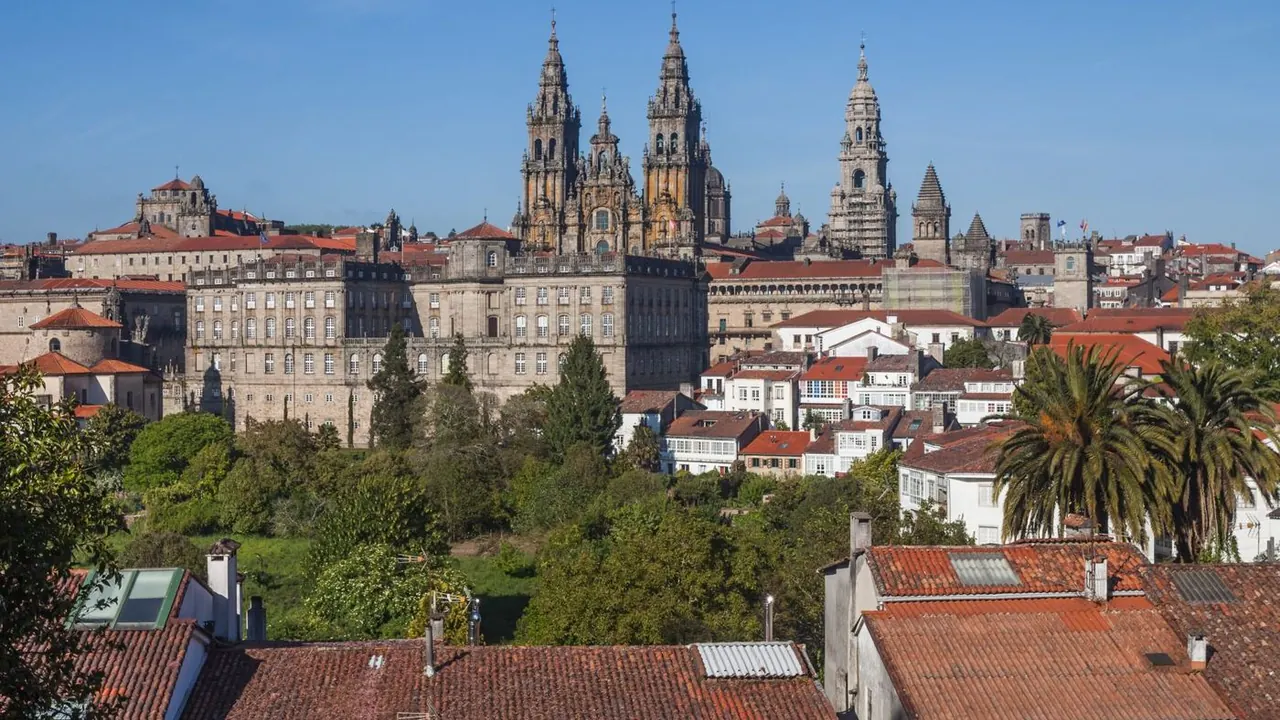
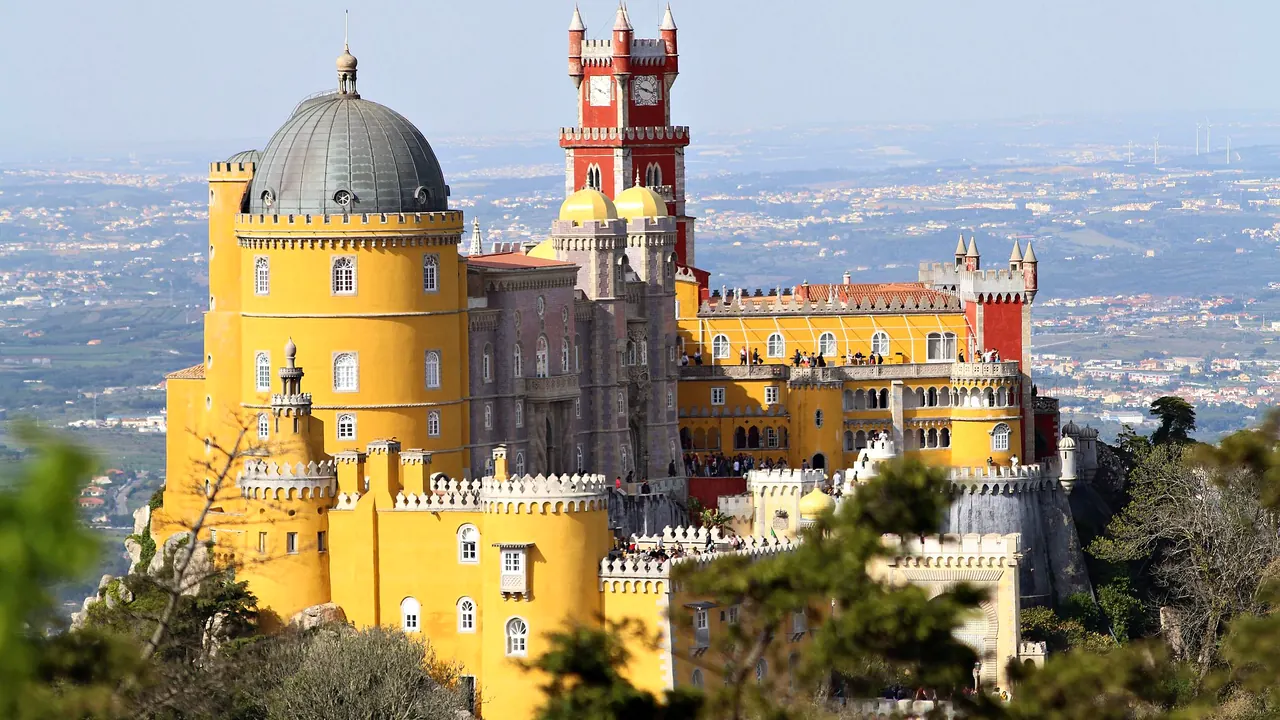
Photos: Santiago de Compostela by Luis Miguel Bugallo Sánchez (Lmbuga), CC BY-SA 3.0, cropped; Sintra by Chabe01, CC BY-SA 4.0, cropped.
Santiago de Compostela or Sintra?
Our verdict in twelve categories, each scored against the same fixed benchmark cities, and the climate month by month, so you can choose for your trip.
Choose Santiago de Compostela for
- nightlife
- food and drink
- live music and the arts
Santiago de Compostela suits travellers who want a real city to settle into for a few days: a compact granite old town you cross on foot, one of Spain's great cathedrals, and some of Europe's best seafood eaten cheaply in tavern streets that a student crowd keeps busy after dark. It is the easier and cheaper base, and trains reach A Coruña, Pontevedra and Ourense quickly. The price is rain, which falls through much of the year.
Choose Sintra for
- nature and the outdoors
- beaches
- day trips
Sintra is for travellers who come for scenery and spectacle. Its fairy-tale palaces stand in a forested hill range, with trails leading out to Atlantic cliffs, and the sun shines far more often than in Galicia. Lisbon is close enough that a stay here can also be a stay near a capital. Expect quiet evenings, ordinary food in the old town and steep lanes between the sights.
Scoreboard
Twelve categories on one fixed scale from 0 to 100. The shaded stretch is the gap between the two.
Your match
Pick a travel style or drag the sliders, and both match scores follow your weighting.
Wins on nightlife and food and drink with your weighting.
Wins on nature and the outdoors and beaches with your weighting.
What matters to you?
Category by category
What the scores mean for a trip.
Beaches & swimming
Neither town is built for a beach vacation, but Sintra makes the sea easier to reach. Praia Grande, Praia das Maçãs and the cove at Adraga are about 20 minutes away, there is a summer tram down from the hills, and the tidal pool at Azenhas do Mar is worth seeing. The catch is heavy surf and fog that can roll in on a sunny day.
Santiago's beaches are 35km off on the Ría de Muros e Noia and the Ría de Arousa, and a beach day takes a bus or a car. In return, the white sand inlets there are sheltered and calmer for swimming. On both coasts the water stays cold.
Food & drink
This is where Santiago pulls well ahead. Octopus, scallops, razor clams and percebes come fresh from the Mercado de Abastos, where some counters will cook what you buy. Rúa do Franco and Rúa da Raíña serve pimientos de Padrón, empanada and tetilla cheese with Galician white wine, and food lovers can build a whole trip around it.
Sintra's food fame rests on two pastries, the almond-filled travesseiro and the little queijada cheese tart. Old-town restaurants mostly cook for day-trippers and quality is patchy. The good meals are grilled fish in the coastal villages, and serious dining means a trip into Lisbon.
Culture & sights
Sintra has the edge for sightseeing because it offers a whole landscape of palaces rather than one great monument. The painted Pena Palace, the Moorish Castle walls, the National Palace with its giant chimneys, Quinta da Regaleira's Initiation Well and Monserrate all lie within a few square kilometres. They fill two full days, best started early.
Santiago builds on its cathedral, with the Pórtico da Gloria and the shrine of Saint James, set on the grand Praza do Obradoiro inside a UNESCO old town of arcades and monasteries. It also has the museums Sintra lacks, such as the Museo do Pobo Galego and the contemporary art centre at Bonaval.
Nightlife
Santiago has a real night out and Sintra does not. During term the university fills the old town: wine along Rúa do Franco, pub-like bars around Rúa da Raíña and the Praza de Cervantes, folk sessions, and a few clubs open until the small hours, liveliest on Thursdays. In summer the pilgrims make it calmer.
Sintra empties once the last train leaves for Lisbon. A glass of wine on a café terrace is about the limit, so a proper evening means 40 minutes into the capital and watching the clock for the ride back.
Nature & outdoors
Sintra puts wild landscape on the doorstep. The Serra de Sintra is a granite ridge of cork, oak and giant ferns, often wrapped in mist, and trails climb straight from town to high viewpoints over the Atlantic. Beyond them are the clifftop paths of Cabo da Roca, surfing at Praia Grande, and mountain biking or horse riding in the park.
Santiago's own surroundings are gentler: farmland hills and the Camino paths, which make easy walks. Its dramatic places, the Costa da Morte cliffs, the ancient Fragas do Eume woodland and the Rías Baixas for kayaking, lie an hour or two away.
Day trips
Santiago makes a sound base for the rest of Galicia, and much of it is reachable by train. The Roman Tower of Hercules at A Coruña is about half an hour away, Pontevedra's pedestrian old town and the port of Vigo are a short ride south, and Ourense with its old bridge is not much further. Lugo, ringed by complete Roman walls, is a longer outing that fills a whole day. The Albariño villages around Cambados, the granaries of Combarro, and Fisterra and Muxía at the end of the Camino are easier with a car or a tour.
Sintra has the stronger list, above all because Lisbon is about 40 minutes away by suburban train, and it is a whole capital with its own neighbourhoods and sights. Cascais and the Estoril coast are just over the hills by bus. With a car you can add the baroque palace and basilica at Mafra, the surf village of Ericeira, the walled town of Óbidos and the great monasteries of Alcobaça and Batalha, with Évora as the furthest you can reasonably go in a day.
Good for families
The two are much alike for families, since neither has anything built for children. Sintra has more adventure: castle walls to climb and tunnels to explore at Quinta da Regaleira will thrill school-age children, though steep cobbles, queues and rough surf are hard work with toddlers.
Santiago is the gentler, smaller stay, safe and relaxed, with children welcome in the streets late into the evening. The hilly granite lanes and runs of rainy days are the drawbacks, and the aquarium in A Coruña is the nearest treat built for children.
Getting around
Santiago is the easier place to get about. Nearly everything is inside a pedestrian old town you can cross in twenty minutes, and coastal trains make day trips simple. Wet granite underfoot is the main hazard.
Sintra's centre is just as small, but its main sights are not in it. The Pena Palace and Moorish Castle sit far above the town, so you face a stiff climb, a crowded circular bus or a tuk-tuk, and narrow one-way roads make driving near the palaces a struggle.
Shopping & style
Neither is a fashion destination, but Santiago has more worth bringing home. Black jet amulets are carved and sold on the Azabachería beside the cathedral, there are blue-and-white Sargadelos ceramics, and delicatessens sell tinned seafood and tetilla cheese.
Sintra's old-town lanes sell hand-painted tiles, cork goods, linen and boxes of pastries, mixed with plenty of souvenirs. Its Sunday fair at São Pedro de Penaferrim is the best stop for antiques, and anything more serious means Lisbon.
Affordability
Santiago is cheaper. Tapas often come free with a drink, set lunches are generous, seafood costs less than in big Spanish cities, the cathedral is free to enter, and pensiones and pilgrim hostels keep rooms cheap outside the busy weeks of July.
Sintra's day-to-day costs are modest too, with cheap tascas, pastries and the Lisbon train. What raises the bill is a separate ticket for each palace, plus the higher rates of manor-house rooms in the centre. Staying out by the coast saves money.
Live music & performing arts
Santiago offers more to go and see. The Real Filharmonía de Galicia plays a season at the Auditorio de Galicia, two theatres stage drama, and Galician bagpipes, folk sessions and caped student tunas fill the old town without a ticket.
Sintra's highlight is its summer festival of classical music and dance, held in palaces and quintas. Those are memorable evenings, but outside the festival there is little beyond the Olga Cadaval centre, so most performances mean going to Lisbon.
Wellness & relaxation
Santiago has hot springs within reach and Sintra has none. From Santiago, the old spa towns of Caldas de Reis and Cuntis and Ourense's riverside thermal pools make an easy outing for tired walking legs, and the town itself slows down once the day's pilgrims have arrived.
Sintra's calm comes from its setting instead. Stay overnight in a quinta among old gardens and misty forest, and enjoy the early mornings and evenings after the crowds have gone. Monserrate's gardens are the quietest corner.
When should you go?
Pick your month. The climate figures are measured averages, not a forecast.
Santiago de Compostela in July
Sintra in July
Daytime high, °C
Rainfall in the month, mm
Temperature and rainfall are climate normals, averaged over the years shown. Santiago de Compostela: 1991-2020 normals, Santiago / Labacolla (8.4 km from centre). Sintra: 1991-2020 (rainfall 1961-1990) normals, Lisboa / Geof (22.7 km from centre).
Santiago is at its best from June to September, when highs reach about 25°C and the rain eases. July and August are the only months warm enough for an occasional beach afternoon on the rías, and the sea stays cold all year. From October to January the city is very wet, with more than 200mm of rain most months. The granite looks fine in the rain, but long days of walking turn soggy, and winter days are cool and grey.
Sintra is warmer and much sunnier through the whole year. From June to September it barely rains, with about 5mm in July, and highs of around 28°C are pleasant in the shade of the forested hills. Late summer brings the sea to about 19°C, still bracing. Its wet season runs from October to January too, but it is milder and far lighter than Galicia's, so spring and autumn are good times for palaces and trails.
Which traveller are you?
On a food and nightlife trip, Santiago is the clear choice. Its market hall and tavern streets serve Galician seafood with Albariño, and the student bars and folk sessions keep the old town going late, while Sintra goes quiet at dusk.
For an outdoors trip, Sintra wins. Trails leave town and climb through mossy forest to the Pena Park, Cruz Alta and Peninha, then carry on to the cliffs of Cabo da Roca and the surf at Praia Grande. Santiago's best landscapes are a drive away.
On a trip on a tight budget, Santiago stretches money further. Tapas often come free with a drink, the cathedral costs nothing to enter, and there are pilgrim hostels. In Sintra a separate ticket for each palace soon adds up.
Before you go
| Measure | Santiago de Compostela | Sintra |
|---|---|---|
| Official language | Spanish | Portuguese |
| Currency | Euro (EUR) | Euro (EUR) |
| Sockets | CF230 V, 50 Hz | CF230 V, 50 Hz |
| Driving side | Right | Right |
| Time zone | UTC+1, UTC+2 in summer | UTC, UTC+1 in summer |
| Emergency number | 112 | 112 |
| Elevation | 260 m | 193 m |
| Main airport | Santiago-Rosalía de Castro Airport (SCQ)10 km from centre29 non-stop destinations | Lisbon Humberto Delgado Airport (LIS)22 km from centre156 non-stop destinations |
| Public holidays this year | 13 days | 14 days |
By the numbers
| Measure | Santiago de Compostela | Sintra |
|---|---|---|
| City population | 100,965 | 385,606 |
| People per km² | 459 | 1,208 |
| Museums within 10 km | 6 | 12 |
| UNESCO World Heritage sites within 50 km | 2 | 3 |
| Swim season, months above 21 °C | None | None |
Where else could you go?
Every comparison below shares a destination with this one, so you can follow Santiago de Compostela or Sintra somewhere new.
- Lisbonvs Sintra
- Coimbravs Sintra
- Portovs Santiago de Compostela
- Farovs Sintra
- Portovs Sintra
- Coimbravs Santiago de Compostela