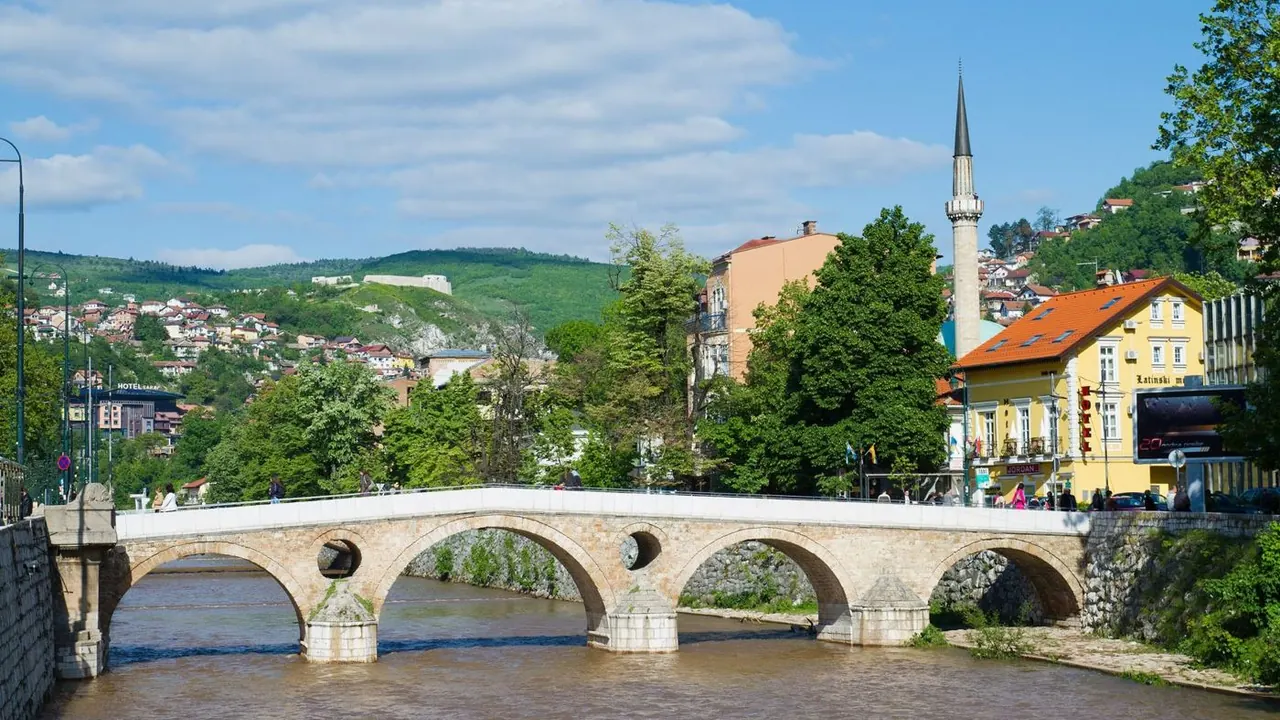
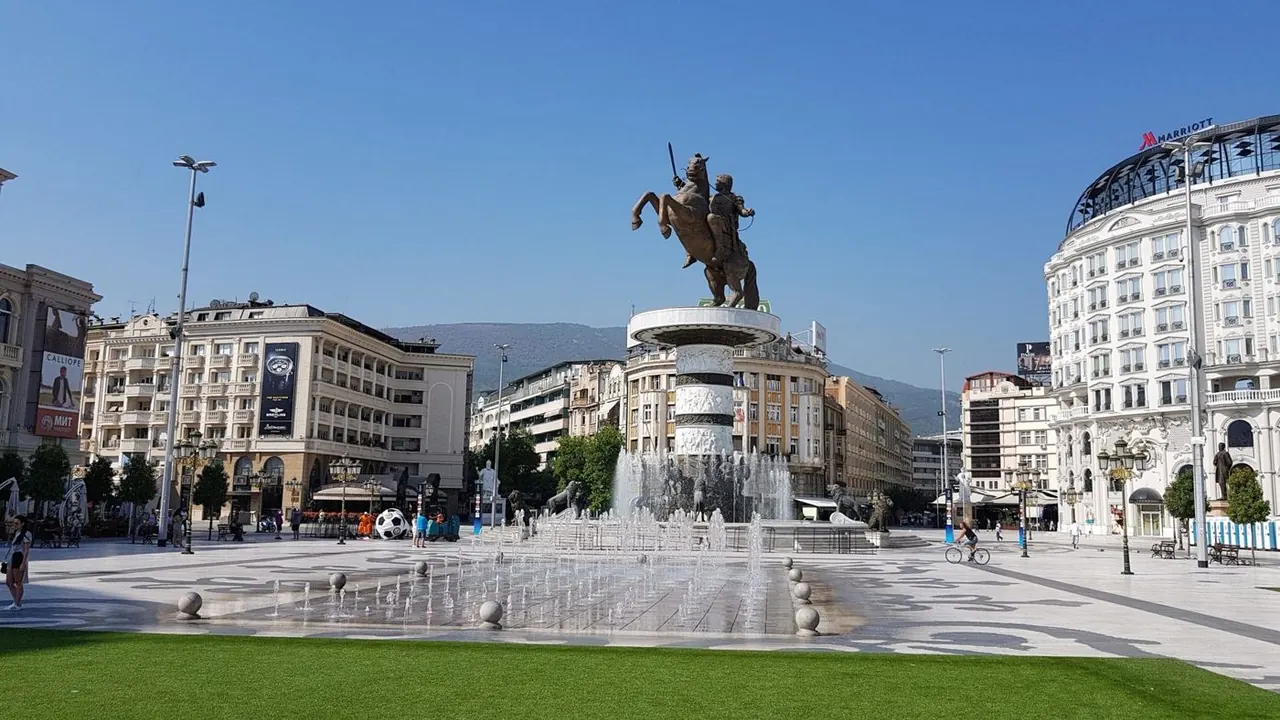
Photos: Sarajevo by Tumi-1983, CC0; Skopje by George M. Groutas, CC BY 2.0, cropped.
Sarajevo or Skopje?
Our verdict in twelve categories, each scored against the same fixed benchmark cities, and the climate month by month, so you can choose for your trip.
Choose Sarajevo for
- getting around
- wellness
- food and drink
Sarajevo suits the traveller who wants history close up, from the Ottoman bazaar and the Austro-Hungarian avenues to the 1914 corner by the Latin Bridge and the siege sites. Ski slopes and mountain trails are an easy drive away. It is the easier city to get around, thanks to its valley-floor tram, and it adds a thermal spa at Ilidža, the train ride through the gorge to Mostar, and coffee and ćevapi that are reasons to come in themselves.
Choose Skopje for
Skopje does not lead in any category we score.
Skopje is the better pick for someone curious about a capital that has rebuilt itself twice, after the earthquake and again in statues and facades, and who would rather spend evenings over Vranec in a Debar Maalo tavern. It is drier and sunnier, its large Old Bazaar is worth an unhurried morning, and the Tikves wineries and Kratovo's crater town are within reach. It costs just as little as Sarajevo but asks a little more effort, as there is no tram and the outings mostly need a taxi or a car.
Scoreboard
Twelve categories on one fixed scale from 0 to 100. The shaded stretch is the gap between the two.
Your match
Pick a travel style or drag the sliders, and both match scores follow your weighting.
Wins on getting around and wellness with your weighting.
Has no clear advantage with the weighting you have chosen.
What matters to you?
Category by category
What the scores mean for a trip.
Beaches & swimming
You can't do a beach trip from either city, and both are about three hours by road from the nearest proper swimming. The difference is the water you end up in. From Sarajevo you would go on to the salt water of the Croatian or Montenegrin Adriatic. From Skopje you would go to the freshwater shores of Lake Ohrid.
Closer to home, Sarajevo has cold mountain rivers and the lake at Jablanica on the road south. Skopje's Matka reservoir is for kayaking, not swimming, so in summer it is the city pools.
Food & drink
Sarajevo eats a little better. Its ćevapi in soft somun with kajmak are a dish to travel for, the pita bakeries sell burek by weight, and slow dishes such as begova čorba keep the Ottoman kitchen alive. Bosnian coffee from a copper džezva, with a cube of sugar and rahat lokum, is a ritual worth fitting into your days.
Skopje's cooking is homelier: tavche gravche in clay dishes, ajvar, and pastrmajlija in the bazaar grills. Its strength is the wine, and long tavern dinners in Debar Maalo with live music. In both cities you will have worked through the local dishes within a few days.
Culture & sights
Sarajevo has the deeper set of sights. In a few streets the Gazi Husrev-beg Mosque gives way to the Orthodox and Catholic cathedrals and the Old Synagogue. The Latin Bridge marks where the First World War began, and the Tunnel of Hope and the War Childhood Museum tell the story of the siege honestly. The Sarajevo Haggadah adds a medieval treasure.
Skopje's Old Bazaar is larger as a market quarter, with caravanserais and Kale Fortress above it, and the carved iconostasis in the Church of the Holy Saviour is a real find. Across the river, the bronze statues of Skopje 2014 divide opinion, and the stopped clock of the old station tells the story of the 1963 earthquake.
Nightlife
Evenings in both cities follow the same pattern: café-bars that move from coffee to rakija and stay sociable rather than wild. In Sarajevo the student crowd keeps cellar bars and a few small clubs going around Ferhadija late at weekends. In Skopje the terraces of Debar Maalo are the centre, with summer open-air parties near the City Park and quiet weeknights.
Nature & outdoors
Sarajevo has the bigger mountains, and they are closer. The cable car rises from the Old Town to Trebević and the overgrown Olympic bobsleigh track. Jahorina and Bjelašnica, under an hour away, offer reliable skiing in winter and open ridges for hiking in summer. Lukomir's stone village above the Rakitnica canyon and rafting on the Neretva add real wild country.
Skopje has Vodno rising straight from its suburbs and the limestone walls of Matka Canyon, half an hour away, for kayaking and cliffside monasteries. The high Sar ridges and Mavrovo are further out and really need a car, and the valley's summer heat pushes walking into spring and autumn.
Day trips
Sarajevo has the better day out in Mostar, reached by a scenic train through the Neretva gorge. Konjic's bunker, Blagaj's dervish house and Počitelj can be added along the way, and Višegrad's UNESCO bridge and Ottoman Travnik lie in other directions, though the roads are slow.
Skopje's best-known town, Ohrid, is too far for a day, so its trips are quieter: the painted Sarena Mosque at Tetovo, the mosaics at Stobi with the wineries beyond, and Kratovo built inside a volcanic crater. Crossing into Kosovo for Prizren's old town is something Sarajevo has no equivalent for, and buses reach most places.
Good for families
Neither city is built around children, though both make families welcome. Sarajevo's flat Old Town, the carriage ride to Vrelo Bosne and gentle skiing in winter work well, but its sights are heavy with war and winter smog is hard on small lungs. Skopje offers the City Park with its funfair and a boat in Matka Canyon, while summer heat and busy roads wear children out quickly.
Getting around
Sarajevo is easier to move around. Its long, narrow valley gives the city a simple shape, and the tram line, which dates from the nineteenth century, runs from Baščaršija out to Ilidža and covers most of what a visitor needs. Away from that corridor, steep steps and a confusing network of buses take over.
Skopje's sights are also within a flat walk along the Vardar, but there is no tram, and the red double-decker buses are hard for a newcomer to work out. In practice that means cheap taxis for Vodno, Matka and the bus station.
Shopping & style
Shopping in both cities centres on the old bazaar, and neither has much design or luxury beyond it. Sarajevo is better for crafts, with coppersmiths still hammering on Kazandžiluk and kilims and slippers around the Bezistan. Skopje has silver filigree and the everyday Bit Pazar, with its spices, cheese and peppers, and Ohrid pearls and local wine are the usual things to carry home.
Affordability
These are two of the cheapest capitals in Europe, and money goes just as far in either. Sarajevo's bargains are its grills, pita bakeries and trams, though prices rise a little in the Old Town during the summer film festival. In Skopje a tavern dinner with wine costs very little, and most of the main sights are free.
Live music & performing arts
Both have the opera, ballet and philharmonic of a small capital, and plays mostly in the local language. Each also has a respected autumn jazz festival. Sarajevo adds MESS for international theatre and the melancholy sevdah heard in traditional restaurants. Skopje puts on a summer festival in the Old Bazaar and at the fortress, and starogradska songs play in the Debar Maalo taverns.
Wellness & relaxation
Sarajevo is the better place to unwind. Ilidža's sulphurous springs, in use since Roman times, have a proper spa complex at the end of the tram line, and the streams of Vrelo Bosne are a short walk on. The one drawback is the winter smog in the valley.
Skopje's Ottoman hamams have become galleries, and Katlanovska Banja, half an hour out, has mineral pools in an old sanatorium rather than a polished spa. Its gentlest pleasure is free: long hours over coffee on the shaded terraces of Debar Maalo.
When should you go?
Pick your month. The climate figures are measured averages, not a forecast.
Sarajevo in July
Skopje in July
Daytime high, °C
Rainfall in the month, mm
Where the figures come from
Skopje has no rain gauge within 25 km of the centre, so its rainfall comes from a gridded climate dataset read at the city rather than from a gauge further away.
Skopje's sunshine is measured 68 km from the centre, at Stip.
Temperature and rainfall are climate normals, averaged over the years shown. Sarajevo: 1991-2020 normals, Sarajevo-Bejelave (2 km from centre). Skopje: 1991-2020 (sunshine 1961-1990) normals, Skopje-Petrovec (18.3 km from centre).
Both cities have properly cold winters, with daytime highs of only about 5°C in December and January. That is a season for the ski mountains rather than long walks, and Sarajevo's valley can sit under smog. Late spring and early autumn suit walking in either city. Summer is when they part. Sarajevo tops out at about 28°C in July and August, still comfortable on foot and good for the trails, so it works from May right through to September. Skopje climbs to about 32°C, too hot for long afternoons in the streets, so April, May and late September into October suit it better.
Rain is the other big difference. Sarajevo is wet all year and gets close to 90mm a month in late spring and again from September to December. Skopje gets roughly half as much in most months. The gap narrows in May and November and is widest in September. Skopje is also the sunnier of the two, with over 300 hours of sunshine a month in high summer. In neither city is it warm enough for a beach. Summer swimming means pools, lakes or cold rivers.
Which traveller are you?
For a short city break, Sarajevo makes better use of a few days. The tram runs along the valley floor, the flat centre covers mosques, cathedrals, a synagogue and the 1914 corner within a walk, and the cable car goes up Trebević from the edge of the Old Town.
On a relaxing and wellness trip, Sarajevo is the gentler choice. Its summers stay mild enough for slow days outdoors, warm thermal water is a tram ride away rather than a taxi trip, and cool mountain forest is close at hand. Skopje offers café terraces more than treatments.
For wine lovers, Skopje is the clear choice. The Tikves vineyards around Kavadarci and Negotino are an easy trip, with Stobi's Roman mosaics on the way, and Vranec and Temjanika are poured in every tavern. In Sarajevo it is mostly beer and rakija.
Before you go
| Measure | Sarajevo | Skopje |
|---|---|---|
| Official language | Croatian, Serbian, Bosnian | Albanian, Macedonian |
| Currency | Convertible Mark (BAM) | Denar (MKD) |
| Sockets | CF230 V, 50 Hz | CF230 V, 50 Hz |
| Driving side | Right | Right |
| Time zone | UTC+1, UTC+2 in summer | UTC+1, UTC+2 in summer |
| Emergency number | 112 | 112 |
| Elevation | 518 m | 251 m |
| Main airport | Sarajevo International Airport (SJJ)7 km from centre38 non-stop destinations | Skopje International Airport (SKP)16 km from centre52 non-stop destinations |
| Public holidays this year | 8 days | 12 days |
By the numbers
| Measure | Sarajevo | Skopje |
|---|---|---|
| City population | 275,524 | 422,540 |
| People per km² | 1,947 | 739 |
| Museums within 10 km | 25 | 17 |
| UNESCO World Heritage sites within 50 km | 1 | 0 |
Where else could you go?
Every comparison below shares a destination with this one, so you can follow Sarajevo or Skopje somewhere new.