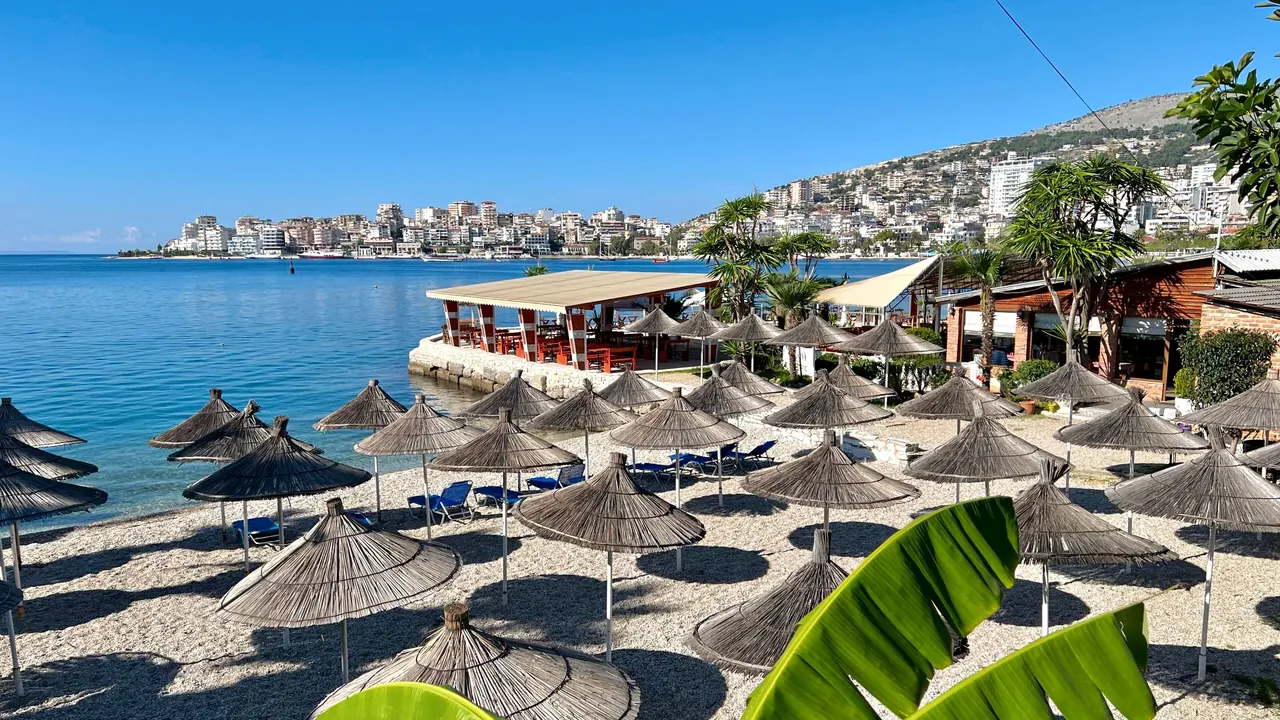
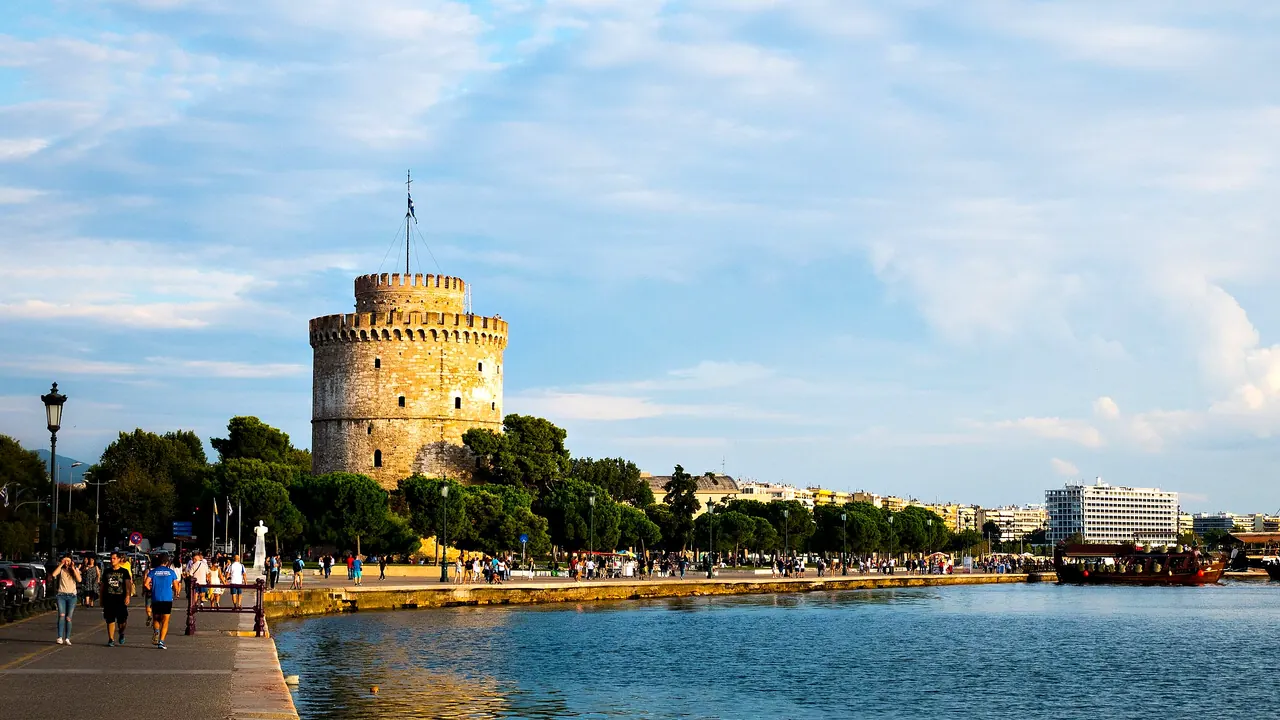
Photos: Saranda by Sharon Hahn Darlin, CC BY 2.0, cropped; Thessaloniki by Destinygreece, CC BY-SA 4.0, cropped.
Saranda or Thessaloniki?
Our verdict in twelve categories, each scored against the same fixed benchmark cities, and the climate month by month, so you can choose for your trip.
Choose Saranda for
- beaches
- prices
Saranda suits a trip where the sea comes first. Ksamil's clear coves and the quieter Riviera bays are a short ride away, Butrint and Corfu make easy outings, and simple rooms and grilled fish keep costs down. Outside the beach and the evening promenade, the town has little to fill the hours, so it works best as a base for swimming and excursions.
Choose Thessaloniki for
- culture and sights
- live music and the arts
- food and drink
For a city trip built around eating, history and late nights, Thessaloniki is the stronger choice. Byzantine churches and fine museums fill the days, and meze tables in Ladadika and the market lanes take over in the evening, with a student crowd keeping the bars full until the small hours. Vergina and Pella are within an hour. The good beaches mean a drive to Halkidiki, so swimming becomes a day out rather than part of each day.
Scoreboard
Twelve categories on one fixed scale from 0 to 100. The shaded stretch is the gap between the two.
Your match
Pick a travel style or drag the sliders, and both match scores follow your weighting.
Wins on beaches and prices with your weighting.
Wins on culture and sights and live music and the arts with your weighting.
What matters to you?
Category by category
What the scores mean for a trip.
Beaches & swimming
Saranda is the beach town of the two. Its small pebble beaches sit right below the promenade, Ksamil's clear coves and islets are about twenty minutes south, and longer, quieter bays such as Lukova and Borsh lie up the Riviera.
Thessaloniki's waterfront is for strolling, not swimming, and the suburban beaches at Perea and Nea Michaniona are ordinary. The excellent water is in Halkidiki, about an hour's drive away, so each swim takes a day out of the city.
Food & drink
Thessaloniki is a serious eating city. Ottoman, Sephardic and Anatolian influences give it range, from soutzoukakia and meze with tsipouro to bougatsa in the morning, and the Kapani and Modiano markets have tavernas tucked between the stalls.
Saranda eats well within a narrow band: Butrint lagoon mussels, grilled fish, byrek and southern Albanian home cooking, best in the back-street taverns. Beyond that, the coffee, wine and international choice are thin.
Culture & sights
Thessaloniki's heritage runs much deeper. It has UNESCO-listed churches such as the Rotunda and Agios Dimitrios, the Arch of Galerius, the Museum of Byzantine Culture and the Ottoman lanes and walls of Ano Poli, though in the lower centre these sights stand among modern blocks.
Saranda itself offers a synagogue-turned-church with mosaic floors, a few stretches of wall and the view from Lekuresi Castle. Visitors who come for history spend their time at Butrint instead.
Nightlife
Thessaloniki goes out late all year and on weeknights too. The bars and meze places in Ladadika, the louder small bars around Valaoritou and the tables of the Bit Bazaar are busy from eleven onwards, and in summer the big open-air clubs on the city's edge join them.
Saranda's nights belong to high summer. In July and August the promenade fills with loud cocktail bars and Ksamil has DJ beach clubs, mostly for young Albanian and Kosovar vacationers. Out of season, a night out means a quiet drink on the waterfront.
Nature & outdoors
Both have fine landscapes, but of different kinds. Saranda's are close and coastal: the horseshoe bay facing Corfu, the lagoon and reed beds of Butrint for birdwatching, the deep blue spring at the Blue Eye, and sea kayaking to caves along the Riviera.
Thessaloniki's are grander and further away. The Seich Sou forest sits right behind the city, but Mount Olympus, with the Enipeas gorge and hut-to-hut routes, and winter skiing at Kaimaktsalan both need a car. In both places, summer heat pushes walking into spring, autumn or the early hours.
Day trips
Each has a strong list of trips, with a different character. From Saranda the outings are short and varied: the layered ruins of Butrint, the stone tower houses of Gjirokaster, and a ferry to Corfu that adds a Greek island and its Venetian old town to the trip.
Thessaloniki's trips dig into ancient Macedonia, with the royal tombs at Vergina, the mosaics at Pella and the sanctuary at Dion, plus Edessa's waterfalls and Naoussa's vineyards. Intercity buses reach much of this, but a car makes the circuit easier.
Good for families
Neither city is built around children, but Thessaloniki has a little more for them: the Noesis science centre and planetarium, a small zoo in the Seich Sou forest, and playgrounds along the seafront park. Saranda's strength is the water itself, with calm, sheltered coves at Ksamil for young swimmers, and little beyond it.
Both have steep streets, heavy traffic and hot summers. In Saranda a pool hotel in June or September makes life easier, while families visiting Thessaloniki often stay in Halkidiki for the beaches and come into the city for the day.
Getting around
Thessaloniki is the easier city to move around. The White Tower, the markets, Ladadika and the main churches all lie in a flat strip near the waterfront, a metro line and buses fill the gaps, and cheap taxis take you up to Ano Poli.
Saranda's promenade links its restaurants, beaches and port on foot, but hotels on the slopes mean climbs and buses run without printed timetables. For the Blue Eye or Gjirokaster, a car or taxi is far simpler, and summer traffic clogs the coast road.
Shopping & style
Thessaloniki has a real high street along Tsimiski, with fashion and shoe shops, malls on the city's edge and the Kapani and Modiano markets for spices, cheeses and loukoumi. Saranda sells beachwear and souvenirs, and its best buys are olive oil, mountain honey and raki from small grocers. For crafts, the bazaar in Gjirokaster is the better bet.
Affordability
Both are easy on the budget, and Saranda is a little cheaper day to day. Grilled fish, byrek, local buses and rooms in family hotels cost little, especially in late spring and September, but July and August push up the price of seafront hotels and sunbeds at Ksamil.
Thessaloniki is priced for students and locals rather than visitors, so generous meze dinners and nights out stay gentle on the wallet all year. The main extra cost is car hire for the day trips.
Live music & performing arts
Thessaloniki has a proper cultural calendar. The State Orchestra plays at the waterfront Concert Hall, the National Theatre of Northern Greece runs seasons mostly in Greek, the hill theatre at Dasos hosts summer concerts, and rebetiko fills the tavernas late at night. Saranda has almost nothing beyond the odd summer concert, a rare performance in Butrint's ancient theatre and live Albanian music in some restaurants.
Wellness & relaxation
Neither city has a living bathing culture. Thessaloniki has a little more to offer, with simple spring-fed baths at Lagadas about half an hour away, and an everyday rhythm of long iced coffees and evening walks along the seafront that makes it calm all year.
In Saranda, how restful a stay feels depends on the month. It is loud with music and traffic in July and August, then slow and quiet in May, June and late September, and hotel spas are the only treatments on offer.
When should you go?
Pick your month. The climate figures are measured averages, not a forecast.
Saranda in July
Thessaloniki in July
Daytime high, °C
Rainfall in the month, mm
Where the figures come from
Saranda's temperatures are measured 30 km from the centre, at Kerkyra Airport.
Saranda has no rain gauge within 25 km of the centre, so its rainfall comes from a gridded climate dataset read at the destination rather than from a gauge further away.
Temperature and rainfall are climate normals, averaged over the years shown. Saranda: 1991-2020 normals, Kerkyra Airport (29.8 km from centre). Thessaloniki: 1991-2020 normals, Thessaloniki Airport (14 km from centre).
Saranda's beach season runs from June to September. July and August are dry and sunny, with highs of 32°C, and the sea is warmest in August at 25°C. May is the best month for walking and sightseeing because it is warm and mostly dry. Late September still has warm water and milder days, although the rain starts to come back. October is warm and the sea is still swimmable, but it is a showery month. From November the town turns very wet, with over 200mm a month into December, so winter is quiet and grey.
Thessaloniki has the same hot July and August, when the afternoons are too hot for long walks between churches and museums. June is already hot enough to push sightseeing into the mornings. The best months for walking the city are April and May, then late September through October, when highs range from the high teens to the mid twenties. Winters are colder than in Saranda, around 10°C in January, but much drier, with no month above 56mm. A winter city break works in Thessaloniki in a way that a winter stay in Saranda does not.
Which traveller are you?
On a beach and sun trip, Saranda is the clear pick. Ksamil's pale coves and islets are about twenty minutes away and the Riviera bays lie further north, whereas from Thessaloniki the good swimming means an hour's drive to Halkidiki.
For a culture and arts trip, choose Thessaloniki. Its UNESCO-listed Byzantine churches, the Archaeological Museum's Macedonian gold and a proper concert and theatre scene leave Saranda far behind, since in Saranda the history lies mostly outside town, at Butrint.
On a food and nightlife trip, Thessaloniki wins easily. There are ouzeri meze tables, bougatsa breakfasts and working markets, and then bars in Ladadika and around Valaoritou that are busy well past three. Saranda offers good seafood and loud bars, but mainly in July and August.
Before you go
| Measure | Saranda | Thessaloniki |
|---|---|---|
| Official language | Albanian | Greek |
| Currency | Lek (ALL) | Euro (EUR) |
| Sockets | CF220 V, 50 Hz | CF230 V, 50 Hz |
| Driving side | Right | Right |
| Time zone | UTC+1, UTC+2 in summer | UTC+2, UTC+3 in summer |
| Emergency number | 112 | 112 |
| Elevation | 0 m | 6 m |
| Main airport | Corfu Ioannis Kapodistrias International Airport (CFU)32 km from centre88 non-stop destinations | Thessaloniki Macedonia International Airport (SKG)14 km from centre93 non-stop destinations |
| Public holidays this year | 14 days | 15 days |
By the numbers
| Measure | Saranda | Thessaloniki |
|---|---|---|
| Population | 22,613 | 309,617 |
| People per km² | 383 | 16,042 |
| Museums within 10 km | 0 | 32 |
| UNESCO World Heritage sites within 50 km | 3 | 1 |
| Swim season, months above 21 °C | 5 months | 5 months |
Where else could you go?
Every comparison below shares a destination with this one, so you can follow Saranda or Thessaloniki somewhere new.
- Corfuvs Saranda
- Kalambakavs Saranda
- Kalambakavs Thessaloniki
- Ohridvs Saranda
- Tiranavs Saranda
- Leccevs Saranda