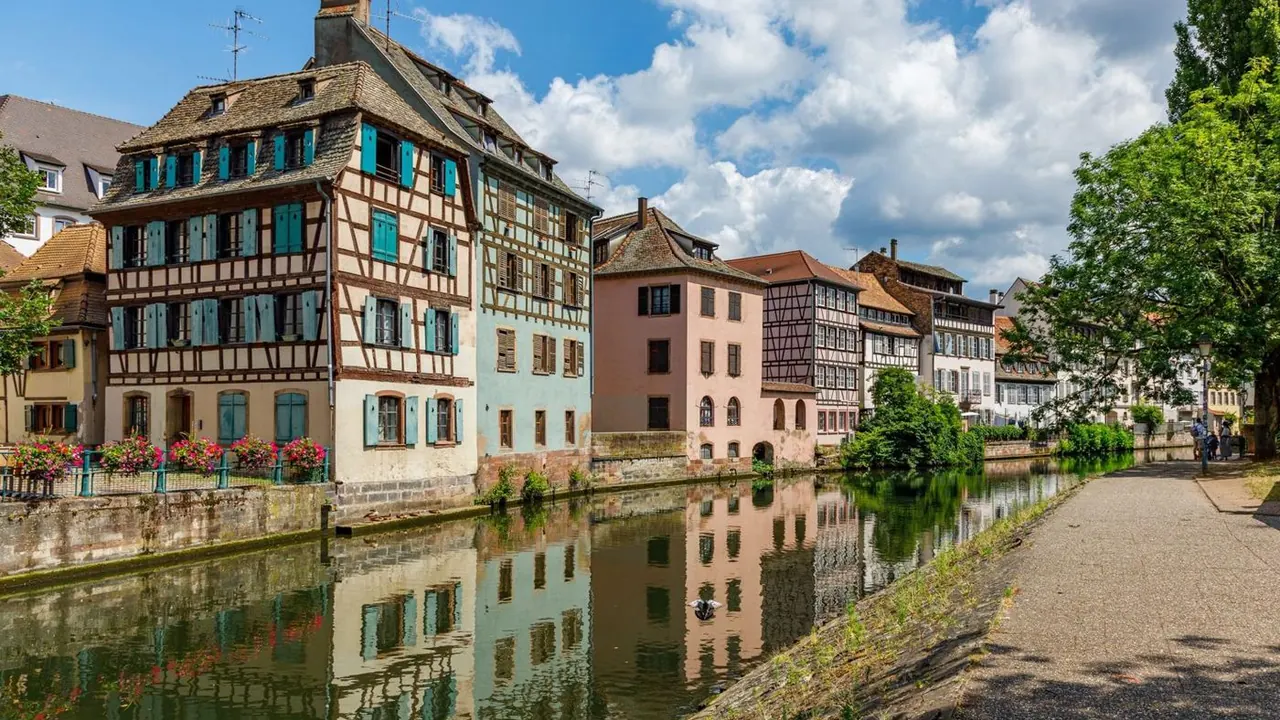
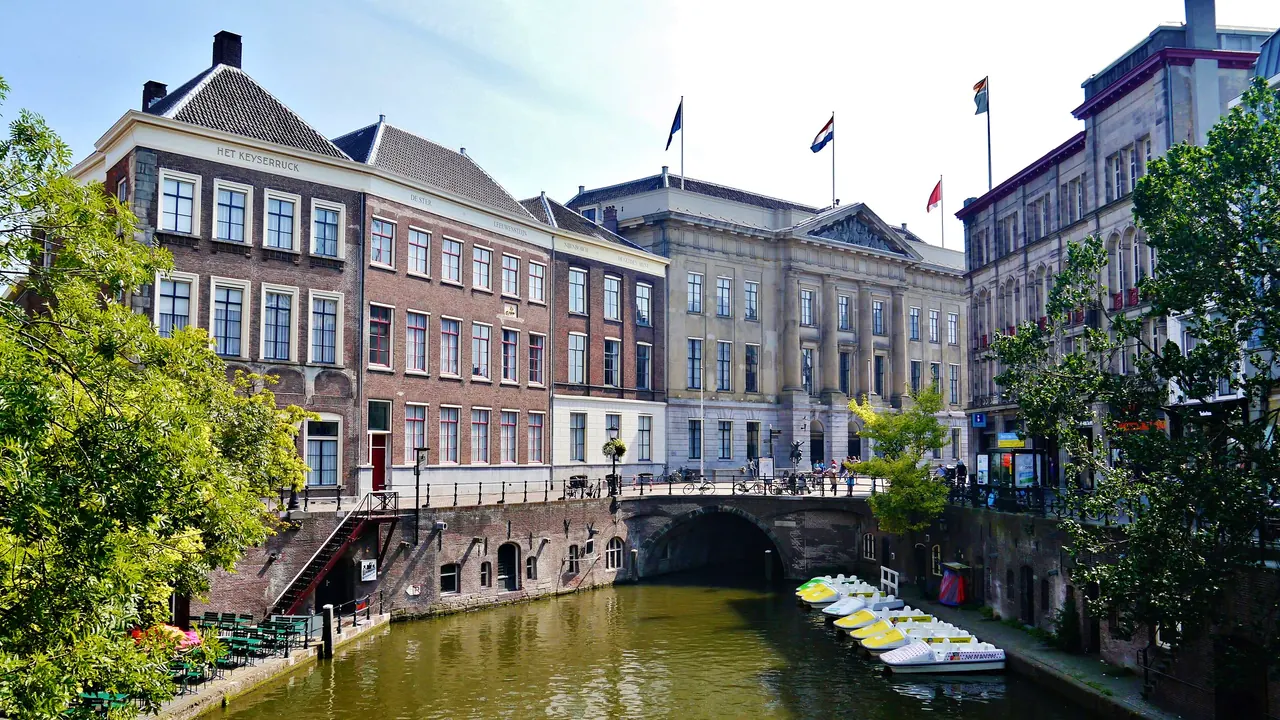
Photos: Strasbourg by Edoardo Colombo, Pexels License; Utrecht by Zairon, CC BY-SA 4.0, cropped.
Strasbourg or Utrecht?
Our verdict in twelve categories, each scored against the same fixed benchmark cities, and the climate month by month, so you can choose for your trip.
Choose Strasbourg for
- food and drink
- wellness
- nature and the outdoors
Strasbourg suits travellers who want a vacation built around eating, sightseeing and getting out into the hills. Alsatian cooking and winstub evenings with local Riesling give it a food culture Utrecht can't match, and the cathedral, Petite France and the Palais Rohan museums make a richer old town. The Vosges and the Black Forest are close, Baden-Baden's thermal baths are under an hour away, and day-to-day costs are a little gentler.
Choose Utrecht for
- day trips
- beaches
- nightlife
Choose Utrecht if you want a calm, easy base for seeing the Netherlands by train. Amsterdam, Rotterdam, The Hague, Delft and Leiden are all short rides from a station that sits on the edge of the old town, so you can see a whole country without changing hotels. The canal-side terraces on the Oudegracht wharves fill on weeknights as well as weekends, and the concert life is broad, from early music to pop.
Scoreboard
Twelve categories on one fixed scale from 0 to 100. The shaded stretch is the gap between the two.
Your match
Pick a travel style or drag the sliders, and both match scores follow your weighting.
Wins on food and drink and wellness with your weighting.
Wins on day trips and beaches with your weighting.
What matters to you?
Category by category
What the scores mean for a trip.
Beaches & swimming
Neither city is a beach destination. In a heatwave both rely on lakes on the city's edge: in Strasbourg the gravel pits such as the Baggersee, which you can reach by tram, and in Utrecht the Maarsseveense Plassen and the Loosdrecht lakes.
Utrecht has the slight edge because it has a real coast within reach. Zandvoort and Scheveningen on the North Sea are about an hour away by train, although the water is cool and the season is short. Strasbourg is too far inland for any sea at all.
Food & drink
Food is where Strasbourg pulls furthest ahead. Alsace mixes French and German cooking in dishes such as choucroute garnie, baeckeoffe and foie gras, served in wood-panelled winstubs with wine from vineyards just south of the city. There is also a strong fine-dining tier in the city and the surrounding villages.
Utrecht has no cuisine of its own to match. What it does well is atmosphere: meals at tables right by the water on the old wharves of the Oudegracht. It also has more variety, with Indonesian and Surinamese kitchens and casual student cafés, where Strasbourg has only a limited choice of other cuisines.
Culture & sights
Strasbourg has the grander set of sights. The pink sandstone cathedral with its astronomical clock, the timber-framed Grande Ile, Petite France and the German-built Neustadt together form a UNESCO-listed ensemble. The three museums in the Palais Rohan go deeper than anything in Utrecht.
Utrecht's appeal is more intimate. You can climb the Dom Tower, which stands on its own since the nave fell in 1674, and walk the unusual two-level Oudegracht. Its standout is modern design: the Rietveld Schröder House and the De Stijl collection at the Centraal Museum. Either city fills two or three unhurried days.
Nightlife
Going out in both cities means student bars rather than clubs, and neither suits a really late night. The difference is when they are busy. Utrecht's centre fills on weeknights too, with brown cafés and drinks at the canal edge around the Neude and the Janskerkhof. In Strasbourg the Krutenau and the streets around Place Saint-Étienne go quiet by midnight on weeknights, and the summer riverside terraces are the best of it.
Utrecht also has an easy fallback for a bigger night out, since Amsterdam is a short train ride away.
Nature & outdoors
Strasbourg has far more serious country within reach. The Vosges rise above the vineyards to the west, with forest trails, castle ruins and the ridge walk at Mont Sainte-Odile. To the east, the Black Forest offers proper hiking among fir woods, and both are about an hour away. Even inside the city, the Rhine forests are home to storks, herons and beavers.
Utrecht's surroundings are gentler and suit bikes rather than boots. You can cycle along the Vecht past estates and windmills, or ride sandy trails across the low ridges of the Utrechtse Heuvelrug. The Loosdrecht lakes are good for sailing and canoeing.
Day trips
Both make excellent bases, but Utrecht's position at the centre of the Dutch rail network gives it the edge. Amsterdam, Rotterdam, The Hague, Delft, Leiden, Haarlem and Gouda are all a short, simple train ride away, and you never need a car.
Strasbourg's trips span two countries. Colmar and the Alsace wine villages lie to the south, and Baden-Baden, Freiburg and Heidelberg are across the Rhine. The catch is that the wine route, the best of it, is much easier by car or bike than by train.
Good for families
Both cities are equally easy with children, with flat, compact centres and short distances. Utrecht has the stronger museums for children: the national Railway Museum in an old station and a museum for toddlers devoted to Miffy. The one hazard is the steady stream of bikes.
Strasbourg offers more outdoors and bigger outings. Children can see storks at the Orangerie, take the boat trip through Petite France and try the hands-on exhibits at Le Vaisseau. Europa-Park is about an hour away across the border.
Getting around
Getting about is easy in both, mostly on foot or by bike. Utrecht is slightly simpler. The main station sits right at the edge of the old town, and one tap-in card covers trains, buses and trams, so you will never want a car.
Strasbourg relies more on its trams, which run from the island centre out to the European quarter and across the Rhine to Kehl. A car only becomes useful for the wine villages and the hills.
Shopping & style
The two are evenly matched, and neither offers much luxury shopping. Strasbourg is the place to buy things that come from the region: Alsace wine, Soufflenheim pottery, printed linens and kougelhopf moulds. In December the Christmas market adds crafts and decorations.
Utrecht is better for browsing independent fashion, design and homeware along the Oudegracht wharves and the Twijnstraat. It also has flower and textile markets, and the chains are gathered in the mall attached to the station.
Affordability
Strasbourg is the cheaper of the two, though neither is a budget destination. Winstub meals and wine by the pichet are fair value, the cathedral and the old town cost nothing, and hotels are the main expense. Rooms get much dearer during the Christmas market and the weeks when the European Parliament sits.
In Utrecht, the scarcity of hotels in the centre keeps the cost of a bed high, and a sit-down dinner at Dutch prices adds up quickly. Students' lunch cafés and a walkable centre help keep daily costs down.
Live music & performing arts
Both have a serious music calendar for their size, but they cover different ground. Strasbourg has the opera, with the Opéra national du Rhin on Place Broglie, and the Théâtre National is one of France's leading stages. The autumn Musica festival is devoted to contemporary music.
Utrecht puts everything under one roof at TivoliVredenburg, which can stage classical, pop and jazz on the same evening. The Festival Oude Muziek draws early-music lovers from across Europe. It has no opera house, and theatre is mostly in Dutch.
Wellness & relaxation
Strasbourg is better for unwinding. The tiled pools and hammam of the Bains municipaux are right in the city, and the thermal baths of Baden-Baden are under an hour away across the Rhine.
Utrecht has no bathing tradition of its own. Its large sauna complexes are out in the green belt and need a short drive or bus ride. Its quieter pleasures are evenings on the canal wharves and the Pandhof cloister garden beside the Dom.
When should you go?
Pick your month. The climate figures are measured averages, not a forecast.
Strasbourg in July
Utrecht in July
Daytime high, °C
Rainfall in the month, mm
Temperature and rainfall are climate normals, averaged over the years shown. Strasbourg: 1991-2020 normals, Strasbourg (9.1 km from centre). Utrecht: 1991-2020 normals, De Bilt (4.3 km from centre).
Strasbourg has the warmer, sunnier summer. July and August reach about 26°C, against 23°C in Utrecht, and June to August bring Strasbourg its longest spells of sunshine, which makes it the better choice for lazy afternoons at the gravel-pit lakes. Its heaviest rain falls from May to July, mostly as summer showers, while late winter is fairly dry at around 35mm a month. Utrecht works the other way round. Its sun peaks earlier, in May, and is already fading by August. April is its driest month, and from July to December it stays wet at around 80mm in most months.
Both cities are cold and grey from November to February, so walking the streets means coats and short days in either place. In Strasbourg, May, June and September are warm enough for long walks without the midsummer heat. For Utrecht, late April to June gives the best balance of mild days, lighter rain and the most sunshine. The North Sea within reach of Utrecht peaks at only about 19°C in August, which is bracing rather than inviting.
Which traveller are you?
For a food and nightlife trip, Strasbourg is the better choice. Its choucroute, baeckeoffe, tarte flambée and winstub wine taverns make eating a reason to travel. Utrecht's canal-side bars are a bit livelier late at night, but its food is pleasant rather than memorable.
For an outdoors trip, Strasbourg wins clearly. Forest trails and castle ruins in the Vosges are about an hour west, and the higher ridges of the Black Forest are a similar distance east. Around Utrecht there is gentle country for cycling, with low wooded ridges but no real hills.
For a short city break, Utrecht is the easier choice. You step off the train almost straight into the old town, and the Dom Tower, the Oudegracht wharves and the main museums are all a short walk apart. Amsterdam is under half an hour away if you have a spare afternoon.
Before you go
| Measure | Strasbourg | Utrecht |
|---|---|---|
| Official language | French | Dutch |
| Currency | Euro (EUR) | Euro (EUR) |
| Sockets | CE230 V, 50 Hz | CF230 V, 50 Hz |
| Driving side | Right | Right |
| Time zone | UTC+1, UTC+2 in summer | UTC+1, UTC+2 in summer |
| Emergency number | 112 | 112 |
| Elevation | 132 m | 5 m |
| Main airport | Strasbourg Airport (SXB)10 km from centre43 non-stop destinations | Amsterdam Airport Schiphol (AMS)34 km from centre287 non-stop destinations |
| Public holidays this year | 11 days | 11 days |
By the numbers
| Measure | Strasbourg | Utrecht |
|---|---|---|
| City population | 293,771 | 359,370 |
| People per km² | 3,752 | 3,619 |
| Museums within 10 km | 21 | 28 |
| UNESCO World Heritage sites within 50 km | 1 | 5 |
| Swim season, months above 21 °C | - | None |
Where else could you go?
Every comparison below shares a destination with this one, so you can follow Strasbourg or Utrecht somewhere new.