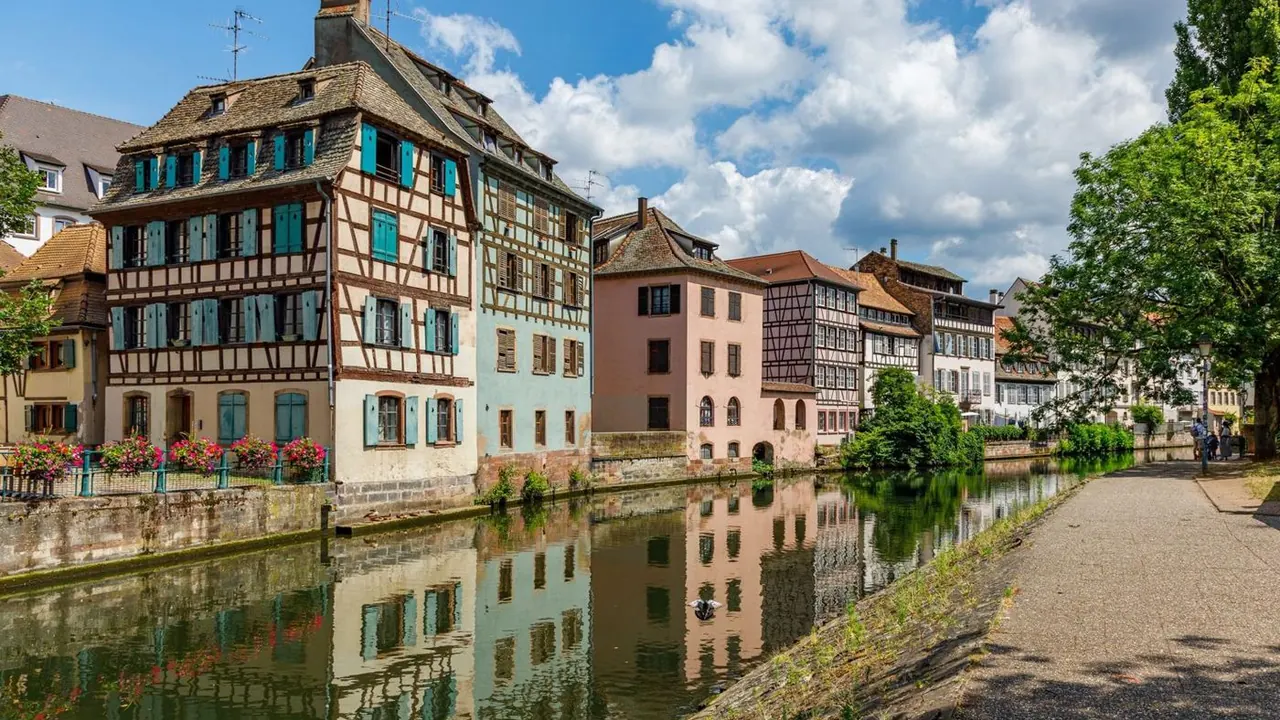
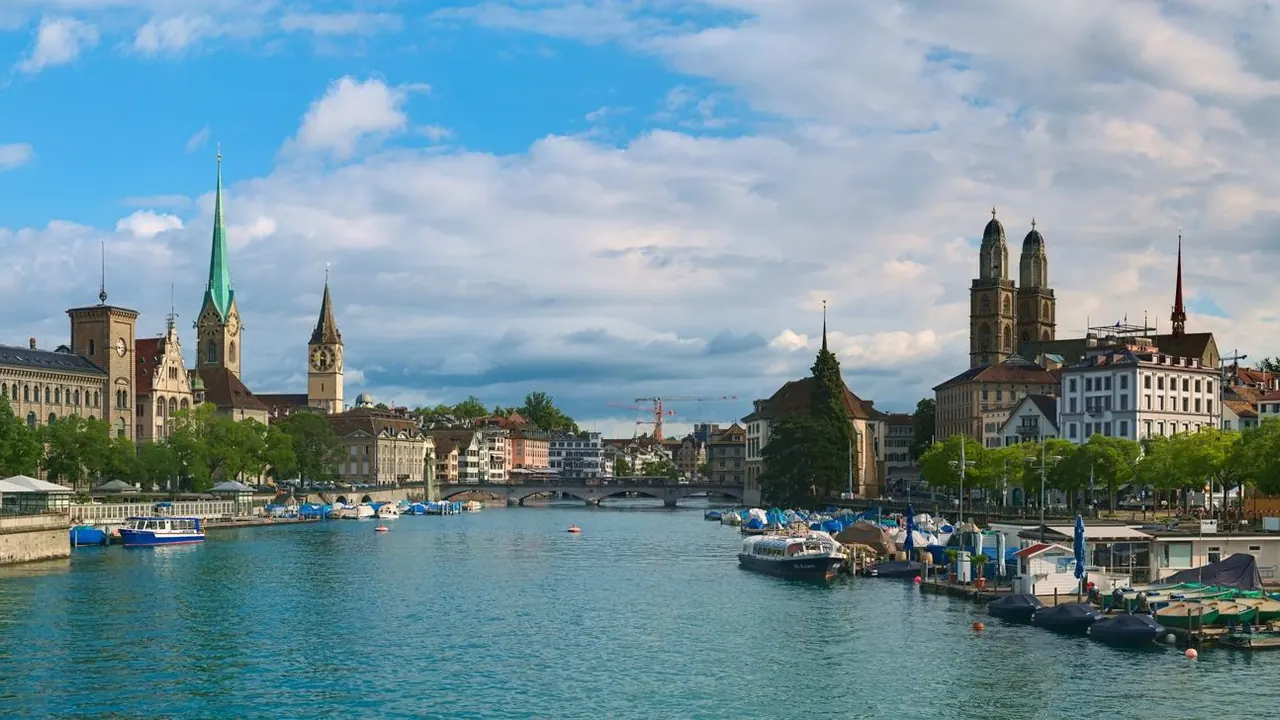
Photos: Strasbourg by Edoardo Colombo, Pexels License; Zurich by Daniel Kraft, CC BY-SA 3.0, cropped.
Strasbourg or Zurich?
Our verdict in twelve categories, each scored against the same fixed benchmark cities, and the climate month by month, so you can choose for your trip.
Choose Strasbourg for
- prices
- food and drink
- culture and sights
Strasbourg suits the traveller who wants a historic old town to wander, rich regional cooking and money left over at the end. The cathedral, Petite France and the Neustadt make a stronger set of sights than Zurich's, the winstubs pour wine from vineyards just down the road, and the Alsace wine villages and the German towns across the Rhine are easy days out. Evenings are gentle rather than late, and it is the better pick in the colder months, when its food is at its best.
Choose Zurich for
- beaches
- nightlife
- nature and the outdoors
Zurich is for those who want water, mountains and a city that runs like clockwork, and who can absorb some of the highest prices in Europe. You can swim in a clear lake in the city centre, reach high Alpine walking or a ski slope within an hour, and stay out until morning in the clubs of Kreis 4 and 5. Families, outdoor travellers and opera-goers get more from it. Anyone counting costs will feel every day of the stay.
Scoreboard
Twelve categories on one fixed scale from 0 to 100. The shaded stretch is the gap between the two.
Your match
Pick a travel style or drag the sliders, and both match scores follow your weighting.
Wins on prices and food and drink with your weighting.
Wins on beaches and nightlife with your weighting.
What matters to you?
Category by category
What the scores mean for a trip.
Beaches & swimming
Zurich is far the better place for a swim. Wooden bathing houses and lawned lidos line the lake right in the city at Utoquai, Enge and Mythenquai, the water is clean and clear, and at the Letten river baths you can drift down the Limmat with the current.
Strasbourg's swimming means the old gravel-pit lakes on its outskirts, such as the Baggersee at the end of a tram line. They are pleasant on a hot afternoon but nothing like as close or as attractive. In neither city is there sand, and neither is a beach vacation.
Food & drink
Strasbourg eats better, and more distinctively. Its winstubs serve choucroute garnie, baeckeoffe and tarte flambée with Riesling or Pinot Gris from the vineyards to the south, and the covered market and street markets are well stocked with Munster and charcuterie. The weak spots are the tourist menus around the cathedral and a narrow choice of other cuisines.
Zurich's cooking is reliable but more limited: veal Geschnetzeltes with rösti, fondue in the guild houses, and outstanding chocolate and pastries in the old tea rooms on Paradeplatz. It has a wider spread of international places around Langstrasse, but few markets and little street food, and every meal costs a lot.
Culture & sights
Strasbourg has the richer set of sights. The pink sandstone cathedral with its astronomical clock, the timber-framed lanes of Petite France and the imperial avenues of the Neustadt together form a UNESCO-listed townscape that Zurich's old town cannot match. The Palais Rohan's three museums and the Alsatian Museum add depth on top.
Zurich's strength is in particular collections rather than the townscape. The Kunsthaus, with Monet, Munch and Giacometti, is the stronger art museum of the two cities, and the Chagall windows in the Fraumünster and the Grossmünster's Reformation history are the highlights of a neat, compact Altstadt.
Nightlife
Zurich goes out properly, and Strasbourg mostly does not. Zurich's electronic scene runs deep, with clubs in Kreis 4 and 5 and Zurich West open until morning at weekends, rough-edged Langstrasse at the centre of it and summer bars in the lake bathing houses. The cost of a round is the main brake on a long night.
Strasbourg's evenings revolve around bars: student places and beer cellars in the Krutenau and around Place Saint-Étienne, and full riverside terraces in summer. There are only a few clubs, and much of the city is quiet by midnight on weeknights.
Nature & outdoors
Zurich has more striking scenery and more of it close by. The lake, with the snow-capped Glarus Alps at its far end, is part of the city, the Uetliberg ridge is a short train ride away, and high-mountain hiking on Rigi or Pilatus and skiing at Flumserberg are within an hour, all reachable by rail.
Strasbourg is flat and green, with the Orangerie, riverside forests with storks and beavers, and some of France's best cycling along the Rhine. Its hills are gentler: the forested Vosges with their castle ruins to the west and the Black Forest to the east, both easier to explore with a car.
Day trips
Both cities make excellent bases, and the difference is in the kind of trip. From Strasbourg the days out are about wine and timber-framed towns: Colmar, the Alsace wine route through Riquewihr and Eguisheim, Haut-Koenigsbourg above the vineyards, then a second set in Germany with Baden-Baden, Freiburg and Heidelberg. The wine villages are much easier by car or bike.
From Zurich the rail network does all the work, and the trips are to lakes, waterfalls and other Swiss cities. Lucerne, Bern and St Gallen's abbey library are each about an hour away, and the Rhine Falls pair well with Stein am Rhein. Basel is within reach of both.
Good for families
Zurich is the easier and more rewarding city with children. Its zoo, with the indoor Madagascar rainforest and the elephant park, is a full day on its own, the lake lidos have shallow areas made for small swimmers, and the Technorama and Lucerne's transport museum are short train rides away.
Strasbourg is pleasant and manageable, with boat trips through Petite France, storks and rowing boats in the Orangerie and the Vaisseau science centre. Its trump card is one Zurich lacks: Europa-Park, a major theme park about an hour away across the border.
Getting around
Zurich is about as smooth as city transport gets. Trams, buses, S-Bahn trains, funiculars, the Uetliberg railway and even the lake boats all run on one ticket, and the airport is a short train ride from the main station.
Strasbourg is also easy without a car, but in a different way. Its island centre can be crossed on foot in twenty minutes, the trams reach as far as Kehl in Germany, and separated cycle lanes make a bike the quickest way about. It falls short of Zurich mainly beyond the city, where the wine villages and hills are much easier with a car.
Shopping & style
Zurich is the stronger shopping city, though only at the top end. Bahnhofstrasse runs from the station to the lake past watchmakers, jewellers and fashion houses, and the railway viaduct arches in Zurich West hold design shops. Beyond luxury and design the range is narrow, and prices are high throughout.
Strasbourg is more about regional things to take home: Alsace wine, Soufflenheim pottery, printed linens and kougelhopf moulds from the lanes near the cathedral, with craft stalls at the December market. It has little luxury or fashion to speak of.
Affordability
This is the largest gap between the two cities. Strasbourg costs what a big French regional city does, with reasonably priced winstub meals, cheap trams and bike hire and free old-town sights. Hotels are the main expense, and they climb sharply during the Christmas market and Parliament sessions.
Zurich is among the most expensive cities in the world to visit. Rooms, meals, drinks, museums and transport are all priced high. Supermarket lunches, lakeside picnics, the free public lidos and a visitor card help a little, but the same stay will cost far more than in Strasbourg.
Live music & performing arts
Zurich has the bigger stage. The Opernhaus on the lake shore is among Europe's most respected opera and ballet houses, the Tonhalle Orchestra plays in a restored nineteenth-century hall, and the old Rote Fabrik factory and venues in Kreis 4 and 5 bring jazz, indie and electronic acts. The Schauspielhaus is a leading theatre, but nearly all of it is in German.
Strasbourg's calendar is serious for its size: the Opéra national du Rhin on Place Broglie, the Philharmonic and the Théâtre National de Strasbourg. Its particular strength is contemporary music, with the Musica festival every autumn.
Wellness & relaxation
The two are close here, and each has a spa town called Baden on its doorstep. From Strasbourg it is Baden-Baden, under an hour away, with the grand Friedrichsbad and Caracalla baths. In the city itself the tiled Bains municipaux, with their hammam and saunas, are a local habit.
Zurich's Swiss Baden is only twenty minutes by train. In town, the thermal baths in the vaults of the old Hürlimann brewery have a rooftop pool, and in the colder months the wooden bathing houses on the lake and the Limmat become saunas with cold-water dips between sessions.
When should you go?
Pick your month. The climate figures are measured averages, not a forecast.
Strasbourg in July
Zurich in July
Daytime high, °C
Rainfall in the month, mm
Temperature and rainfall are climate normals, averaged over the years shown. Strasbourg: 1991-2020 normals, Strasbourg (9.1 km from centre). Zurich: 1991-2020 normals, Zurich Town / Ville. (2.2 km from centre).
Both cities follow the same Central European rhythm, cold and grey in winter and pleasantly warm in summer, but Strasbourg is a little warmer and much drier. Its summer highs reach about 26°C against Zurich's 24°C, and April and May are already comfortable for long walks through the old town. Zurich's summer is its wettest season, with around 126mm in July against Strasbourg's 72mm, so heavy showers are part of the deal there even in the best months.
For swimming, July and August are the reliable months in both, with Zurich's lake season stretching from June into early September. Sunshine is similar through the year, slightly stronger in Strasbourg in summer. From November to February both are cold, with highs of around 4°C to 9°C and short, dull days. These are months for museums, warm taverns and baths, not for lingering outdoors. September is a good compromise in either city, still mild and drier than high summer in Zurich.
Which traveller are you?
On a trip on a tight budget, Strasbourg is the clear choice. It is not cheap, but winstub meals, wine by the pichet, cheap trams and free old-town sights stretch a budget much further than Zurich, where even a simple lunch or hotel room is a serious expense.
For an outdoors trip, Zurich wins. The Uetliberg is a short train ride from the centre, and Rigi, Pilatus and the Glarus valleys bring proper Alpine hiking, plus winter skiing, within an hour. Strasbourg's Vosges and Black Forest are gentler and easier with a car.
On a family trip with children, Zurich is easier and offers more. The zoo with its Madagascar rainforest hall, shallow lake lidos and lake boats fill the days, and the transport handles buggies smoothly. Strasbourg holds its own only if Europa-Park is the main reason for coming.
Before you go
| Measure | Strasbourg | Zurich |
|---|---|---|
| Official language | French | French, German, Italian, Romansh |
| Currency | Euro (EUR) | Swiss Franc (CHF) |
| Sockets | CE230 V, 50 Hz | CJ230 V, 50 Hz |
| Driving side | Right | Right |
| Time zone | UTC+1, UTC+2 in summer | UTC+1, UTC+2 in summer |
| Emergency number | 112 | 112 |
| Elevation | 132 m | 408 m |
| Main airport | Strasbourg Airport (SXB)10 km from centre43 non-stop destinations | Zürich Airport (ZRH)9 km from centre226 non-stop destinations |
| Public holidays this year | 11 days | 10 days |
By the numbers
| Measure | Strasbourg | Zurich |
|---|---|---|
| City population | 293,771 | 440,935 |
| People per km² | 3,752 | 5,016 |
| Museums within 10 km | 21 | 63 |
| UNESCO World Heritage sites within 50 km | 1 | 1 |
Where else could you go?
Every comparison below shares a destination with this one, so you can follow Strasbourg or Zurich somewhere new.