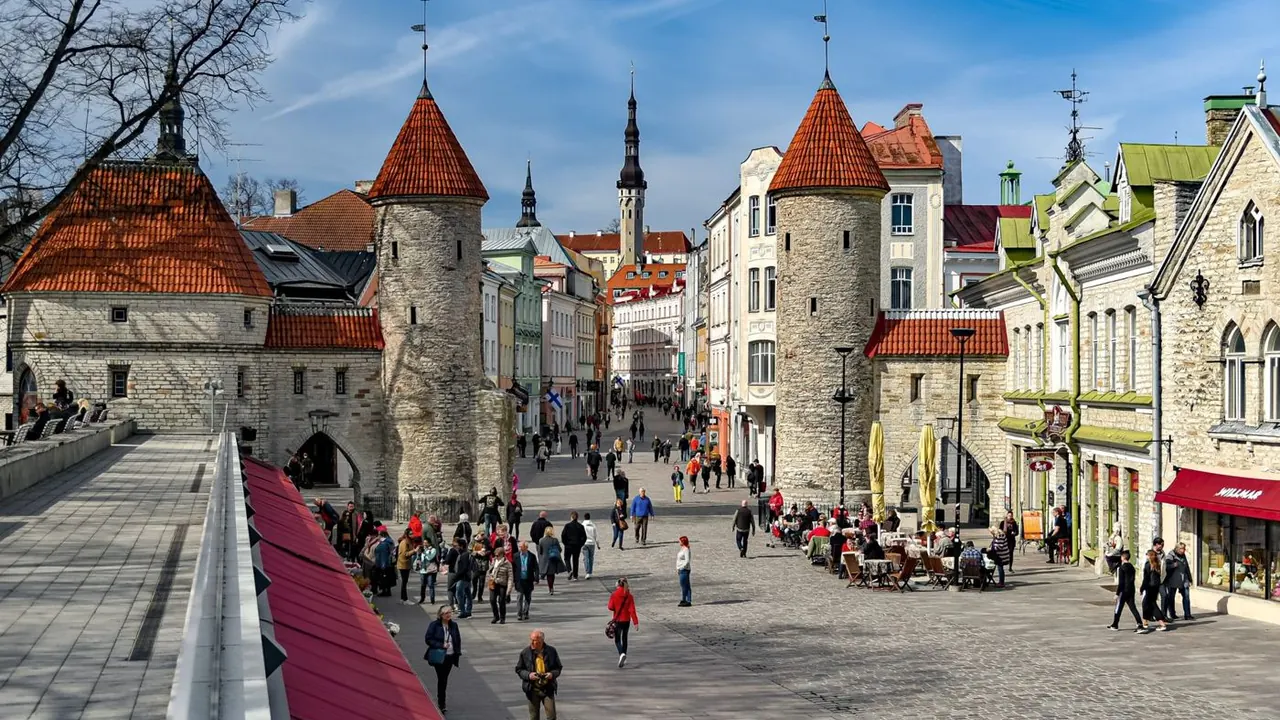
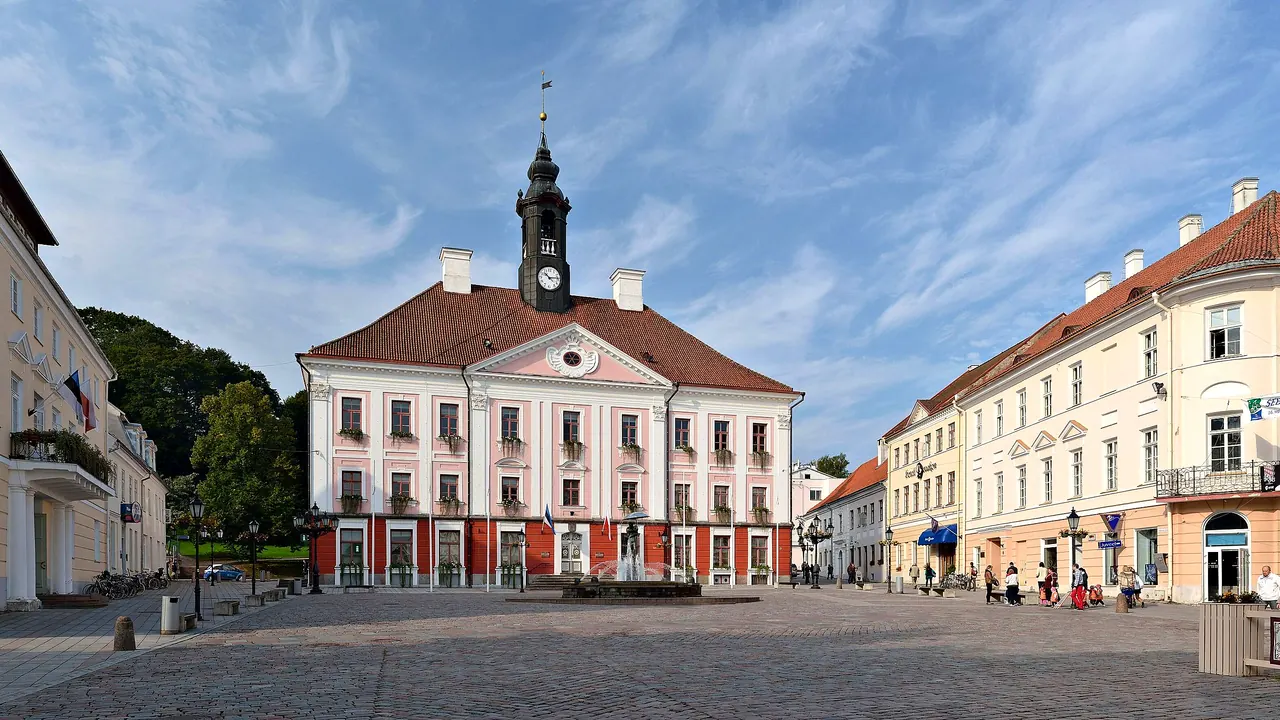
Photos: Tallinn by Jorge Franganillo, CC BY 2.0, cropped; Tartu by Ivar Leidus, CC BY-SA 3.0 EE, cropped.
Tallinn or Tartu?
Our verdict in twelve categories, each scored against the same fixed benchmark cities, and the climate month by month, so you can choose for your trip.
Choose Tallinn for
- culture and sights
- shopping
- food and drink
Tallinn is the better choice for most first visits to Estonia. Its walled Hanseatic Old Town and Toompea hill are the country's main sight, the cooking in Telliskivi and Kalamaja goes further, and there is more to do in the evenings and with children. Helsinki is a ferry ride away for an extra day out. It suits a city break of three or four days where you want plenty packed into a small, walkable place.
Choose Tartu for
- prices
Tartu is a quieter, cheaper university town. It suits travellers who have already seen the capital, or who would rather spend a few unhurried days among students, riverbanks and the Estonian National Museum. It also makes a good base for the south: the Otepää uplands, the Old Believer villages on Lake Peipus and the smoke saunas of Võromaa are all within reach, especially with a hire car.
Scoreboard
Twelve categories on one fixed scale from 0 to 100. The shaded stretch is the gap between the two.
Your match
Pick a travel style or drag the sliders, and both match scores follow your weighting.
Wins on culture and sights and shopping with your weighting.
Wins on prices with your weighting.
What matters to you?
Category by category
What the scores mean for a trip.
Beaches & swimming
Neither city is a beach destination, but Tallinn at least has sand within its limits. Pirita is backed by pine forest, while Stroomi and Pikakari face the bay, all a short bus ride from the centre. On a warm July day the shallow Gulf of Finland is pleasant enough for a swim.
Tartu has only the river beach at Anne Kanal in town. For anything bigger you drive to the woods around Pühajärve or the sandy Lake Peipus shore near Kallaste, below its red sandstone cliffs. These are lovely summer outings, but they need a car and take up most of a day.
Food & drink
Both cities cook with the same Estonian larder of rye, smoked fish, mushrooms, game and berries, but Tallinn does far more with it. Its creative quarters hold bistros and a handful of serious tasting menus, and the Baltic Station Market works for a quick lunch. The one thing to avoid is the medieval-themed dining inside the Old Town walls.
In Tartu the choice is mostly student cafés, bakeries, a few ambitious kitchens and the riverside market hall. Its most memorable food is out of town, where roadside stalls in the Peipus Old Believer villages sell smoked fish and onions.
Culture & sights
This is the widest gap between the two. Tallinn's Old Town is one of northern Europe's best-preserved Hanseatic towns, with long stretches of wall, the Gothic Town Hall and the views from Toompea. Beyond the walls are KUMU, the Kadriorg palace and the Seaplane Harbour, enough to fill two or three busy days.
Tartu's heritage is quieter and mostly neoclassical, built around the pale university building, the sloping Town Hall Square and the cathedral ruins on Toome Hill. Its big draw is the Estonian National Museum, which tells the country's story better than anywhere in the capital. Even so, the town is comfortably seen in two days.
Nightlife
Tallinn has more going on, and it peaks at weekends. Cellar bars in the Old Town draw visiting groups, while Telliskivi and Kalamaja have a younger local crowd in converted factories. A few clubs stay open until morning on Fridays and Saturdays.
Tartu follows the university calendar instead. In term time, Rüütli street and the lanes around the university fill with students in cider and craft beer bars, sometimes even on weeknights. In summer the town quietens to riverside terraces, and there is hardly anywhere for a big night of dancing.
Nature & outdoors
The two are close here, but the scenery differs. Tallinn's outdoors is the coast: the seaside promenade, the limestone klint cliffs and Keila-Joa waterfall to the west, then Lahemaa an hour out, with its boulder-strewn peninsulas and the boardwalk across Viru bog.
Tartu looks inland and gets a little more height. You can canoe or paddleboard on the Emajõgi, walk the sandstone gorge at Taevaskoja, or head to the Otepää and Haanja uplands for lake hikes in summer and Estonia's best-known cross-country ski trails in winter.
Day trips
Tallinn has the stronger list, led by Helsinki, a whole second capital about two hours away by fast ferry. Closer in are the Lahemaa manors at Palmse and Sagadi, Rakvere castle and the bishop's castle at Haapsalu, many of them reachable without a car.
From Tartu, the best day out is the reverse trip, two hours by train to Tallinn's Old Town. Otherwise the choice is quieter: Viljandi's castle ruins, the painted Old Believer villages and Alatskivi Castle by Lake Peipus, or the farm country of Võromaa. Most of these are far easier to reach by car.
Good for families
Both cities are safe and easy with children, but Tallinn holds their interest for longer. Children can climb inside the submarine at the Seaplane Harbour, and there is also a large zoo, the open-air museum's windmills, and the Proto and Energy Discovery centres for older ones. The Old Town cobbles are the one real trial with a pushchair.
Tartu has one big draw, the AHHAA science centre and planetarium, which can fill a whole day, along with a toy museum and an indoor water centre. Its flat, quiet streets are gentler on small legs, but with no zoo you run out of things to do after two or three days.
Getting around
Both centres are easy to walk, so the difference is in the details. In Tallinn the main districts are about twenty minutes apart on foot, though Toompea is a steep climb. Trams run all the way to the airport, which is close to the centre, and the Helsinki ferries leave a short walk from the Old Town.
Tartu is smaller and flat, and the city's electric bike share is the quickest way to reach the national museum or the river beach. The catch comes beyond the town: the lake villages, manors and forest trails really call for a hire car.
Shopping & style
Tallinn gives shoppers more to browse. Craft workshops in and around St Catherine's Passage sell glass, ceramics, leather and knitwear, Estonian designers have studios in Telliskivi and Rotermann, and a few malls stock international brands, though there is no luxury district.
Tartu offers a department store, a short run of shops near Town Hall Square and a handful of boutiques selling linen and ceramics. The market is good for honey and berries, but you would not plan a day around it.
Affordability
Tartu is the easier city on the wallet. Central rooms, student cafés, lunch menus and bikes all cost noticeably less than in the capital, though an evening meal in a good restaurant or a round of drinks is priced much as elsewhere in Western Europe.
Tallinn costs about the same as a typical Western European capital, more than many visitors expect, and Old Town restaurants charge extra for the setting. Lunch menus outside the walls and cheap public transport help, and rooms are better value away from the summer and cruise-ship season.
Live music & performing arts
In both cities, visitors who don't speak Estonian will spend their evenings at opera, ballet and concerts, since nearly all theatre is in Estonian. Tallinn offers more. The Estonia Theatre houses the national opera, ballet and symphony orchestra, churches in the Old Town host organ and early-music concerts where Arvo Pärt is often played, and the Song Festival Grounds hold the great national choral gatherings.
Tartu's Vanemuine, the first theatre to perform in Estonian, still stages opera, ballet and musicals, and the first Song Festival was held here in 1869. In term time, student bands fill the small venues.
Wellness & relaxation
Sauna is the heart of relaxing in both, and Tallinn has the slight edge in town. You can try an old public neighbourhood sauna in Kalamaja, a seaside sauna with a cold plunge into the Baltic, or a harbour spa hotel with a pool.
Tartu has a water centre, a few hotel spas and summer saunas by the river. It is also an hour from Võromaa's farm smoke saunas, the most traditional experience of all, which is a much longer trip from the capital. Neither city has thermal springs.
When should you go?
Pick your month. The climate figures are measured averages, not a forecast.
Tallinn in July
Tartu in July
Daytime high, °C
Rainfall in the month, mm
Temperature and rainfall are climate normals, averaged over the years shown. Tallinn: 1991-2020 normals, Tallin / Harku (10.9 km from centre). Tartu: 1991-2020 normals, Tartu (8.9 km from centre).
The two cities share the same northern year. Winters stay around freezing, with highs near -2°C in January and February and very little daylight, so walking the streets is a matter of short, cold outings. Both are at their best from late May to early September. July is warmest, about 22°C in Tallinn and 23°C in Tartu, and long, bright evenings around midsummer make up for the changeable weather. Summer is also the wettest part of the year in both, and Tartu gets its heaviest rain in June at 87mm.
The coast makes the real difference. In Tallinn the Baltic only warms to about 17°C in August, so swimming is for hot days and the hardy. Tallinn also gets a little more sunshine than inland Tartu from spring to late summer. Tartu's lakes and river beaches have the same short season, from late June to August, and both cities turn grey and dark again from October.
Which traveller are you?
On a culture and arts trip, Tallinn is the clear pick. You get the medieval Old Town and Toompea, KUMU and the Kadriorg palace, the Seaplane Harbour, then opera at the Estonia Theatre or a choral concert in a Gothic church. Tartu's university quarter and national museum fill two days at most.
On a tight budget, see Tallinn as a long day out by train and sleep in Tartu. Fill the other days with things that cost nothing, such as Toome Hill, the riverside paths and Anne Kanal beach, and skip the Peipus villages, which really need a hire car.
For a food and nightlife trip, choose Tallinn. Kitchens in Telliskivi, Rotermann and Kalamaja cook Nordic-style Estonian food with real ambition, craft beer bars fill old factories, and a few clubs stay open until morning at weekends. Tartu's student pubs are friendly but have little depth.
Before you go
| Measure | Tallinn | Tartu |
|---|---|---|
| Official language | Estonian | Estonian |
| Currency | Euro (EUR) | Euro (EUR) |
| Sockets | CF230 V, 50 Hz | CF230 V, 50 Hz |
| Driving side | Right | Right |
| Time zone | UTC+2, UTC+3 in summer | UTC+2, UTC+3 in summer |
| Emergency number | 112 | 112 |
| Elevation | 28 m | 79 m |
| Main airport | Lennart Meri Tallinn Airport (TLL)6 km from centre56 non-stop destinations | Tartu Airport (TAY)8 km from centre1 non-stop destination |
| Public holidays this year | 12 days | 12 days |
By the numbers
| Measure | Tallinn | Tartu |
|---|---|---|
| City population | 457,572 | 97,759 |
| People per km² | 2,871 | 2,507 |
| Museums within 10 km | 15 | 4 |
| UNESCO World Heritage sites within 50 km | 1 | 1 |
| Swim season, months above 21 °C | None | - |
Where else could you go?
Every comparison below shares a destination with this one, so you can follow Tallinn or Tartu somewhere new.